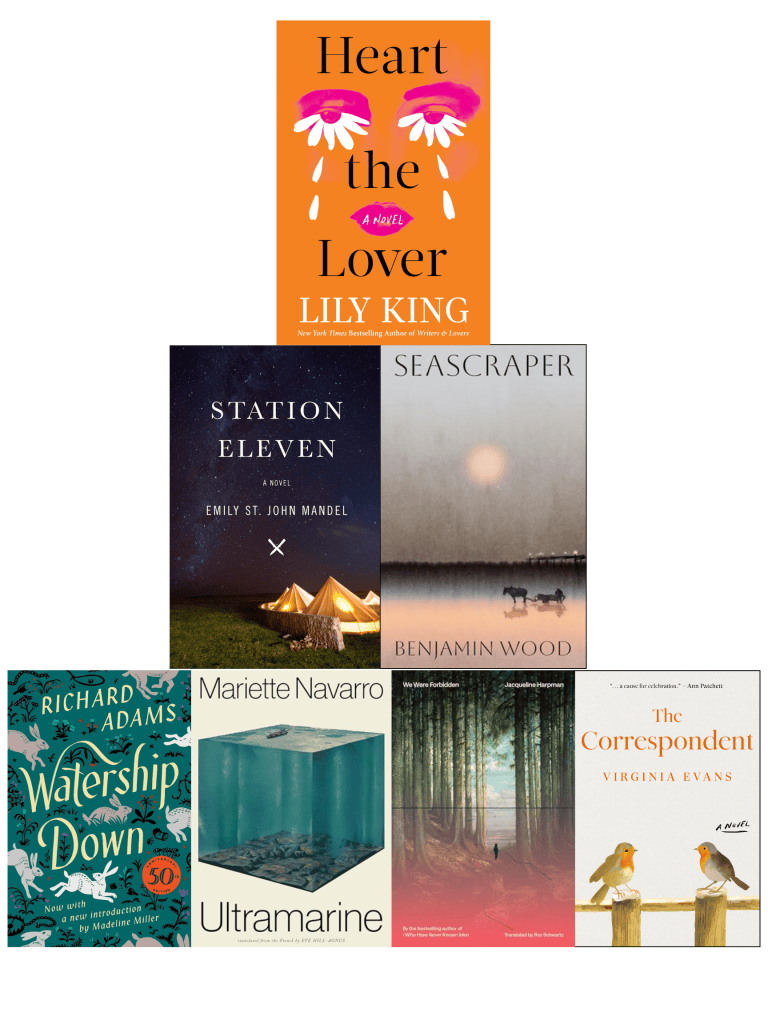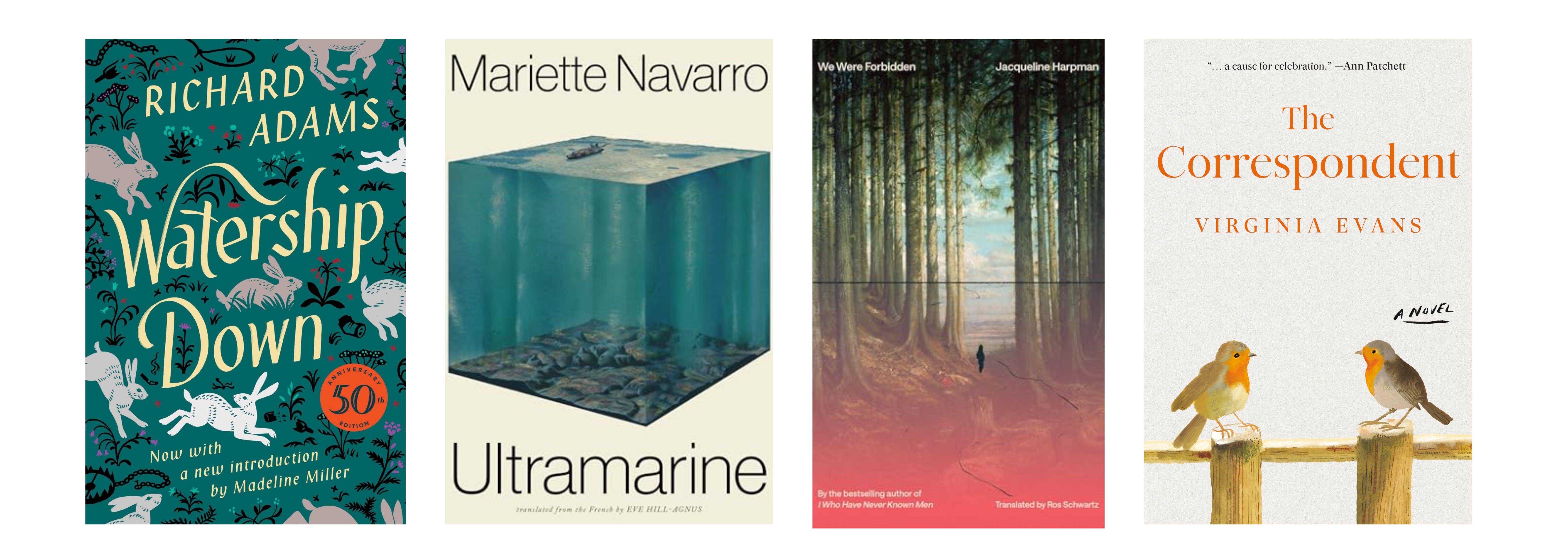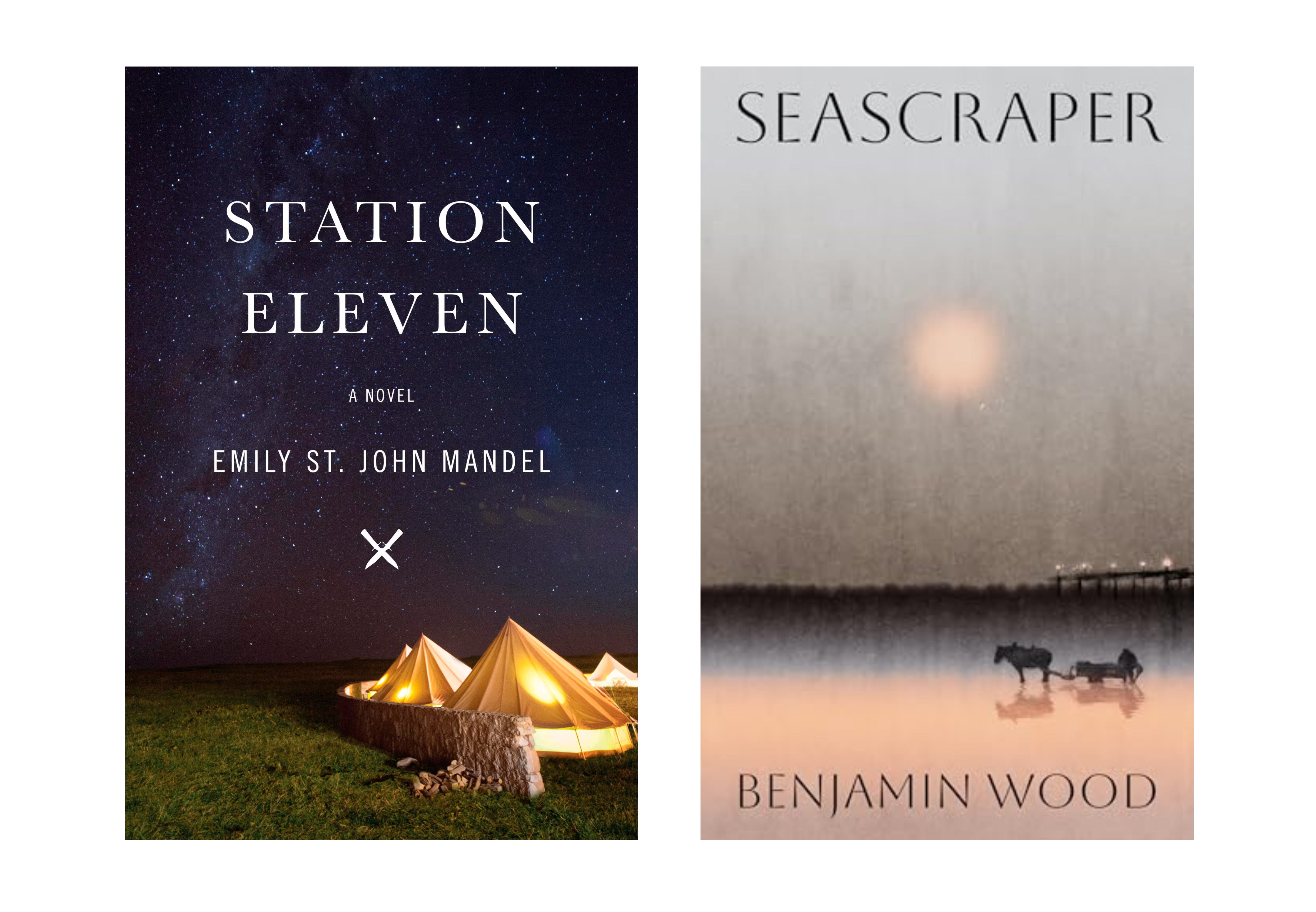
Those claws, those claws, those claws

Lit Chat Vol. 35—May and June in Review

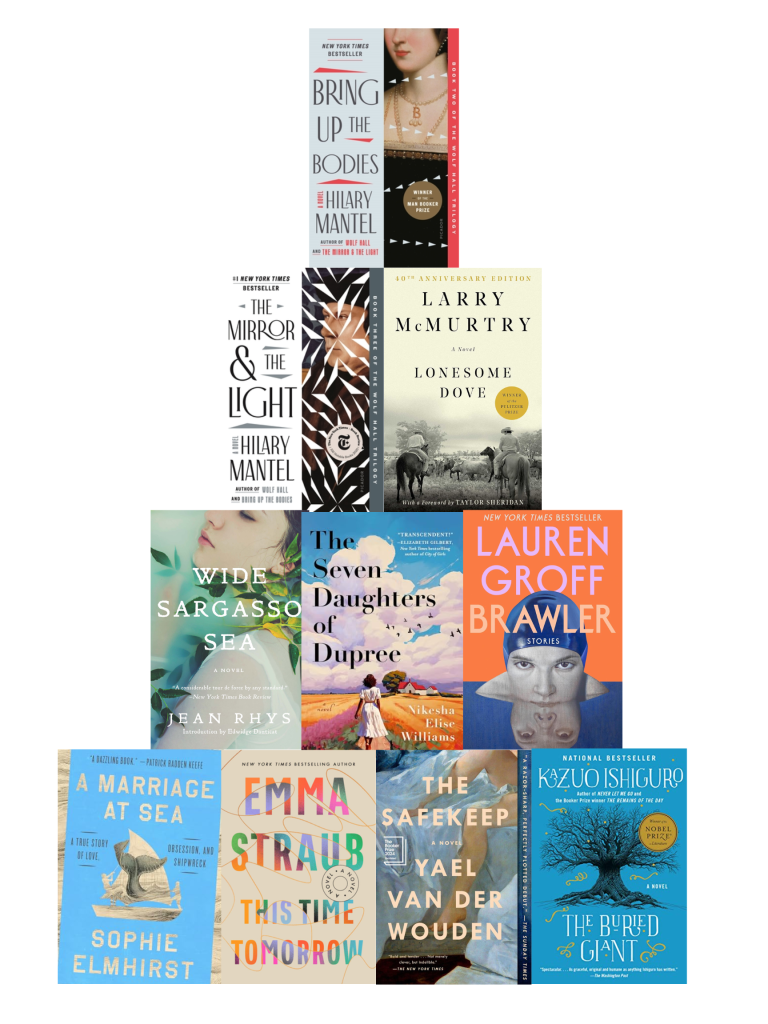
Pyramid of book cover images with  A Marriage at Sea by Sophie Elmhirst, This Time Tomorrow by Emma Straub, The Safekeep by Yael Van Der Wouden, and The Buried Giant by Kazuo Ishiguro on the bottom; Wide Sargasso Sea by Jean Rhys, The Seven Daughters of Dupree by Nikesha Elise Williams, and Brawler by Lauren Groff in the third row; The Mirror & the Light by Hilary Mantel and Lonesome Dove by Larry McMurtry in the second row, and Bring Up the Bodies by Hilary Mantel on top

Hi friends,

I have a confession to make: I’ve forgotten how to read.

Okay, obviously not actually, but I am in a big ol’ reading slump. This happens to me sometimes in the summer. I start off hot and excited about summer reading, and then somewhere between the heat waves and the excessive travel and the wildfire smoke, all I want to do by mid-July is lay flat on the couch and mainline Love Island UK.

What gets you out of a reading slump? I’m hoping this newsletter will reset me, because I did read quite a lot in May and June before the inclination to do anything cerebral exited my brain. This is actually going to be a pretty big one to compensate, so bear with me! The top few are worth it.

If you’d rather get this post straight to your inbox, subscribe to my Substack here!


THE FOUNDATION

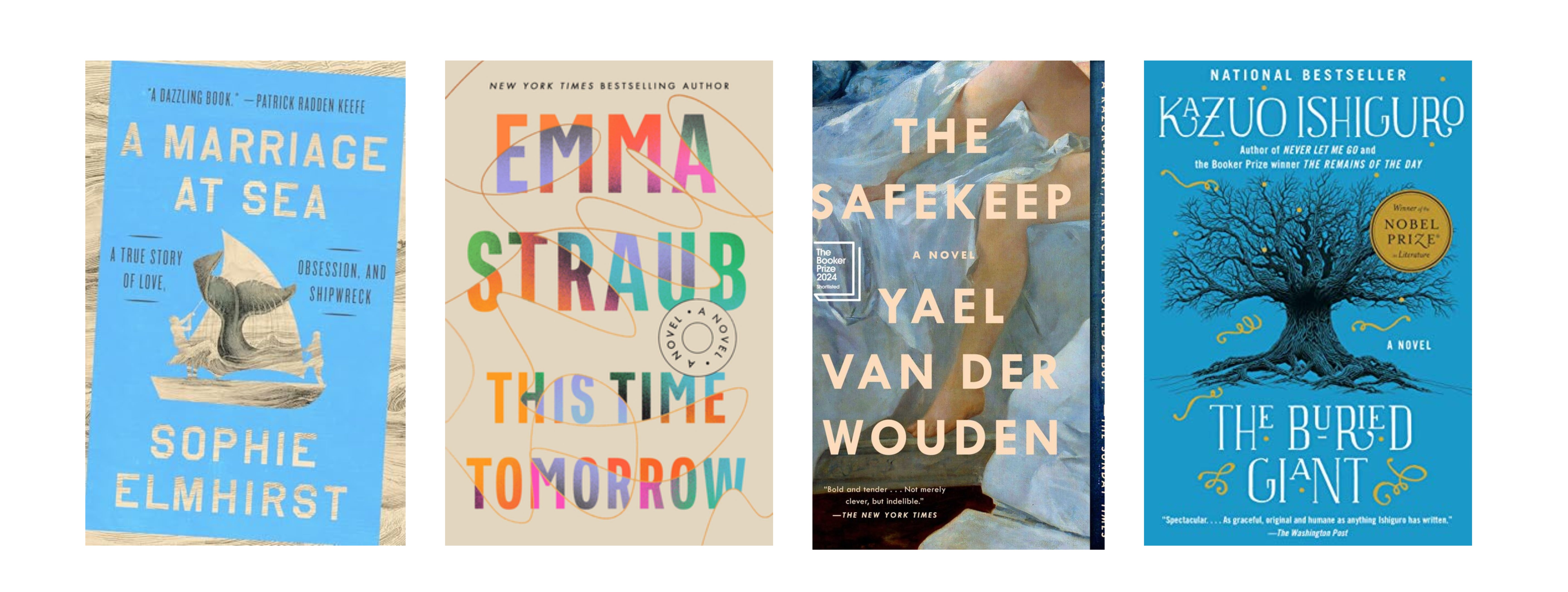
Book cover images for A Marriage at Sea by Sophie Elmhirst, This Time Tomorrow by Emma Straub, The Safekeep by Yael Van Der Wouden, and The Buried Giant by Kazuo Ishiguro

A Marriage at Sea — Sophie Elmhirst

If you’re planning a sea voyage anytime soon, this is not the book for you. However! If you’re interested in real-life survival stories that double as an examination of a relationship, then definitely add this one to your list. A Marriage at Sea tells the true story of Maurice and Maralyn Bailey, a British couple who survive being shipwrecked in the Pacific Ocean for 118 days in 1973. However, the shipwreck part is only about a third of the book, as the rest follows Maurice and Maralyn’s journey both before and after the voyage that made them famous. Although not as exciting or interesting as the actual emergency, understanding both of their personalities and their dynamic together is essential for understanding how they’re able to survive as a unit as long as they do—both before and after the rescue. I recommend this one on audio!

This Time Tomorrow — Emma Straub

It’s no secret that we’re big fans of time travel stories over here at Lit Chat HQ, and I’m always looking to see how different authors handle the mechanics. In this one, 40-year-old Alice discovers she can go back and relive her sixteenth birthday whenever she wants, and starts experimenting with how making different decisions on that day alters her life in the future. Her ultimate hope is that she can somehow figure out a way to make her dad, hospitalized in the present, well again. I enjoyed getting a feel for 90s New York in the time travel scenes, but it lost me for a bit in the middle with all the different iterations of Alice’s potential lives. The real heart of the story lies in the time spent exploring her relationship with her dad, reliving her teenage days with the younger, healthier version of the father she is on the brink of losing in the present. Their relationship brought me back into the story and ultimately landed the emotional plane for me.

The Safekeep — Yael van der Wouden

Real ones also know I love a good historical fiction novel, and The Safekeep delivers in unexpectedly novel and satisfying ways. Set in the outskirts of Amsterdam in the aftermath of World War II, it follows a young woman forced to host her brother’s girlfriend at her family home for an indeterminate amount of time. Though initially strained, the connection between the two women takes on a depth that has farther-reaching impacts than either of them could have imagined. I also learned something new about WWII history, which I can’t fully get into here for fear of spoilers, but which added an unexpected layer of significance and emotional impact to the novel. Fast-paced and just gorgeously written, this novel would be a great addition to your tote bag this summer.

The Buried Giant — Kazuo Ishiguro

I picked this up in Exile in Bookville when I was in Chicago for a conference in April and had lots of time to kill, and I didn’t even realize that it was an Ishiguro book at first because it doesn’t look like any of his other Penguin covers. This one checks a lot of my boxes as a historical-ish novel that reads like a fairytale about ancient heroes, forgotten glory, and gentle, persistent love. Set in medieval Britain, it follows an elderly Saxon couple as they journey across the land to visit their son, but they and everyone else around them are thwarted by a fog that has stolen most of their memories. Ishiguro’s style is elegant and ethereal, evocative of legend and the simplicity of times past—perhaps not as they actually were, but as we imagine them to have been. If A24 gave this The Green Knight treatment, I’d watch the hell out of it.


SOLID SUPPORTS PART ONE

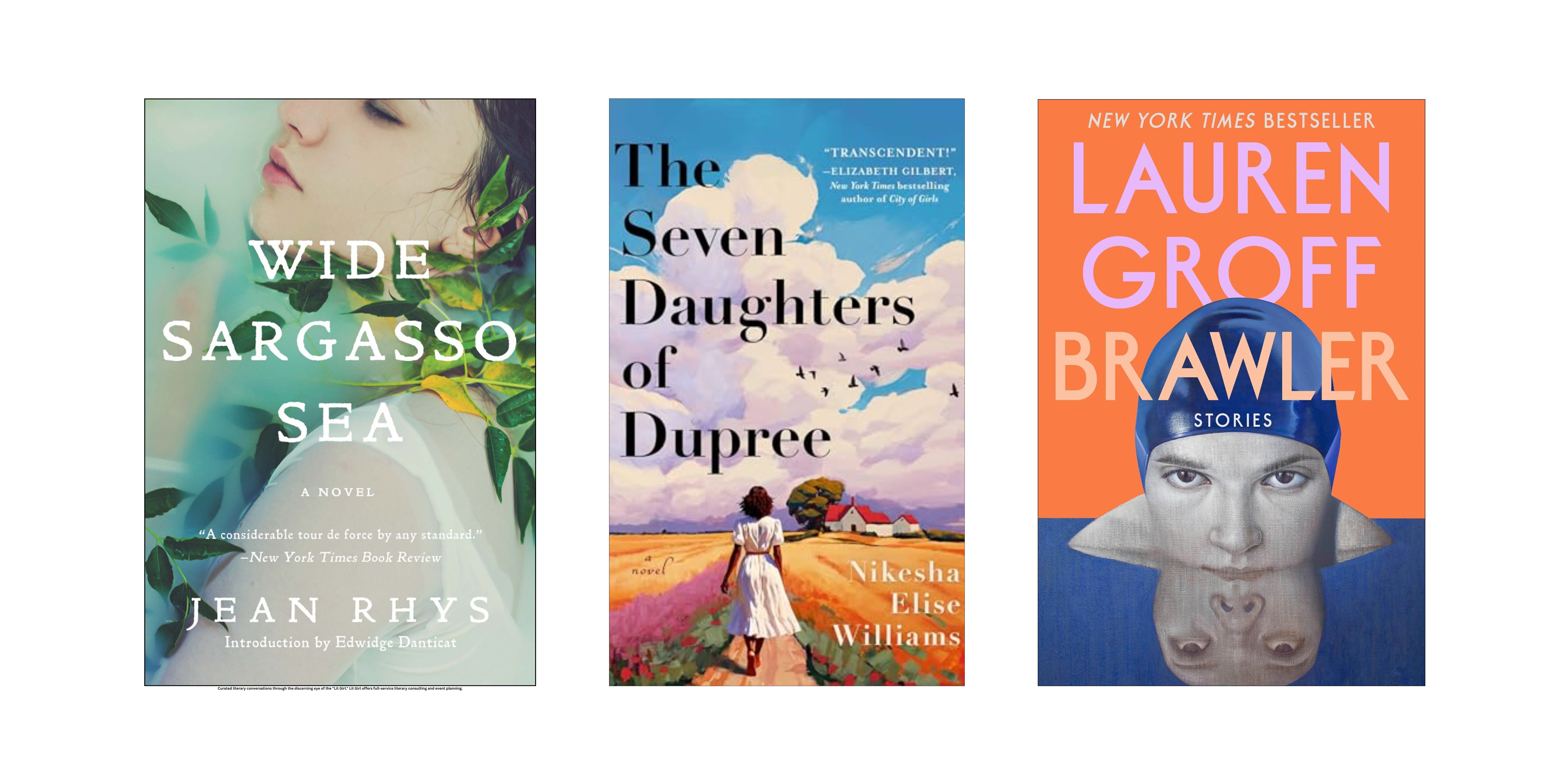
Book cover images for Wide Sargasso Sea by Jean Rhys, The Seven Daughters of Dupree by Nikesha Elise Williams, and Brawler by Lauren Groff

Wide Sargasso Sea — Jean Rhys

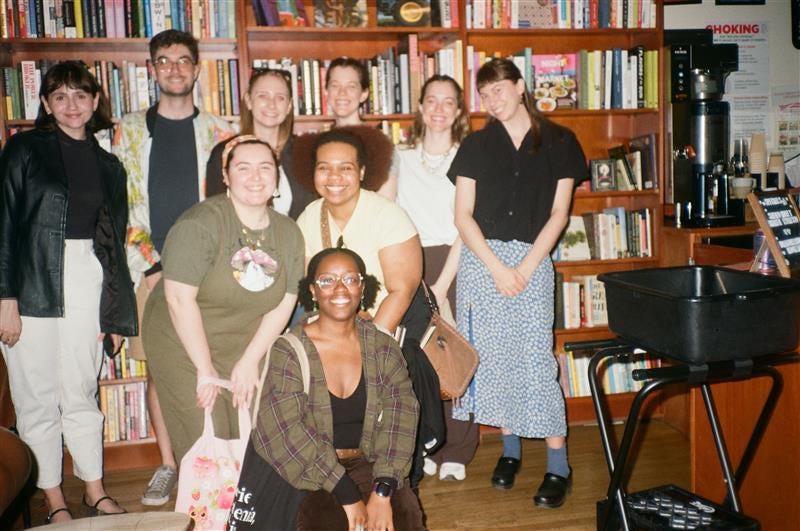
I picked this one up during a Reading Club field trip to Liz’s Book Bar in April. Side note: look how cute everybody is!

A group of adult friends in front of a large bookshelf in Liz's Book Bar
shoutout to Sarah’s film camera!

Apparently Jean Rhys, who was born in the Caribbean, took issue with the fact that all we knew of Mr. Rochester’s unstable wife in Jane Eyre was that she was also from the Caribbean, so she took it upon herself to write the story of that first wife. In Rhys’s hands, Bertha Mason becomes Antoinette, a white Creole girl growing up in poverty on a post-slavery Jamaican plantation. Rhys’s descriptions of her homeland are full of color and spirit, dominated by an inherent wildness that Antoinette’s eventual, unnamed English husband refuses to understand and seems to fear as much as he does the resentment from their emancipated neighbors. As Edwidge Danticat writes in the introduction, the result is a deliberately misunderstood woman who would likely have gotten along quite well with Jane Eyre, and had plenty to talk about, if only they’d been given the chance.

The Seven Daughters of Dupree — Nikesha Elise Williams

I was given a PDF of this book to read in evaluation for the Center For Fiction’s First Novel Prize, but eventually switched over to the audiobook for the sake of time and because the narrator turned out to be fantastic. This is a multi-generational story of one family of Black women, spanning from 1861 Alabama to 1995 Chicago. Descendants of an enslaved woman and a white plantation master, each generation of women seeks answers to the “curse” of their generational trauma, culminating in the reveal of a long-buried secret about their ancestor’s violent fate. Well-balanced and driven by each character’s unique voice, I loved how each generation seemed to explore the same questions of identity, family, and fate in ways that were particular to their time and place, yet very much part of the ongoing conversation of their family history. I really hope this debut sees some recognition from the CFF!

Brawler — Lauren Groff

I’ve read a couple of Groff’s books before, so, obviously, I knew she could write, but I didn’t realize she could physically hurt me with her words. This collection was gut punch after gut punch of short stories, nearly all of them following characters either in a crisis or on the brink of one, exploring the humanity revealed in the way they dealt with their circumstances. Reading these stories made me feel like I was in back in school, like I wanted to sit down and copy her sentences out for myself just to see how they were working. I wonder, sometimes, why writers feel the need to create characters just to make them suffer, but Groff’s stories do more than that. They invite us to suffer with them, to experience a full range of human emotion, to ask ourselves what we would do in their position and would we be able to see the beauty in it, as we can as a reader? I’m actually still reeling about this one a little, if you couldn’t tell.


SOLID SUPPORTS PART TWO

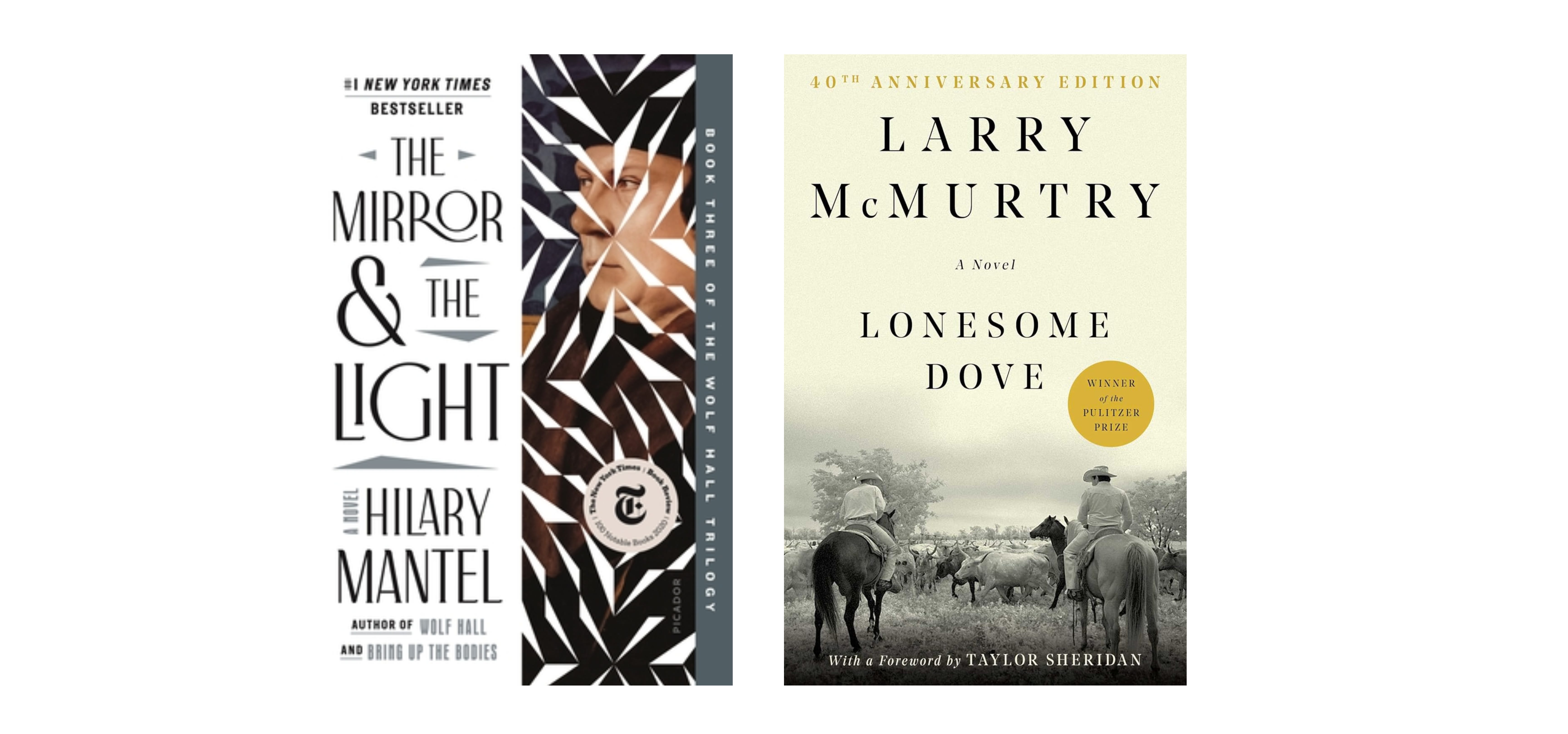
Book cover images for The Mirror & the Light by Hilary Mantel and Lonesome Dove by Larry McMurtry
ohhhh boy, now we’re getting into the big guns

The Mirror & the Light — Hilary Mantel

Now, I know what you’re thinking. Yes, this is the third book of the trilogy. Yes, we have not discussed book #2 yet. I considered combining books two and three because I read them pretty much back to back and as a whole, they provided the most superior reading experience of my summer so far. HOWEVER. Both books were also completely different reading experiences, and I will get more into this in just a moment!

Suffice it to say that I finished book #3 of the trilogy while sick in bed after too much travel, devastated by the inevitability of events that already came to pass nearly five hundred years ago, but which you can’t help but hope will somehow be stopped. The injustice of it all! The hubris of kings and would-be kings!! Power is a wheel of fortune from whose turning no one is safe, etc. etc. The real reason I’m ceding the top spot to the second volume is because it is simply much more fun to read about somebody coming into their power than falling from grace, and also because the title phrases of the mirror and the light were referenced just a few too many times for my liking. We get it! It’s the title!

Lonesome Dove — Larry McMurtry

If you had told me in January how deeply invested I would become in the logistics of an 800-page cross-country cattle drive by June, I would have been confused but honestly, not surprised. What did surprise me was how fast each week’s fifty or so assigned book club pages seemed to fly by, and how difficult it was to put it down and pace myself over the course of several months. For a book about a bunch of mostly white guys who have difficulty expressing their feelings, they sure made me feel a whole lot!!

Historical (in)accuracies aside, I was charmed by the idea of a young America still so vastly undeveloped by white settlers, of large expanses of land that are probably now Walmart parking lots but were once wild and dangerous and beautifully untouched. Just as charming were the cowboys themselves, from the youngest ranch hand to the oldest former Texas Rangers past their prime, in search of a little more glory.

Their quest for purpose and legacy, their sense of honor and duty, and their respect for nature and the unpredictable twists of fate that governed their journey made me feel—similar to The Buried Giant—nostalgic for a time and place that may or may not have ever existed outside of our collective imagining. And yet, by the end of the book, one is left with the feeling that something intangible has been lost with the completion of their journey, an era officially ended and its heroes gone with it. One is also left with an extremely questionable Facebook Marketplace algorithm.


THE TIPPY TOP

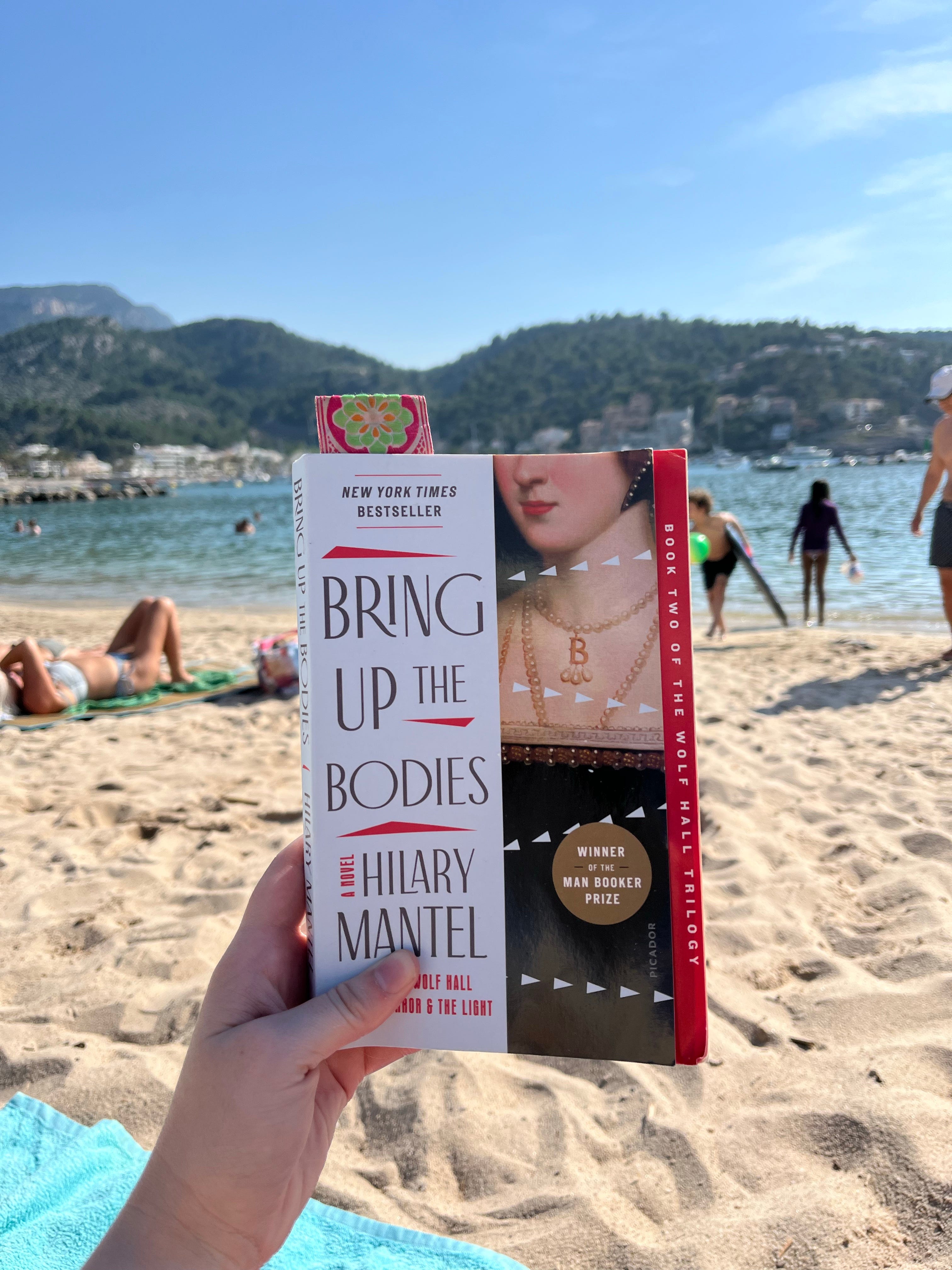
A hand holding up the book Bring Up the Bodies by Hilary Mantel in front of the water on a Mallorcan beach
obviously, the Mallorcan beach was going to be the superior reading experience

Bring Up the Bodies — Hilary Mantel

Okay, just so we’re all caught up: Bring Up the Bodies picks up where Wolf Hall left off, with Henry VIII growing suspicious of Anne Boleyn’s inability to give him a son and starting to get the hots for Jane Seymour. Who but Thomas Cromwell, the architect of Henry’s first divorce from Katherine of Aragon, should be the man to make his king’s dreams come true again? Bring Up the Bodies chronicles the downfall of Anne Boleyn and her supporters, and the rise in favor of Thomas Cromwell as the man who makes it all happen.

I’ve long been fascinated by the mechanisms and intricacies of power: who has it, who doesn’t, who can learn to speak its language before being silenced by it. This is not simply the story of a king in love and his humble servant; it’s the story of a world power seeking to position itself to its advantage against other world powers, via the scheming of someone who has lived enough lives across the continent to be deeply familiar with the inner workings and key players of each empire. Europe is Thomas Cromwell’s chess board, and Henry’s court is a game of checkers where Cromwell seems poised to king himself.

There’s a reason Anne Boleyn’s story persists with more mythos than the rest of Henry’s wives: it’s juicy! Her ladies sold her out! Was she a witch? Did she have sex with her brother? We’ll never actually know. What we do know, we’ve pieced together from what the other game players left behind: the laws they wrote, the trials they recorded, and of course, the graves they dug. The Mirror & the Light concludes Cromwell’s story the only way it can, but Bring Up the Bodies is the best of the trilogy, in my opinion, because it shows him at his best. Fluent in intrigue, master manipulator, always three steps ahead and never blind to how he and those he loves may benefit.

Was he right? Was he just? It’s morally gray at best. But was he good at what he did? Hilary Mantel gives us the pleasure of witnessing that for ourselves


Can you see now how the Wolf Hall trilogy has ruined me for other summer reading? I spent almost 2,000 pages of feasting on gorgeous prose with the guy just for him to lose his head. It’s been a month and I’m still in mourning for Thomas Cromwell, but I have been eyeing the four-in-one Elena Ferrante I got for Christmas lately, so maybe it’s time to trade one saga for another.

In the meantime, I’d love to hear about how your summer reading is going. Inspire me, I’m begging you! You can find me in all the usual places.

Until next time, happy reading!
❤ Catherine


Housekeeping note: all book links go to my Bookshop storefront, where each purchase supports independent bookstores (and this newsletter, because I get a small percentage of each sale).
A door out of the disarray

Lit Chat Vol. 34 — March/April in Review

Pyramid of book cover images with On the Calculation of Volume IV by Solvej Balle on top; The End of Romance by Lily Meyer and The Rachel Incident by Caroline O'Donoghue in the middle; The Art of Vanishing by Morgan Pager, Brideshead Revisited by Evelyn Waugh, and Lost Lambs by Madeline Cash on the bottom.

Hi friends,

I did something recently that I haven’t done in a long time: I read some bad books, all the way to the end.

These books all had vastly different faults: in one, the dialogue and the pacing were clunky to the point of distraction. In another, the language was dense and overwrought, muddying what little plot existed. The last was just poorly written and could have sorely used a better editor.

Two of these books were advance copies I read for the Center For Fiction’s first novel prize, so I’m not including them here because they’re not even published yet and it feels mean. All of the “bad” books were debuts, though, which made me realize how often I’m reading books by writers much farther along in their careers, and how much this shows in the level of skill and execution. That said, I have another couple of novel debuts in this round-up which I found genuinely delightful, so it can’t all be chalked up to a lack of experience.

In general, I found it refreshing to be reminded that the books I tend to choose for myself are often exceptionally good. This can be explained by a combination of taste (sue me!), great recommendations from trusted friends and critics, and having clearly defined interests and preferences as a reader. But reading subpar books every now and then is also helpful from a writing perspective, to learn how to pinpoint where things go wrong and how to avoid those pitfalls in my own work. Reading is learning! Reading is craft. None of it is ever wasted.

Anyway, now that I’ve teased you enough, shall we chat about what I’ve been reading lately?


THE FOUNDATION:

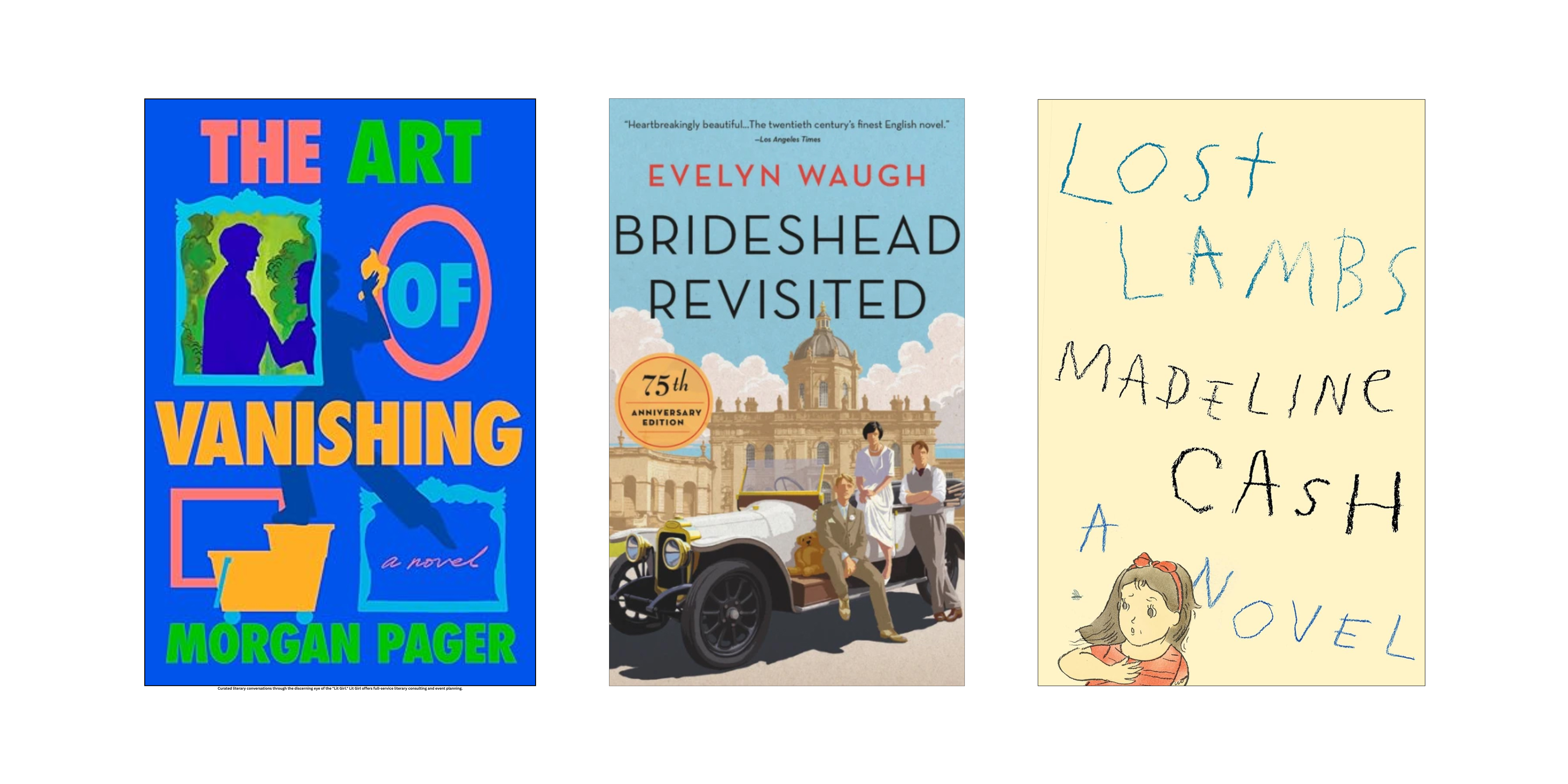
Book cover images for The Art of Vanishing by Morgan Pager, Brideshead Revisited by Evelyn Waugh, and Lost Lambs by Madeline Cash

The Art of Vanishing — Morgan Pager

I really do hate to rag on a debut, but this was the first of the bunch to make me realize how much I take the high quality of my normal reading diet for granted. I would have DNF’ed it thirty pages in, but Paige insisted I finish so we could discuss. The premise is promising: a girl who can enter and move through paintings in an art museum, and who falls in love with one of their subjects. This book needed to go through like, three more rounds of developmental edits, though. The romance felt rushed and forced, the characters underdeveloped, and there were a few too many plot twists for it to feel narratively cohesive. This one needed a lot more time in the oven, and it’s frankly a shame it didn’t get it, considering the author’s high profile as a well-known bookstagrammer.

Brideshead Revisited — Evelyn Waugh

I’m realizing this is going to be an audiobook heavy round-up, because I’ve been doing a lot more walking and moving this spring than I have sitting down reading. A sign of the times! That said, I had been listening to this audiobook in fits and starts since September, because I kept not finishing it before the due date and then having to wait 4-6 weeks to get it back from the Libby gods. I think this is one I should return to on paper someday, because I simply could not remember all of what had happened before and I didn’t care enough to rewind. That said, Jeremy Irons is lovely as the narrator, and his stately voice evokes the perfect atmosphere of postwar British pride and nostalgia that the novel aims to capture. Maybe I’ll just watch the movie and call it a day.

Lost Lambs — Madeline Cash

I first encountered a wild excerpt from Cash’s debut novel in The Drift, and knew then I was going to have to read the whole thing sooner or later. I listened to it on audio, and while I enjoyed that experience, part of me wishes I could have read it on my own so I didn’t have someone else’s voice and inflection influencing how the jokes landed. Lost Lambs is about a family in individual and collective crisis, and I was pleasantly surprised by how it managed to make all five distinct storylines (mother, father, and three teenage daughters) converge with a satisfying and surprising final twist. It’s witty and weird and a bunch of fun, and while the strongest storylines were those of the daughters, Cash manages to make each character’s voice feel distinct, urgent, and vulnerable. She’s one to watch IMO—and not just because of that Gap ad.


SOLID SUPPORTS:

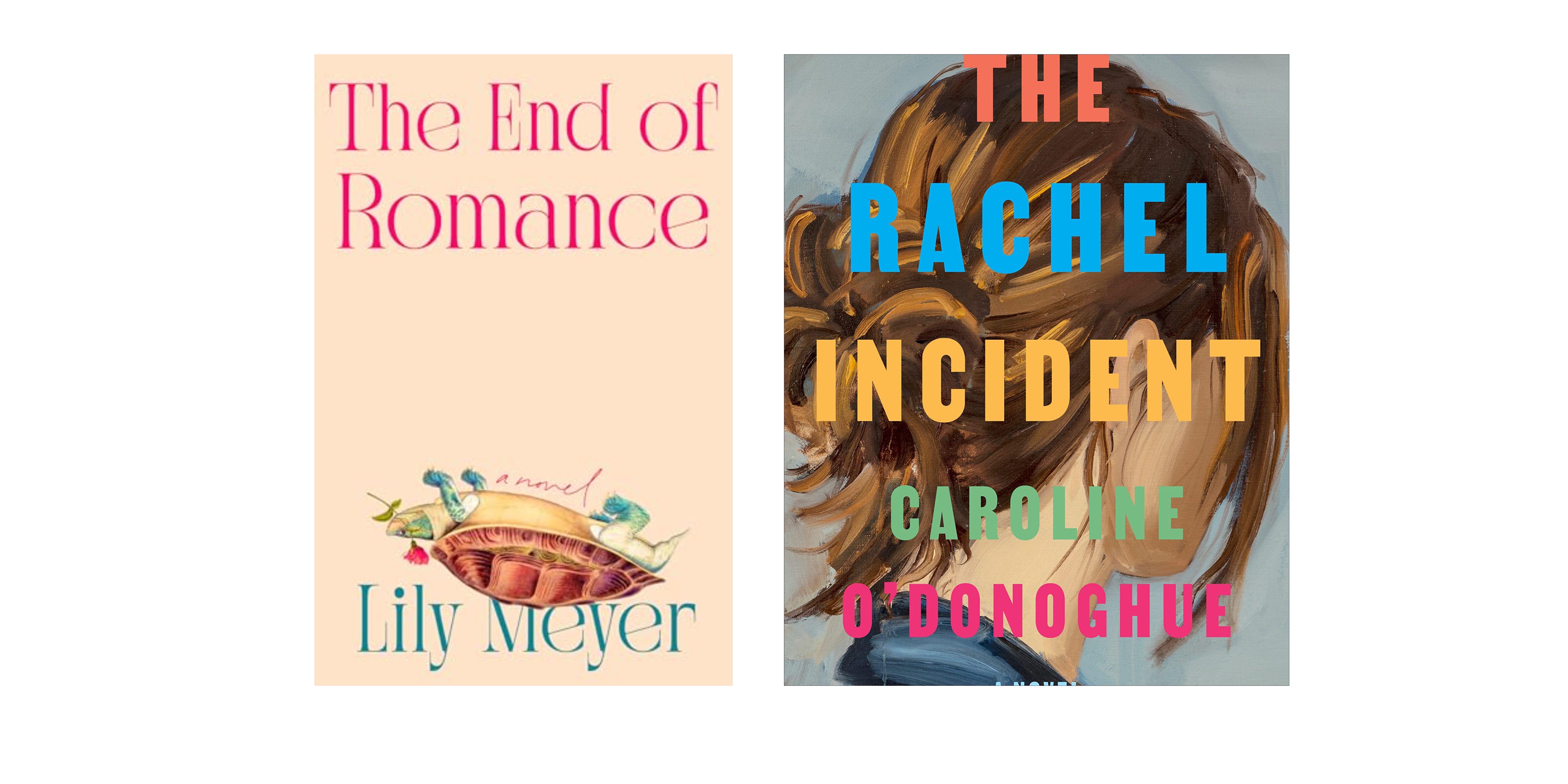
Book cover images for The End of Romance by Lily Meyer and The Rachel Incident by Caroline O'Donoghue

The End of Romance — Lily Meyer

This book was not on my radar until my friend Sarah quite literally pressed it into my hands, and after a stint of disappointing reads, it was SUCH a joy to immerse myself in a smart, well-written, and thoughtfully crafted novel. It follows a young woman who escapes an abusive marriage to enroll in a Philosophy PhD, where she tries to argue for an ideal post-romantic world, only to find it much more complicated in practice than in theory. I can’t express how much of a relief and a treat it was to witness a character deep in thought. There are entire pages where all she does is walk around thinking about philosophy and her thesis and you’re like wow, yes, thank you, now I remember what it’s like to have a brain. As a bonus, the inevitable romance is equally smart and sexy, and leads to further intellectual reflection and stimulation. Education, love, and personal growth—women really can have it all!

The Rachel Incident — Caroline O’Donoghue

This audiobook was a top-tier recommendation from fellow Irish Lit enthusiast Katy P, and it was a delight to have in my ears as I restarted my seasonal morning walks through Brooklyn Bridge Park. It’s primarily about the friendship between a young college student, Rachel, and her gay roommate James, but also about how their relationship intersects with that of one of Rachel’s professors and his wife. It’s clever and surprising, at once deeply Irish and also somehow universally relevant to anyone who has ever been young during (or before, or after) a recession. With humor and tenderness, O’Donoghue nails that specific flavor of economic anxiety and how it compounds the preexisting struggle of being young and trying to reconcile the gap between who you are and who you want to be. Evergreen content, honestly! I whole-heartedly undersign Katy’s endorsement.


THE TIPPY TOP:

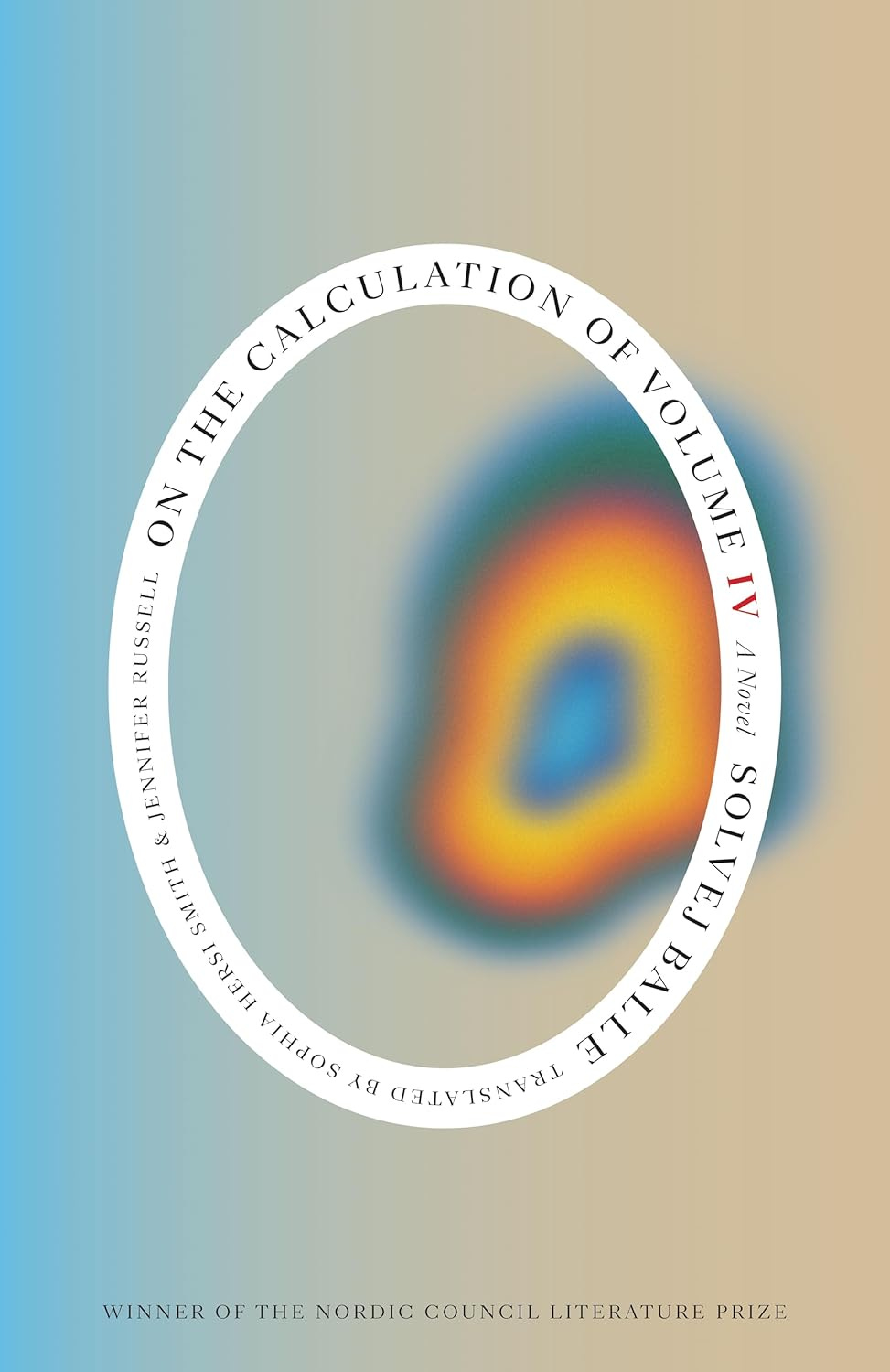
On the Calculation of Volume IV — Solvej Balle (translated by Sophia Hersi Smith and Jennifer Russell)

Book cover image for On the Calculation of Volume IV by Solvej Balle

Come on, guys. Be so for real. Did you really expect a new one of these to come out and for it to not be the top book on my list? I’ll keep this short because it’s hard to talk about the fourth book in a series without some major spoilers, but what I admire most about this installment is the balance between some of the philosophical-forward thinking I enjoyed in the first couple of volumes, and more actual plot! Plus, Balle continues to knock us flat with cliffhangers and then force us to wait another six months for her faithful English translators to bring us sweet relief. A deviation in the routine—what could it mean??? We are once again counting down to the 18th of November in this house.


That’s all for now! I’m in the Berkshires this weekend and it’s raining, and there’s a spot on the couch in front of the wood-burning stove with my name on it. If you want to chat some more in the meantime, you can find me in all the usual places.

a fire lit in a wood-burning stove in front of a stone chimney. A copy of Elena Ferrante's My Brilliant Friend sits on a metal coffee table in front of the fire.
Not my Elena Ferrante, but I WILL be returning to Elena Ferrante this year, so stay tuned.

Until next time, happy reading!
❤ Catherine


Housekeeping note: all book links go to my Bookshop storefront, where each purchase supports independent bookstores (and this newsletter, because I get a small percentage of each sale).
To whatever end

Lit Chat Vol. 33 — January/February in Review

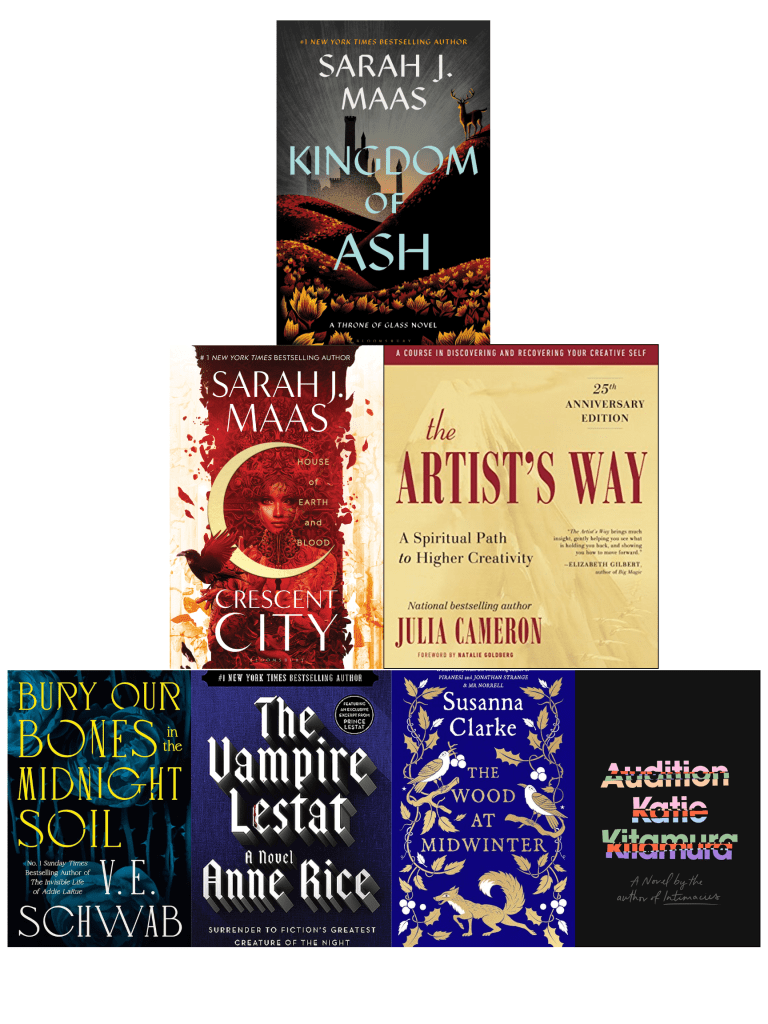
Pyramid of book cover images with Bury Our Bones in the Midnight Soil by V.E. Schwab, The Vampire Lestat by Anne Rice, The Wood at Midwinter by Susanna Clarke, and Audition by Katie Kitamura on the bottom; House of Earth and Blood by Sarah J. Maas and The Artist's Way by Julia Cameron in the middle; Kingdom of Ash by Sarah J. Maas on top.

Hi friends,

I started 2025 with a really clear idea of what I wanted to do with my time and my brain. I had a strong drive to learn, stretch, and achieve via a self-imposed curriculum. And I enjoyed it! I’m glad I did it. But come January 2026, I needed a rest.

For me, rest is letting myself luxuriate in 500+ page books that take well over a month to read. I gravitate towards these (mostly fantasy) books during times of hibernation and withdrawal, protracted escapes from the rest of the world.

I think I’m branding 2026 as the year of the long read. The project read, if you will. I’m currently in a book club to read Larry McMurtry’s western epic Lonesome Dove over the next few months. I desperately need to return to (read: binge) the Wolf Hall trilogy. I’d also like to finally tackle some Dostoyevsky, and maybe we’ll return to some Proust in the summer? Who’s to say!

For the past three years, I’ve shied away from longer books because I was afraid they’d leave me with not enough to write about here on a monthly cadence. That’s not interesting to me anymore! This year, we’re eliminating that stress. As a result, these updates may be a little less frequent until I feel like mixing it up again. You’ll hear from me when you hear from me, but I’m always around if you want to chat.

Speaking of, we’ve got some catching up to do. Shall we?


THE FOUNDATION:

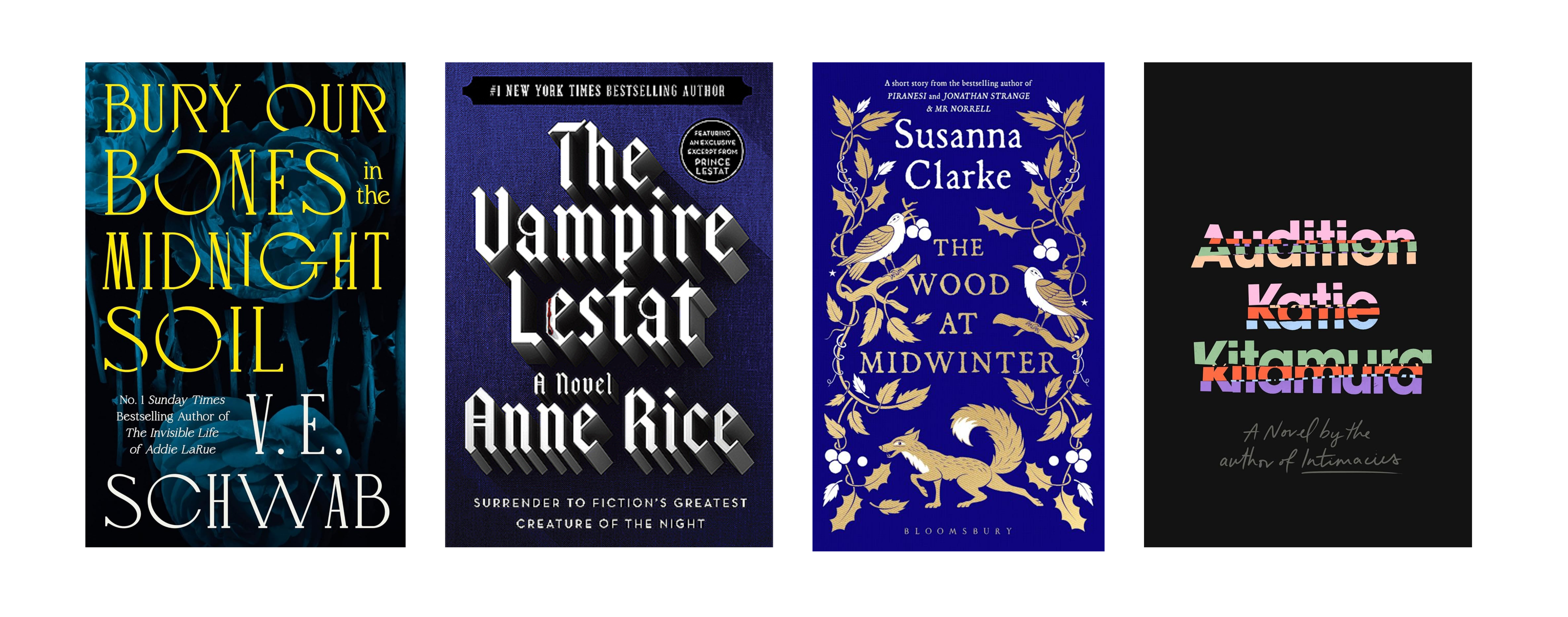
Book cover images for Bury Our Bones in the Midnight Soil by V.E. Schwab, The Vampire Lestat by Anne Rice, The Wood at Midwinter by Susanna Clarke, and Audition by Katie Kitamura

Bury Our Bones in the Midnight Soil — V.E. Schwab

I wanted to love this one! I really did. Chalk it up to bad timing, that I happened to read two vampire books more or less concurrently. I usually enjoy Schwab’s writing and was intrigued by the three different eras her characters belonged to: 2019 Boston, Regency-era London, and sixteenth-century Spain. However, I don’t think the length worked in this one’s favor. When each of the POVs are novel-length in their own right, the moment when they finally convene needs to feel deservedly momentous. This one kind of just devolved into an anticlimax about grief and toxic relationships, and I don’t think it brought anything particularly new and exciting to the canon of vampire novels. Speaking of…

The Vampire Lestat — Anne Rice

I first read Interview with the Vampire six or seven years ago, and absolutely loved the luxurious, sensual campiness with which Rice essentially defined the modern vampire novel. Once you’ve read it, everything else (unfortunately, Bury Our Bones included) just feels like an imitation. That said, this did take me closer to four months to get through because, as fascinating a character as Lestat is, this nearly 600-page book is more autobiography than true plot. This made it easy to put down and pick back up during the different eras of Lestat, but didn’t make me want to read nonstop to the exclusion of all else. We do get some cool vampire origin lore in this volume, though, and I do intend to finish the rest of this series eventually.

The Wood at Midwinter — Susanna Clarke

Susanna Clarke is a delight at whatever she does, be it a 1,000-page fantasy doorstop or a 64-page fairy tale. I would read her grocery lists, but in their absence, The Wood at Midwinter is an exquisitely illustrated short story about a strange girl and her affinity for the woods who speak back to her like a character in their own right. This is a perfect snow day book for adults and children alike—exactly the length of a cup of hot chocolate.

Audition — Katie Kitamura

Listen, it’s been two months and I still have no idea how to feel about this book. My first response after finishing it in one sitting was just ???, and my second response was to message some friends who I knew had read it:

screenshot of a discord message that says "I can't decide if it's genius or obnoxious. This one requires some stewing.
spoiler alert: still stewing!

I don’t even know how to talk about it without spoiling it? On the surface, it’s about an actress and a young man who claims to be her son, the emotional fallout that ensues, and its effects on her performance in an upcoming play. But there’s a twist! And the twist has you questioning everything you’ve read up until then, the reliability of each character, and the reliability of the narrative itself. It lands in a sufficiently WTF place that answers absolutely zero questions, which is why it’s either genius or obnoxious. I think I’ve landed on possibly both? But I’m still kind of annoyed. If you’ve read this one, I want to hear from you!!


SOLID SUPPORTS:

House of Earth and Blood — Sarah J. Maas

I have officially reached the point in my SJM reading journey where I’m just committed to reading everything she’s written. After finishing the Throne of Glass series in January (more on that to come, dw), I couldn’t resist the temptation of yet another 900-page book on my Kindle to take with me on a trip to Florida.

HOEAB is the first book in the Crescent City series, and I’ll admit I’m not vibing with the urban fantasy elements quite as much as I was the classic high fantasy of Throne of Glass. There’s something just kind of wrong to me about angels using cell phones and watching TV. This one, however, scores points for being written for an adult audience, and I was pleasantly surprised by how quickly it sucked me in despite having to learn yet another new world’s worth of vocabulary, geography, and lore. This is another series I’m committed to seeing through to the end this year. Probably sooner rather than later, if Libby keeps delivering the e-books this fast.

The Artist’s Way — Julia Cameron

Enough creative friends of mine had been threatening to do The Artist’s Way for long enough that in December, we actually started, and in February, I finished! Twelve weeks of consistent morning pages, Artist’s Dates, and challenging my relationship with art, creativity, and the universe’s role in all of it.

I think my biggest takeaways were:

  1. How much calmer I feel in my day when I spend the first fifteen minutes dumping my brain out into my fancy Italian leather journal like Dumbledore’s pensieve.
  2. How fun it is to go to the movies by myself and not share my popcorn.
  3. How much more likely I am to get something done if I a) write it down and b) tell other people about it.

This journey also helped me recommit to my creative writing and to the possibility of sharing it with the world in a big way (I’ve been submitting to literary magazines for the first time in like six years), which I’ll admit is very scary! And hard to open myself back up to rejection in that way! But if I can be brave then so can you, because Julia Cameron says so.


THE TIPPY TOP:

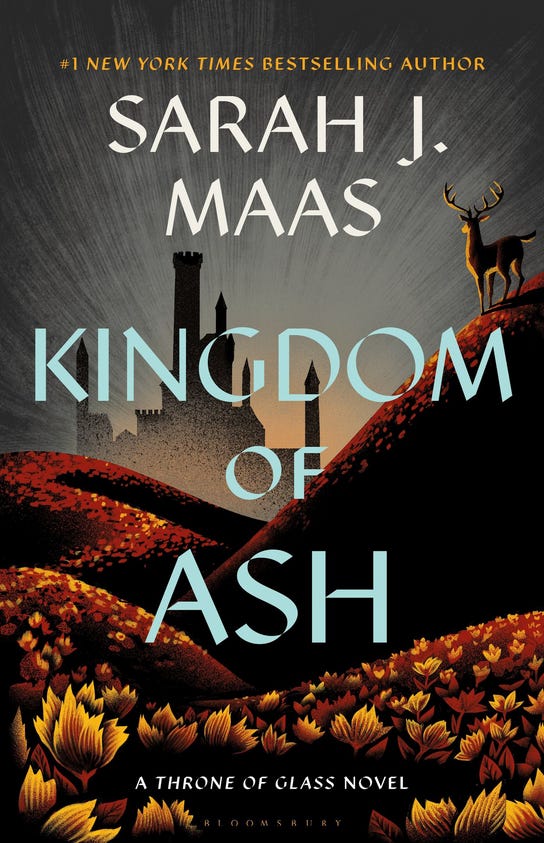
Book cover image for Kingdom of Ash by Sarah J. Maas

Kingdom of Ash — Sarah J. Maas

I think as a general rule, if I’m going to invest upwards of four thousand pages of my reading time to a single series, then the last book is actually legally obligated to be good enough for the top spot. Fortunately for SJM, Kingdom of Ash was.

This is the seventh book in a series, so at this point it’s almost impossible to discuss without spoilers. I’ve talked in previous posts about how much I was enjoying the ways the geographical world of the novel continued to expand, and how satisfying it was when characters from different corners of the map finally teamed up. But in finishing (and starting) yet another SJM series, I’ve also been thinking a lot about the romantasy genre as a whole, especially in response to Daniel Yadin’s essay in The Drift.

A significant portion of Yadin’s essay about the recent rise of romantasy in pop culture goes for shock value in quoting some of the steamier sex scenes and using them as a lens to explore the representation of female freedom and sexual liberation, often at the cost of literary quality. What I think he dismisses in his argument about how fate and overdetermination weaken the characters’ individual agency is the fact that said overdetermination is…kind of the whole point?

Yes, we come to these books for an escape, but the main fantasy is not the magic or the dragons or the “unfathomably hung” love interests. The real fantasy is the guarantee that somehow, even when all signs point towards certain doom, everything is still going to work out okay. The hands of fate are always working for the good: the war will be won, the lover found true and whole, the friendships strengthened and preserved. In a reality of horrific news cycles where we are reminded every day that absolutely none of this is promised to us, isn’t that kind of certainty the wildest fantasy of all?

Anyway, that’s just a teaser of my full rant (The Drift can commission me for a full rebuttal if they want), but I’ll end by saying these books are also just really fun to read! And for what it’s worth, Throne of Glass is the least raunchy, as it’s technically YA. Safe to share and enjoy with both teens and grandmas.


Well, friends, thanks for hanging and for bearing with me as I figure out what I want this newsletter (and my life in general) to look like in 2026. If you want to chat more about any of these books, or want to commit to a buddy read of Infinite Jest (I think I’m kidding…maybe), drop a comment or hit me up in any of the other usual places.

And until next time, happy reading!
❤ Catherine


Housekeeping note: all book links go to my Bookshop storefront, where each purchase supports independent bookstores (and this newsletter, because I get a small percentage of each sale).
The Best Books of 2025: Round Three

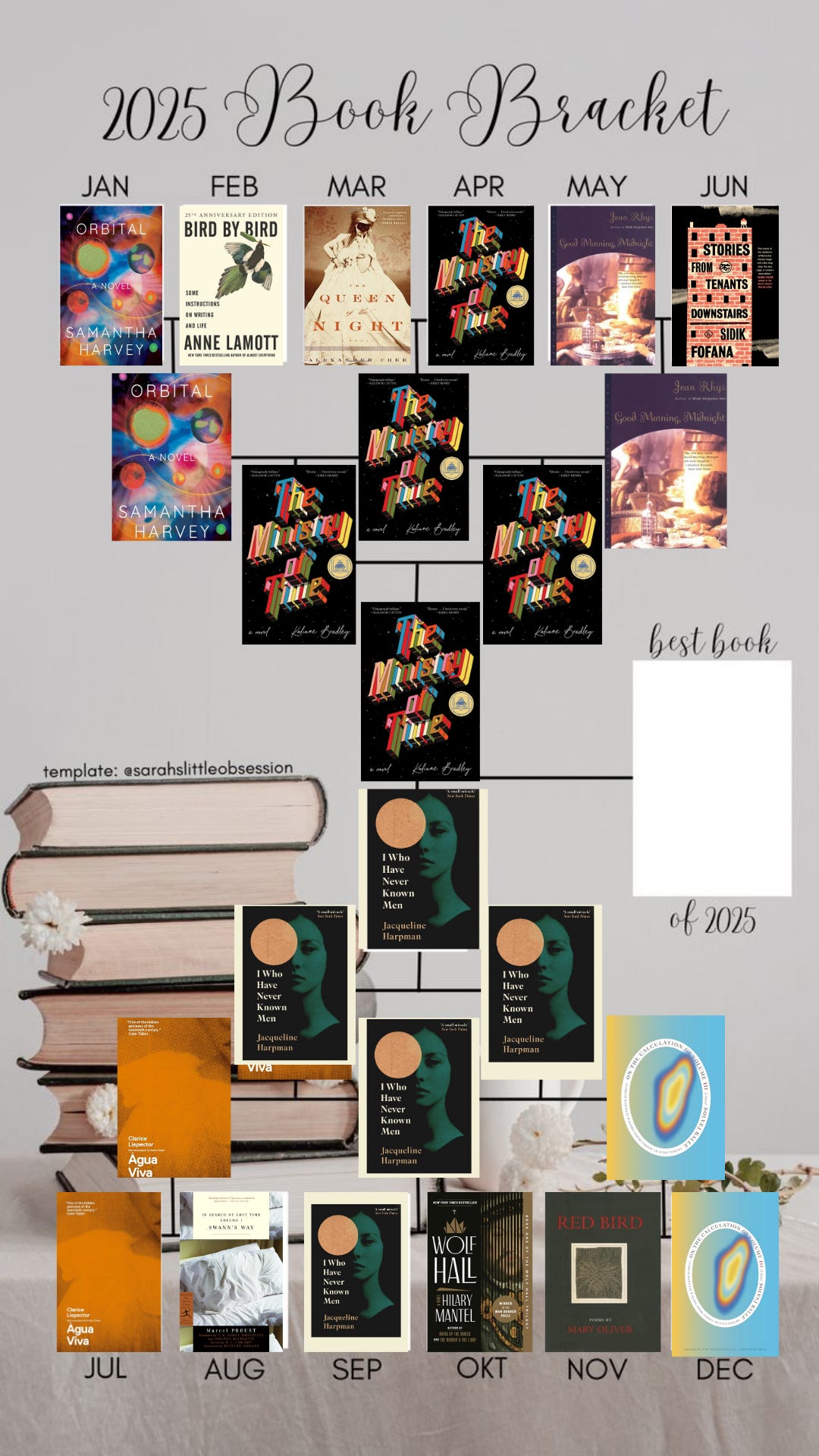
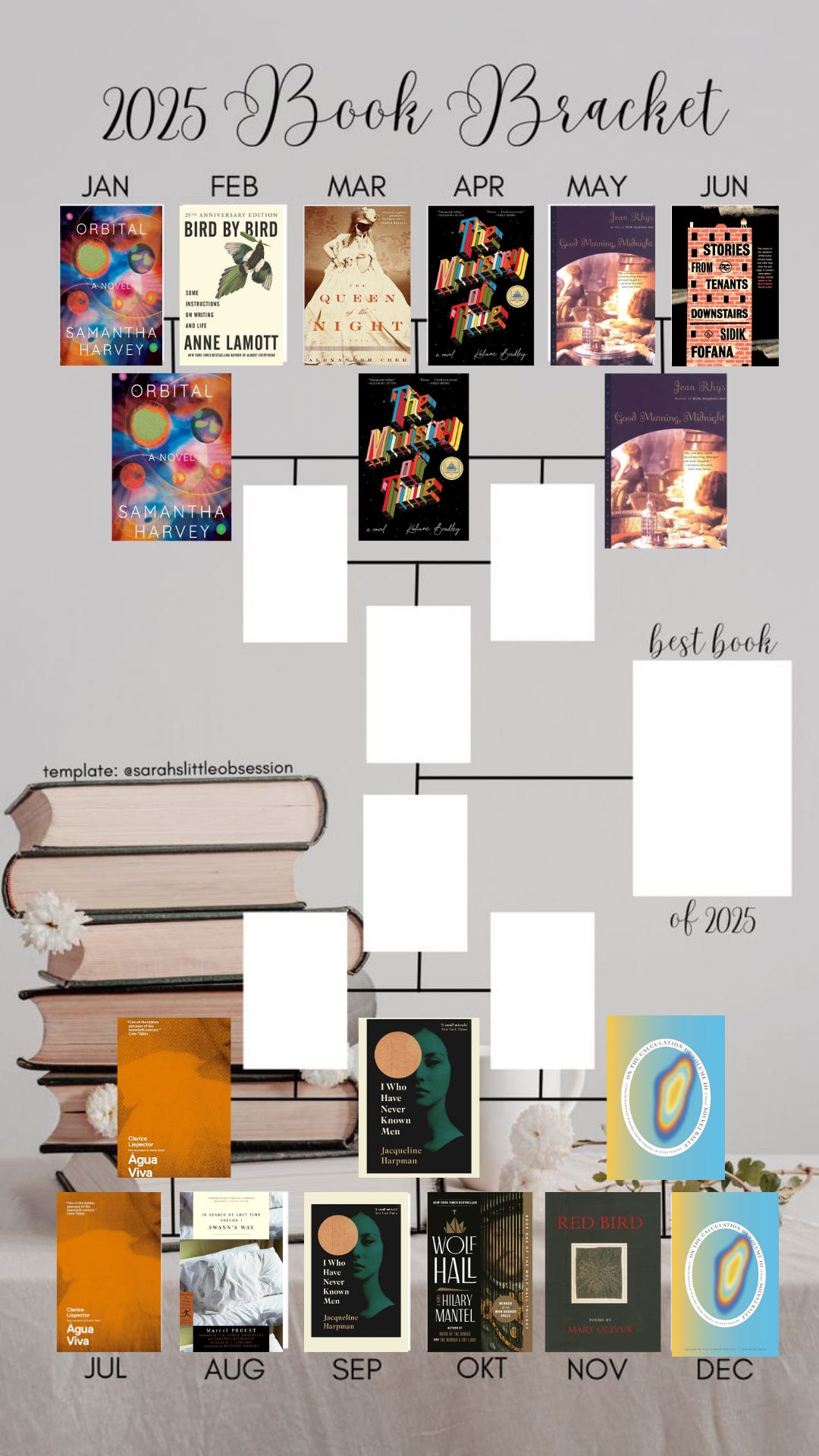
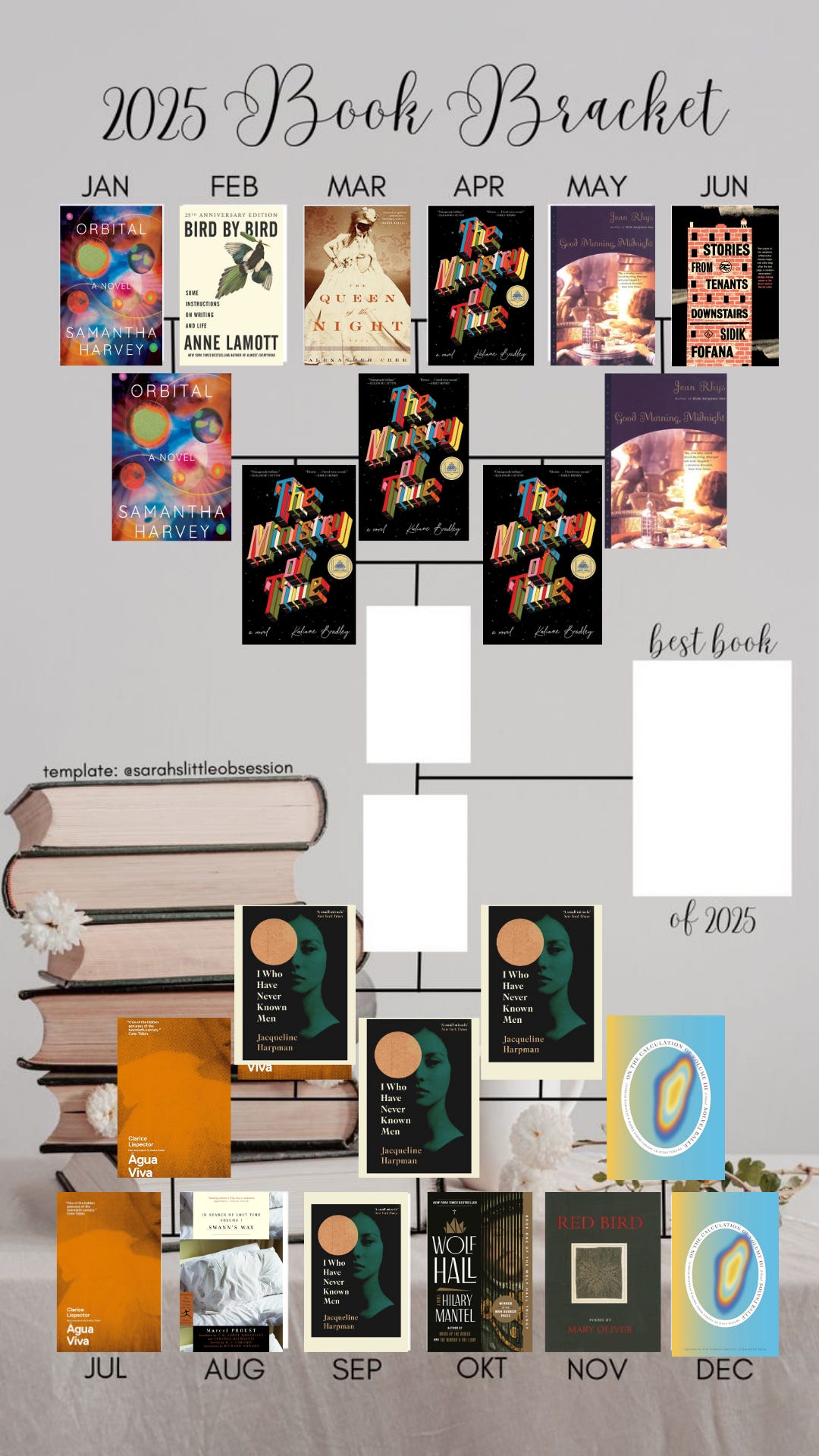
At last! We’ve made it to the finals. If we were following along with our silly bracket, it would look like this:

Best Books of 2025 bracket with all but the final round filled out
again: SILLY

But this isn’t quiiiiite accurate, because per round two, Água Viva should still be in the mix as well. I’m not good enough at Canva to mess with the bracket layout, so just imagine it’s in there somewhere one more time.

Okay! No more stalling, let’s finish this.

Drum roll, please…

Below are the winners of Lit Chat’s Best Books of 2025 Bracket.


RUNNERS-UP:

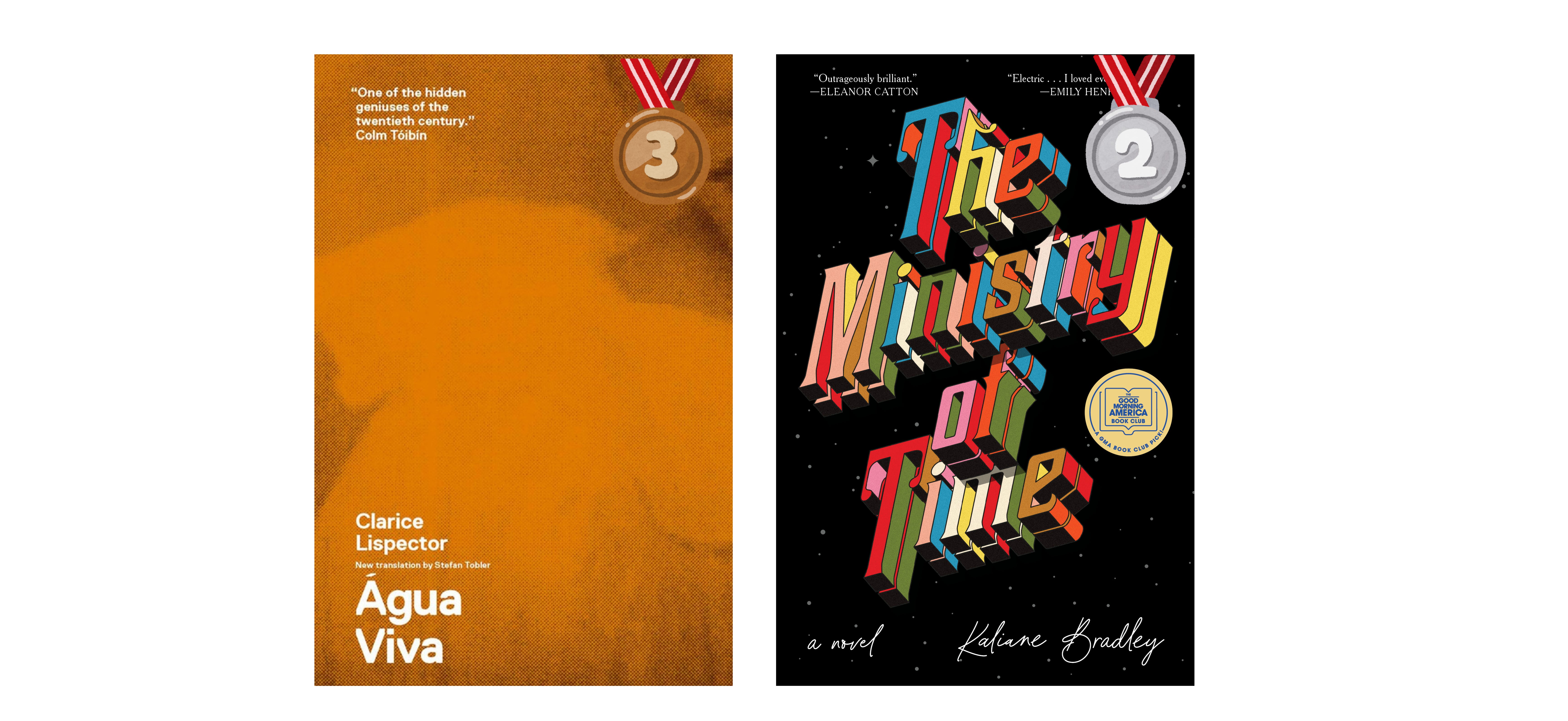
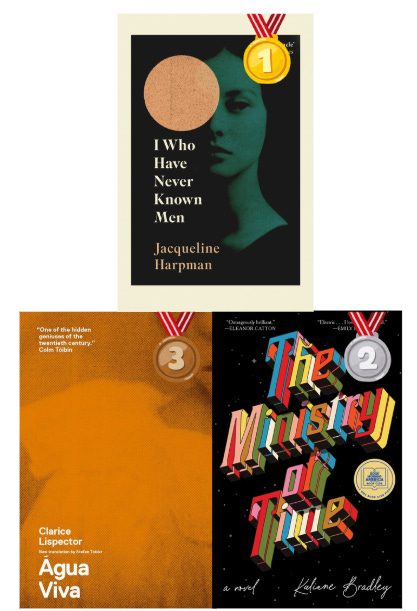
Book cover image of Agua Viva by Clarice Lispector with a bronze medal in the top right corner, and book cover image for The Ministry of Time by Kaliane Bradley with a silver medal in the top right corner
these little medals are truly the extent of my Canva skills

Água Viva by Clarice Lispector (Third Place) and The Ministry of Time by Kaliane Bradley (Second Place)

I’ve actually flip-flopped quite a few times over which book should take second vs. third place. It’s hard to compare Água Viva to other books with characters and plots, as I noted in its match-up against Good Morning, Midnight. If we’re judging which of the two was the smoother, more enjoyable reading experience, then it’s definitely The Ministry of Time. But if we’re comparing which one is more experimentally genre-shattering and intellectually stimulating, then Água Viva should prevail.

Then again, The Ministry of Time does also have a cerebral element to it. Keeping the events of each timeline straight definitely requires brainpower, especially towards the end. And much like On the Calculation of Volume, I found myself still thinking about the implications of its characters’ situations long after the book ended. I’d catch myself wondering what Commander Gore would make of certain TikTok trends, which would lead to daydreams about how I would explain the Internet to someone from the eighteenth century (and how they would inevitably fall in love with me, obviously).

I still treasure my annotated copy of Água Viva and the intellectual thrill it brought me, but it feels right to bestow The Ministry of Time with second place, for the amount of enjoyment both in the reading experience and the ensuing daydreams it inspired.


THE WINNER:

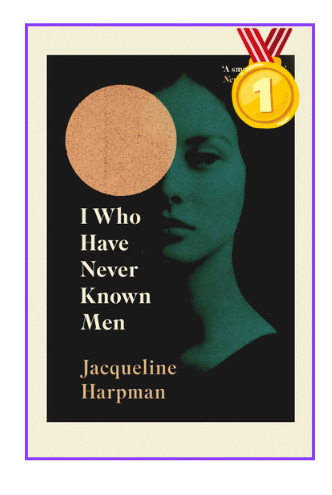
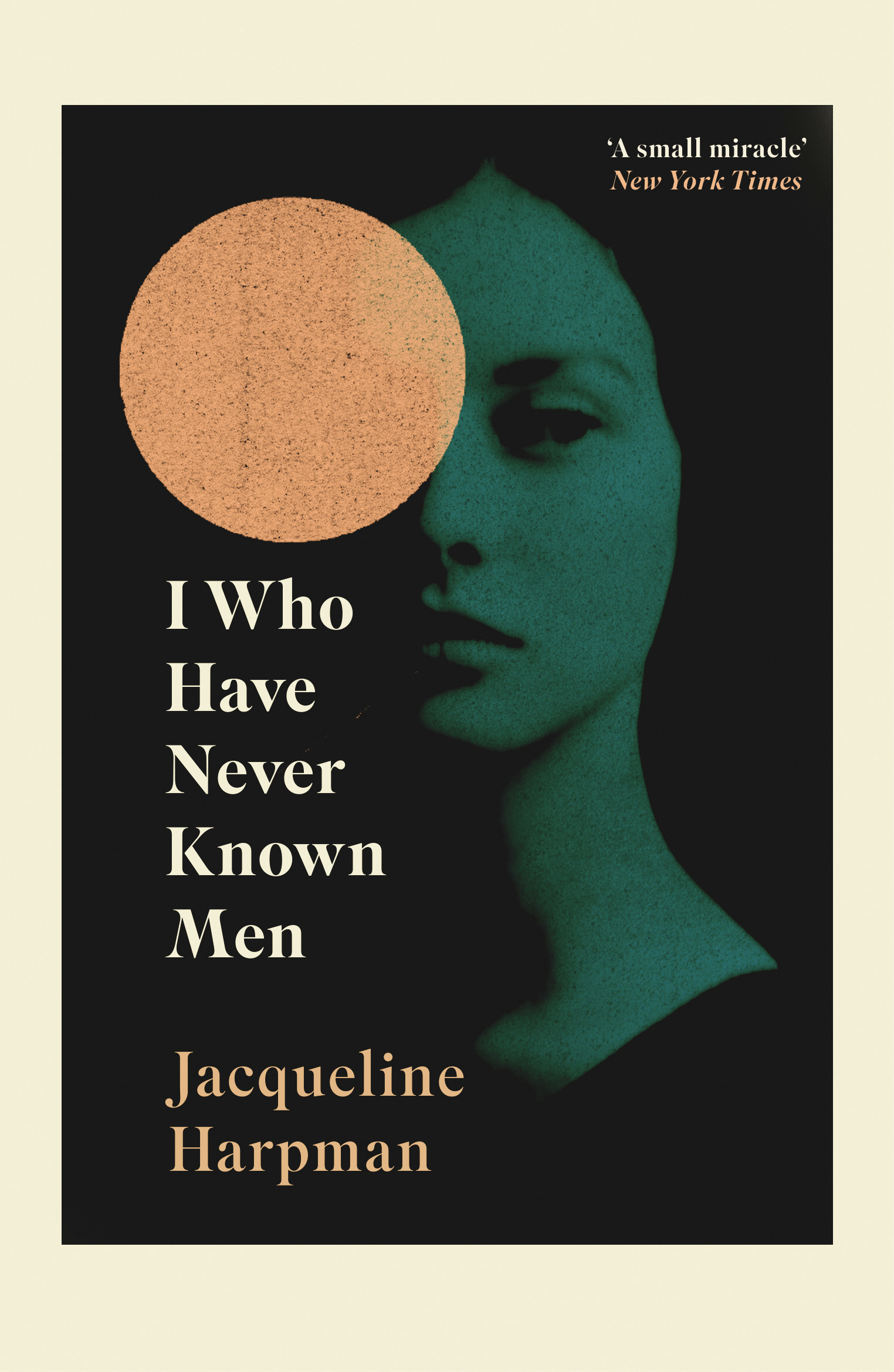
Book cover image for I Who Have Never Known Men by Jacqueline Harpman with a gold medal in the top right corner

I Who Have Never Known Men by Jacqueline Harpman

Pretty much as soon as I set the first round of this bracket, I knew this was how it would end up.

I Who Have Never Known Men has drawn a lot of parallels to The Handmaid’s Tale for being a similarly eerie, dystopian novel that centers a group of oppressed women. Both books also experienced a renewed popularity surge ~30ish years after their initial publication—The Handmaid’s Tale (1985) was adapted into a TV show in 2017, during the first Trump presidency, and I Who Have Never Known Men (1995) became a BookTok darling after its U.S. reissue in 2022, when we were just barely out of the Covid pandemic.

These resurgences speak to the staying power of the themes and emotions present in both books, and I’m here to argue that I Who Have Never Known Men is just as memorable and impactful as The Handmaid’s Tale, because it’s just as presciently relevant to our current time.

The women’s imprisonment and isolation, even after they’ve been freed, strikes a nerve for all of us who lived through the loneliness and confusion of the pandemic. The lack of explanation for the events that set the novel in motion is also all too familiar for those of us living under a government that makes seemingly inexplicable decisions every day. To think there’s a whole generation of people being born who will have never known a different world boggles the mind.

Ultimately, one of the defining takeaways of I Who Have Never Known Men is that nobody is coming to save us.

We don’t know why we’re here or what we did to deserve it. We don’t know what else, if anything, is out there beyond us. But we have each other, and we have our own minds, and all we can do is make the best of it. We create community, ritual, and meaning where we can. We try to treat each other with grace and patience, even when it’s hard. We remember and honor each other when we pass. We focus on what we can control, and try not to let ourselves be tormented by the rest.

Perhaps this is why I Who Have Never Known Men has struck such a chord for so many readers—especially female readers—in recent years. Women have always known how to persevere and preserve, and the past few years have called on us to do so over and over again. Our knowledge is as timeless as our bonds, transcending time, language, and location. All we have at the end is each other. Whether we like it or not, it has to be enough.


pyramid of book cover images with Agua Viva on the bottom left, The Ministry of Time on the bottom right, and I Who Have Never Known Men on the top.
this is better than the bracket, anyway

And with that, we tuck 2025 into bed with a little forehead kiss and say goodnight, wishing it sweet dreams of all the books we’ll read in 2026.

I hope you enjoyed following along for this year’s bracket! If you’re new here, I invite you to subscribe and stick around for my monthly reading recaps. They’re fun, I promise.

I’ve got big reading dreams for 2026, including reading more exclusively from my bookshelves, tackling some more classics (War and Peace book club, anybody? Another volume of Proust??) and maybe experimenting with a few mini themed curricula for myself and friends.

But until then! I’m taking a nap, and so should you.

Happy reading,
❤ Catherine


Housekeeping note: all book links go to my Bookshop storefront, where each purchase supports independent bookstores (and this newsletter, because I get a small percentage of each sale).
The Best Books of 2025: Round Two

Listen, I know most people come out with their end-of-the-year wraps well before the year actually ends, but personally, I need a little bit more time to stew on things. This round especially needed extra time to marinate, because I’ll be honest, I was flip-flopping on the last one up until the very end.

2025 Book Bracket with the first two rounds filled in with book cover images.

Before we move on, I want to say that I don’t love this bracket design (sorry sarahslittleobsession, whoever you are, it’s not personal). Instead of having the middle books duke it out twice in this round, we’re just going to have three match-ups: the Jan-Feb winner vs. the Mar-Apr winner; the May-Jun winner vs. the Jul-Aug winner; and the Sep-Oct winner vs. the Nov-Dec winner.

Essentially, we’re skipping a bracket round as it’s designed here, but you’ll see why at the end. Don’t worry about it! Just enjoy the ride. And if you’d rather enjoy it on Substack, you can do so here:


ROUND TWO:

Book cover images for Orbital by Samantha Harvey and The Ministry of Time by Kaliane Bradley

Orbital by Samantha Harvey vs. The Ministry of Time by Kaliane Bradley

Ah, the classic conundrum: space travel vs. time travel. Orbital was such an ideal book to begin 2025 with, especially for me, coming off a hectic 2024. There was something so peaceful about feeling far removed from Earth and all its demands, and in being reminded of just how teeny tiny our little lives and dramas are in comparison to the big, beautiful universe. A quiet and contemplative read, Orbital was perfect for easing back into the January stratosphere.

The Ministry of Time, however, is on the opposite end of the spectrum. It’s a book that’s very much about being in the world, and the inclusion of characters from other times made the present moment feel vast and expansive and foreign without having to leave the planet. It feels reductive to say The Ministry of Time is just more exciting, but at the end of the day, it is! There’s intrigue, there’s romance, and there’s a provocation for the reader to consider their place in the world and what we owe to generations past, present, and future. The Ministry of Time advances, but with no less love for Orbital.


Book cover images for Good Morning, Midnight by Jean Rhys and Agua Viva by Clarice Lispector

Good Morning, Midnight by Jean Rhys vs. Água Viva by Clarice Lispector

Interesting, interesting! These books have absolutely nothing to do with each other, and must therefore be assessed by other factors because they can’t be compared like two novels can. Good Morning, Midnight has a lot going for it that Água Viva does not: a plot, for example, and characters, and a strong sense of time and place—even if that sense is fallible and ultimately unreliable.

And yet!! When I think of Água Viva, I think of a fire burning in my brain. I read both of these books in one sitting while traveling, but Água Viva is the one I came back to for seconds. Água Viva is the one I went to the bookstore to buy so I could underline it on my second read, which is something I almost never do. There was an urgency, an authenticity to Lispector’s searching that utterly possessed me. Água Viva moves forward!


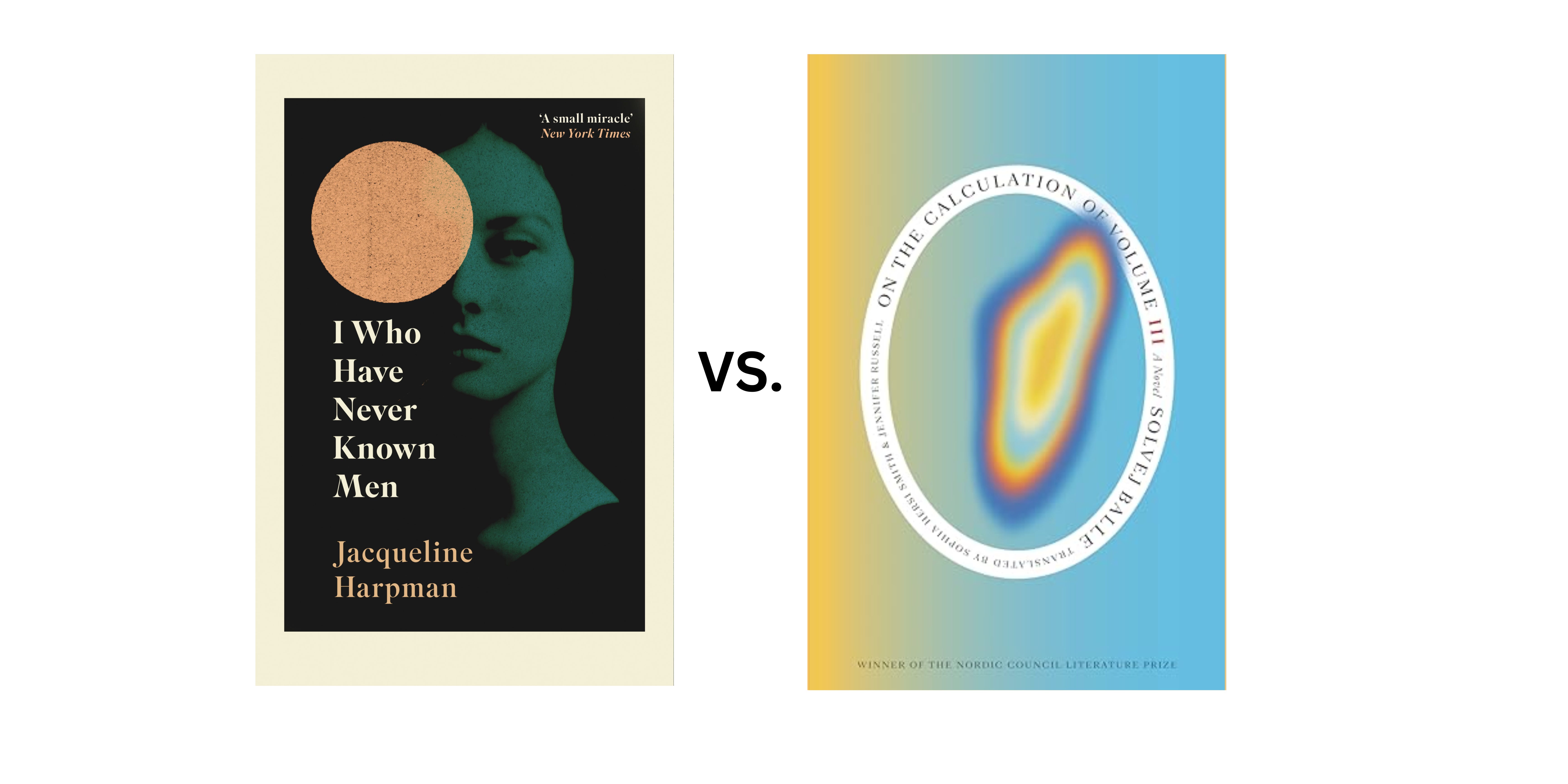
Book cover images for I Who Have Never Known Men by Jacqueline Harpman and On the Calculation of Volume III by Solvej Balle

I Who Have Never Known Men by Jacqueline Harpman vs. On the Calculation of Volume III by Solvej Balle

I find this pairing incredibly upsetting, because if you asked me to just list my top ten books of the year, all of the On the Calculation of Volume books would probably be on that list. But to pit just one of them against I Who Have Never Known Men, of all other books I read this year! Life isn’t fair.

Alas, one must be the victor. I remain deeply, deeply obsessed with the On the Calculation of Volume series, and will continue proselytizing to all of my bookish friends until we are a cult big and important enough to demand and receive a midnight indie bookstore release party for all subsequent volumes.

However.

It feels unfair to weigh the entire series against I Who Have Never Known Men. That’s not what’s in the bracket! And if we’re going off the merits of the individual book as a standalone, I don’t think Volume III holds up. I Who Have Never Known Men has an equal, if not greater amount of originality, and yet its strength is in being contained to this single volume. While we hold onto hope for answers in Volume IV, we know that answers are never coming for I Who Have Never Known Men, and we’re left to reckon with that not-knowing. The not-knowing is the point, and the not-knowing is what’s so haunting. With a conflicted heart, I Who Have Never Known Men advances to the finals.


Do you see now why it would’ve been silly to stick to the bracket as it was designed? It would’ve eliminated a round anyway, because it would’ve reduced the semifinals to just two books instead of four. This way is better because I say so.

2025 Book Bracket with the first three rounds filled in with book cover images
SILLY!

Anyway, stay tuned for the final round tomorrow, which is just a little mini pyramid ranking the top three. I’m ready to put 2025 behind us and I’m sure you are too, but in the meantime, I hope you find some inspiration for your 2026 reading.

Until then, thanks for hanging and happy reading!

❤ Catherine


Housekeeping note: all book links go to my Bookshop storefront, where each purchase supports independent bookstores (and this newsletter, because I get a small percentage of each sale.

The Best Books of 2025: Round One

Well, well, well, if it isn’t 2026 already.

If Goodreads is to be believed, I read 62 books in 2025. I smashed the goals I set for myself to read more short story collections and books in translation (7/6 and 16/4, respectively), read exactly six stellar poetry collections, and fell just short of my goal for craft books (5/6). Can’t win em all!

I also finally finished Emily Wilson’s translation of The Iliad in December, and successfully led a cute little Proust book club over the summer to read Volume One of In Search of Lost Time. All in all, it was another fabulous year for books, and I’m proud of the way I challenged myself to broaden my regular reading horizons.

But we’re not done yet.

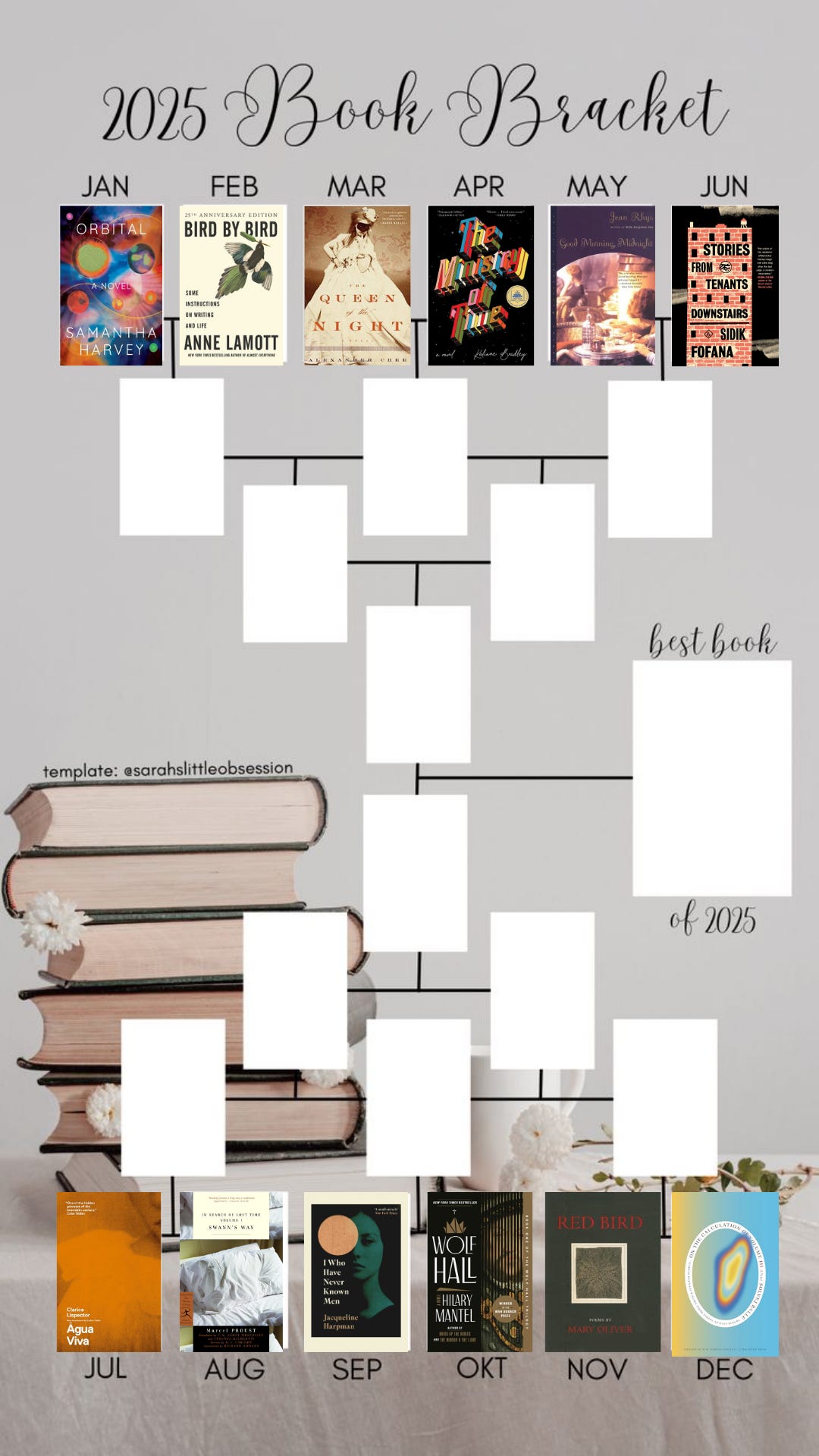
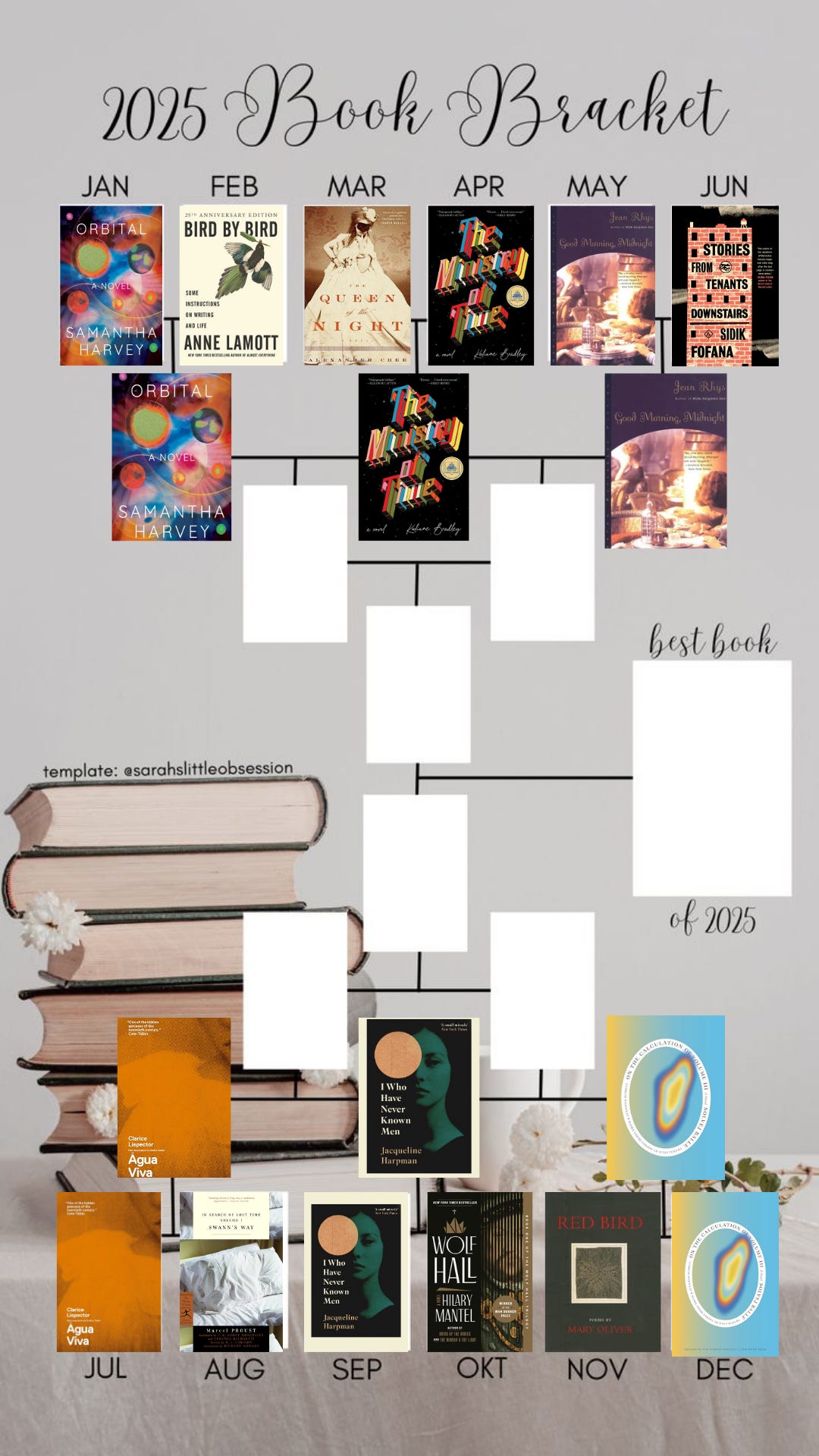
Welcome, friends, to Round One of the Best Books of 2025 bracket! 2025 may be over, but we can’t put it to bed entirely without first crowning a winner.

2025 Book Bracket with book cover images filling the first round of spots

This is my third year running this bracket, and I’m amped to dive into these match-ups. Not only were there some absolute bangers in the top spots this year, but a lot of these books also explored many of the same themes in surprisingly complementary ways.

I think this year’s bracket is going to be a really cool reflection/accumulation of a lot of the thoughts I’ve had this year about time, space, and art, so it’s going to be interesting to see what comes out on top as a marker of my final takeaways for the year.

But enough preamble, let’s dive in! You can also read this directly on my Substack here:


ROUND ONE:

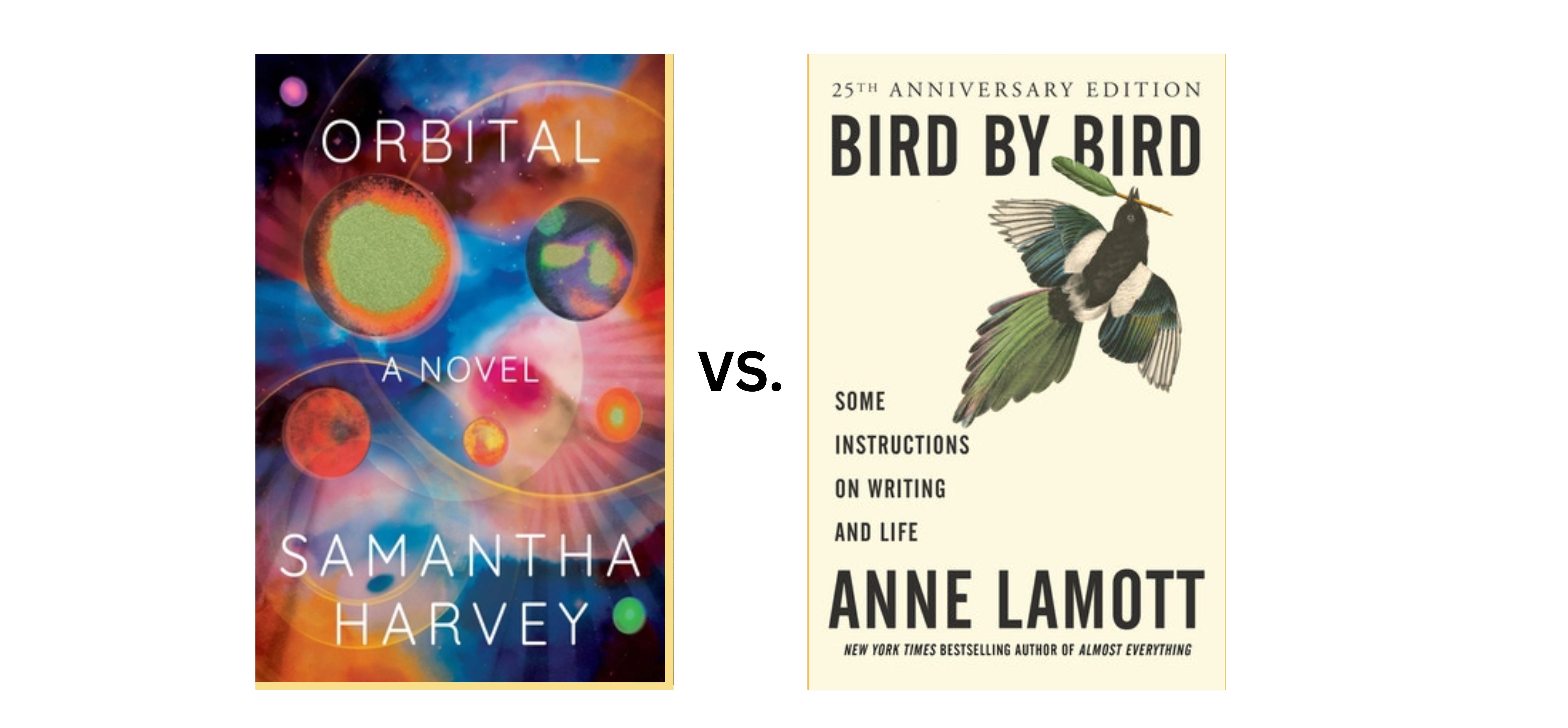
Book cover images of Orbital by Samantha Harvey vs. Bird by Bird by Anna Lamott

Orbital by Samantha Harvey vs. Bird by Bird by Anne Lamott

A tough one to start us off with! Two books in totally different genres that I loved for totally different reasons. As much as I enjoyed and feel that I have made good use of the wisdom that is Bird by Bird, I feel like Orbital set the tone for much of the reading I did for the rest of the year. The explorations of time and (literal) space, and how we navigate the physical and temporal spaces we have and the people inside of them, feel like defining themes for 2025. Plus, the kid version of me who wanted to be an astronaut still gets goosebumps thinking about Harvey’s descriptions of seeing Earth from space. For these reasons, Orbital advances.

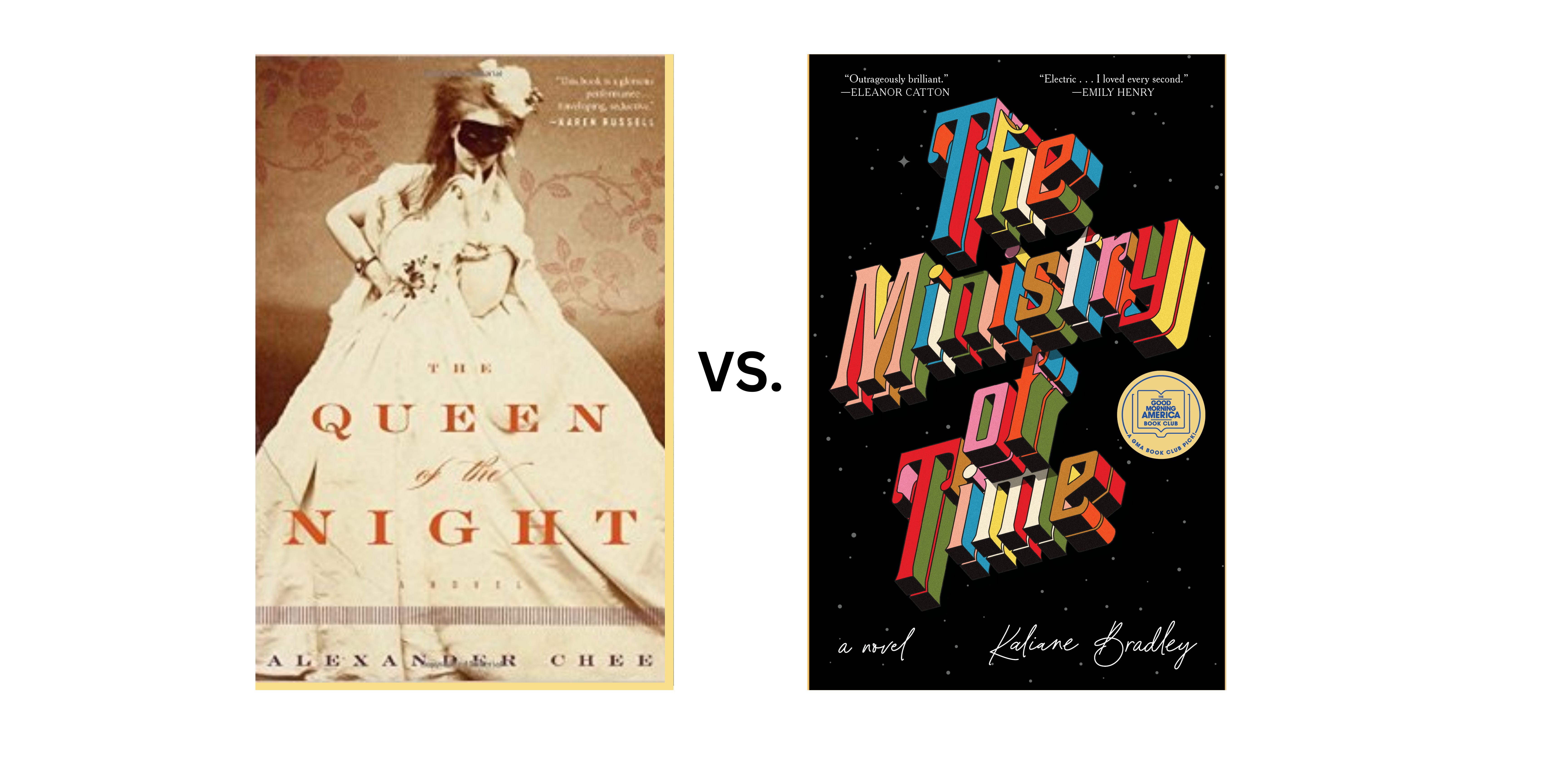
The Queen of the Night by Alexander Chee vs. The Ministry of Time by Kaliane Bradley

I’m already upset because I loved both of these books so much. The Queen of the Night was hands-down the best audiobook I listened to all year, and scores points for hitting many of my favorite elements of historical fiction: eighteenth-century Paris, theatre, the circus, romance, self re-invention. But The Ministry of Time also ticked a bunch of my boxes (namely, time travel and hot Victorian love interests).

I think what it comes down to is that The Ministry of Time took an angle I haven’t seen explored in time travel fiction before, making both its characters and readers answer the same questions about the state of our current world, how we choose to share it with those we love, and the lengths we’d go to protect our version of events. For novelty and long-term thought provocation, The Ministry of Time advances, but I will forever be recommending The Queen of the Night as one of my new all-time favorite historical fiction novels.

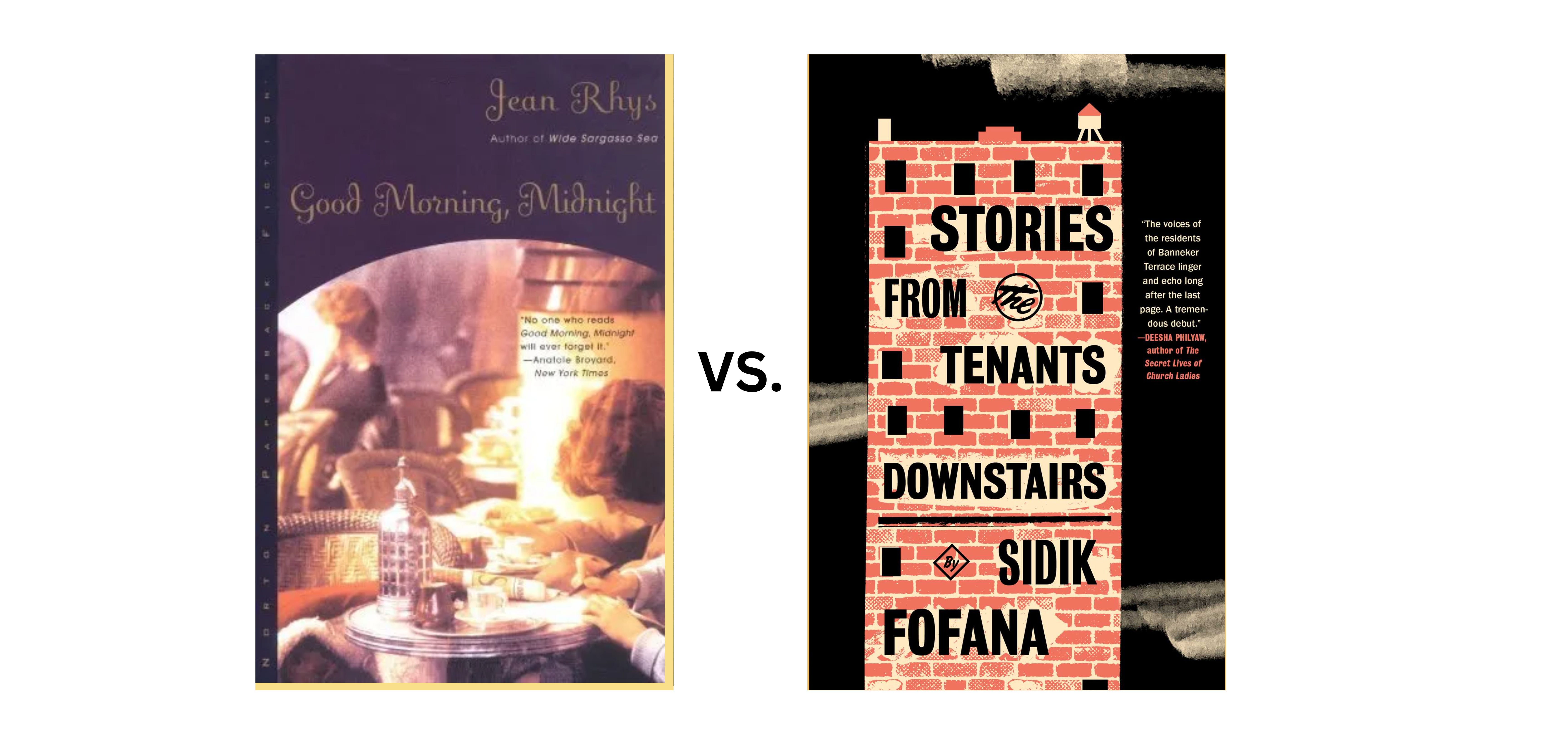
Book cover images for Good Morning, Midnight by Jean Rhys vs. Stories from the Tenants Downstairs by Sidik Fofana

Good Morning, Midnight by Jean Rhys vs. Stories from the Tenants Downstairs by Sidik Fofana

What I admire most about Stories from the Tenants Downstairs is how vividly Fofana captured all of the individual voices in a way that clearly distinguished them but also thematically united them. And yet, Good Morning, Midnight was the one that somehow stuck with me longer.

This may just be the nature of the format—I felt more emotionally connected to Rhys’s protagonist and her corner of Paris in a way that there wasn’t time to do with the individual characters in Fofana’s story collection. In a quieter, subtler sense, Good Morning, Midnight also feels on theme for the year with its exploration of how time changes people and places, rendering them unreliable at best and unrecognizable at worst. Highly recommend both again, but Good Morning, Midnight advances here!

Book cover images for Agua Viva by Clarice Lispector vs. Swann's Way by Marcel Proust

Água Viva by Clarice Lispector vs. Swann’s Way by Marcel Proust

This is such a funny match-up to me, because even though on the surface these could not seem more different, there’s a weird thematic similarity between these two books. One is bite-sized and I read it twice in one weekend, and the other I read slowly over the course of eight weeks. One expressed itself in immediacy, in short bursts of thought and feeling, and the other had long, meandering sentences that went on for entire pages.

Yet both focus on a driving sense of interiority, with the aim of rendering that interiority into something consumable, of capturing the immediate moment as thoroughly as possible with the limited means available to the artists: that is, words. Honestly, if I were a professor, I would pair these books together in the same syllabus because I think they make a surprisingly effective companion read, but for the sake of the bracket, I’m going with Água Viva because its brevity was such a relief after a summer of Proust.

Book cover images for I Who Have Never Known Men by Jacqueline Harpman and Wolf Hall by Hilary Mantel

I Who Have Never Known Men by Jacqueline Harpman vs. Wolf Hall by Hilary Mantel

Another devastating match-up, because I remain deeply obsessed with both of these books. Wolf Hall tapped into my formerly forgotten obsession with Tudor England with prose so freaking lovely and intimate you almost forget you’re witnessing the making of not one, but two notorious tyrants. It’s the best kind of historical fiction, and I’m so looking forward to finishing the trilogy in 2026. And yet I Who Have Never Known Men wasn’t just one of the best books I read this year, but maybe the past decade? It’s one I continue to think about months after reading, and that feels somehow uniquely tailored to the anxieties of our current society, despite being thirty years old. For sheer staying power, I Who Have Never Known Men advances.

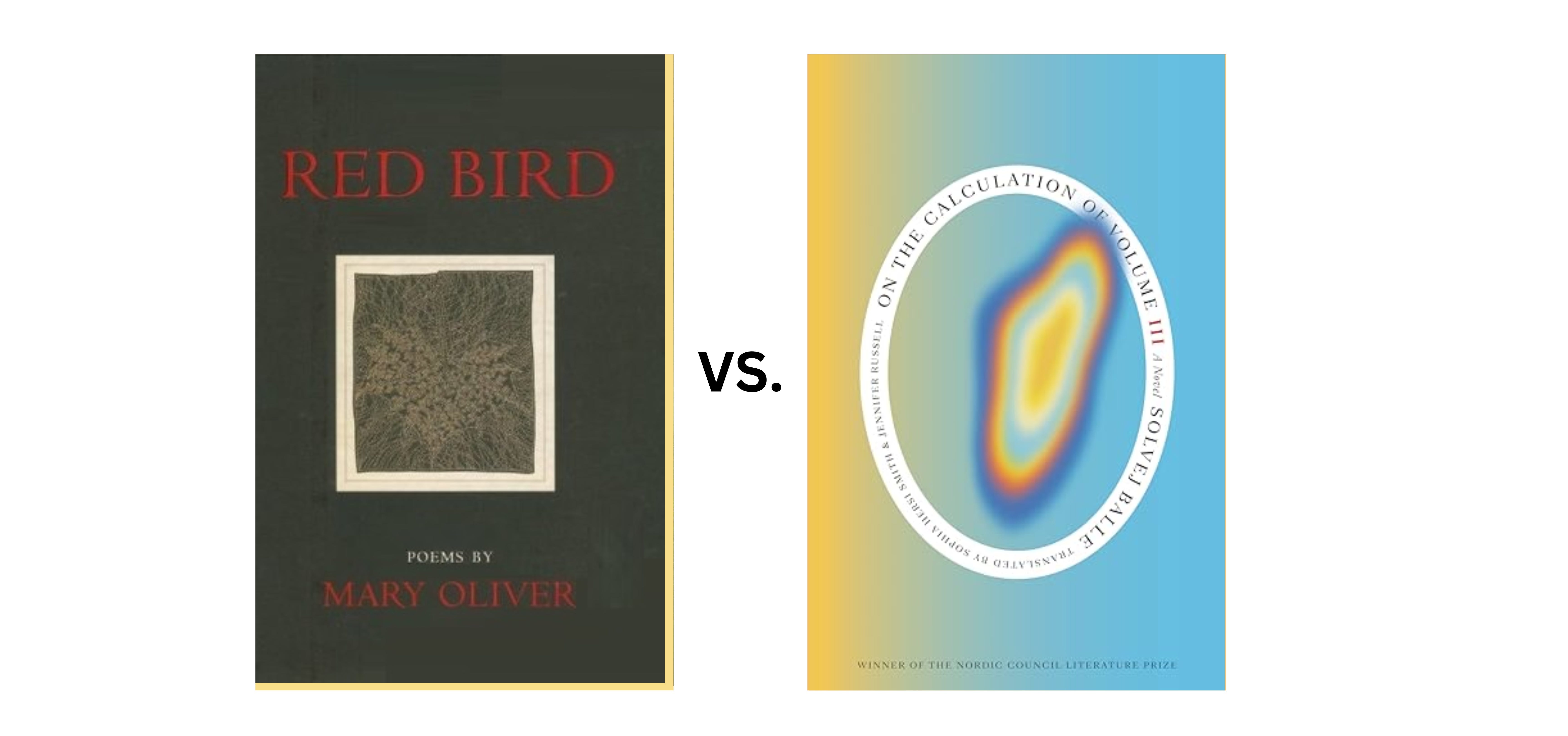
Book cover images for Red Bird by Mary Oliver vs. On the Calculation of Volume III by Solvej Balle

Red Bird by Mary Oliver vs. On the Calculation of Volume III by Solvej Balle

A tough one for sweet Mary Oliver, because as delightful as this collection of poems is, Red Bird is woefully outmatched here. The third and most recent installment of On the Calculation of Volume (and frankly, the entire series) consumed so much of my reading and thinking brain in the back half of 2025 that little else seems to stand a chance.

I loved this third installment in particular for the way it somehow managed to introduce a plot into this otherwise meditative, introspective series, and for how it continued to expand the world in a way that still left you with more questions than you started with. I’m excited to see OTCOVIII face some of the other advancing books; competition seems STIFF for book of the year, but this one is definitely one to watch.


2025 Book Bracket with book cover images filling the first and second round spots

And then there were six! Stay tuned for Round 2 coming at you later this week. Would love to hear your thoughts on the results of the first round in the meantime, especially if you’ve read any of these too!

Until next time, happy reading!
❤ Catherine


Housekeeping note: all book links go to my Bookshop storefront, where each purchase supports independent bookstores (and this newsletter, because I get a small percentage of each sale).

Still full of beans

Lit Chat Vol. 32 — November in Review

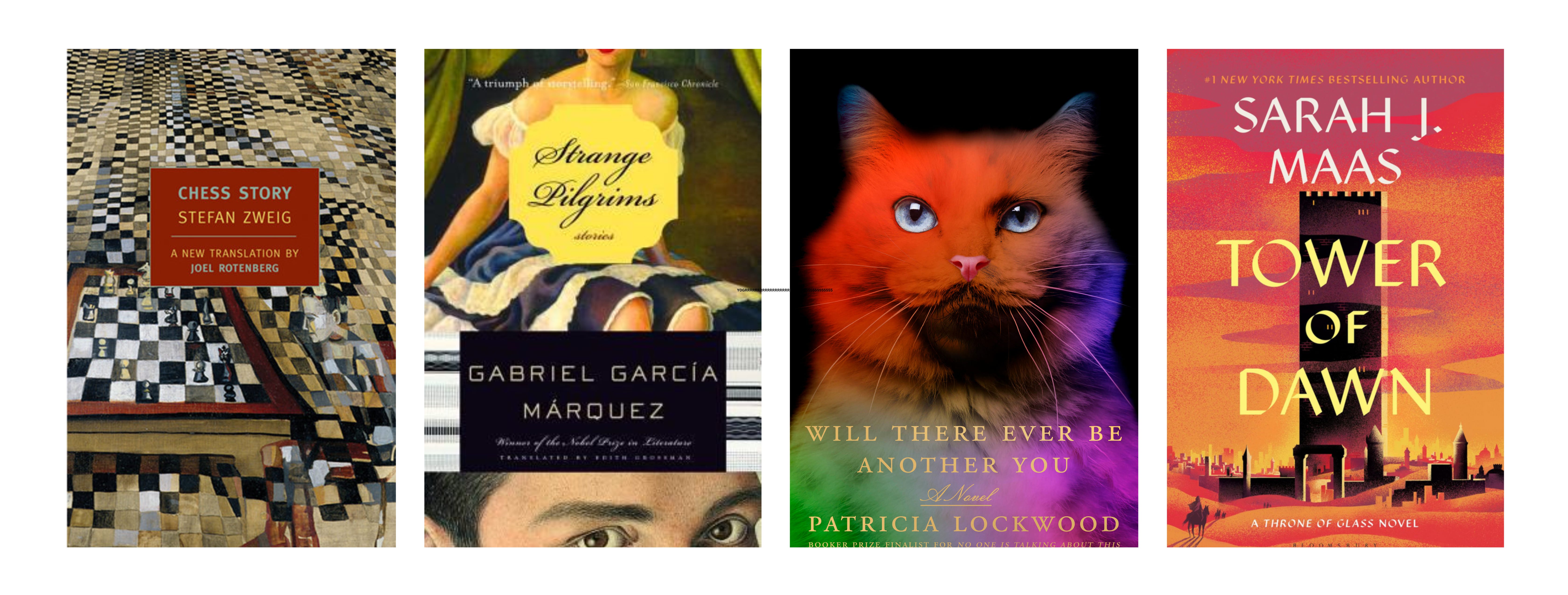
Pyramid of book cover images, bottom row: Chess Story by Stefan Zweig, Strange Pilgrims by Gabriel Garcia Marquez, Will There Ever Be Another You by Patricia Lockwood, and Tower of Dawn by Sarah J. Maas; middle row: Atmosphere by Taylor Jenkins Reid and The Bluest Eye by Toni Morrison; top: Red Bird by Mary Oliver

Hi friends,

We’ve approached my least favorite/favorite time of year. It’s cold, it’s dark, everybody you know is perpetually a little sick. Really, the only thing this time of year is good for is reading.

But we’re also approaching a reflective time of year, and I think I still have a little gratitude hangover from Thanksgiving. As I looked back at past pyramids this week to check whether I’ll meet the goals I set for myself in January, I was overwhelmed by how low-key stellar this reading year has been.

Not only were there so many bangers I’m already anxious that they won’t all get a fighting chance in the Best Of bracket due to seeding, but this year also left me so excited to keep reading: finishing series I’ve started, exploring more authors and genres I’ve discovered in a myriad of languages, wondering what I’ll unexpectedly fall in love with next year.

Overall, I’m just grateful that I’ve had so much time to spend with these words and worlds this past year. I know my life won’t always have the space to accommodate so much reading time like it does now, which makes this era of relative freedom and abundance of literary community to share it with feel extra precious. Not taking any of it for granted!!!

Anyway, TLDR:

Substack note posted on November 27 by Catherine Thoms that reads:
"grateful for all the books I've read in 2025
grateful for all the books I'll read in 2026"

But the year’s not over yet! We’ve still got November and December to chat about, baby, so let’s dive on in. And a reminder that you can get these posts straight to your inbox by subscribing to Lit Chat on Substack:


THE FOUNDATION:

Book cover images for Chess Story by Stefan Zweig, Strange Pilgrims by Gabriel Garcia Marquez, Will There Ever Be Another You by Patricia Lockwood, and Tower of Dawn by Sarah J. Maas

Chess Story — Stefan Zweig, tr. Joel Rotenberg

Work book club strikes again! This is a story of madness, told within the deceptively simple frame narrative of a man witnessing a chess match onboard a ship traveling from New York to Buenos Aires. The players are a world champion and a former Nazi prisoner, who taught himself chess to cope with the isolation of solitary confinement. The latter’s relapse of “chess sickness” is the climax of the novella, but it’s almost overshadowed by the historical context of its publication: Zweig, an Austrian living in exile in Brazil in 1942, committed suicide the day after turning in this manuscript. These circumstances can’t be separated from those of the novella, which is defined by the as-yet-vague but inevitable horror of the war to come, and the irrevocable estrangement from one’s home and former way of life. Highly recommend the Lit Century podcast ep on this novella as a companion listen to this haunting story.

Strange Pilgrims — Gabriel García Márquez, tr. Edith Grossman

I enjoyed dipping in and out of Márquez’s weird little worlds over Thanksgiving break, so near to our own but always with his signature twist of magical realism. Much like Zweig, Márquez was an expat writing about expats, and there’s a sense of displacement and unbelonging that permeates the stories in this collection. Most of the stories feature Latin Americans gone astray in Europe, e.g., a young wife accidentally stranded in a women’s asylum, a family on holiday trapped by supernatural winds, and a pair of ill-fated newlyweds separated by a strange injury. There’s a sense of wrongness, an encroaching sinisterness beneath the façade of civility and culture in each story that ties them all together, despite their being written over the course of two decades. I find it fascinating when authors revisit the same themes and ideas over the course of their career, and this is a perfect example of that kind of lifelong creative exploration.

Will There Ever Be Another You — Patricia Lockwood

The first and only word I could think of to describe this book upon finishing it was: wackadoo. I’m tempted to leave things there, but I can elaborate by explaining that this “novel” is a product of the author’s brain-scrambling experience with long Covid, which made me feel similarly disoriented and unstable just reading her attempts at translating that experience into words. And yet, there are also profound moments of grief and anxiety, as the author simultaneously deals with episodes of tragic loss and illness within her family. Having read Lockwood’s prior novel, Will There Ever Be Another You, (and having once been an avid Twitter follower), I know much of this work draws from real life. The trick of the novel is that you’re never quite sure what’s real and what’s not; truth and reality become somehow immaterial.

Tower of Dawn — Sarah J. Maas

Yes, we are still cruising through the Throne of Glass series!! I blew through book six in three days while I was home for Thanksgiving, reliving my childhood glory days of staying up past my bedtime to cram the last hundred pages in before midnight. What’s cool about this one is that it takes a complete detour from the previous book, following a couple of side characters to a whole different continent, and introducing new characters and cultures that expand and enrich the world of the series in a complex yet refreshing way. I expect we’ll catch up with the main crew in the next and final book of the series in approximately…eight weeks, when my Libby hold comes in.


SOLID SUPPORTS:

Book cover images for Atmosphere by Taylor Jenkins Reid and The Bluest Eye by Toni Morrison

Atmosphere — Taylor Jenkins Reid

Being an astronaut was one of my many short-lived childhood career dreams, so I was especially excited for TJR’s latest. Set in the early 1980s, this book follows the second-ever group of NASA astronaut candidates to include women, and features a slow-burn romance between two of the women, Joan Goodwin and Vanessa Ford.

I’ve been describing it as Apollo 13 but with lesbians, which means it’s not a spoiler to tell you that the book opens with disaster striking during a space mission. In the span of minutes, Vanessa becomes the only surviving astronaut capable of bringing the ship home, with the help of Joan’s coaching from Houston. The rest of the story is told in intermittent flashbacks to their selection and training, including the development of their relationships with the other astronauts in their class.

I resented this structuring a bit because I knew it was going to make me care about characters that just die in the first chapter, and I don’t appreciate that kind of emotional manipulation!! But I still raced through it and thought it was not only a beautiful love story, but also drove home just how impactful—and not guaranteed!—it was for women to succeed in this field at that time, securing a future for entire decades of women in STEM.

The Bluest Eye — Toni Morrison

I read this book in the span of my travel day from Chicago back to New York, finishing just as the plane touched down at LaGuardia. Although it didn’t take me very long to read, the heaviness of its subject material ensures that it’s not an “easy” read by any means. The opening pages prepare you for a story of child sexual abuse, and the rest of the novel unfolds through the eyes of the classmates, family members, and neighbors of the victim: a little Black girl who makes a wish for blue eyes.

What I found almost even more interesting than the novel itself was Morrison’s Afterword. First published in 1970 and reissued with the Afterword in 1994, I was surprised to see Morrison express dissatisfaction with the structure of the novel as a means of engaging with themes of internalized and structural racism. She acknowledges what she was trying to do and the shortcomings of her approach, compounded with the difficulty of striking the right tone in the language itself, in the pursuit of “race-specific yet race-free prose.”

I was surprised and impressed by this admission, at how Morrison was still finding ways to engage with and challenge her work by the changing standards of the time and her own skill level, decades after its publication. The choice to publish these thoughts as an Afterword is not one of a more experienced author excusing the failures of a younger self, but of an artist continually in conversation with all versions of herself, her work, and her world, challenging her readers to stay in that conversation, too. Cool as hell, in my humble opinion!


THE TIPPY TOP:

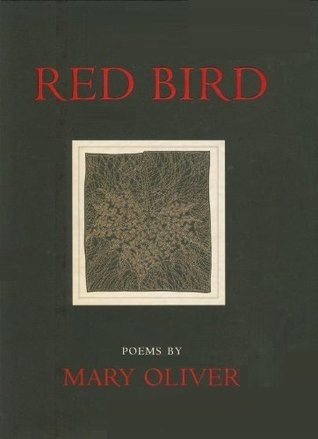
Book cover image for Red Bird by Mary Oliver

Red Bird — Mary Oliver

What can’t an afternoon spent with Mary Oliver fix? I had requested this volume specifically from the library because it’s the book Coyote Sunrise searches for in Coyote, Lost and Found by Dan Gemeinhart, which I read back in August.

The titular red bird opens and closes the collection and pops up throughout, often serving as a go-between for the physical and spiritual world. The collection features Oliver’s signature awe and wonder for the natural world, but there’s an undertone of grief and distress that can be attributed to a number of factors: the loss of Oliver’s long-term partner in 2005, three years before this volume was published, the Iraq war, the melting of the ice caps. To love the natural world as Oliver does is to feel all of its suffering, but also to see God everywhere in its beauty.

I’ll leave you with some of my favorites, because everybody needs a little more poetry in their lives, and because this was my only five-star book of the month for a reason:

  • The poem Coyote seeks is “Mornings at Blackwater,” which made me a little teary remembering the emotional release of encountering it for the first time in Gemeinhart’s novel.
  • Self-Portrait” made me laugh and so charmed me that it inspired this newsletter heading.
  • Love Sorrow” is the kind of poem you keep in your back pocket, to return to in inevitably difficult times.
  • I don’t want to live a small life” is one you may have seen before, a classic Oliver love poem disguised as inspirational nature poem.
  • Oliver wrote a whole series of poems about her dog, Percy. If you pick just one of these poems to read today, let it be this one: “I Ask Percy How I Should Live My Life.”

One more month to go! Historically, I’ve wound down my reading in December so I don’t have to do both a December recap and an EOY bracket, but there is simply too much to read, and it’s still anybody’s game (although On the Calculation of Volume III just might come out swinging).

Time will tell, so stay tuned, and as always, thanks for being here! Grateful for this lil circle of book lovers—you know where to find me if you ever want to chat more about these or any other books.

Until next time, happy reading!
❤ Catherine


Housekeeping note: all book links go to my Bookshop storefront, where each purchase supports independent bookstores (and this newsletter, because I get a small percentage of each sale).

Beneath every history, another history

Lit Chat Vol. 31 — October in Review

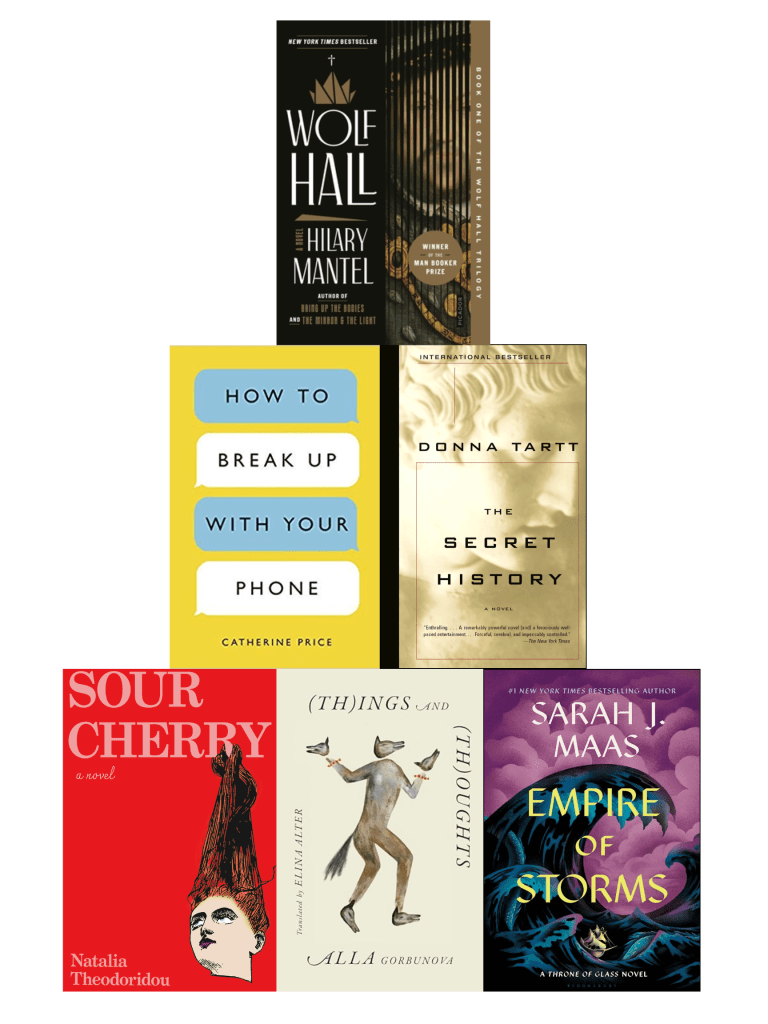
Pyramid of book cover images. On the bottom: Sour Cherry by Natalia Theodoridou, (Th)ings and (Th)oughts by Alla Gorbunova, and Empire of Storms by Sarah J. Maas; In the middle: How to Break Up with Your Phone by Catherine Price and The Secret History by Donna Tartt; On the top, Wolf Hall by Hilary Mantel

Hi friends,

Does anyone else feel like time has been moving suspiciously fast and loose this year? Like I blinked, and suddenly, it’s November.

I’m trying to be really intentional about my reading for the rest of the year, keeping in mind the original reading goals I set for myself, but my library holds keep delivering all at once! This is, unfortunately, the Way of the Library.

I have nine books currently checked out and one on hold to be picked up, which puts me in a bit of a reading pickle, actually. Which highly anticipated new release from six months ago will get to skip the TBR line so it can get returned in time to check out the highly anticipated new release from three months ago?? It’s getting pretty high-stakes over here.

Speaking of high stakes, I’m also starting to think about my Best Books of 2025 bracket, because there have been some absolute bangers in the top spot lately (this month, especially!!!) and I’m excited to see them duke it out.

But before I get too far ahead of myself, let’s get into October’s books! Per usual, if you prefer to get this post delivered right to your inbox, you can subscribe to my Substack here:


THE FOUNDATION:

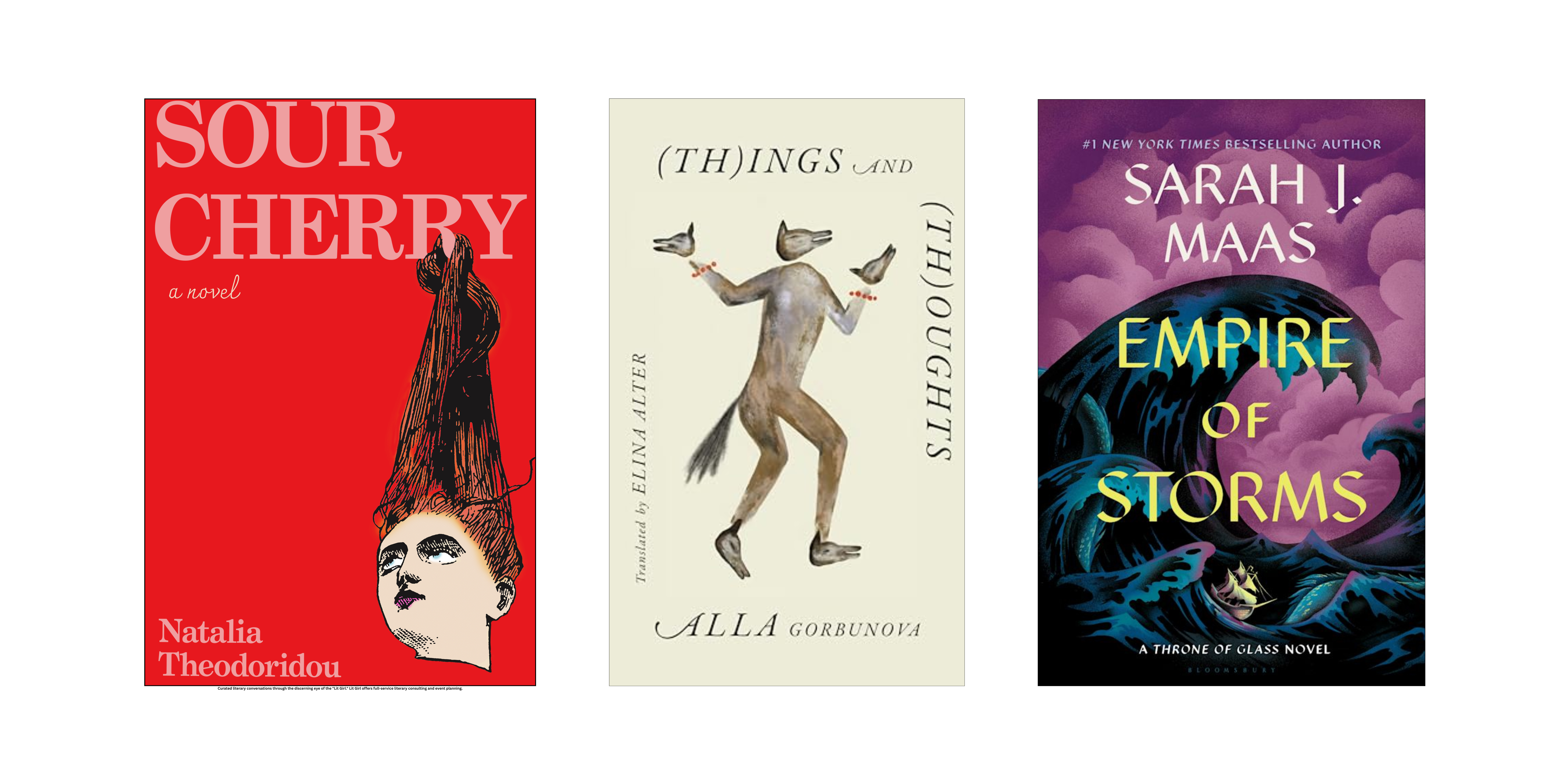
Book cover images for Sour Cherry by Natalia Theodoridou, (Th)ings and (Th)oughts by Alla Gorbunova, and Empire of Storms by Sarah J. Maas

Sour Cherry — Natalia Theodoridou

This one seemed like it would check all my boxes: fairy tales, Gothic mansions, dark curses—yes, please! Sadly, I didn’t feel this book lived up to its potential. It’s essentially a retelling of the Bluebeard fairytale, but in this version, the cursed lord doesn’t kill his wives outright, but leaches life from his surroundings until everything he touches eventually turns to rot. The prose is beautiful and dream-like, but I wanted the story to go deeper beneath the fairytale, to explore more of the characters’ interiority and the mechanics of its world. Instead, it jumps perspective too often to feel settled in one character, and the modern-day narrative throughline felt underdeveloped. I get what it was trying to do in terms of allegorizing toxic masculinity, but it felt like this was at the expense of the actual story. A miss for me, unfortunately!

(Th)ings and (Th)oughts — Alla Gorbunova, tr. Elina Alter

Shoutout to Sarah McEachern for slipping me this galley from the Deep Vellum tent at the Brooklyn Book Festival in September! These absurdist shorts were the perfect kick-off to my month, vignettes that span the weird and the tender and somehow felt both universal and definitively Russian. Often just a few pages long, each short prose piece contains an entire mini universe, filled with bumbling and bewildered characters who search for meaning in religion, nature, train stations, municipal cemeteries, folk tales, and of course, the many frustrations and fulfillments of love. I’ll admit I’m not as well-versed in Russian literature as I am in other literary traditions, but I was reminded of Gogol in the surrealism overlaid onto even the most mundane settings, transforming something as banal as a trip to the gynecologist into a profound and revelatory experience.

Empire of Storms — Sarah J. Maas

That’s right, #5 in the series! These are getting harder to write about without spoilers. However! I’ll say that what I enjoyed most from this installment was seeing all the different characters’ storylines finally intersect as Aelin begins to consolidate her allies, and I’m always just as surprised and delighted as the rest of her team to discover how her scheming ultimately pays off. I’m also perpetually interested in the mechanics of power in fiction (both magical and political/interpersonal), so the chess game that is building an army, fighting battles, and strategizing for a war is something that’s keeping and holding my interest in these later books. Onwards, to book #6, I guess!


SOLID SUPPORTS:

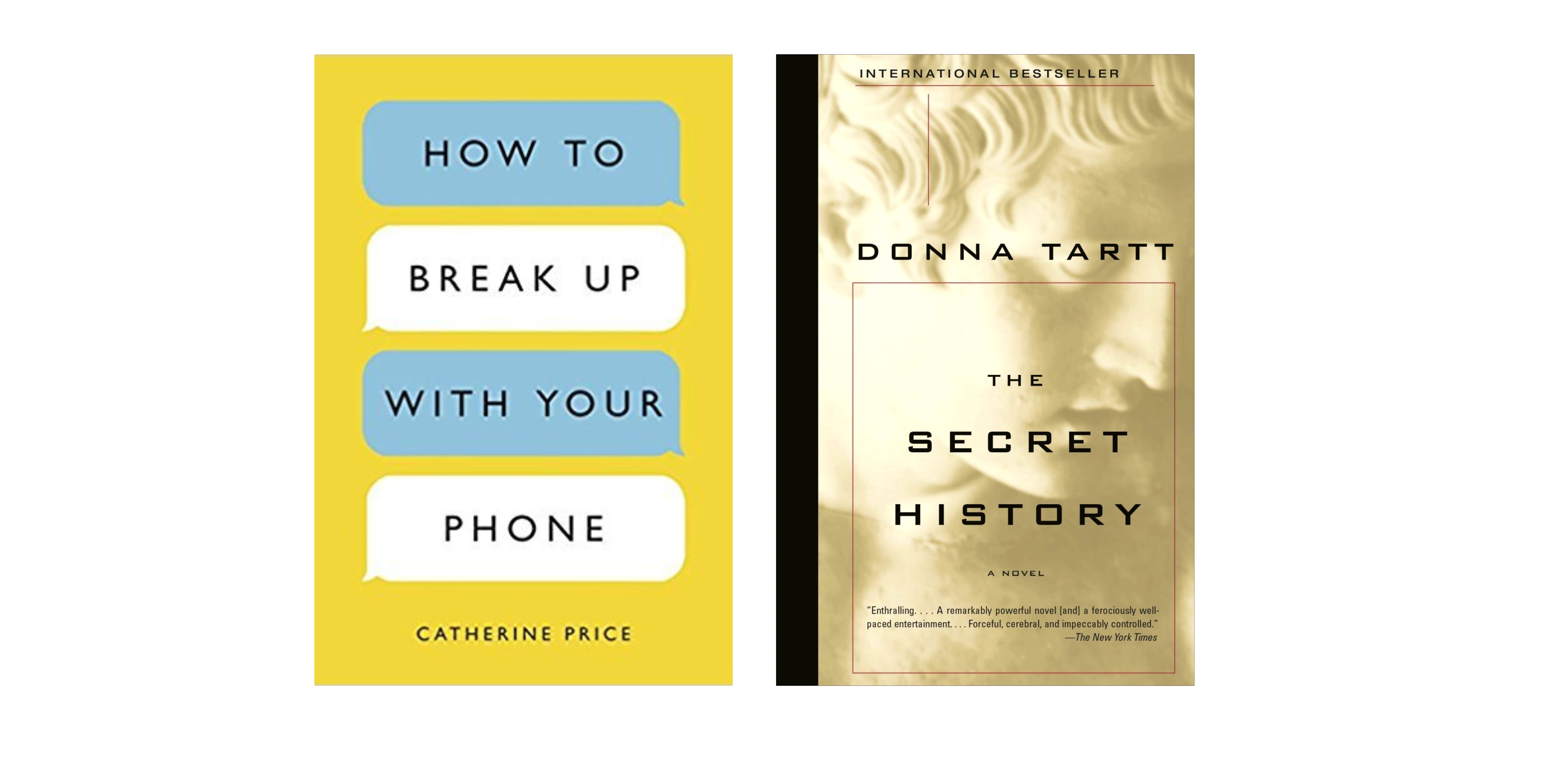
Book cover images for How to Break Up with Your Phone by Catherine Price and The Secret History by Donna Tartt

How to Break Up with Your Phone — Catherine Price

If you’ve seen me in the past month, then you’ve probably already heard me preach about this book and/or my journey to be on my phone less (and likely more than once, sorry!). Spoiler alert: we’re all addicted to our phones. Like, clinically. And it’s not okay! We’ve normalized it because we’re all doing the same thing, but if we swapped our phones out for cigarettes or alcohol in terms of our obsessive usage and the anxiety we feel around having/not having them, it’d be pretty obvious that we all have a problem.

This book does an incredible job of first opening our eyes to the fact that our time and attention are being intentionally manipulated away from us and sold to the highest bidder (aka advertisers on social media), then provides an accessible, mindfulness-based 30-day plan for reclaiming our time/memories/attention spans/lives in general. If you (like me!) are noticing a spike in tiredness, boredom, or general dissatisfaction—especially with the recent time change—or if you often catch yourself thinking you could do so much more with your day if you only had a couple extra hours: put down your phone. That’s where your extra time is. Read this book and take back your life!!!

The Secret History — Donna Tartt

This was such a funny reading experience for two main reasons. The first is that I listened to this on audio, narrated by Donna Tartt herself, and was shocked to discover that she has a little southern twang! This unfortunately meant that her voice for Bunny veered dangerously into Bugs Bunny territory, which I wasn’t sure I was going to be able to get used to, but now I can’t separate Donna’s dulcet tones from the internal monologue of Richard Papin.

The second reason this was funny is that this was technically a re-read. I first read this book in high school (on a recommendation from Kate, if I recall correctly!), but I remembered almost nothing except Bunny’s death and the bacchanal (not spoilers, trust me). The things my impressionable young brain held onto!

Reading this as an adult is a comparatively wild experience. I remember thinking the college-aged characters were such glamorous adults when I read this as a teenager, with their seemingly extensive knowledge of ancient Greek and casual alcoholism. As an adult, you realize that even the most intelligent and collected of them is just a kid in over his head. This book is an absolute master class in atmosphere and tension, and there’s something weirdly nostalgic about the pre-Internet of it all. You simply can’t kill your friends and get away with it like you used to, these days!


THE TIPPY TOP:

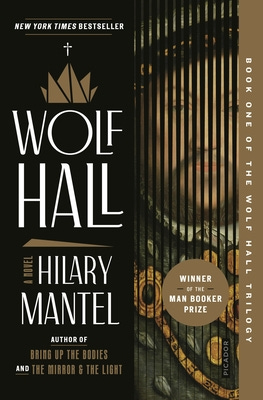
Book cover image for Wolf Hall by Hilary Mantel

Wolf Hall — Hilary Mantel

Who would have expected that my second obsession this month (next to reducing my screen time) would be the court of Henry VIII? Actually, this is likely not a surprise to anyone who knows me. I’ve been obsessed with this kind of fictional biography deep-dive, and this era in particular, since reading Margaret George’s Autobiography of Henry VIII back in high school. Returning to the Tudor court via the eyes of Thomas Cromwell was exactly what my newfound attention span was begging for.

I mentioned earlier that I’m interested in fictional explorations of power, and what better example than this book? Thomas Cromwell, the son of an abusive blacksmith, rises through the ranks of Henry VIII’s court by spreading influence throughout Europe and cultivating a network of allies and informers until he is one of the king’s most trusted advisors. He is personally responsible for many of the machinations that ultimately enable Henry to divorce Katherine of Aragon, proclaim himself head of the Church of England, and put Anne Boleyn on the throne. And that’s just book one.

I’m grateful I read this book when I did, at a time when I was putting special emphasis on retraining my brain and my attention span, because there’s a quietness and a delicacy to the language that requires you to slow down and let it all soak in. Mantel brings these notorious characters to life with such gorgeous intimacy and interiority, while at the same time fostering an atmosphere of intrigue that makes one of history’s oldest and most famous stories feel like a truly novel page turner. This is definitely going to be another contender for my top book of the year, and I can’t wait to read the rest of the trilogy.


And that’s October done! What are you trying to squeeze in before the year’s over? Personally, I will be going home to binge Patricia Lockwood’s (overdue from the library) Will There Ever Be Another You so I can return it this weekend and check out R.F. Kuang’s Katabasis, which also came in this week.

The end is in sight, folks! And there’s still so much reading time left. As always, thanks for being here, and until next time, happy reading!

❤ Catherine


Housekeeping note: all book links go to my Bookshop storefront, where each purchase supports independent bookstores (and this newsletter, because I get a small percentage of each sale).
Talking is existing

Lit Chat Vol. 30 — September in Review

pyramid of book cover images with Hurricane Season by Fernanda Melchor, The Time of the Novel by Lara Mimosa Montes, and The Funeral Party by Ludmila Ulitskaya on the bottom; Queen of Shadows by Sarah J. Maas and On the Calculation of Volume II in the middle; I Who Have Never Known Men by Jacqueline Harpman on the top

Hi friends,

October already! I love this time of year because I feel like I fall back in love with reading every fall. Part of it, this year, is that I’m on a journey to drastically reduce my screen time, which I’ll talk more about next month when that journey is complete. But part of it has also been embracing the slowdown of the year by indulging in books and genres I already know I’m going to like.

I was overjoyed to hear at yesterday’s Reading Club that nearly half of the other attendees were feeling the same way, having finally broken out of their reading ruts by leaning into books that were just fun. By reconnecting with genres that were childhood favorites, diving into weird and campy series, or settling in for a couple of excellent page-turners, my friends were finally excited about reading again. Truly nothing makes me happier!!

If you’d like to check out some of the rut-busting books that were shared, I’ve put them in a Bookshop list here:

My reading advice for you today: lean into what you love. Don’t stress about whether it’s lowbrow or uncool. If it gets you off your phone and out of a rut, pick up that YA fantasy or pulpy detective novel and let yourself enjoy it. There’s no bad way to be a reader.

Okay, now that I’ve told you about what my friends have been reading, it’s my turn!! I read a bunch of bangers in September, and 4/6 of them were translations, which seems to be the unintentional theme of this reading year. If you’d like to read this post on Substack, you can do so here:

Otherwise, if you’re sticking around here, buckle up and let’s get this show on the road.


THE FOUNDATION:

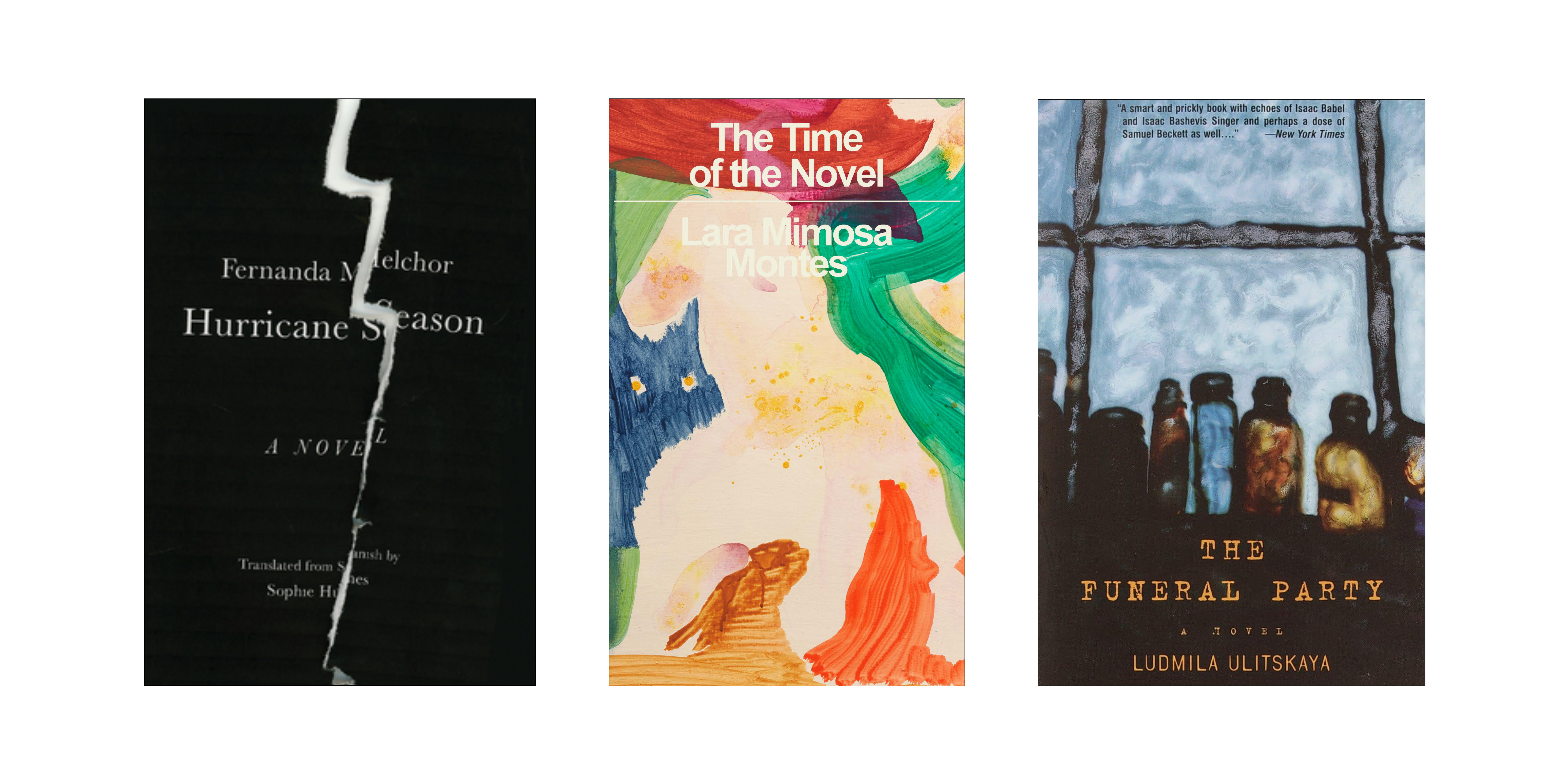
Book cover images for Hurricane Season by Fernanda Melchor, The Time of the Novel by Lara Mimosa Montes, and The Funeral Party by Ludmila Ulitskaya

Hurricane Season — Fernanda Melchor, tr. Sophie Hughes

What I’m enjoying most about my office’s translation book club is how it prompts me to read books I never would have picked up on my own. This book opens in a small, rural Mexican town, with the discovery of the town “witch” dead in a local river. Each of the following chapters is narrated by a different community member, but they all revolve around the witch, her influence on the town, and the circumstances of her death. There’s quite a bit more physical and sexual violence than I usually prefer, so this definitely isn’t a book I’d recommend to everyone, but it inspired a thoughtful conversation about how fear and power are so often inextricably linked with gender and social norms. Translated from the Spanish, the prose is vivid and immediate, with long yet momentous sentences that capture your attention and drop you right into the headspace of its characters, making it almost impossible to look away.

The Time of the Novel — Lara Mimosa Montes

I picked this one up at Greenlight Bookstore’s kick-off party to the Brooklyn Book Festival because I simply can’t say no to a slim volume with a colorful cover! At just 88 pages, this funky little novella captures the narrator’s attempt to become just that: the narrator of the story. She quits her job and sublets a temporary apartment in an attempt to remove herself from the world and focus on translating her experiences into narration. A little meta, a little self-indulgent, this would make a great gift for any writers in your life looking to hit their Goodreads goal before the end of the year!

The Funeral Party — Ludmila Ulitskaya, tr. Cathy Porter

I have to confess: for the first time I think ever, I forgot a book in last month’s newsletter! This was actually the August pick for my office book club, and I think because I read it on a plane and then returned it to the library early in the month, it slipped my mind. This forgetfulness is not at all reflective of how much I enjoyed this book, though. Set in a sweltering Manhattan apartment in the middle of summer, the book chronicles the last few days of a dying artist’s life, in which his friends and lovers (all mostly Russian émigrés) have gathered to keep vigil. The eccentric cast of characters is the main delight of this novel, as they range from the angsty to the absurd, united despite their differences by their love for the artist. It’s a moving portrait of immigrant community and an intimate snapshot of 1990s New York, and it handles heady questions of faith and identity with humor and generosity.


SOLID SUPPORTS:

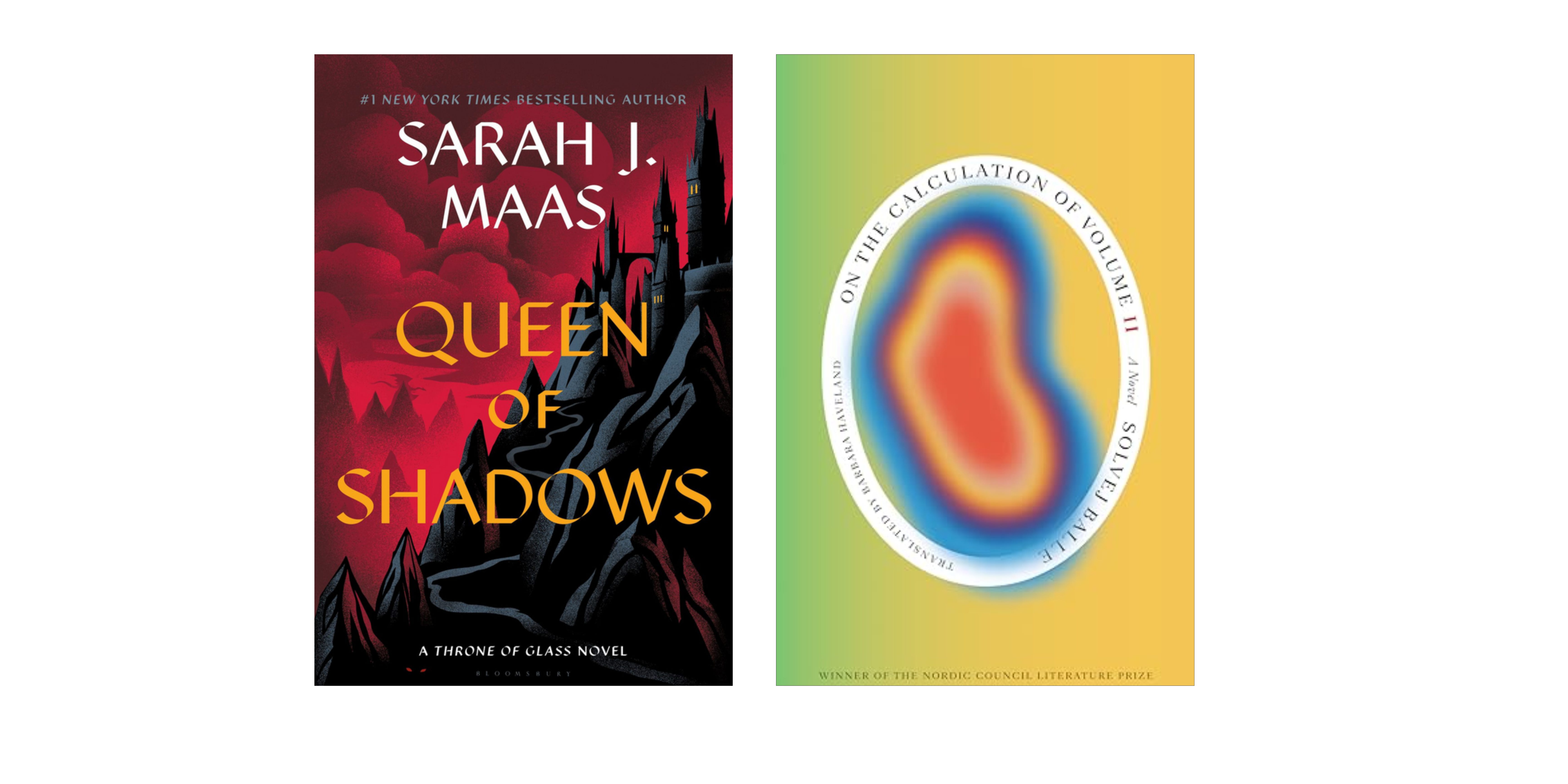
Book cover images for Queen of Shadows by Sarah J. Maas and On the Calculation of Volume II by Solvej Balle

Queen of Shadows — Sarah J. Maas

I am positively cruising through this series despite the fact that each book seems to be 100 pages longer than the last. They’re technically YA, so it’s fast-paced and easy reading, but also kind of the perfect escapism for these times? Idk, something about the combination of magic, friendship, hot people, and good old-fashioned scheming to take down a big bad villain is really speaking to me right now.

This is book #4 out of 7, so no spoilers, but the deeper we get, the more invested I am in seeing how all the different storylines intersect in the battle for the soul of Erilea. Highlights from this installment include the introduction of new allies and a satisfying series of emotionally charged rescues, reunions, and revenge plots. I’m now committed to finishing the series by the end of the year and am most looking forward to seeing more of the continent beyond Rifthold and Morath in the volumes to come!

On the Calculation of Volume II — Solvej Balle, tr. Barbara Haveland

It was a real fight between this book and the next one for the top spot this month, because both are books that I have consistently been unable to stop thinking about. *Mild spoilers ahead!*

This second volume picks up right where the first left off—still on November 18th. The narrator’s belief that time will reset after a full year of November 18ths has been proven false, so she embarks on a journey to fashion her own year by traveling in pursuit of different seasons.

I really loved the way this book tested both the boundaries of the world as we have come to understand them, as well as our own perceptions of time and seasonality as markers of change and novelty in our own (assumedly still changing) worlds. More often than not, this only created more questions to be answered in future volumes, which I am so deeply here for. I’m obsessed with how complex and far-reaching the implications of this simple idea of a single repeating day have turned out to be, and am truly on the edge of my seat for the next volume to be published on—you guessed it—November 18th, 2025.


THE TIPPY TOP:

Book cover image for I Who Have Never Known Men by Jacqueline Harpman

I Who Have Never Known Men — Jacqueline Harpman, tr. Ros Schwartz

Everyone and their mother seemed to be reading this book this summer, so I snagged it from Daunt Books when I was in London last month and bumped it to the top of my list. In the new 2025 afterword by Nick Skidmore, Publishing Director of Vintage Classics, this book is described as The Handmaid’s Tale meets The Road. I think this perfectly encapsulates the specific brand of dystopian haunting this book manages to effect, and explains why it’s now particularly appealing to contemporary readers thirty years after its original French publication.

The teenage narrator of the book does not remember life outside of the underground cage she shares with forty other women, defined by the constant supervision of male guards who dictate their daily routines and interactions. When the guards one day disappear and the women find themselves suddenly and inexplicably freed, they ascend to discover a barren landscape unlike any country any of them can remember.

The journey that follows is one of tragic discovery that produces no real answers to any of the women’s (or the reader’s) questions about where they are or why they’re there. The narrator, having never known any other life, serves as a fascinating yet horrifying foil to the taken-for-granted simplicity of our normal lives, calling into question everything that we have come to accept as truth about love and purpose, the power of community, and the meaning of legacy in an uninhabited world. I know I say this a lot, but this is a book that I genuinely don’t think I will ever be able to stop thinking about, and will probably be up there for one of the best of the year.


And that’s a wrap on our first leg of fall books! I don’t know about you, but October is where my seasonal reading truly begins to shine. So far, I have The Secret History queued up on audio, and I’ve also pulled Wolf Hall off our bookshelf, inspired by my recent visit to Hilary Mantel’s alma mater, The University of Sheffield. I’m in the market for one good (not too scary!) thriller/horror book to round out the month, and then I think I’ll be satisfied.

What’s on your October reading docket? Anything spooky? Let me know what’s on your TBR in the comments below or in any of the usual places—I’m always down to chat!

Until next time, happy reading!
❤ Catherine


Housekeeping note: all book links go to my Bookshop storefront, where each purchase supports independent bookstores (and this newsletter, because I get a small percentage of each sale).
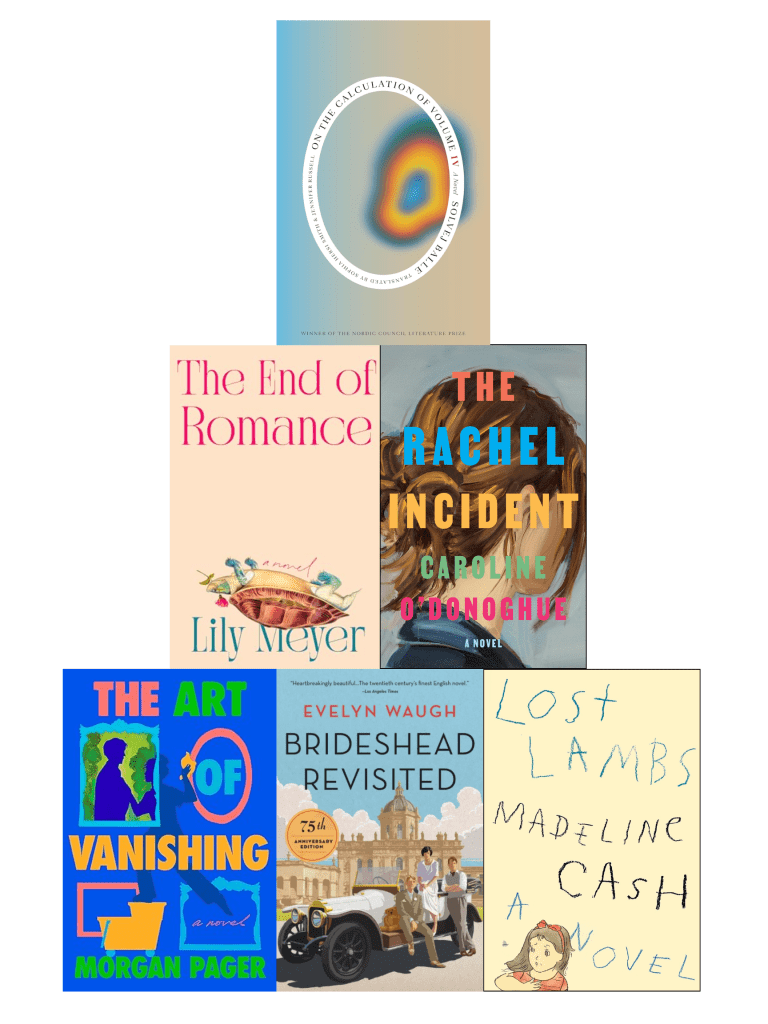
Always try to keep a patch of sky above your life

Lit Chat Vol. 29 — August in Review
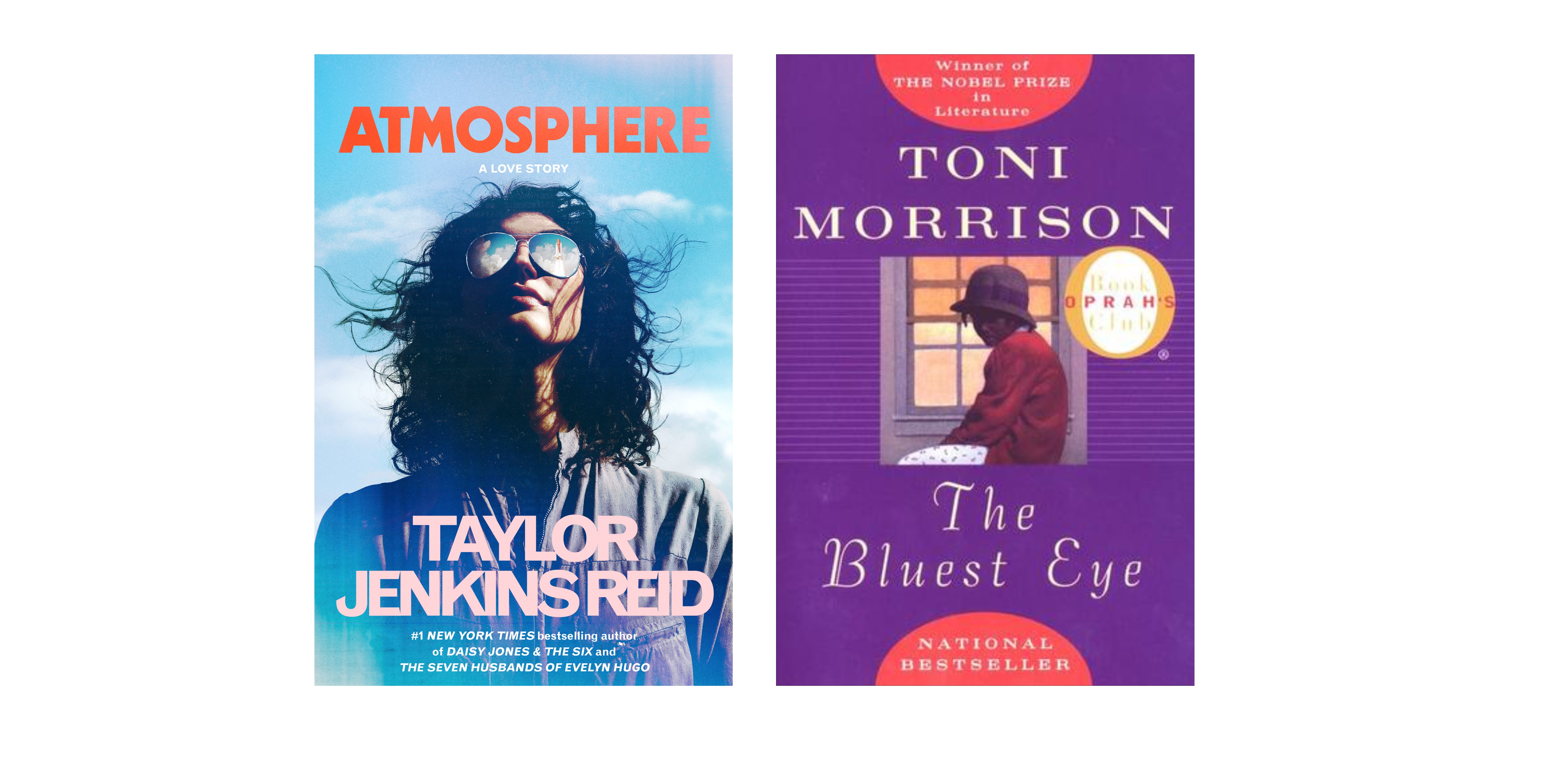
Pyramid of book cover images with Heir of Fire by Sarah J. Maas, Tenth of December by George Saunders, and Coyote Lost and Found by Dan Gemeinhart on the bottom; The Mobius Book by Catherine Lacey and On the Calculation of Volume I by Solvej Balle in the middle; and Swann's Way by Marcel Proust on top.

Hi friends,

I have good news and bad news. The bad news is: this newsletter officially marks the end of summer reading time.

I know, I know, technically we still have another week, I’m over it. Here’s where the good news comes in: I hereby declare it officially Back to School/Cozy Fall reading season! Put on a scarf and re-read The Secret History on a park bench to celebrate.

But before I get too far ahead of myself seasonally, I do have one more month of summer reads left to share. I’m not sure my summer brain is less discerning than usual, but I gave every book in this newsletter four stars on Goodreads. Some probably could have been half stars if Goodreads had that option, but since they don’t, this pyramid is organized purely on vibes and a little bit of recency effect.

I’d love to hear if you had any favorite summer reads or surprise highlights of the season, or if there’s anything in particular that’s on your TBR as the weather starts to cool down and the era of cozy reading is almost upon us. Let me know!

And of course, if you’d rather get this in an email straight to your inbox, you can subscribe to my Substack here:


THE FOUNDATION:

Book covers for Heir of Fire by Sarah J. Maas, Tenth of December by George Saunders, and Coyote Lost and Found by Dan Gemeinhart

Heir of Fire — Sarah J. Maas

Another Throne of Glass book! Not much to say about this one without spoilers, except for the fact that this was the first one that I listened to as an audiobook, and I enjoyed that experience more than I thought I would. It’s also the first book in the series to jump around with POVs beyond just those immediately involved in Celaena’s story, expanding the world to include concurrent storylines from other characters and continents, new and old. Consider this my formal request for Libby to add the fourth audiobook to their catalog (please)!!!

Tenth of December — George Saunders

George Saunders, certified weirdo and probable genius, is a master of the short story. There’s a conversation with David Sedaris included at the end of the book, in which Saunders talks about how he likes to push his characters to their breaking points. This can sometimes make the stories seem cruel, but it’s this cruelty that forces his characters into a crisis, triggering the intrigue and emotional complexity that we expect from Saunders.

You can trace this strategy through each of the stories in this collection, which all live somewhere on a sliding scale of bizarreness: whether it’s the teen boy deciding to intervene in an assault on his neighbor in “Victory Lap,” or the learned desensitization in the world of “Semplica Girl,” which is a story that still haunts me. Even in the strangest, most dystopian settings, Saunders’ characters hold up a mirror to our most mundane and authentically human motivations and desires.

Coyote Lost and Found — Dan Gemeinhart

The first book featuring this character, The Remarkable Journey of Coyote Sunrise, was one of my favorite middle-grade titles to hand-sell when I worked at Books of Wonder in 2019. This sequel sees the return of Coyote, her dad Rodeo, and Yager, the outfitted school bus they lived in for the six years following the accidental death of Coyote’s mom and two sisters. This time, we’re on the road again in search of a lost book that contains a final message from Coyote’s mother.

Gemeinhart manages to infuse these quirky characters with so much heart it actually hurts—the first book made me ugly cry, so at least I was prepared for it this time around. It also handles the pandemic in a way that feels natural and respectful while also portraying the dangers and frustrations of the time in a way that young readers can process and understand, regardless of whether they remember it first-hand. (How wild that we now live in a world where kids may not remember Covid? Oh, to be so lucky.)


SOLID SUPPORTS:

The Möbius Book — Catherine Lacey

A new weird-ass book from Catherine Lacey, thank god! The Möbius Book is a hybrid memoir/fiction experiment, and I didn’t fully understand the title until I finished both halves and realized that you could continue going back and forth between the two sides and discovering new ways that each has seeped into the other, likely indefinitely.

It’s a captivating look at the author’s loss of a relationship and her struggle to rebalance her world and her other relationships in its wake, and these themes of grief, loss, and identity pop up in sneaky ways in the accompanying work of fiction. It’s obvious which section is which, but they’re not marked. The front and back of the book appear exactly the same; you just have to pick a side and start reading. There’s no wrong way to read this book—you’ll find yourself returning to the beginning again no matter where you start.

On the Calculation of Volume I — Solvej Balle, tr. Barbara Haveland

I read most of this book on the train from London to Sheffield for a conference, complimentary tea and biscuits at hand, which was an elite reading experience!!

Hand holding a paperback book open next to a paper cup of tea and packet of shortbread biscuits. Travel bag and train car in the background.
this one goes out to the East Midlands Railway

How engrossing can a novel about a woman reliving the same day over and over again really be? The answer is: VERY. I could not stop thinking about this book once I’d started, and finished it within 24 hours.

The premise is basic: a woman wakes up to the same calendar day every day for a year. The same events happen around her each day, but she seems to be the only one who remembers them. I don’t want to say too much and spoil anything because it’s such a short book and I think most of the wonder comes from truly not knowing what to expect, BUT! I can say that I found the protagonist’s exploration of her new reality and its limitations and opportunities completely engrossing. This is the first of SEVEN volumes, and the third will be released in English in November. I can’t wait to see how this world can possibly continue expanding.

Swann’s Way — Marcel Proust, tr. C.K. Scott Moncrieff and Terence Kilmartin, revised by D.J. Enright

Blue hardcover of Marcel Proust's Swann's Way in the middle of a white table, surrounded by half-full drink glasses
from our lovely halfway point chat a few weeks ago!

As you may be aware, I’ve been reading Proust this summer along with a few brave friends and documenting it on Substack! Over the course of eight(ish) weeks, we read Swann’s Way, the first volume of In Search of Lost Time—which is no small feat when you look at how long the paragraphs are.

While the writing style certainly took some getting used to (that man never met a comma he didn’t love), I found myself genuinely enjoying disappearing first into the world of his family’s country home in Combray, and then into Belle Époque Paris. Although the plots (if you can call them that) of each section could not have been more different, similar themes of time, memory, and love were easily trackable through each storyline. Its social commentary was so much funnier than I expected, and taking the time to turn my former English major brain on each week to do a little analysis was deeply refreshing. Getting to talk about it with friends and discover new layers to the text together has been even better!

Though this maybe wasn’t the most “fun” read I had this summer, it’s the one I’m most proud of, and therefore deserves the top spot. Finishing this book and keeping up with the weekly updates felt like a true achievement, and while I definitely need a break before trying my hand at any future volumes, at least now I know that I’m absolutely up to the task.


Summer reading, you were fun! I’m now very excited to lean into the dark academia vibes for fall: I honestly might do a Secret History re-read, and I’m also hoping to get my hands on R.F. Kuang’s newest, Katabasis. Plus, V.E. Schwab’s latest, Bury Our Bones in the Midnight Soil, looks deliciously dark and vibey, per usual.

What will you be reading this fall? I want to hear about it! Always down to chat in all the usual places.

Until next time, happy reading!
❤ Catherine


Housekeeping note: all book links go to my Bookshop storefront, where each purchase supports independent bookstores (and this newsletter, because I get a small percentage of each sale).