A long one for your dissociative pleasure

October in Review — Lit Chat Vol. 22
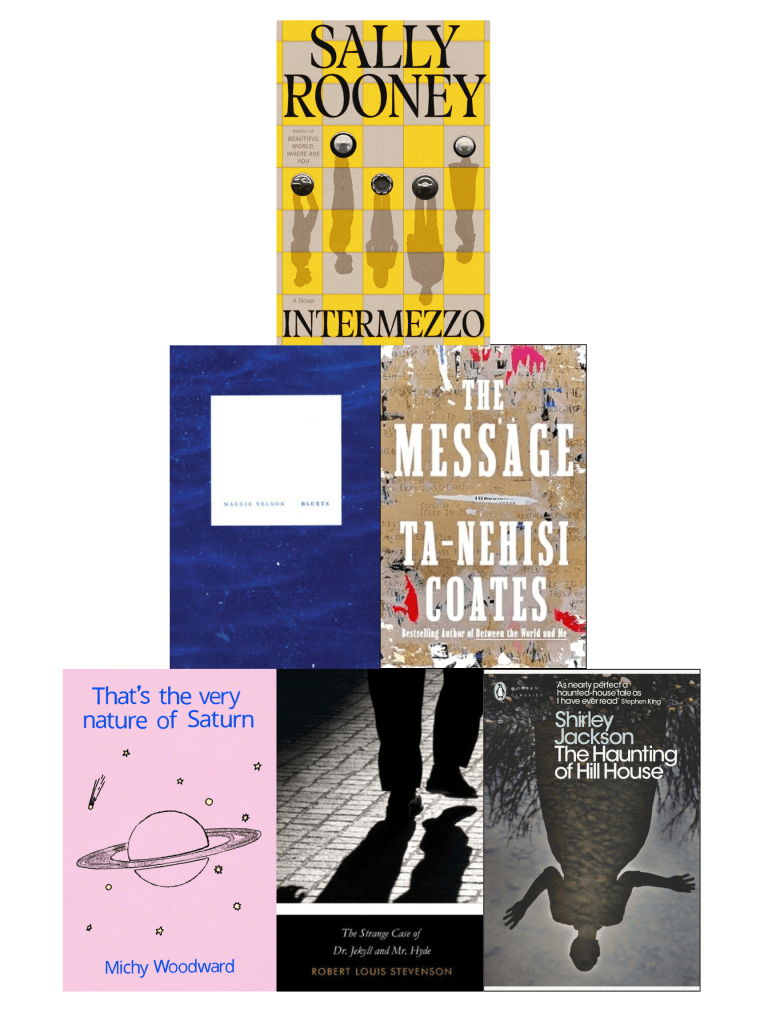
A pyramid of book cover images with Intermezzo by Sally Rooney on top; Bluets by Maggie Nelson and The Message by Ta-Nehisi Coates in the middle; That's the very nature of Saturn by Michy Woodward, The Strange Case of Dr. Jekyll and Mr. Hyde by Robert Louis Stevenson, and The Haunting of Hill House by Shirley Jackson on the bottom.

Hi friends,

The vibes are a little different since the last time we chatted. A little heavier, a little more uncertain. There’s a familiarity to the absurdity of recent events, but it’s not a comfortable one. Personally, I’ve been struggling with an almost preternatural exhaustion. Like because we’ve been here before, my body knows how much anxious/sad/angry energy is about to be expended in the coming weeks/months/years and is trying to stockpile rest in anticipation.

In the meantime, I’ve been finding solace in the wisdom of authors I admire, whose Substacks currently offer a much-needed source of perspective. Alexander Chee and Sarah Thankam Mathews have stood out lately for providing ways to think about what comes next that feel actionable without being overwhelming. Both of them emphasize the importance of focusing in on ourselves and our communities, on the ways we can continue to support and care for those we love and make each other feel safe.

One avenue through which I hope to continue building and supporting my community is the newly formed Reading Club, which met for the first time the weekend before the election and was a smashing success!
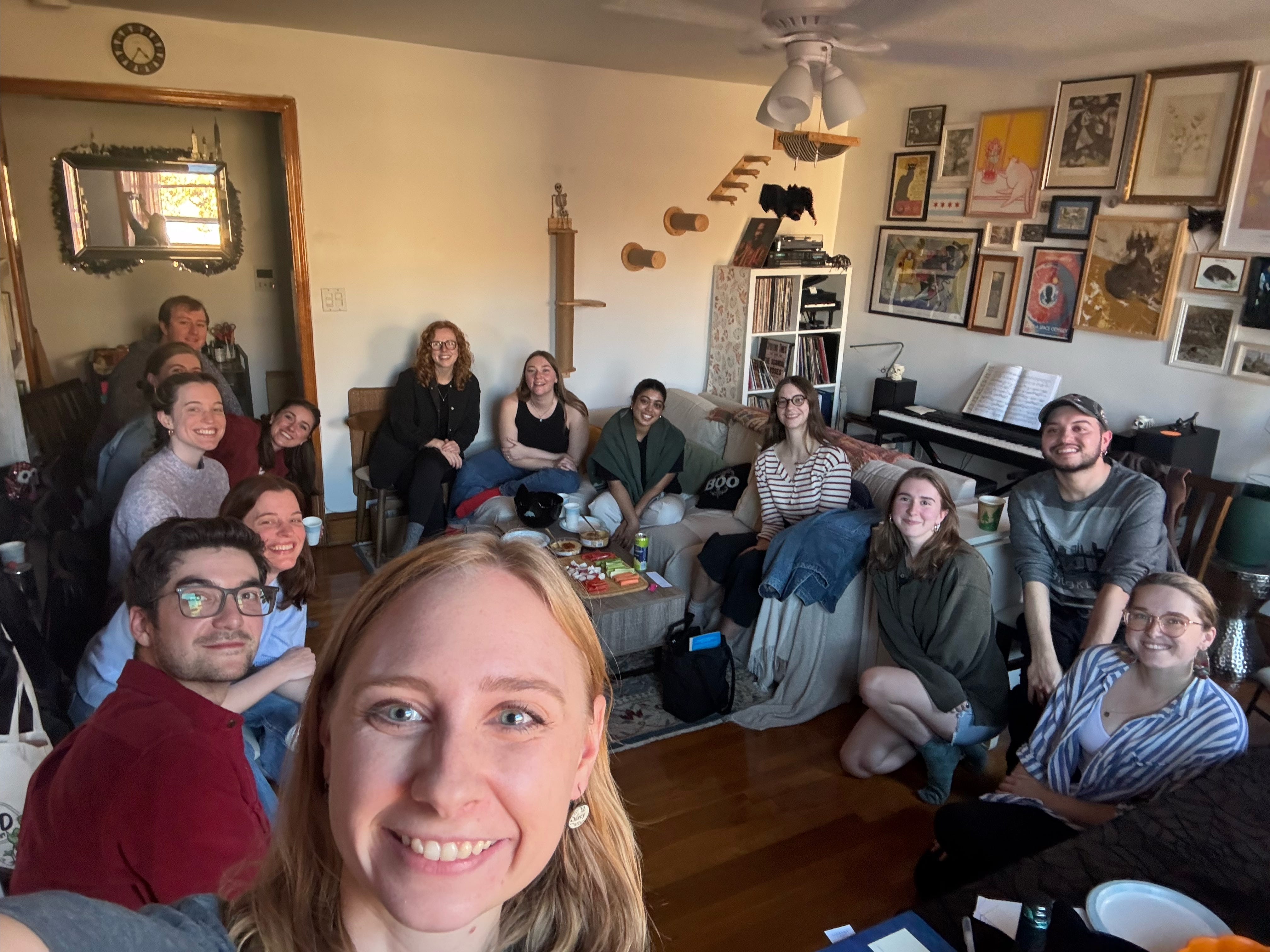
A group of fourteen people sitting in a living room on chairs and couches in a circle, smiling.
look at all these cutie readers!!

A huge thank you to all of the kind, thoughtful, and enthusiastic readers who made this one of the loveliest afternoons I’ve spent in a long time. If you missed last month’s newsletter, Reading Club is a book club where everyone reads whatever book/story/article/poem they want, and then comes prepared to talk about it. In practice, this ranged from Substack articles to poetry collections to sci-fi thrillers, and so much more! If you’d like to see all the books we chatted about, I collected them in a Bookshop list here:

And if you’d like to join us next time, let me know! We’re doing a Holiday Book Swap on December 15th—if you’re local and want the Partiful invite, feel free to text/email me!

But before we get too ahead of ourselves, we still have October to cover. I love reading in October, because I love an excuse to indulge in a couple especially atmospheric reads in honor of spooky season. This October also stands out as being an especially re-read heavy month, as half of the books I read were ones that I had read before. So without further ado, let’s get into it, shall we?

And if you’d like this directly in your inbox, subscribe to Lit Chat on Substack here:


THE FOUNDATION:
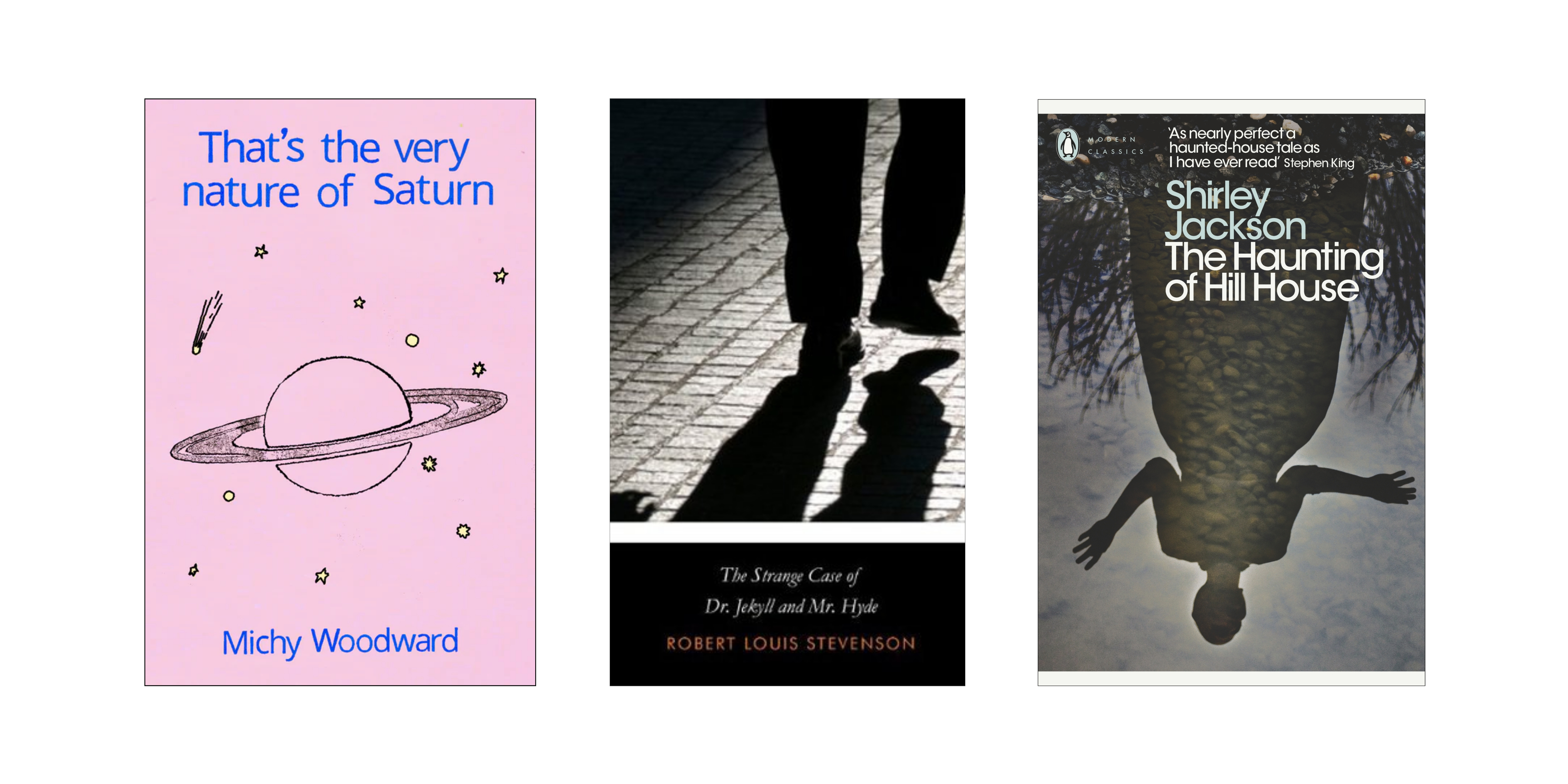
Book cover images for That's the very nature of Saturn by Michy Woodward, The Strange Case of Dr. Jekyll and Mr. Hyde by Robert Louis Stevenson, and The Haunting of Hill House by Shirley Jackson

That’s the very nature of Saturn — Michy Woodward

I’m SO excited to start off this Lit Chat with an incredible accomplishment from my pal Michy: her debut poetry chapbook published by Bottlecap Press! It has been an honor and a delight to witness the evolution of these poems through workshops and readings over the past couple of years, and I am continuously inspired by the tenderness, vulnerability, and gentle humor that ground this collection of poems through a time of personal and cosmic chaos. “We used to be a society,” “hot girls,” and “ode to stupid boys” are perpetual crowd favorites, but I also have a soft spot for the sweet sensuality of “tiger balm” and the heady, heartbreak momentum of “[unrelenting]”. Support your friendly neighborhood poets and buy Michy’s chapbook below!

The Strange Case of Dr. Jekyll and Mr. Hyde — Robert Louis Stevenson

Despite first reading this weirdo novella in the seventh grade, my memory of the story mostly consisted of the Brain’s musical number from a 1998 Arthur episode:
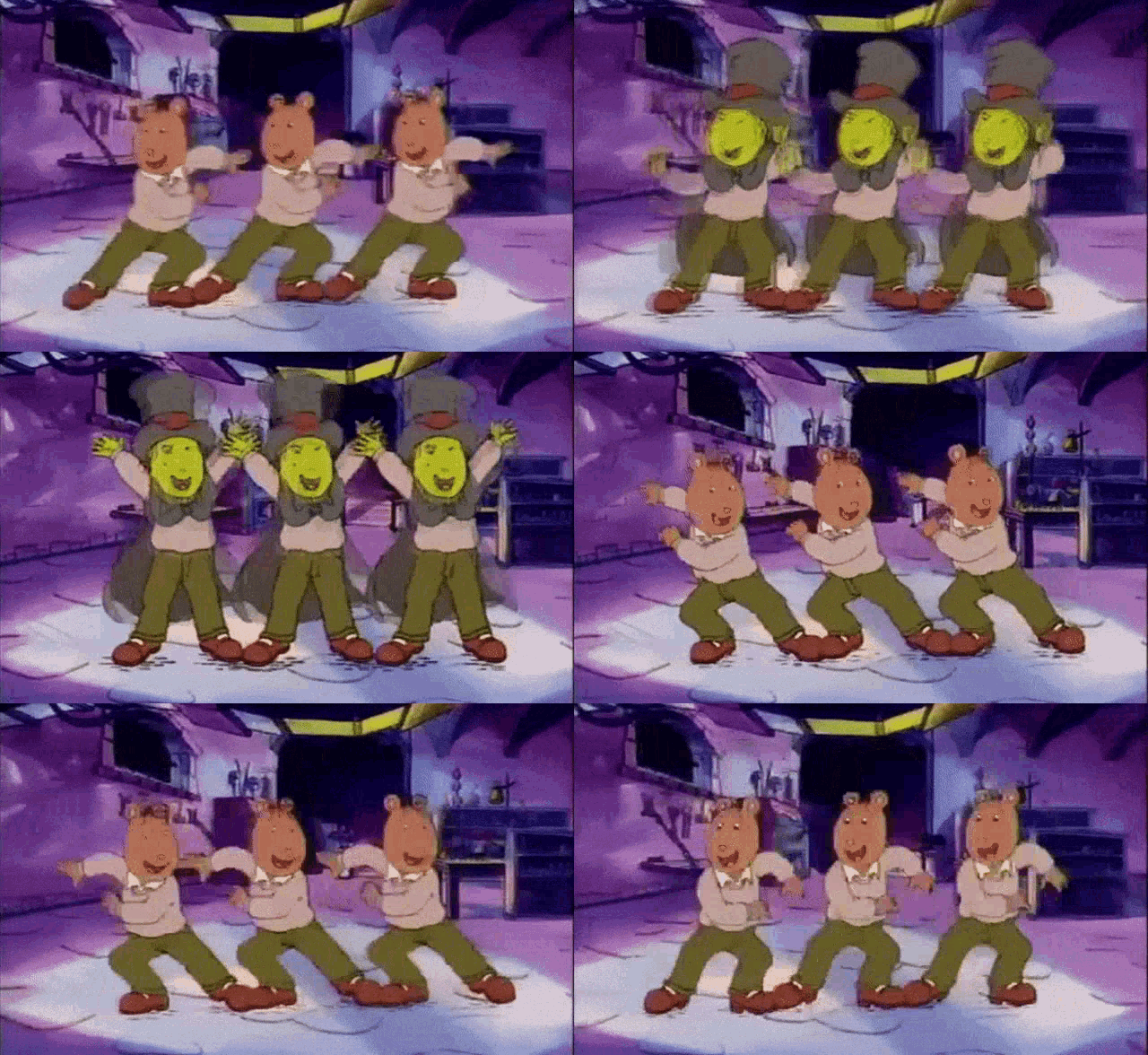
three cartoon characters (the Brain from Arthur) are dancing in a room with a purple background
♫ Jekyll Jekyll HYDE Jekyll HYYYYYYYDE ♫

What I love about reading spooky stories from different historical eras is that they function as a window into the psyche of their contemporary readers. For the Victorians, the complete release from any kind of moral obligation was as terrifying as it was strangely seductive. Dr. Jekyll’s secret desire to maintain his public life of virtue while also guiltlessly indulging his basest desires speaks to the cultural strain of physical and emotional repression, and yet his inability to give up the persona of Mr. Hyde signals a recognition that a certain level of “evil” is an inescapable part of the human experience—one that could take over at any time. I could write a whole AP Lit essay about this, but instead, I think this story is ripe for a modern retelling, preferably with some female characters who aren’t just victims of violence. If anyone decides to write this, please give me a shout-out in your acknowledgements.

The Haunting of Hill House — Shirley Jackson

This is one of my absolute favorite Halloween stories because it combines all of the best tropes: a large old house with a questionable past, a ragtag cast of characters, ghosts(!?), and an unreliable narrator to drive home the ambient unease. Hill House begins as it ends: with an invocation of insanity that dares the reader not to investigate. Our narrator, Eleanor, answers this call with the hopeful naivete of an emotionally stunted young woman who has been so secluded from the reality of adult life that she can’t help romanticizing every element of her new adventure as a paranormal researcher. Things go downhill when Hill House’s spiritual manifestations begin to target Eleanor specifically, calling into question her grip on both her fantasies and her reality. From the house’s unnatural architecture and inexplicable disturbances to Eleanor’s obsessive, one-sided relationships, this book has one of the most unsettling atmospheres and all-encompassing momentums you could ask for during spooky season.


SOLID SUPPORTS:
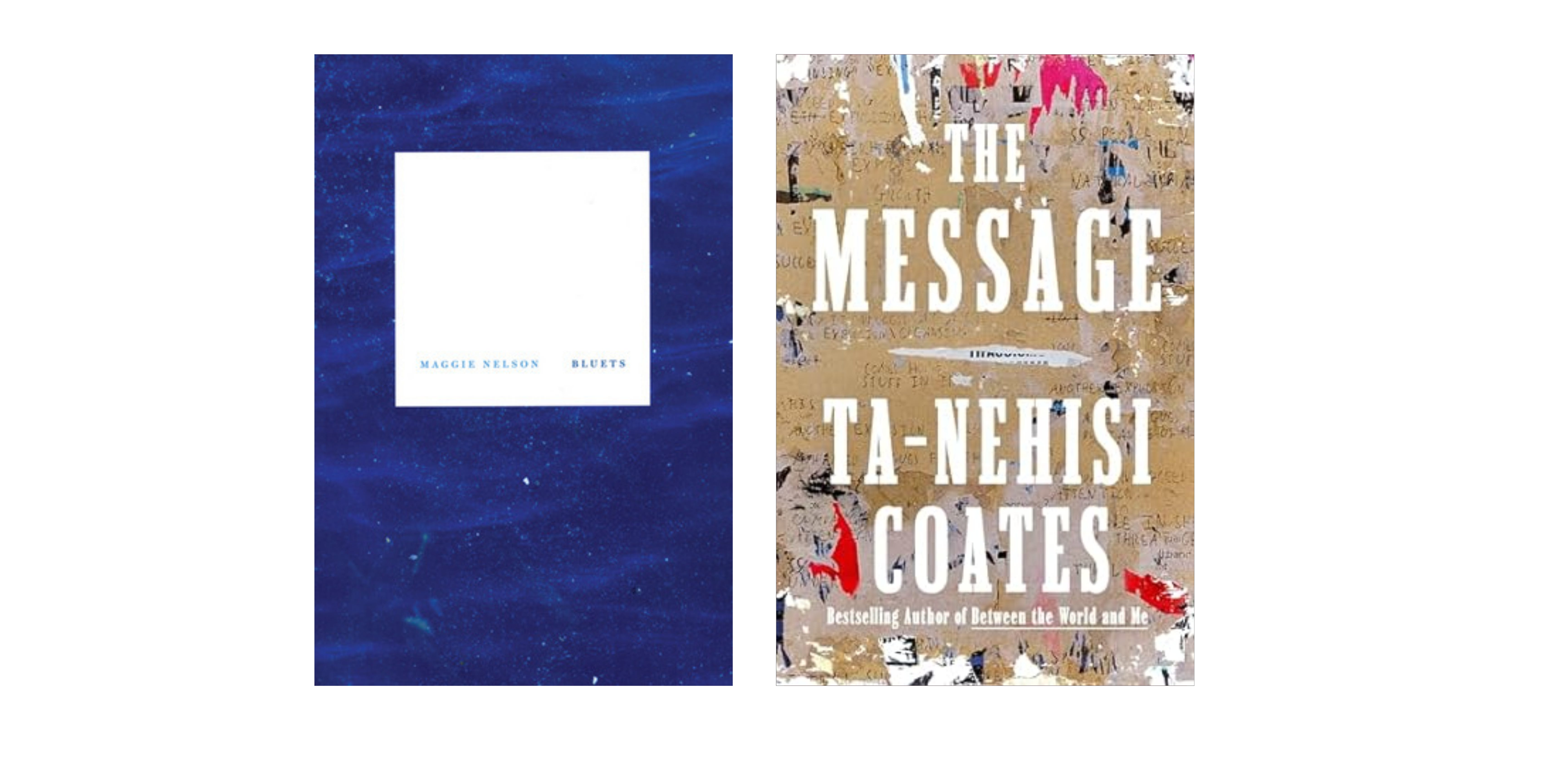
Book cover images for Bluets by Maggie Nelson and The Message by Ta-Nehisi Coates

Bluets — Maggie Nelson

Bluets is another all-time favorite that just felt right to revisit in the days leading up to the election. Told in a series of numbered mini-essays, Bluets is as much an ode to its narrator’s obsessive love for the color blue as it is an exploration of desire and grief after the loss of a major relationship. Nelson uses the color blue as a literal and metaphorical touchstone to ground her and her loved ones through various devastating life changes, analyzing the function of color in art, music, and poetry as a vehicle for translating emotion and assigning meaning to life.

Alternating between a personal and academic lens, Nelson intersperses private musings and anecdotes with supplementary texts across history from Goethe to Wittgenstein to Leonard Cohen, and more. These eclectic entries vary in length, ranging from one sentence to entire pages, but it’s often the shortest ones that are the most likely to knock the wind out of you. This is one you’ll want to have on your bookshelf and return to as needed every couple of years.

The Message — Ta-Nehisi Coates

I listened to this audiobook (narrated by the author, always a treat!) in the last week of the month, which now feels eerily prescient in the wake of the election. The Message is a collection of craft essays centered on how Coates’s experiences and identity as a writer shape his approach to personal, ancestral, and collective history. The longest and final chapter, “The Gigantic Dream,” is one that I found incredibly moving and relevant, as it draws connections between the American and Israeli fights for democracy and the shared pathway both countries have taken for the oppressed to become oppressors themselves under an ugly banner of nationalism.

The parallels Coates depicts between Palestine as an apartheid state under Israeli settler occupation and the American South under the Jim Crow laws are stark and striking. Supported by Coates’s first-hand experience traveling to Israel and the West Bank in May of 2023, the inherent racism and inequality that Coates witnessed serves as a reminder of how frighteningly easy it is for a ruling government to dismiss and punish any group perceived as “other” as second-class citizens. Considering the devastating violence that has escalated in the region since October 7th, and the uncertainty now facing immigrants in our own country, Coates’s words are not just a message, but a warning against the unsustainability of these kinds of structural injustices.

Coates’s 2015 book Between the World and Me is one of the most frequently banned books in the United States. In fact, a whole chapter of The Message is devoted to Coates’s experience traveling to South Carolina in support of a teacher who faced community backlash for including it in her curriculum. Considering the incoming administration’s commitment to both supporting Israel’s genocidal military agenda and banning books that don’t align with their extremist conservative values, I don’t think it’s alarmist to predict that The Message may ultimately face a similar fate. For these reasons, it is more important than ever to read and champion books like these.


THE TIPPY TOP:
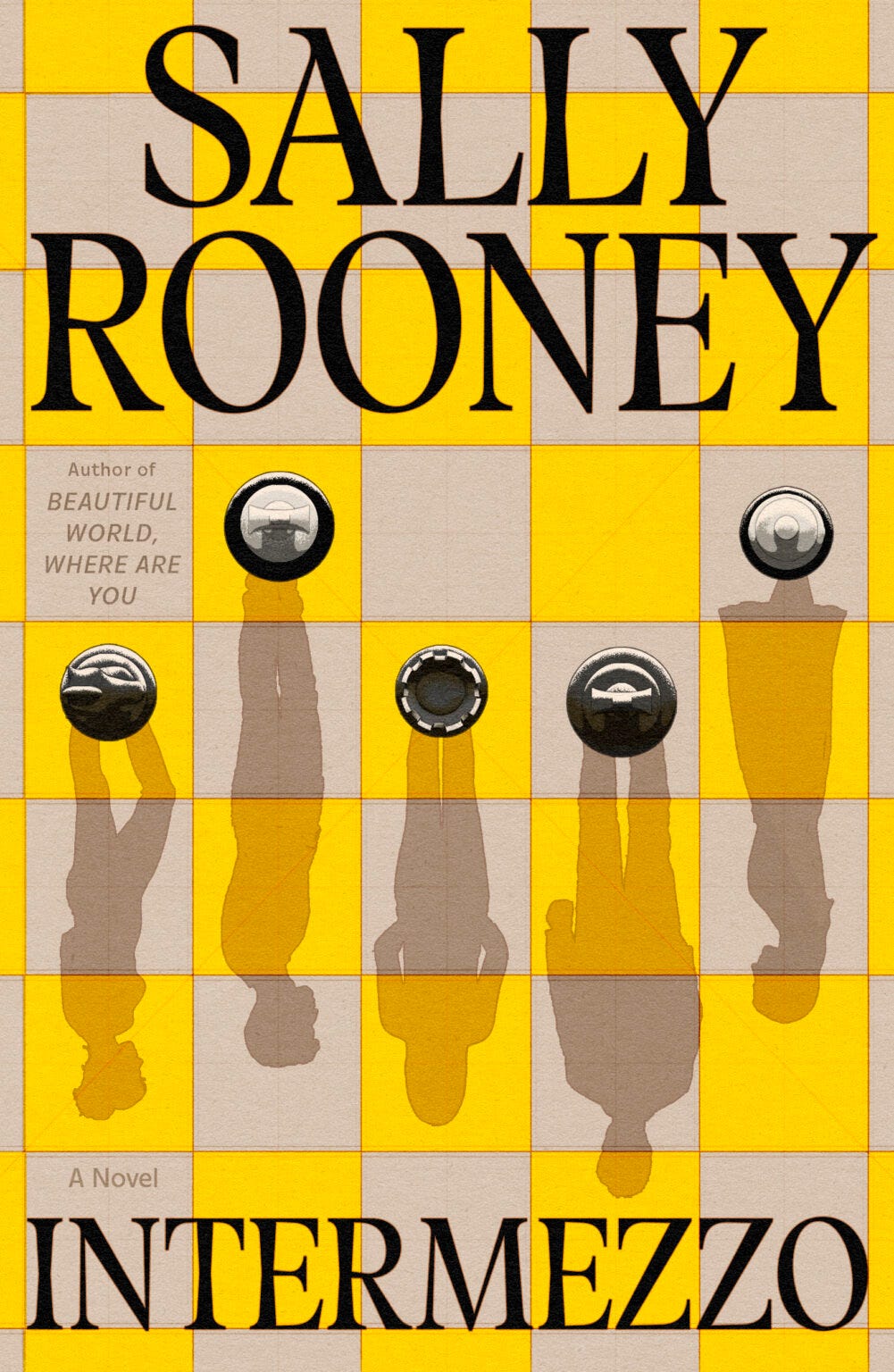
Book cover image for Intermezzo by Sally Rooney

Intermezzo — Sally Rooney

I’m late to the game and I know the internet discourse has largely moved on from Intermezzo, but I was slow to get into it and frankly, once I was in, I really just wanted to take my time. I am very much a Sally Rooney stan (see last month’s Lit Chat for me at Greenlight Bookstore’s midnight release party), but because I didn’t much care for Beautiful World, Where Are You, I was skeptical about diving into Intermezzo in case the trend of disappointment continued. I’m relieved to report it did not!

Intermezzo gets back to what Sally Rooney does best in this story about two brothers grieving the loss of their father. Peter, the older brother, is in his early thirties and dating Naomi, a woman in her early twenties, despite still being in love with his former long-term girlfriend, Sylvia. Ivan, the younger brother, is a 22-year-old former chess prodigy struggling to regain his momentum after pausing competition during his father’s illness. At a local tournament, he meets and falls for Margaret, a divorcée in her mid-thirties.

I liked that each of these relationships felt, if not entirely new in themselves, then at least novel enough to engage with readers’ preconceptions of morality and propriety in love, attraction, and relationships. Sibling relationships are comparatively less common in contemporary fiction, especially ones with an age gap as big as Peter’s and Ivan’s, and I thought Rooney really pulled off the difficulty of seeing past each other’s childhood memories of the other to view each other as adults and equals, and unpacking the frustrations and resentments that come with ultimately leading very different lives outside of the original shared home.

The pure optimism of Margaret and Ivan’s romance is tempered by the very real pressures of how Margaret’s past and the prejudices of her small-town life hinder their ability to publicly embrace their relationship. For both of them, their romance is an opportunity to embrace being selfish for the first time in a long time, as both had been caretakers to some extent in previous familial and romantic relationships.

In contrast, the selfishness that defines Peter, Naomi, and Sylvia’s relationships provides the foundation for most of the main conflict. Peter is in love with both of them, which makes his condescension towards Ivan and Margaret’s relationship hypocritical and needlessly cruel. Naomi is in love with Peter but also manipulating him for his money, their relationship an ongoing battle for dominance and control. Sylvia wields her physical inability to be sexually intimate as a means of both provoking Peter and keeping him at arm’s distance, refusing to absolve him of his suffering while also refusing to let him go.

None of these characters are clear heroes or villains, but equally flawed people whose decisions you may not agree with, but by nature of being in their heads, you fully understand. Rooney’s trademark stream-of-consciousness style allows the reader to intimately experience the emotional journeys raging inside her characters’ heads, for better or worse (some heads definitely make for more pleasant reading than others). This is what Rooney is so good at, and what I’ve loved about her writing ever since reading Conversations With Friends in my early twenties and recognizing my own motivations and mistakes in Frances, even if her circumstances were wildly different from mine. Intermezzo is the same: the circumstances are specific, but the experiences of love, grief, desire, and shame are universal.


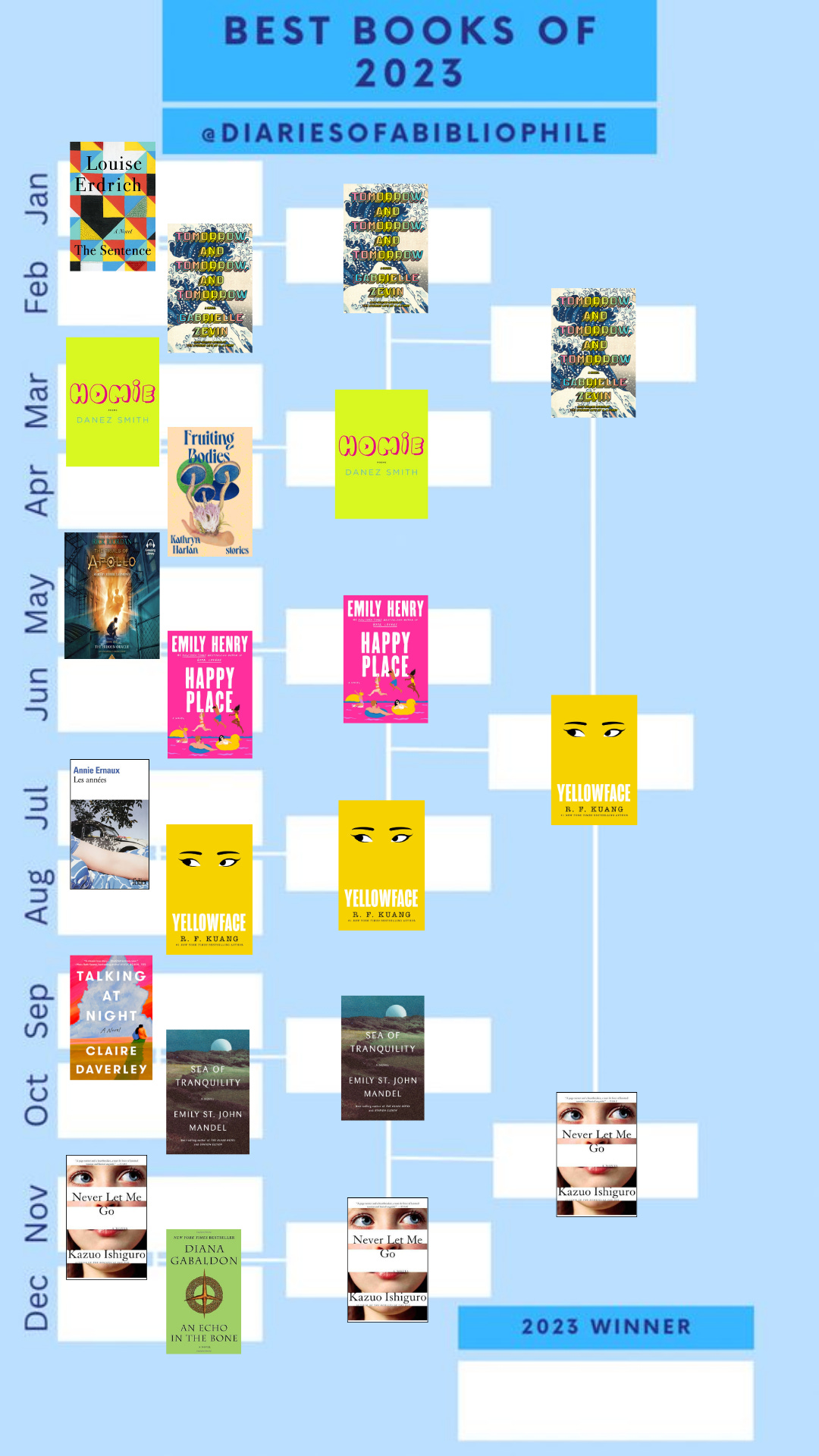
That’s all for now! As it’s already quite late into November, I can report that I’ve definitely been turning more to reading as escapism while also looking for opportunities to refocus and recommit to my writer brain, and I’m excited to tell you about it next month. I’m also already thinking about my end-of-the-year reading bracket, so start placing your bets now!

Until next time, be kind to yourselves, and happy reading.

❤ Catherine


Housekeeping note: all links go to my Bookshop storefront, where each purchase supports independent bookstores (and this newsletter, because I get a small percentage of each sale).
In da (reading) club, we all fam

September in Review — Lit Chat Vol. 21

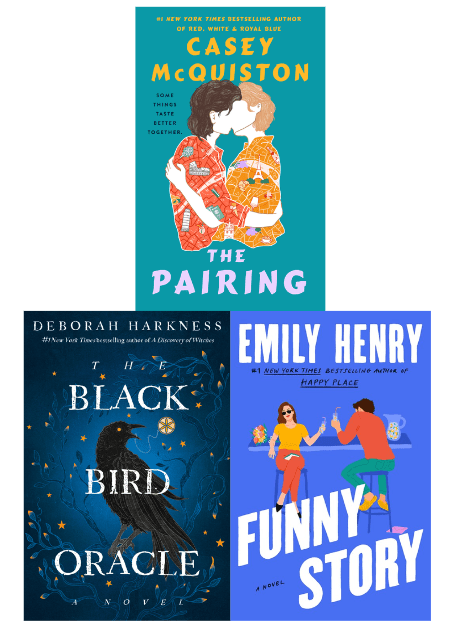
Book cover images for The Pairing by Casey McQuiston, The Black Bird Oracle by Deborah Harkness, and Funny Story by Emily Henry

Hi friends,

Before anyone asks, no I have not finished the new Sally Rooney yet, but I did go to the midnight release party at Greenlight Bookstore and came in third place during Sally Rooney trivia!!

September was a bit of a doozy and I did not get as much reading done as I’d hoped. I considered waiting until next month to check in when I had more to talk about, but then I realized that this month also marks two years of sending these little newsletters out, so I wanted to at least say hi and commemorate that! Two years! Thanks so much for being here.

To celebrate, for my NYC based friends: I am hosting a little reading club/party on November 2nd at 3pm! All are welcome! Everybody just has to come prepared to talk about something they’ve read recently (book, story, poem, essay, article, etc.) , and there will be snacks and drinks. I had first wanted to do this in January and never got around to it, but I’m serious this time and hoping to make it a regular thing in 2025! Consider this a soft launch (ten months late). RSVP here!

For now, though, I have a mini update of three books to chat about, all from favorite authors whose books I will always be excited to pick up. Let’s get into it!


SOLID SUPPORTS:

Book cover images for The Black Bird Oracle by Deborah Harkness, and Funny Story by Emily Henry

The Black Bird Oracle — Deborah Harkness

I was pleasantly surprised to learn that there was a new book in the All Souls series, and even more so to find that it felt more like the beginning of a new series than an end to one! I’ve read or listened to all four of the other books in this series about a modern-day witch who falls in love with a vampire, but it was a pleasure to be back in Diana’s head as she reconnects with her late father’s side of the family. Ravenswood is the perfect magical home to serve as a backdrop for Diana’s journey to finally begin exploring her penchant for higher magic, featuring an enchanted wood, vividly corporeal ghosts, and generations of family secrets brought to light. I look forward to following the rest of Diana’s journey in future books, and I’d recommend the first All Souls book, A Discovery of Witches, for anyone looking for a dark academia/paranormal romance for spooky season!

Funny Story — Emily Henry

My friends are so divided on Emily Henry, which I honestly find fascinating. My feeling is that if you’re into the rom-com genre, then you’re mostly inclined to like her books, but if it’s not for you, then it’s not for you and that’s okay! For what it’s worth, I think Henry is a master of her genre, and Funny Story has all the hallmarks: witty banter, a dangerously hot love interest in near-constant close proximity, and a fake dating scheme that turns into real feelings remarkably fast. Another thing I deeply appreciate about her books is the comparatively uncommon settings: I fell in love with small-town Michigan just as much as I did with the truly delightful supporting characters. Also, I appreciate that Daphne and Miles are well into their thirties and still figuring things out. It eased some of my late-twenties “am I doing the right thing with my life” anxiety by reminding me that regardless of the answer, I still have plenty of time.


THE TIPPY TOP:

Book cover image for The Pairing by Casey McQuiston

The Pairing — Casey McQuiston

Cheating a little bit because I didn’t finish this one until the first week of October—sue me! Casey McQuiston is an always-buy author for me, because their books always seem to be exactly what I need, when I need them. The Pairing is about former childhood best friends/lovers turned exes, Kit and Theo, who unexpectedly reconnect when they both book the same three-week European food and wine tour. To distract from their unresolved feelings for each other, they decide to compete to see who can sleep with the most people in each city of the tour.

As a quick scan of the Goodreads reviews will tell you: this book is not for everyone! It looks like a lot of the qualms were about how sexual this book was (it is McQuiston’s spiciest yet! Consider yourself warned!), or about how unrealistic/inaccurate/stereotypical the characters’ European shenanigans were. To this I say: I don’t particularly care!

For me, rom-coms exist in the same suspension-of-disbelief realm as a good fantasy: they’re meant to be an escape. I don’t care if it’s realistic that Theo and Kit would so easily charm their way onto a yacht in Monaco, or whether a luxury yacht would even technically be able to dock in Monaco at that time of year. I care about indulging vicariously in multi-course Italian meals with perfectly paired wines. I’m here for the glimpses of slow living in the French countryside, and the novelty of experiencing art and architecture I’ve seen with my own eyes through the lens of somebody else’s. Let me be seduced by a good accent and some clever dialogue, even if only in my head!

Yes, it was painful watching Kit and Theo sleep with other people and pretend they didn’t still have a whole lifetime’s worth of feelings for each other. And yes, the international food-wine-sex binge was a little over the top at times. But I also thought it was the perfect backdrop of freedom and decadence against which the characters could reevaluate everything they thought they knew about their relationship and each other. Both Kit and Theo’s queerness is thoughtfully and tenderly explored, and I especially admired the absolute comfort and confidence with which they inhabited and took pride in their bodies. I also appreciated how necessary it was for both of them to take the time apart to grow into themselves before they could go back to growing together as a couple. If nothing else, The Pairing is a reminder that true love knows no bodily or geographical boundaries, and will always find its way back.

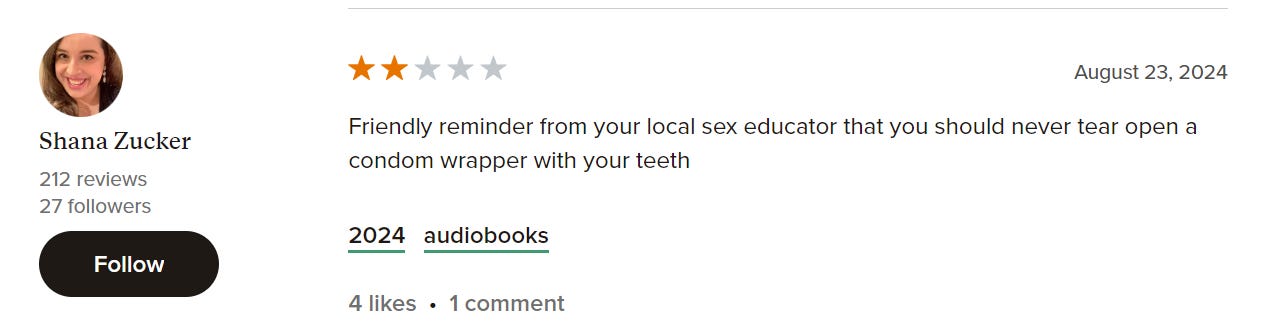
However, I would be remiss if I left you without this much more important reminder from my pal Shana’s review, which did make me cackle:

Goodreads two star review from Shana Zucker that reads "Friendly reminder from your local sex educator that you should never tear open a condom wrapper with your teeth"

That’s all for now! I’m gonna go back to reading Intermezzo so I can finally catch up with the discourse. If you’re local, hopefully you can join me to chat in person in November!

If not, I’m always happy to chat here and anywhere else you can reach me.

Until next time, happy reading!

❤ Catherine


Housekeeping note: all links go to my Bookshop storefront, where each purchase supports independent bookstores (and this newsletter, because I get a small percentage of each sale).

Yoohoo, Big Summer Blow-out!

June/July/August in review — Lit Chat, Vol. 20

Pyramid of book cover images. Bottom tier: Highfire by Eoin Colfer, The Tombs of Atuan by Ursula K. Le Guin, The Familiar by Leigh Bardugo, and A Court of Frost and Starlight by Sarah J. Maas; Third tier: Family Meal by Bryan Washington, A Court of Wings and Ruin by Sarah J. Maas, and Drive Your Plow Over the Bones of the Dead by Olga Tokarczuk; Second tier: The Road by Cormac McCarthy and Either/Or by Elif Batuman; Top: Catch the Rabbit by Lana Bastasic

Hi friends,

It’s September! Thank goodness. I don’t know about you, but this summer really took it out of me. Gone are the days where I could knock out the entire Lake Forest Library summer reading challenge in the span of a couple of days. From what I remember, we were supposed to log our reading in 20 or 30-minute increments, amounting to a total of maybe four hours? That was an easy rainy day for me.

This summer, free half hours have been few and far between, and most of my summer reading was concentrated into plane and train rides or rare, peaceful early mornings before the rest of the AirBnB woke up. I love the flexibility and freedom of summer, and I’m so grateful to have spent the past few months across more than half a dozen cities celebrating friends, family, love, and the joy of being in a new place with your people. That said, I’m exhausted!!! I’m so happy to have spent most of August recovering at home, and I’m so ready to start channeling some much-needed back to school energy into my September.

As you might imagine, this post is a big one! I read ten books over the months of June, July, and August, so for the first time since March 2023, we have an Honorable Mention tier as a ~blog exclusive~. If you usually prefer reading this in your inbox, though, make sure you’re subscribed to my Substack here:

But you’re probably here on the blog for the Honorable Mentions, so let’s get right to it.


HONORABLE MENTION:

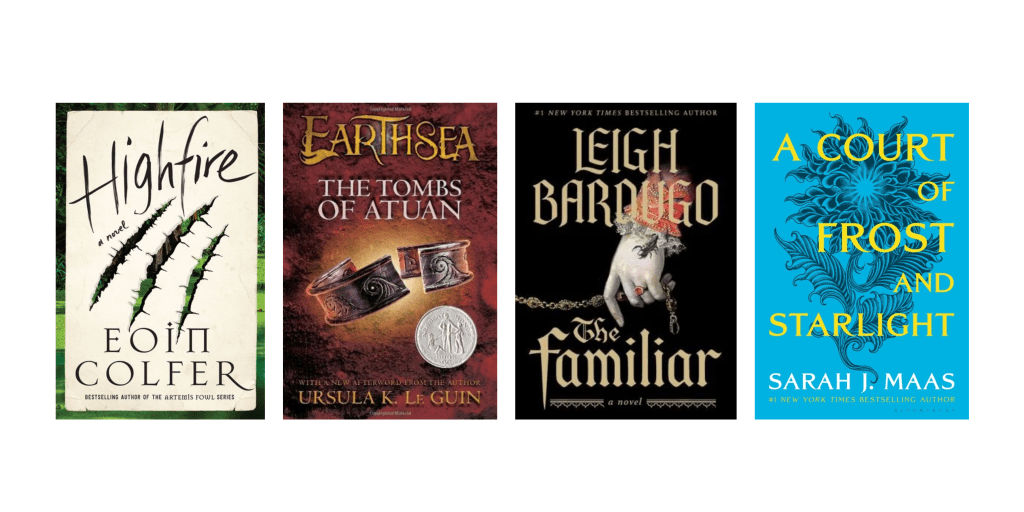
Book cover images for Highfire by Eoin Colfer, The Tombs of Atuan by Ursula K. Le Guin, The Familiar by Leigh Bardugo, and A Court of Frost and Starlight by Sarah J. Maas

Highfire — Eoin Colfer

I grew up reading the Artemis Fowl books and was excited to read an adult book by the same author, but disappointingly, this one didn’t do much for me. Highfire is about a young Cajun boy, Squib Moreau who befriends Lord Highfire (aka Vern), the last living dragon hiding out in the Louisiana bayou. The two become unlikely allies when they unite against a rogue cop trying to expose Vern while also aggressively pursuing Squib’s single mother. It was definitely a high-energy story, but the humor was a bit crass for my tastethe kind I usually refer to as “boy humor.” However! Apparently there’s a TV adaptation in the works, with Nicolas Cage executive producing and voicing the dragon?? So you might want to check it out after all. 

The Tombs of Atuan — Ursula K. Le Guin

I decided to make my way through the Earthsea books on audio as travel companions, but the narrator’s voice is so lovely to listen to that if I pop it on right as I’ve settled into my seat for an early morning flight, I’m asleep before we take off. Granted, I don’t sleep well on planes, so it’s more of a twilight half-sleep where the story kind of infuses into my dreams. I’m never quite sure how much of the story I’ve actually retained, but whenever I rewind, I’m like, “Oh, I listened to this already.” Anyway, this second book features a young priestess named Tenar, who meets an adult Ged when she catches him trying to break into her temple. Ged offers her the choice between the path she’s trained for her whole life, and the potential of a future beyond the temple’s walls. I’m still intrigued enough to want to continue listening to these books, but I think a fully awake physical re-read will produce a completely different experience someday.

The Familiar — Leigh Bardugo

Perhaps an unpopular opinion, but I’ve been a bit underwhelmed by Leigh Bardugo’s latest books! I once claimed that if anyone was well-primed to write the next fully immersive fantasy phenomenon ala Harry Potter or Game of Thrones, it would be Bardugo. And yet, I’ve found her more recent books fairly forgettable. Her latest is a historical fiction (which I usually love!) set in the time of the Spanish Inquisition. Luzia, a young servant girl, unintentionally catches the attention of the Spanish court when she’s caught performing small magics in the home of her employer. She is then thrust into the spotlight and forced to compete against other would-be magicians for a position in the royal court, with the help of her wealthy patron’s mysterious—and mysteriously enticing—familiar. I enjoyed it, but as a standalone historical fantasy novel, I didn’t find it as wholly encompassing as I think her earlier fantasy novels were.

A Court of Frost and Starlight – Sarah J. Maas

I’m still confused as to why this book is considered a novella when it’s still the length of a regular book (232 pages)? I mean, it’s not as long as the other books, but still! That’s a normal book-length! Anyway, no spoilers, but this is considered book #3.5 because it’s basically just a little filler story about Feyre and her extended family spending the holiday season in Velaris after the events of the third book conclude. It was sweet and nothing crazy happened, but as much as I enjoy this world and these characters, it also felt a little unnecessary? I’d rather just skip ahead to the next book, but I guess I’ll wait until I read that one to pass judgment on whether or not we needed this one.


THE FOUNDATION:

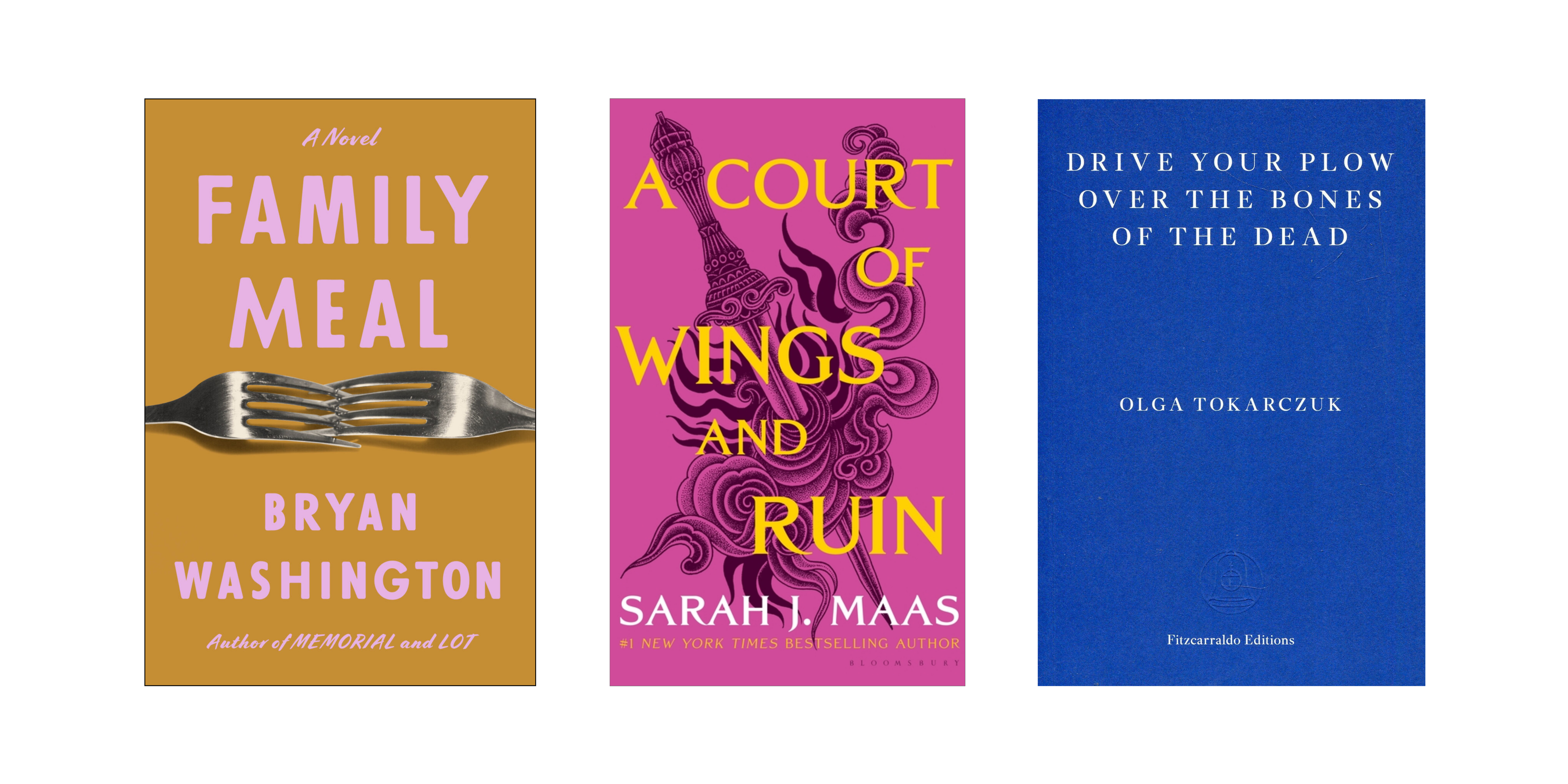
Cover images for Family Meal by Bryan Washington, A Court of Wings and Ruin by Sarah J. Maas, and Drive Your Plow Over the Bones of the Dead by Olga Tokarczuk

Family Meal — Bryan Washington

This was actually the last book I finished in August, and the first contemporary novel that I’d read in a long time—it’s been a big genre summer, as you’ve already seen! This is certainly a novel that will bring you back to the messy beauty of reality. When Cam returns home to Houston from LA after the murder of his boyfriend, he’s not expecting to move back in with his estranged childhood best friend, TJ. But TJ proves to be the lifeline Cam needs when his grief and self-destructive coping behaviors start to overwhelm, and Cam’s newfound presence might just be what TJ needs to reclaim the life he wants, too.

Family Meal is a book about grief, queerness, found family, sex, food, and the many ways our relationships with all of the above can get messed up and heal again with grace and love. This one might be a little more difficult for anyone sensitive to content about eating disorders, addiction, and self-harm, so as Washington’s opening note to the book says: “please be kind to yourself. And go at your own pace. There’s no wrong way to be, and the only right way is the way that you are.”

A Court of Wings and Ruin — Sarah J. Maas

I won’t get into plot details on this one because spoilers, but I will say it had book #5 levels of drama for only being book #3 in the series. Are these the best written books I’ve ever read in my life? Of course not. But the stakes are high, the pace is fast, the characters are hot and in love, and it was just so easy on a jet-lagged, post-work conference brain. I think book #2 is my favorite so far, but this was still a 10/10 reading experience. I’m curious to see where the story goes for book #5, especially knowing that it’s told from a different POV, but there was also enough of a resolution in this one that I feel okay with putting a pause on this series for another month or so.

Drive Your Plow Over the Bones of the Dead — Olga Tokarczuk, tr. Antonia Lloyd-Jones

When one sees a Nobel-prize winner in the Vienna outpost of Shakespeare & Co., one buys it!! The narrator of this strange book is the caretaker of a small community of mostly summer homes in the mountains of a remote Polish border town. When she’s not researching her neighbors’ birth charts or translating William Blake’s poetry, she can often be found advocating for the protection of local wildlife against the town’s hunting community.

Upon discovering that one of her eccentric neighbors has choked to death on the bone of a deer he illegally poached, our narrator becomes convinced that the animals are rising up and seeking justice against humans. When two more questionable deaths occur in the neighborhood, the reader is almost inclined to believe her. Part mystery, part slow-burn thriller, this book’s atmosphere stems largely from the narrator herself: rustic and pastoral but not quite cozy, an underlying tension and the suspicion of hidden secrets prevents the reader from getting too comfortable. This would be a great book to help you ease into fall and the onset of spooky reading!


SOLID SUPPORTS:

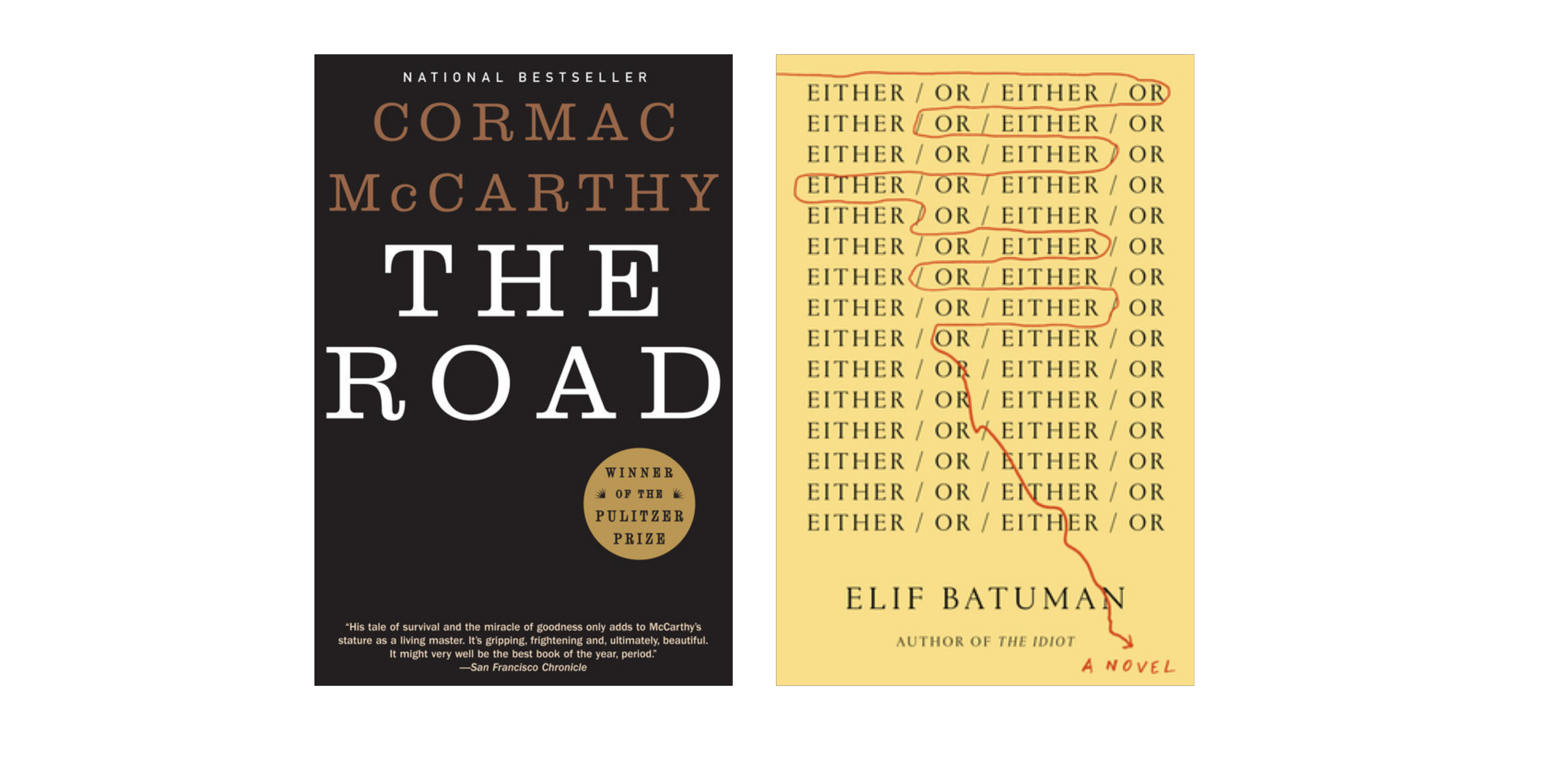
Cover images for The Road by Cormac McCarthy and Either/Or by Elif Batuman

The Road — Cormac McCarthy

I was not expecting this one to break my heart as much as it did!! The Road came highly recommended from a work friend who had recently read McCarthy’s entire oeuvre, and suggested this one as the best entry point to his work. The Road is a devastating novel about a father’s love for his son as they journey through post-apocalyptic America, surviving not for the promise of a better future—because there isn’t one—but simply for each other.

I was most impressed by McCarthy’s stark, spare prose and no-frills dialogue, how successfully it captured not only the hellscape they traveled through but also the intense, unspoken intimacy and vulnerability between the boy and his father. We don’t know their names or their ages, don’t know what happened to the world or what their life was like before the road, but we understand their secret hopes, fears, and defiant resilience with a rare, gut-wrenching clarity. I cried at the end! That should be endorsement enough.

Either/Or — Elif Batuman

I adored this sequel to Batuman’s The Idiot as much as I adored The Idiot, and am so glad we got to see Selin grow through this next chapter of her story. Now a sophomore at Harvard in 1996, Selin is still processing the strange roller coaster of emotions that last year’s situationship with Ivan sent her on, as she searches for meaning in his actions through the books he studied and through her own course reading list.

When her summer plans bring her to Turkey as a student travel writer, Selin’s coming of age begins in earnest, her travels taking her on adventures of varying success including equally varied encounters with men. An education in culture, sex, and of course, more literature, Selin finally comes into her confidence enough to start separating herself from the influences of the friends, family, writers, and philosophers that have defined her life so far. The former English major in me loved watching Selin experience the revelations of growing up and reconciling life with literature, choosing what to keep with her and what to leave behind, all in the timeless pursuit of living a life worth writing about.


THE TIPPY TOP:

Cover image for Catch the Rabbit by Lana Bastašić 

Catch the Rabbit — Lana Bastašić 

My sweet friend Monique honored me by borrowing my pyramid format earlier this year to review her best books of February and March, and selected Catch the Rabbit as her top choice. Obviously, I had to check it out.

The novel, translated into English from Serbo-Croatian by the author, follows a chaotic road trip undertaken by two childhood best friends, Sara and Lejla, who have not spoken to each other in nearly a decade. The story is divided into the present moment of their road trip, driving from Bosnia to Vienna to find Lejla’s long-lost brother, and the past, in which Sara narrates anecdotes that illustrate the progression of their friendship as children and the starring role Lejla played in Sara’s life and memories.

The author nails the strange familiarity of being around people you knew in childhood now as adults, that weird intimacy of knowing someone’s essence and history so completely and yet feeling like time and physical distance have made you strangers. She also impressively captures the slipperiness of memory, the way certain defining moments can be so supercharged with emotion that it overshadows the truth, creating entirely different versions of a memory for the people who share it.

Like Monique, I finished this book and immediately wanted to dive back in knowing what I had learned throughout the course of the book—which included a lot of history about the Bosnian War that I had simply never known anything about—and reexamine both Sara’s and Lejla’s memories and motivations in a different light. No spoilers, but it’s one of the most perfect endings I’ve read in a long time. Unsettling, emotionally intense, unresolved, and yet somehow it’s completely satisfying, because you realize there was no other way that this particular journey could end. It leaves you literally wanting—not for anything specific, but trapped in a paralyzing moment of desperation: an ache of absence, with the hope of fulfillment slipping through one’s fingers.


And that’s a wrap on my summer reading! I’ll be back in October ready to go full send into spooky reads, my favorite time of the year. Until then, let me know if you want to chat about these or any other books or give me some recommendations for the fall! It’s good to be back.

Until next time, happy reading!
❤ Catherine


Housekeeping note: all links go to my Bookshop storefront, where each purchase supports independent bookstores (and this newsletter, because I get a small percentage of each sale).

Summer Reading Szn

May in Review — Lit Chat Vol. 19

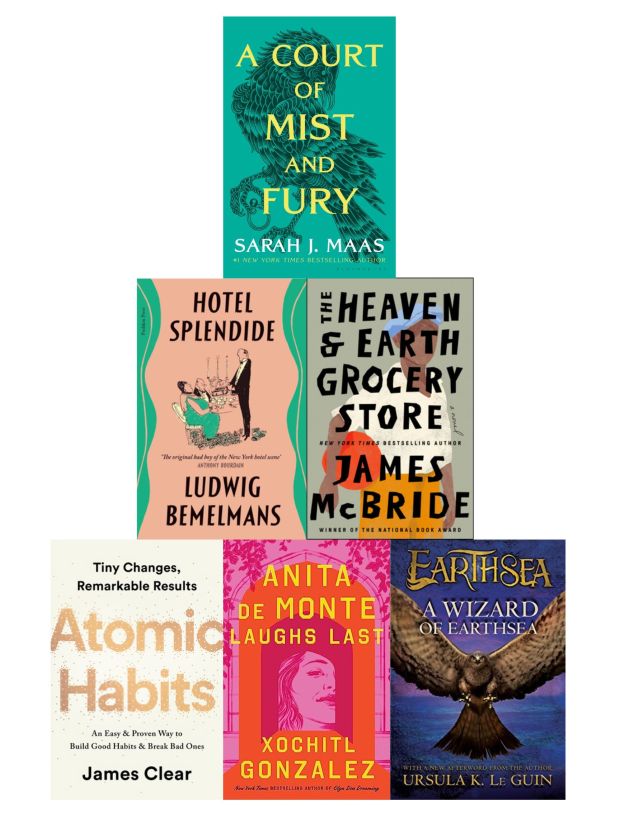
pyramid of book cover images with Atomic Habits by James Clear, Anita de Monte Laughs Last by Xochitl Gonzalez, and A Wizard of Earthsea by Ursula K. Le Guin on the bottom; Hotel Splendide by Ludwig Bemelmans and The Heaven and Earth Grocery Store by James McBride in the middle; A Court of Mist and Fury by Sarah J. Maas on top.

Hi friends,

It’s humid and sticky in Brooklyn, the cicadas are out in Chicago, and my favorite lavender lemonade is back at the Center For Fiction, which can only mean one thing: summer has officially arrived. While I do not work a job that enables me to take the summer off, spiritually, I am poolside at the Lake Forest Club eating chicken tenders and playing Bananagrams while I wait for a tennis lesson (real ones know).

This means that brainpower is at seasonal low, and since I’m also preparing for another travel-heavy summer, Lit Chat might take a lil break again in the next month or two! So if you don’t hear from me for a couple months, don’t worry, I’ll be back eventually. I’ve famously never been able to go too long without homework.

But for now, we still have the best part of summer to look forward to: summer reading! If you prefer to get this post straight to your inbox, remember to subscribe for my Substack here:

Let’s get into it, shall we?


THE FOUNDATION:

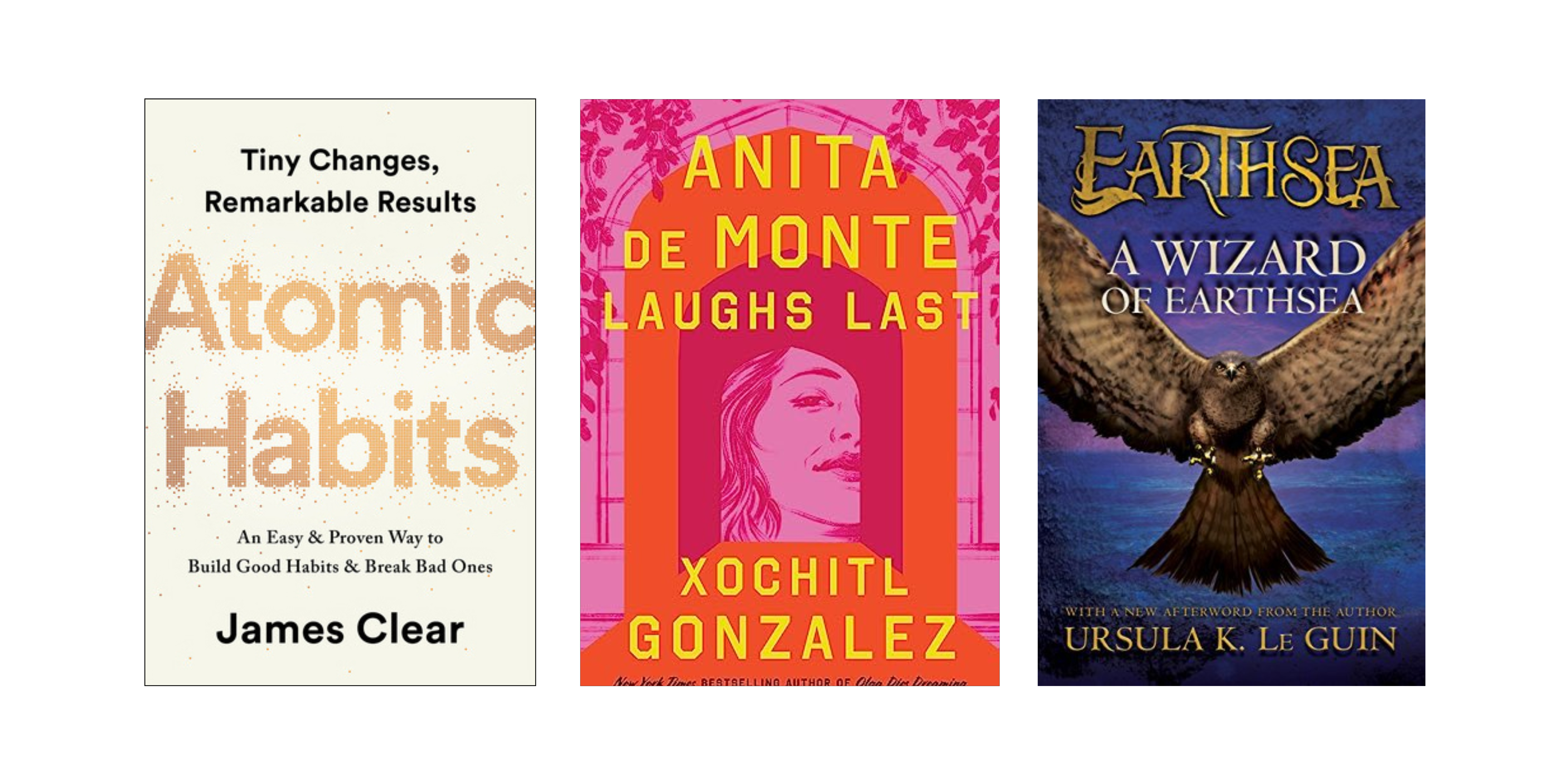
Book cover images for Atomic Habits by James Clear, Anita de Monte Laughs Last by Xochitl Gonzalez, and A Wizard of Earthsea by Ursula K. Le Guin.

Atomic Habits — James Clear

I first put this book on hold at the library like six months ago, which checks out as that aligns with the New Year’s pressure to be a better version of myself whose routine does not consist solely of sourdough grilled cheeses and 100+ hours of Stardew Valley gameplay. By the time Atomic Habits got to me, though, I’d kicked my Stardew addiction and signed back up for ClassPass, so I was basically already a healthy habit queen. I also felt like I’d seen a lot of Clear’s tips and suggestions for habit-forming/routine creation regurgitated on TikTok already, so I didn’t get a whole lot out of the book that felt totally new to me. That said, this is still probably a solid place to start if you feel like it’s time for a lifestyle adjustment or a mental reframe, but need some help breaking that change down into more manageable pieces.

Anita de Monte Laughs Last — Xochitl Gonzalez

What intrigued me most about this novel was that I had seen it marketed as based on a true story: that of the Cuban-American artist Ana Mendieta, who died after “falling” out of the window of her 34th floor apartment in 1985. It’s apparent that Gonzalez borrowed heavily from Mendieta’s life to tell Anita de Monte’s story, as the details of Anita’s artwork and career, her tumultuous marriage to a well-known male sculptor, and her controversial death are lifted almost exactly from Mendieta’s life. I enjoyed the parallel story of a young art history student at Brown who rediscovers de Monte’s work while in a similarly difficult relationship, but I found it off-putting that the author does not properly credit or even mention Mendieta at all in the book beyond a dedication “For Ana.” For a book whose most prominent message is that women lose their power when they/their work are forgotten, something about this omission just didn’t sit right with me.

A Wizard of Earthsea — Ursula K. Le Guin

I had a couple of long flights this month and panicked when I realized the physical books I’d brought with me might prove insufficient (they did), so I downloaded the audiobook for A Wizard of Earthsea after being recommended it as a great starting place for Le Guin’s work many, many times. Audiobooks are a perfect distraction for my nerves while traveling, especially when they’re narrated by old British men who do all the voices like they’re reading me a bedtime story. At its core, A Wizard of Earthsea is a story about the power of words, a power that guides a young boy’s journey to learn enough magic to face the darkness inside of him. While I didn’t find it quite as immersive as some of the other fantasy worlds I’ve been craving lately, I do find it impressive that with its publication in 1967, Le Guin essentially managed to single-handedly rebrand the genre of fantasy as literature that could be accessible to all ages, not just kids. (Unrelated but forever relevant: Le Guin’s daily routine, which I think about probably once a day.)


SOLID SUPPORTS:

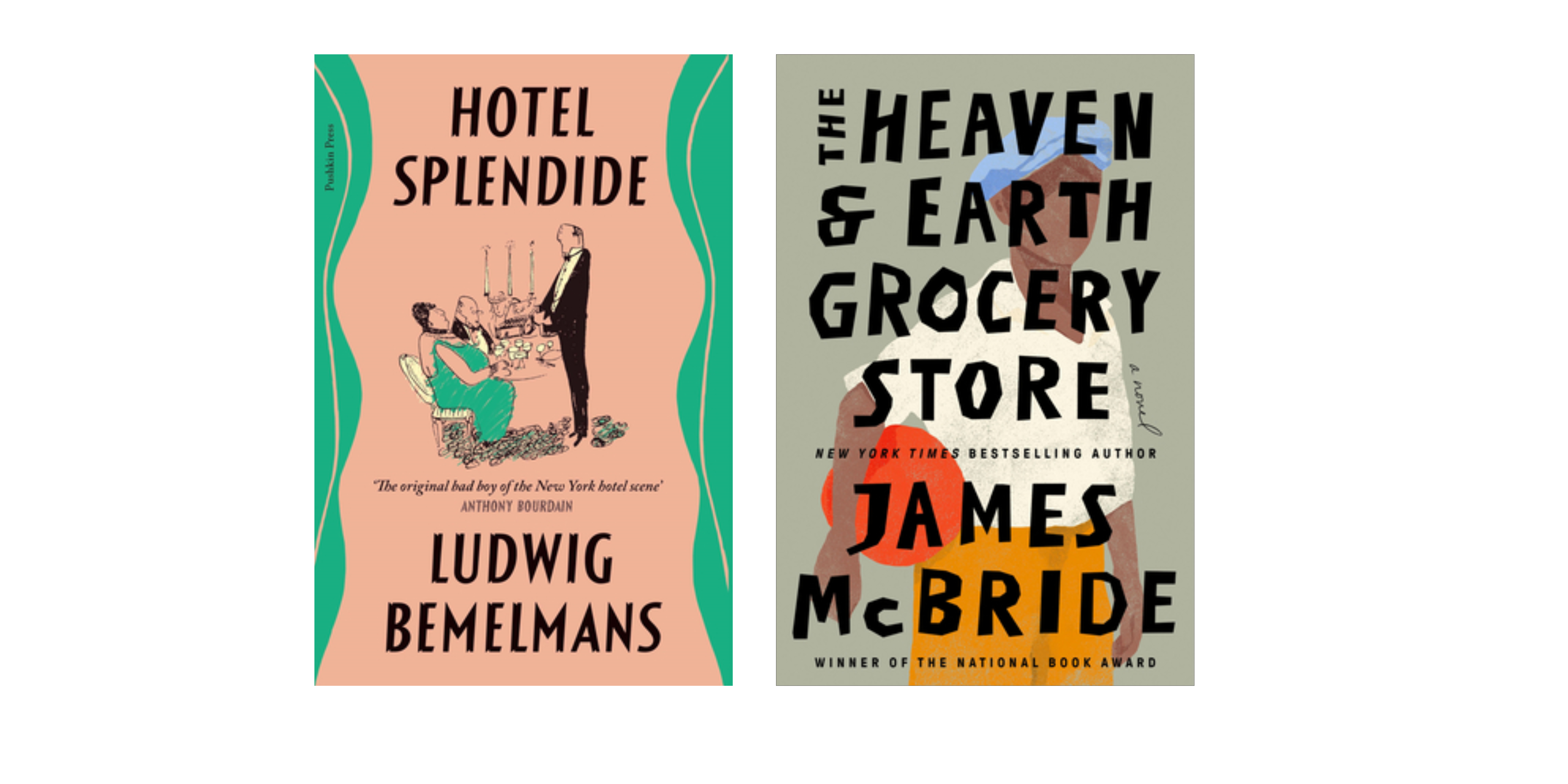
Book covers for Hotel Splendide by Ludwig Bemelmans and The Heaven and Earth Grocery Store by James McBride

Hotel Splendide — Ludwig Bemelmans

I read the entirety of Hotel Splendide on a flight to San Francisco, and was wholly charmed by Bemelmans’ depiction of the New York hotel scene in the 1920s. Each chapter is a vignette from Bemelmans’ time working in an upscale hotel before his Madeleine fame, and his written descriptions of the hotel’s characters somehow match his drawing style exactly: slightly caricature-esque, but drawn with such vulnerability and a flair for absurdity that they feel immediately familiar and beloved.

What delighted me just as much as the truly ridiculous cast of characters (eccentric employees and neurotic guests alike) was the attention to detail and finery that just feels like it doesn’t exist anymore, or maybe only exists outside my tax bracket. The Hotel Splendide’s scrupulous commitment to five-star service was a sharp contrast to the sterility of my Hilton stay, where I checked myself in and out on my phone and the only time I spoke to someone was when the buffet attendant told me breakfast would be a flat $34. If given a choice between the two, I know where I’d rather stay.

The Heaven and Earth Grocery Store — James McBride

I read James McBride’s Deacon King Kong back in January 2023 and deeply admired the way he managed to portray the vibrancy of whole communities as richly as singular characters, weaving their stories together across decades and generations. McBride pulls off a similar feat in this novel, when the fates of the Jewish immigrant and African American communities living side by side in Chicken Hill, Pennsylvania in the 1930s become intertwined over the fate of a young deaf Black boy.

The story primarily follows the lives of Moshe and Chona, a Jewish couple who run the town’s dance hall and grocery store, respectively, and their Black hired helpers, Nate and Addie. When Nate and Addie’s nephew Dodo is delivered into an abusive mental institution at the hands of the town doctor, a vindictive KKK leader who resents the changes that decades of immigration have brought to Chicken Hill, it will take the entire community to bring Dodo to safety again. Each character has a role to play and a life as vividly realized as the next, all done with McBride’s signature humor, compassion, and empathy. The book begins and ends with a skeleton in a well, but this mystery takes a backseat to the daily dramas and intimacies of life in this uniquely engaging community.


THE TIPPY TOP:

Book cover for A Court of Mist and Fury by Sarah J. Maas

A Court of Mist and Fury — Sarah J. Maas

Listen! Listen. No one was a more reluctant Sarah J. Maas convert than me, for no real reason except I saw “faeries” spelled like that and was like, “Ugh, another one of those? Do we need this?” The answer was yes, yes we do need this. After flying through ACOTAR last month, the next obvious choice was to fly through this sequel, which simply had all of the things I love to read about when I don’t feel like using my brain too much. We have enemies to lovers, magical strength training, a brooding, misunderstood hero, and a particularly delicious will-they-won’t-they-ohmygodjustdoitalready situation. And on top of that, there’s actually some pretty impressive worldbuilding going on!

No spoilers, but I love whenever fantasy books expand beyond the first glimpse of the world they give you in Book 1 (the Spring Court/Under the Mountain) to deliver a whole extended universe to accompany the smut (more Courts and new characters!), complete with history, lore, and most importantly, a danger strong enough to threaten everything we’ve fought for so far. Brb, praying my Libby app will deliver Book 3 ASAP before I forget everything that happened in Book 2.


That’s all for now! Signing off to focus on my summer reading (and lounging, mostly lounging), but if you ever want to chat about these or other books, you know where to find me.

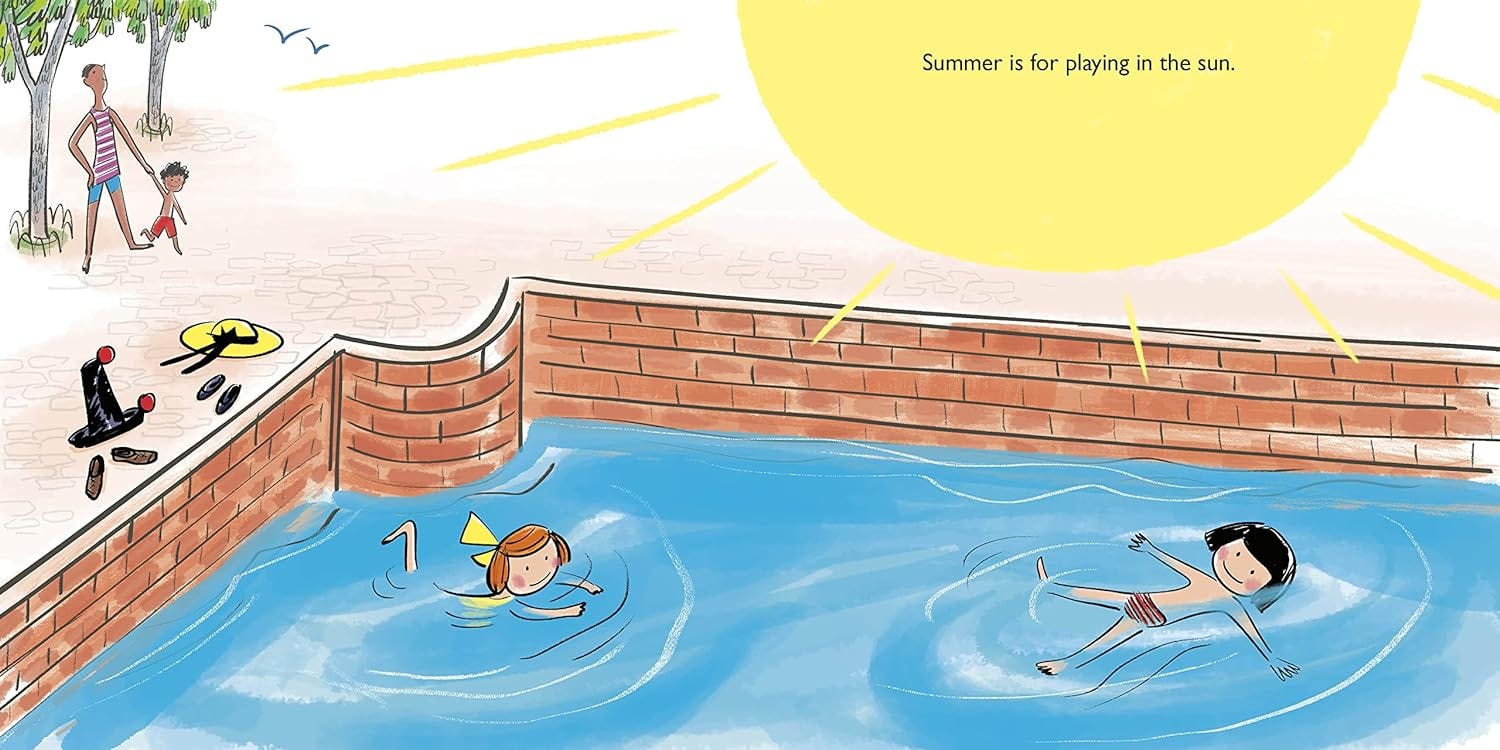
Drawing of Madeleine and Pepito swimming in a pool. Text on the sun above says "Summer is for playing in the sun."
it’s here, this is where you’ll find me

Until next time, happy reading!
❤ Catherine


Housekeeping note: all links go to my Bookshop storefront, where each purchase supports independent bookstores (and this newsletter, because I get a small percentage of each sale).

The only way to the end is through

April in Review — Lit Chat Vol. 18

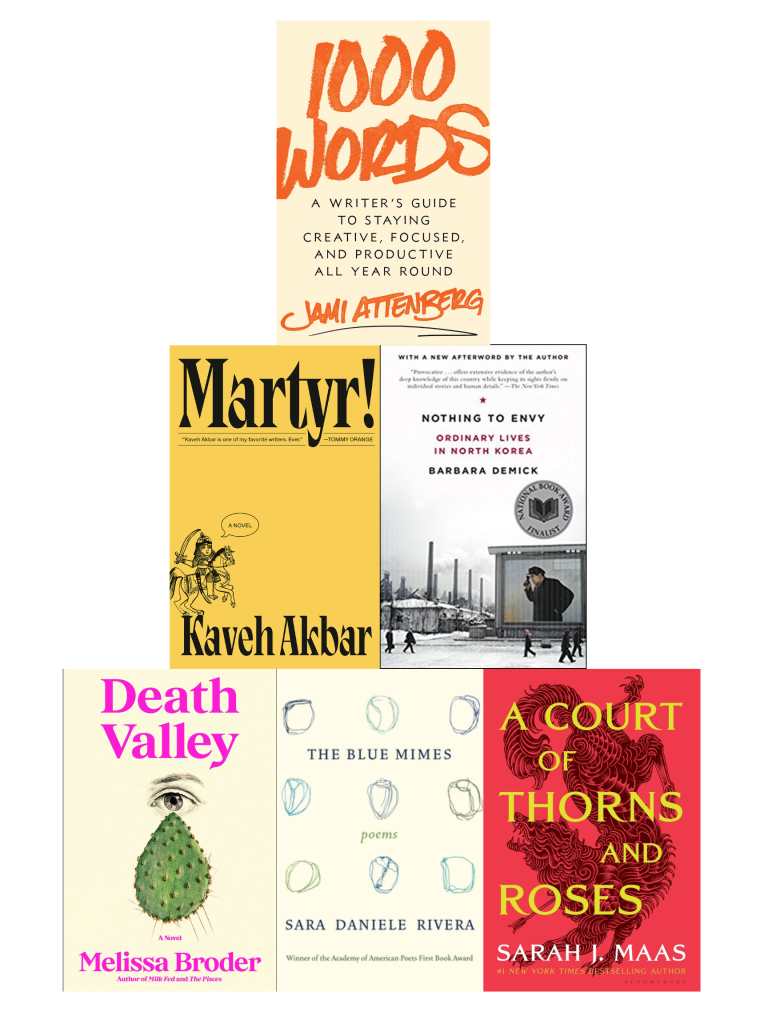
Pyramid of book cover images with 1000 WORDS: A WRITER'S GUIDE TO STAYING CREATIVE, FOCUSED, AND PRODUCTIVE ALL YEAR ROUND by Jami Attenberg on top; MARTYR! by Kaveh Akbar and NOTHING TO ENVY: ORDINARY LIVES IN NORTH KOREA by Barbara Demick in the middle; DEATH VALLEY by Melissa Broder, THE BLUE MIMES by Sara Daniele Rivera, and A COURT OF THORNS AND ROSES by Sarah J. Maas on the bottom.

Hi friends,

April’s big news has been that I’m taking a temporary social media reprieve, and the brain space that has opened up over the past few weeks has been unbelievably refreshing. I went from taking two weeks to read one novel to finishing five books in ten days. My attention span is lengthening by the minute!

It’s silly because I haven’t really enjoyed posting on social media in years. It feels like a hassle, and I mostly prefer to leave my personal life to the imagination. But I love lurking. It’s the lazy girl’s equivalent of eavesdropping in a busy coffee shop. I love listening to other people’s conversations and personal dramas and feeling like I’m in the world even if I’m just alone in my bed. But guess what scratches that same itch? READING! (Shocking! I know.)

Being more or less offline has been freeing. I feel like a kid again, when the first thing I reached for when bored on summer vacation was a book, or a craft, or my bike. I feel like I have a brain again and I’m so excited to use it.

That said, let me tell you about some books! If you prefer to get this post right to your inbox, you can do so by subscribing to my Substack below:


THE FOUNDATION:

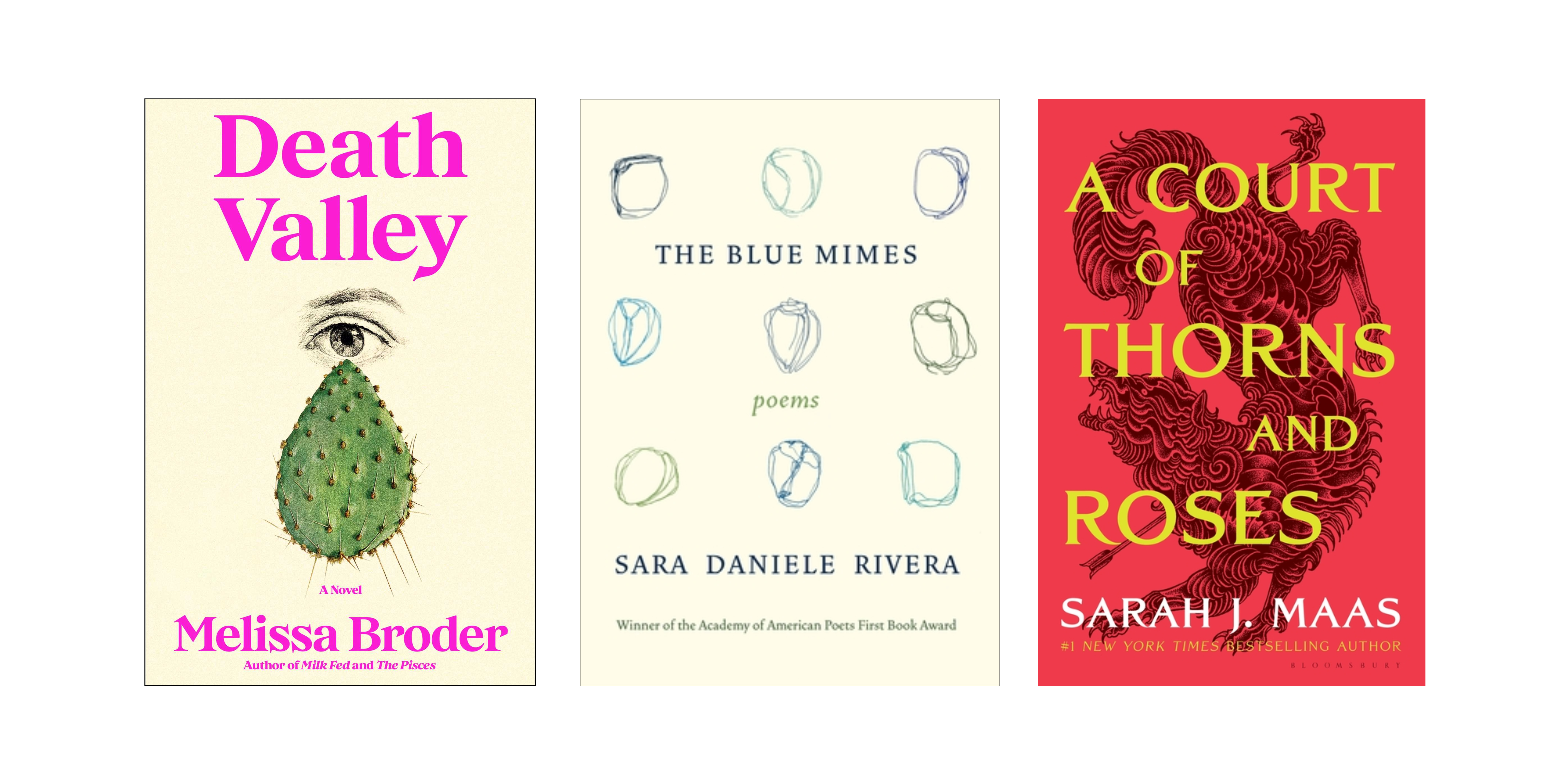
Book cover images for DEATH VALLEY by Melissa Broder, THE BLUE MIMES by Sara Daniele Rivera, and A COURT OF THORNS AND ROSES by Sarah J. Maas

Death Valley — Melissa Broder

Melissa Broder has nailed writing weird little books with female protagonists who are about one mild inconvenience away from a full mental breakdown. In Death Valley, a writer escaping the pressures of tending to her hospitalized father and her chronically ill husband has a bizarre experience in the desert, which leads to her getting lost and coming face-to-face with the realities (surrealities?) of grief and love. Broder strips her protagonist’s needs down to their most primal, placing her basest desires on the same stage as her instinct to survive and proving the two equally necessary and inextricably intertwined. A quick, trippy read! I liked it better than The Pisces, but it didn’t stand out too much otherwise.

The Blue Mimes: Poems — Sara Daniele Rivera

This National Poetry Month was less poetry-heavy than past years, but I had to squeeze at least one collection in! The Blue Mimes won the Academy of American Poets First Book Award for its meditations on grief and longing during the tumultuous years of the Trump presidency and the pandemic, and the personal losses that defined this time for the poet. The poems flow seamlessly between English and Spanish, this dialogue an avenue to explore Rivera’s family legacies in Cuba, Peru, and the U.S. in an effort to preserve the stories and memories that get lost when moving between countries and generations. I really recommend taking a few minutes to read three poems from the collection on Electric Lit here.

A Court of Thorns and Roses — Sarah J. Maas

All of the people who recommended this series to me failed to mention that it is essentially Beauty & the Beast, but with sexy faeries! That would have been a crucial selling point for the former Disney kid in me. A human woman spirited into faerie territory, forced to live in an exquisite mansion with a cursed (but still gorgeous) faerie lord who treats her kindly and comes to love her?? Tale as old as time! Unfortunately for Feyre and Tamlin, the presence of four more books in this series leads me to believe their happily ever after is still a long ways away, but I’m definitely in the mood to see where the rest of this story goes.


SOLID SUPPORTS:

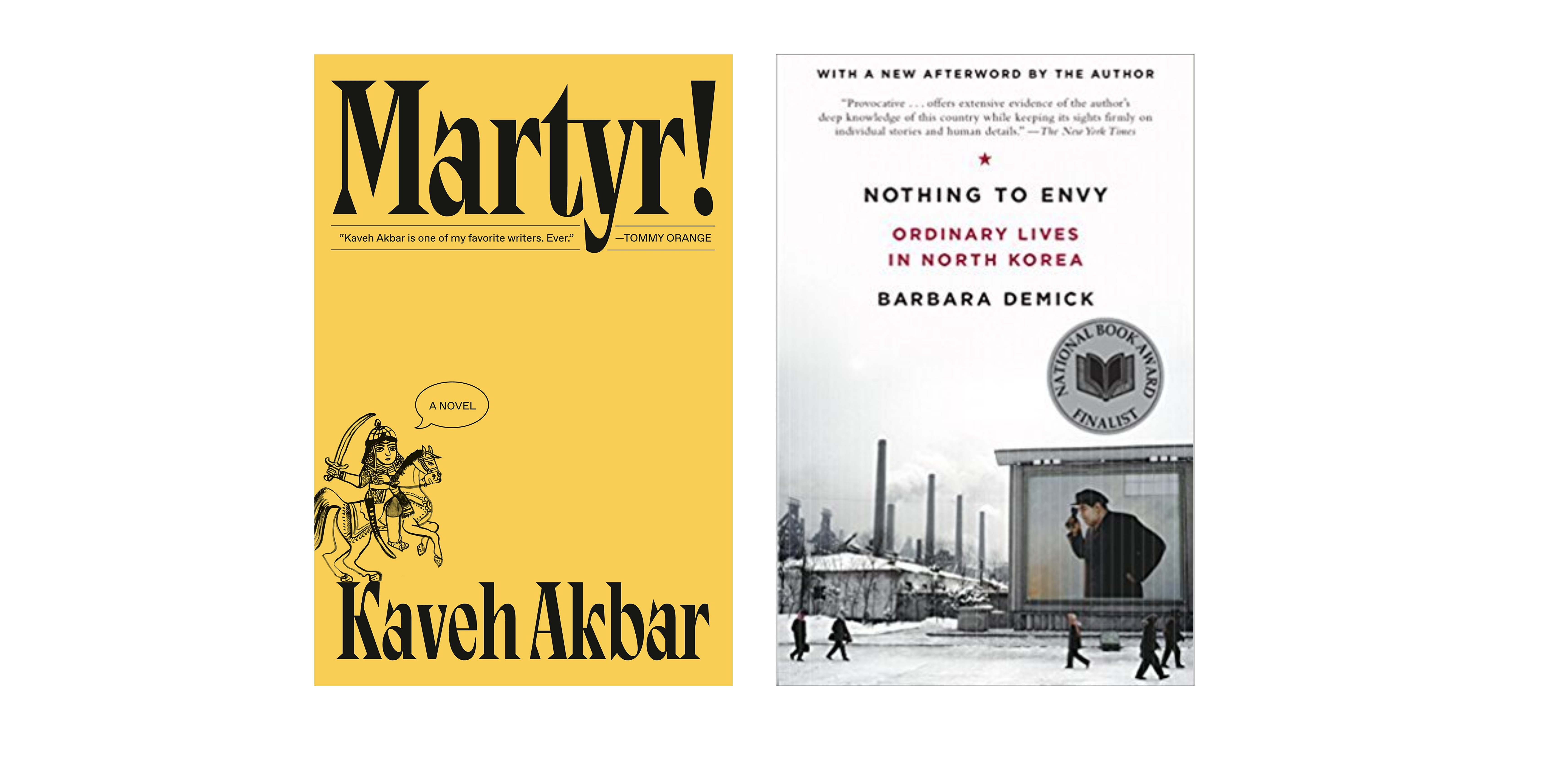
Book cover images for MARTYR! by Kaveh Akbar and NOTHING TO ENVY: ORDINARY LIVES IN NORTH KOREA by Barbara Demick

Martyr! — Kaveh Akbar

In this first novel from poet Kaveh Akbar, struggling writer and recovering addict Cyrus Shams seeks the wisdom of a terminally ill artist who has chosen to spend her final days in residence at the Brooklyn Museum. Having immigrated to America from Iran as a young child after the tragic death of his mother, Cyrus has a fascination with death and martyrs. His latest project, a book of poems about famous martyrs, is an attempt to find meaning in his own life and work, and his conversations with the artist become increasingly personal as he strives to reconcile his desire to die well with the indifferent reality of death.

I had the pleasure of seeing Kaveh Akbar discuss Martyr! at P&T Knitwear back in January, which was an absolute delight. Akbar spoke candidly about how his own journey with sobriety influenced Cyrus’s, and about the myriad influences on his work and creative process in his transition from writing poetry to fiction. Akbar’s sense of genuine awe and gratitude for the world around him are contagious and permeate throughout his work. He signed my book, “May you walk in wonder,” and I just think that’s a beautiful blessing to give to anyone, much less a stranger.

Nothing to Envy: Ordinary Lives in North Korea — Barbara Demick

I want to give a shout out to my Aunt Sally for this recommendation! This book, which follows six former citizens of North Korea who defected to South Korea, was shocking in the ways I expected it to be, and devastating in ways I never thought to imagine. By interviewing defectors from various backgrounds and levels of privilege in South Korea, Demick reveals a country in chaos, rife with widespread poverty, bureaucratic disorganization, and deliberate misinformation during the reign of Kim Jong-Il to 2015, the time of her reporting.

The North Korean regime is often aptly described as Orwellian, in large part due to the nature of its surveillance state and enforced loyalty. However, what struck me the most was the extent of information deprivation throughout the country at all levels of wealth and privilege. Even as they were starving in a famine that killed millions in the 1990s, schoolteachers were still teaching their dying pupils that they should be grateful to be North Koreans, and that everywhere else in the world was inferior. A doctor who escapes across the Chinese border only realizes that this is untrue when she sees that dogs in China have more food to eat than she did back home. It’s easy for us in the West to dismiss North Korea as an anachronistic propaganda machine, but this book was eye-opening in its portrayal of the true horror and suffering its people have experienced for the sake of a few powerful men’s delusions.


THE TIPPY TOP:

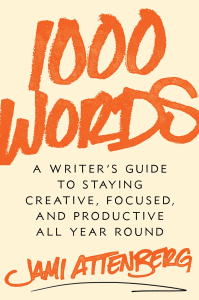
1000 Words: A Writer’s Guide to Staying Creative, Focused, and Productive All Year Round — Jami Attenberg

Book cover image for 1000 WORDS: A WRITER'S GUIDE TO STAYING CREATIVE, FOCUSED, AND PRODUCTIVE ALL YEAR ROUND by Jami Attenberg

I’m giving this book the top spot for April, but I’ve been taking my time with it ever since attending not one but two (!) of its Brooklyn launch events back in January. 1000 Words is the book version of author Jami Attenberg’s annual #1000WordsofSummer challenge, in which participating writers are tasked with writing 1000 words a day for two weeks. For each day of the challenge, participants receive a motivational email from either Jami or another writer, offering much-needed encouragement and perspective. This book is a collection of these letters, as well as a number of short craft talks from Jami, organized seasonally to represent the shifting needs and opportunities of one’s ever-evolving creative practice throughout the year.

It’s hard to express in just a few paragraphs how much #1000Words means to me. I’ve participated in the challenge and its mini offshoots with varying levels of success since 2020, and have found such wonderful and frankly life-changing community, along with significant consistency and improvement in my personal writing practice. I’ve spent the past four months with this book on my desk, reading a few pages at a time before getting busy. Now that I’ve come to the end, I can say with confidence that it’s a volume I’ll continue turning to for a very long time.

This book is essential for all writers, but I’d also recommend it to those with any kind of creative practice. Swap out “writing” for painting, singing, dancing, crafting, etc., and its prescriptions for setting achievable goals, recognizing your strengths, and carving our time for your work—among many, many other things—become universal for creatives everywhere. I’m so grateful for the wisdom and encouragement both inside this book and beyond it in the greater #1000Words community, and I can’t recommend both highly enough. If you’re interested in joining us, the next #1000Words challenge starts on June 1st!


That’s all for April! I’ll probably come back to Instagram eventually, but until then, text/email/these comments are the best way to reach me. And I hope you will still reach me, because I am more jazzed than ever to be reading and talking about books.

Until next time, happy reading!
❤ Catherine


Housekeeping note: all links go to my Bookshop storefront, where each purchase supports independent bookstores (and this newsletter, because I get a small percentage of each sale).

Everything vanishes and nothing returns

March in Review Lit Chat, Vol. 17

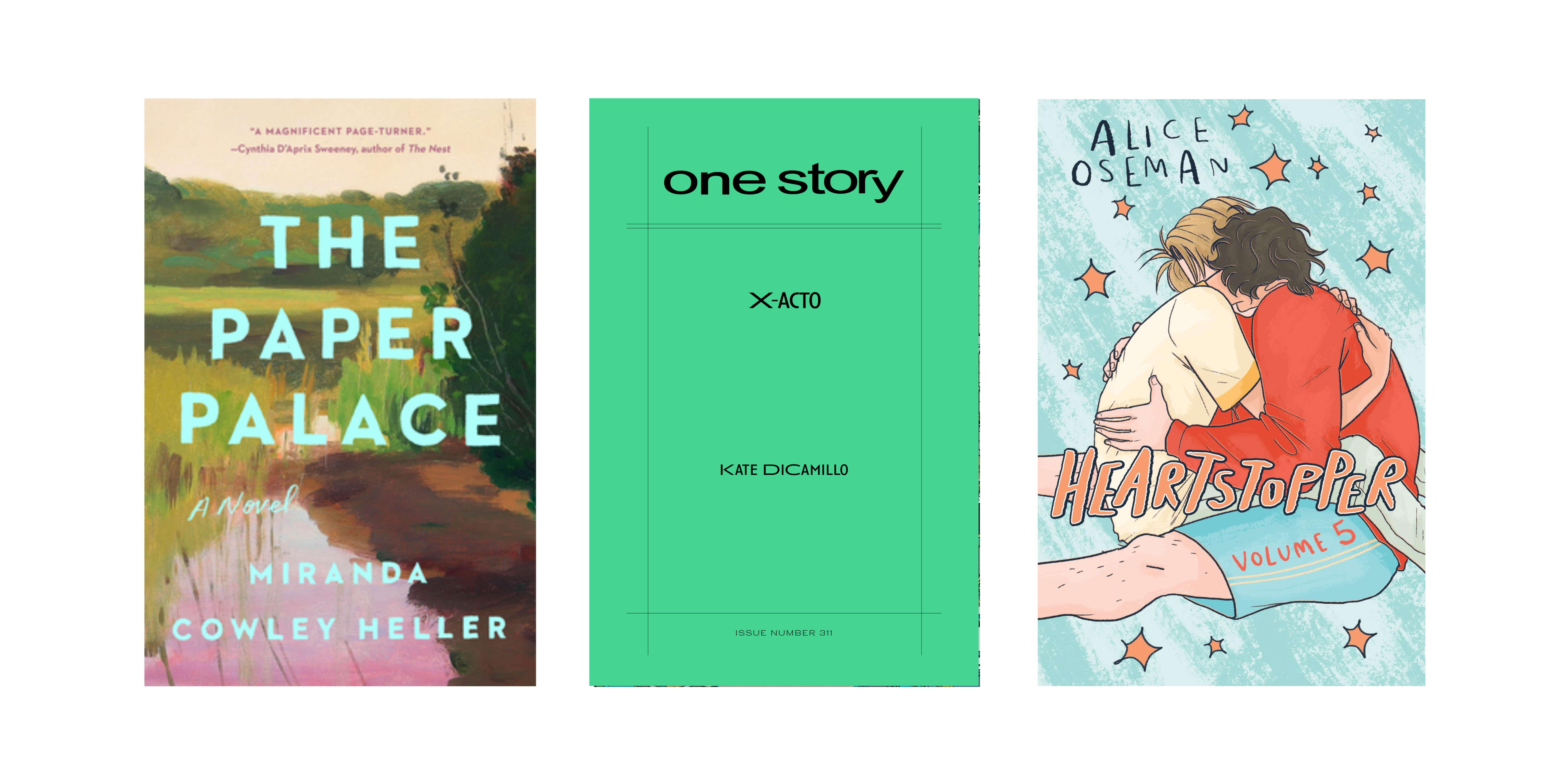
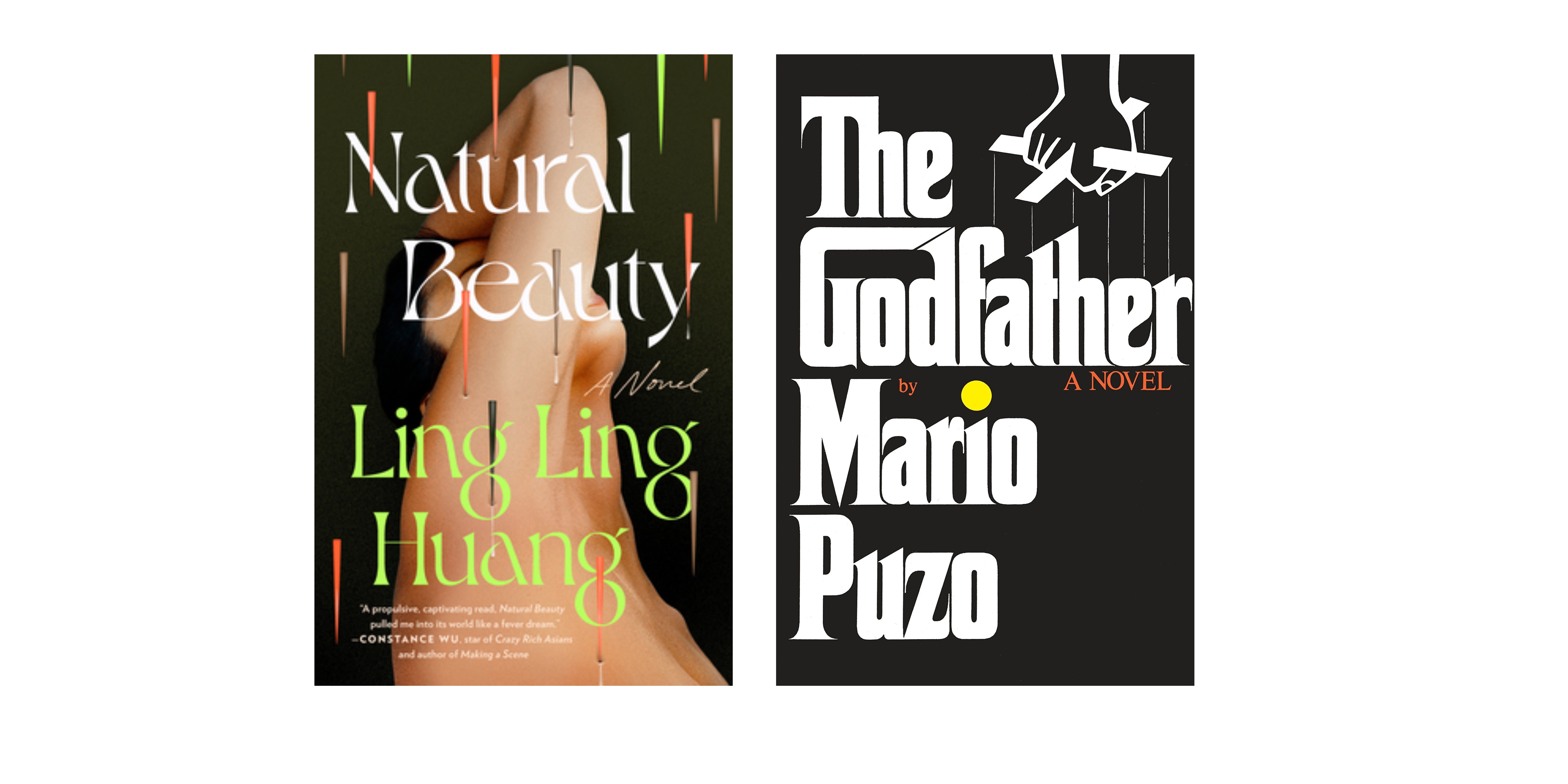
Pyramid of book cover images, with Biography of X by Catherine Lacey on top, Natural Beauty by Ling Ling Huang and The Godfather by Mario Puzo in the middle, and The Paper Palace by Miranda Cowley Heller, X-Acto by Kate DiCamillo, and Heartstopper Volume 5 by Alice Osman on the bottom.

Hi friends,

What is there to say about March? It’s always colder, wetter, and longer than I want it to be, as all the fun seems to go out of it after my birthday. Good reading weather, but not good for much else. Not much to report here, so let’s just skip to the books!

As always, if you’d rather get this post in an email right to your inbox, make sure you’re subscribed to my Substack here:


THE FOUNDATION:

Book cover images for The Paper Palace by Miranda Cowley Heller, X-Acto by Kate DiCamillo, and Heartstopper Volume 5 by Alice Osman

The Paper Palace — Miranda Cowley Heller

Two of my least favorite things to read about are infidelity and sexual assault (particularly CSA), and both of these happen in the first 30 pages, so a big fat content warning for this one! I came very close to noping out after that, but I powered through for the sake of book club. The Paper Palace opens with a woman cheating on her husband with her best friend at her family’s summer lake house, and the rest of the book is spent unpacking the woman’s traumatic past to show how she got to this point of no return. The timeline hopping was a bit tough to keep up with, but the ambiguous ending inspired a heated book club debate, which is always fun. I would’ve never chosen this book for myself, but if you’re someone who enjoys twisted narratives and awful characters, this could be for you!

X-Acto — Kate DiCamillo

This is a soft plug for One Story magazine, which mails its monthly stories to subscribers in a cute little paper zine. This isn’t an ad; I’m just a fan who was delighted to find a story from one of my favorite childhood authors in my mailbox this month! Kate DiCamillo’s “X-Acto” is a short story for adults about two children of divorced parents who go to stay with their father and his new girlfriend for the summer. There’s a darkness to this story that I found surprising compared to my childhood memories of reading DiCamillo, but also a familiar sense of defiant resilience. “Terrifying and hopeful” is how DiCamillo describes this story in an interview with the story’s editor, which you can read here, and while you’re at it, you can buy the story for a whopping $2.50. Is there anything more fun than good snail mail in this digital spam age?? I think not.

Heartstopper Vols. 2-5 — Alice Osman

Oh, my heart! I spent a solid week down with a cold this month, and Nick and Charlie were very much there for me in my congested suffering. Beyond the obvious reasons of representation, I think these books are also so important because they’re teaching an audience of young readers what healthy relationships and communication skills look like, for all gender identities and sexual orientations. Volume 4 in particular, which deals with Charlie’s eating disorder, tenderly portrays the difficulty of wanting to be a supportive partner when you’re not equipped to give the person you love the kind of help they need. Oseman does a beautiful job of teaching that sometimes the best and only thing you can do is listen and be there for someone, and make sure the real help is coming from a trusted (adult) source. I wish I had half the courage and compassion of these kids when I was a teenager, and I’m so glad there’s still one more volume in Nick and Charlie’s story to look forward to.


SOLID SUPPORTS:

Book cover images for Natural Beauty by Ling Ling Huang and The Godfather by Mario Puzo

Natural Beauty — Ling Ling Huang

This was a wild satire of the wellness industry turned unexpected thriller, and I was engrossed in every second of it. Our narrator, a child of Chinese immigrants and former piano prodigy, is strapped for cash when she accepts a job at Holistik, a prestigious beauty and wellness company. Holistik offers everything from products to treatments to pills, and the narrator welcomes the changes the job (and the free products) bring to her life and body, until a series of frightening encounters brings the company’s sinister underbelly to light.

This novel was the joint book club pick for my work’s AAPI and Women’s Networks, and the author was kind enough to join us for a virtual Q&A, which was so special! My personal highlights were when she shared how her career as a violinist and the movie Shrek were two main inspirations for this provocative debut. Natural Beauty is currently being adapted into a TV series by Constance Wu, and you’re definitely going to want to read the book first.

The Godfather — Mario Puzo

Let me just say, I was so unprepared for how much brain space this book (and movie) were about to take up in my mind. Until now, my only frame of reference for The Godfather was Joe Fox’s repeated references in You’ve Got Mail, which honestly always seemed like a red flag to me. Now, after reading the book and seeing the movie (in theaters, no less!), dare I say…I get it.

What fascinated me most about this story was not the way it made other pop culture references finally make sense, but the way it explored the various forms and avenues of power, how that power manifested differently in each of the characters, and how easily and often it was manipulated through the seemingly innocuous institutions of family and friendship. Questions of what it means to be powerful, to embody power and feel entitled to wield it, have been stewing in the back of my brain ever since. I feel like these thoughts come less naturally to women, so I’m now on a mission to find (or create??) some kind of female equivalent. In the meantime, I’m gonna need to watch Part II ASAP.


THE TIPPY TOP:

Book cover image for Biography of X by Catherine Lacey

Biography of X — Catherine Lacey

This book was one of my most highly anticipated reads ever since reading (and loving) Pew last October. On the surface, it is the fictional biography of X, a famously enigmatic artist, written by her widow, C.M. Lucca. Lucca’s biography is a thoroughly researched attempt at understanding her elusive spouse, including interviews, archival material, and numerous secondary sources documenting decades of X’s shifting artistic personas. Depending on who Lucca talks to, X is a genius, a mystery, a liar, a visionary, a manipulator, or a hack—and as impossible to forget as she is to pin down.

I was less intrigued by X’s resistance to definition as I was by the construction of this novel, specifically the way Lacey uses media to create an alternate reality that is both aspirational and dystopian. Set in an alternate history in which the U.S. was divided into regional territories after WWII, X escapes the uber-conservative autocratic Southern Territory as a young woman and spends most of her career in the ultra-liberal democratic haven of the North, integrating herself into the New York arts and literary scene of the 70s and 80s.

Lacey incorporates photographs alongside quoted text from real interviews, letters, articles, and books about historical figures and events—the Berlin Wall, David Bowie, Susan Sontag, and Kathy Acker are just a few—and either attributes them directly to X or manipulates them to reflect the divided world that produced her. I am obsessed with the way Lacey takes details from history and simply refilters them through the lens of X to create a perfectly plausible substitute reality. As with X’s many personas, the line between the truth and the version of it that Lacey offers her readers is not only blurred but completely disposable. The truth is the least interesting part of this novel; X is a variable that isn’t meant to be solved, but clearly that hasn’t stopped me from trying.


Did that even make any sense? I don’t know anymore! Writing it gave me a massive headache, that’s how much this book scrambled my brain. Anyway, let me know if you read it (or any of these books, of course!) because clearly, I have a lot of thoughts.

And if you’d rather avoid the headache, there’s always the Heartstopper Netflix adaptation. 😍

Until next time, happy reading!
❤ Catherine


Housekeeping note: all links go to my Bookshop storefront, where each purchase supports independent bookstores (and this newsletter, because I get a small percentage of each sale).

Why do we romanticize the dead?

February in Review — Lit Chat, Vol. 16

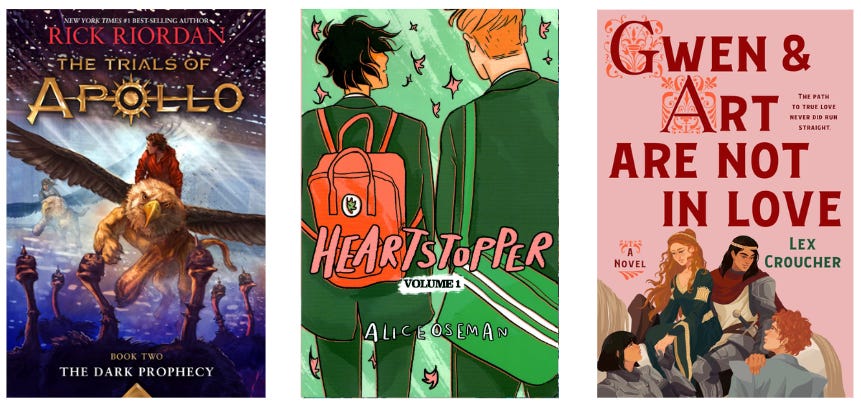
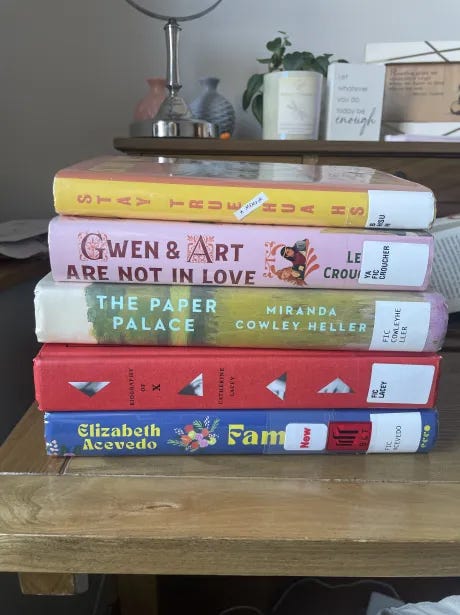
Pyramid of book cover images with I'm Glad My Mom Died by Jennette McCurdy on top, Family Lore by Elizabeth Acevedo and Stay True by Hua Hsu in the middle, and The Dark Prophecy by Rick Riordan, Heartstopper by Alice Osman, and Gwen & Art Are Not in Love by Lex Croucher on the bottom.

Hi friends,

Not to start on a morbid note, but most of the books I read in February feature some form of impending death or loss—an awareness that time spent in a particular place, with a particular character, is precious and finite.

I spent most of February wishing time would go faster so I could get to something I was looking forward to, and then wondering where all the time went. I always feel anxious about not having enough daylight hours to do everything I need/want to do in the winter, but as spring grows closer, this anxiety has felt especially heightened.

At the same time, this month’s reads have almost forcibly prompted me to stop and reflect on this particular time in my life. There are so many things I’m impatient for this year, but at the risk of sounding very cheese-fabreeze, I’m also so exceedingly grateful to just be where I am. My loved ones are safe and healthy and happy and so am I, and that is no small thing in today’s world. The stability that currently defines this chapter of my life is a treat and a welcome relief, and I hope it lasts a long time.

Plot twists and lots of movement make for good reading, but exhausting living. This month, I’m happy to leave them to the books. Speaking of, let’s get into it! Per usual, if you’d like to get this post straight to your email, you can subscribe to my Substack below:


THE FOUNDATION:

Book cover images for The Dark Prophecy by Rick Riordan, Heartstopper by Alice Osman, and Gwen & Art Are Not in Love by Lex Croucher

The Dark Prophecy — Rick Riordan

I finally finished watching the new Percy Jackson adaptation on Disney+ and have been filling the void by once again diving into The Trials of Apollo series, in which the god Apollo is forced to live as a mortal teenager and tasked with the responsibility of restoring hidden or lost Oracles to their former power. I love listening to these books on audio because the narrator, Robbie Daymond, is truly the perfect Apollo in his smug superiority, blissful ignorance of mortal slights, and sheer delight taken in ragging on his godly family. Come for the familiar faces from previous series, stay for the new friends, monsters, and jokes at Hera’s expense.

Gwen & Art Are Not in Love — Lex Croucher

I first saw this medieval YA rom-com on author Casey McQuiston’s Instagram story (they did the front cover blurb), which checks out because the royal context and goofy banter in this book reminded me a lot of Red, White, and Royal Blue. Gwen, the teenage Princess of England, has been betrothed to Arthur since they were children, and their mutual hatred has lasted almost as long. She’s also had her eye on the formidable lady knight Bridget Leclair for long enough to know she’s not interested in marrying a man. Lucky for her, Arthur feels the same way about Gwen’s brother, Prince Gabriel. Cue a mutually beneficial and delightfully silly fake-dating arrangement, until a surprise betrayal jeopardizes the peace not only in Camelot, but in all of England. A fun and quick read, this was the perfect Valentine’s Day indulgence.

Heartstopper, Vol. 1 — Alice Osman

I zipped through this graphic novel in a day and promptly requested the next four volumes in the series from the library (which have all since come in! Yay me). Nick and Charlie are a year apart in their all-boys British prep school, and unlikely friends. Charlie came out last year and has dealt with his fair share of bullying and social fallout. Nick is a rugby player, older and popular, and Charlie has no idea why he’s suddenly taken an interest in teaching him how to do a rugby tackle. This was a beautiful exception to this month’s accidental theme because nobody dies! I’m thoroughly looking forward to spending March with these cuties and watching their relationship unfold throughout the rest of the series (and then binging the TV adaptation, of course).


SOLID SUPPORTS:

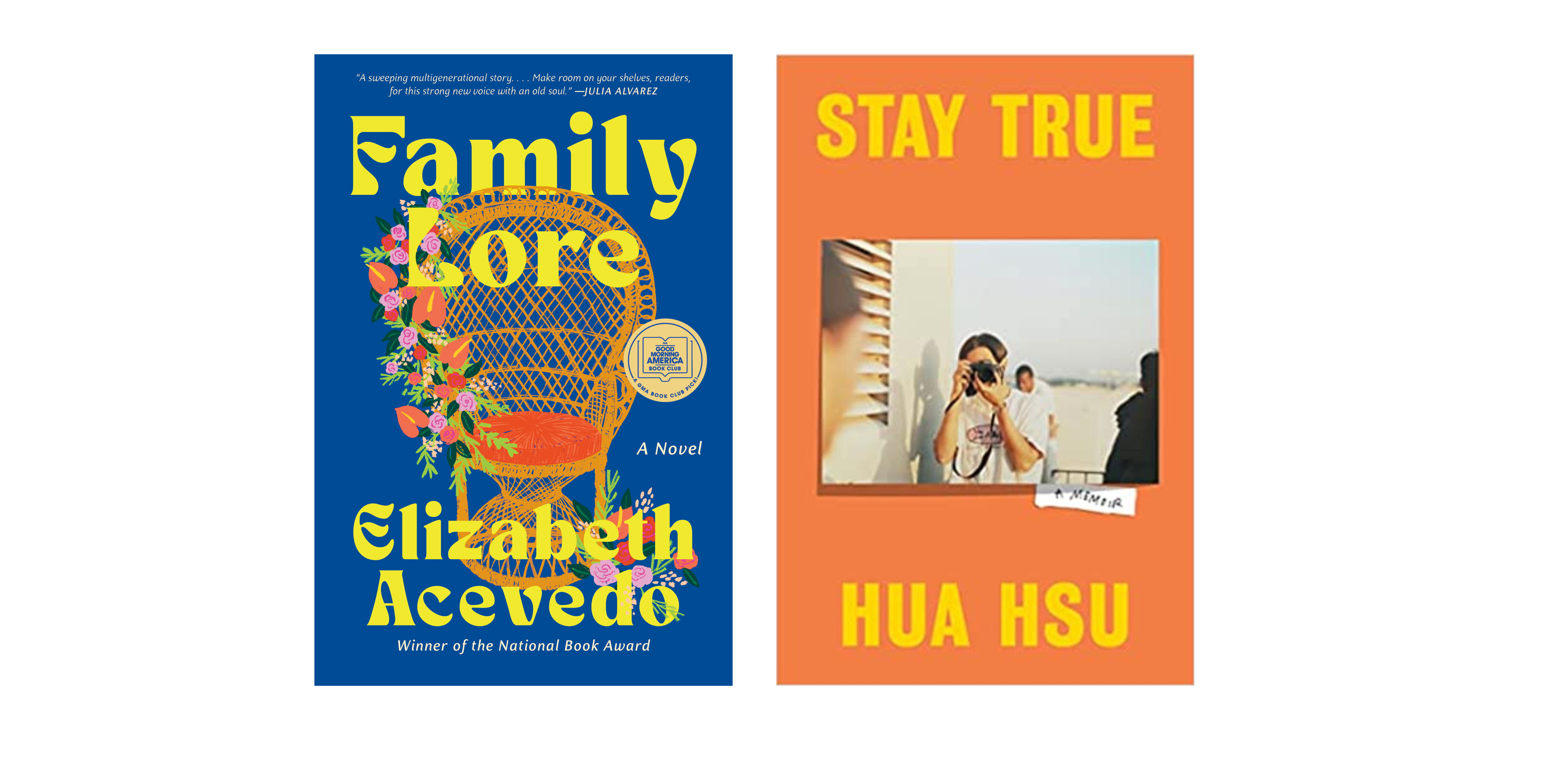
Book cover images for Family Lore by Elizabeth Acevedo and Stay True by Hua Hsu

Family Lore — Elizabeth Acevedo

There was a lot of deserved buzz for this book as Acevedo’s first novel for adults, and having read her YA novels The Poet X and With the Fire on High, I was eager to see how her unique voice adapted to an adult audience. Family Lore did not disappoint. A sprawling family saga that spans oceans and decades, the book follows the four Marte sisters and their daughters in the week leading up to sister Flor’s living wake. Each Marte woman has a gift, and since Flor has the ability to foresee when someone will die, her family is understandably shaken when she decides to host a celebration of her own life on short notice.

Told through the framework of interviews-turned-memories as Flor’s anthropologist daughter, Ona, attempts to preserve her family history, Family Lore traces the Marte sisters’ individual journeys from the Dominican Republic to New York, and all of the ways their lives intertwine in support, success, and disappointment. Acevedo’s signature lyricism is most present in the descriptions of her settings, treating both DR and NYC as wild, magical, proud places, and the tenderness with which she portrays the Marte women and each of their unique struggles makes it easy for readers to recognize their own loved ones in their stories. I’m excited to see more from Acevedo in the adult space!

Stay True — Hua Hsu

This is a book about someone who loses their best friend, but it’s also a book about identity and belonging, love, memory, and preservation. The New Yorker staff writer Hua Hsu eases us into the world of his early adulthood first with a depiction of his high school years, splitting time between California and Taiwan, forging an identity for himself as a loner alt-music fan, at odds with everything popular or mainstream.

This changes his freshman year at Berkeley when he meets Ken, a congenial, easy-going, trend-following frat bro who seems to represent everything Hsu resents, but who adopts Hsu into his world with such earnest compassion and interest that Hsu is powerless to resist his friendship. When Ken is senselessly murdered at the beginning of their junior year, Hsu’s world is shattered, and this memoir is the result of years spent working to reassemble their time together in a way that feels meaningful and respectful to his late friend’s memory.

On the night Ken dies, there’s a scene where Hsu is smoking on Ken’s new balcony, imagining all the memories they’ll make in this apartment in the coming year, only to realize within hours that that future no longer exists. This moment has defined so much of my thinking about time and loss lately, about how entitled we feel to an expected future, and how instantly it can change and render the past a previously unappreciated golden era we can never get back. Stay True is not a fun read, but it is a beautiful and powerful one. Hsu imbibes his friend’s memory with so much love and care that it makes Ken’s everlasting presence, both on and off the page, undeniable.

THE TIPPY TOP:

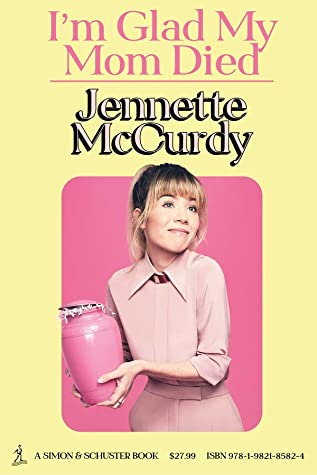
Book cover image for I'm Glad My Mom Died by Jennette McCurdy

I’m Glad My Mom Died — Jennette McCurdy

Unintentional that the two grief memoirs vied for the top spot this month, but these were the ones that had the biggest impact on me. While Stay True was a quieter anguish, Jennette’s narration of her trauma on the audiobook for her memoir brought her past starkly into the present in a way that I couldn’t put down. I feel like everyone I know read this book a year ago, but if you are also fashionably late, Jennette McCurdy’s memoir centers on her relationship with her mother, a terminally ill narcissist who physically and emotionally abused her daughter for the sake of being able to vicariously live out her own show business dreams.

Having grown up watching Jennette as Sam on iCarly, it was devastating to hear her speak about her unhappiness with such candor and to realize how much of it we unknowingly witnessed. I think a lot of late millennials will share the parasocial fondness I feel towards the Disney and Nickelodeon stars of our childhood, so to learn how badly she silently struggled with eating disorders, addiction, and her mother’s harmful control through all those years we watched her on TV, the sadness I felt for her was as if I had been neglecting the suffering of one of my actual friends.

There’s a moment about three-quarters into the book where Jennette hears a therapist verbalize for the first time that what her mother put her through was abuse, and in the narration, her voice cracks. You hear her take a steadying breath and push on with her reading, and in that moment when her worldview is first shattered, my heart breaks for her, too. She’s only a few years older than I am but she has had to fight nearly every day to be able to exist in a world where she can be at peace with herself, her body, and her memories of her mother. Her resilience is awe-inspiring, and the fact that she can write about her experiences with such frankness, insight, and humor speaks to her prowess as a writer and her rare talent to connect with people. I truly wish the best for her, and I am also so glad her mom died and set her free.


Thanks for reading! Next month may very well see the transformation of Lit Chat into a Heartstopper fan page, but I hope you’ll stick with me anyway. In the meantime, let me know if you have any thoughts about these books–I’m always down to chat!

Until next time, happy reading!
❤ Catherine


Housekeeping note: all links go to my Bookshop storefront, where each purchase supports independent bookstores (and this newsletter, because I get a small percentage of each sale).

Angels might be we all

January in Review — Lit Chat, Vol. 15

Pyramid of book cover images with The Book of (More) Delights by Ross Gay on top, Minor Details by Adania Shibli and Trespasses by Louise Kennedy in the middle, and Mad Honey by Jodi Picoult and Jennifer Finney Boylan, Days at the Morisaki Bookshop by Satoshi Yagisawa, and Iron Flame by Rebecca Yarros on the bottom.

Housekeeping note: all links go to my Bookshop storefront, where each purchase supports independent bookstores (and this newsletter, because I get a small percentage of each sale).


Hi friends,

January was a long, hard month, but there were a few bright spots, including a bunch of really great book events (Jami Attenberg! Kaveh Akbar!), comedy shows, time with friends, and absconding to Florida for some much-needed sunshine.

And of course, the books. In a month where most of my well-intentioned goals for the new year went swiftly out the window in record time, at least my reading stayed mostly consistent. Books are always a lifeline for me in the winter, but this year, they’ve felt especially necessary. If you have any good winter escapist recs, I would love to hear them.

Moving right along, we’ve got a full slate this month! If you’d prefer to get this post sent directly to your inbox, consider subscribing to my Substack below.


THE FOUNDATION:

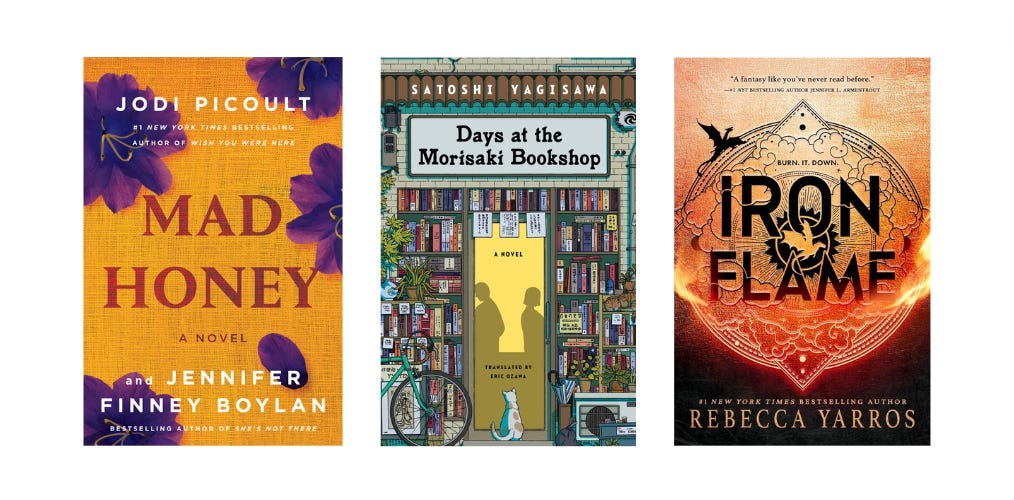
Book cover images for Mad Honey by Jodi Picoult and Jennifer Finney Boylan, Days at the Morisaki Bookshop by Satoshi Yagisawa, and Iron Flame by Rebecca Yarros.

Mad Honey — Jodi Picoult and Jennifer Finney Boylan

I’m not really a Jodi Picoult fan, but this book did prompt one of the most thoughtful book club discussions we’ve had in a long time. Picoult and Boylan largely split the writing for Mad Honey, with Boylan writing the perspective of Lily, a high school senior who tragically dies, and Picoult writing Olivia, a single mother whose son is put on trial for his girlfriend’s death. I preferred Lily’s chapters and appreciated that they were authored by someone with a particularly relevant lived experience, but I didn’t love that the plot ended up hinging on a surprise revelation that made way for a lot of topical spoon-feeding. That said, if there are readers who genuinely learn something about other people’s identities and experiences from this page-turner, then it’s achieving what it sets out to do.

Days at the Morisaki Bookshop — Satoshi Yagisawa, translated by Eric Ozawa

One of my reading goals for the year is to read more in translation, and this one was a fun start! After a bad breakup, Takako quits her life in the city to fulfill my personal dream of living and working in her uncle’s secondhand bookshop in Jimbocho, Tokyo, a neighborhood known for its many used bookshops. Once she’s back on her feet, she finds she has the opportunity to help her uncle do the same when his estranged wife reappears out of the blue. This gentle, heartwarming little book left me with a newfound interest in Tokyo’s secondhand bookshop scene and a whole reading list of translated Japanese literature, courtesy of the translator’s note at the end.

Iron Flame — Rebecca Yarros

The silver lining of an otherwise unsuccessful trip to the DMV in December was discovering that I had somehow been delivered a “skip-the-line” copy of this Fourth Wing sequel on Libby (did anyone else know this existed??). In this one, we’re back with Violet for her second year in the Riders Quadrant, but she’s struggling to hide the truth about what’s really threatening Navarre’s borders from her friends. When she finally caves, the story opens up at last to a world beyond Basgiath, with a host of new characters, folklore, and secrets to be uncovered—and kept. Supposedly this is only book #2 of 5, and judging by the ending, I’d say readers will need to strap in tight for the rest of the series. (TV adaptation when???)

SOLID SUPPORTS:

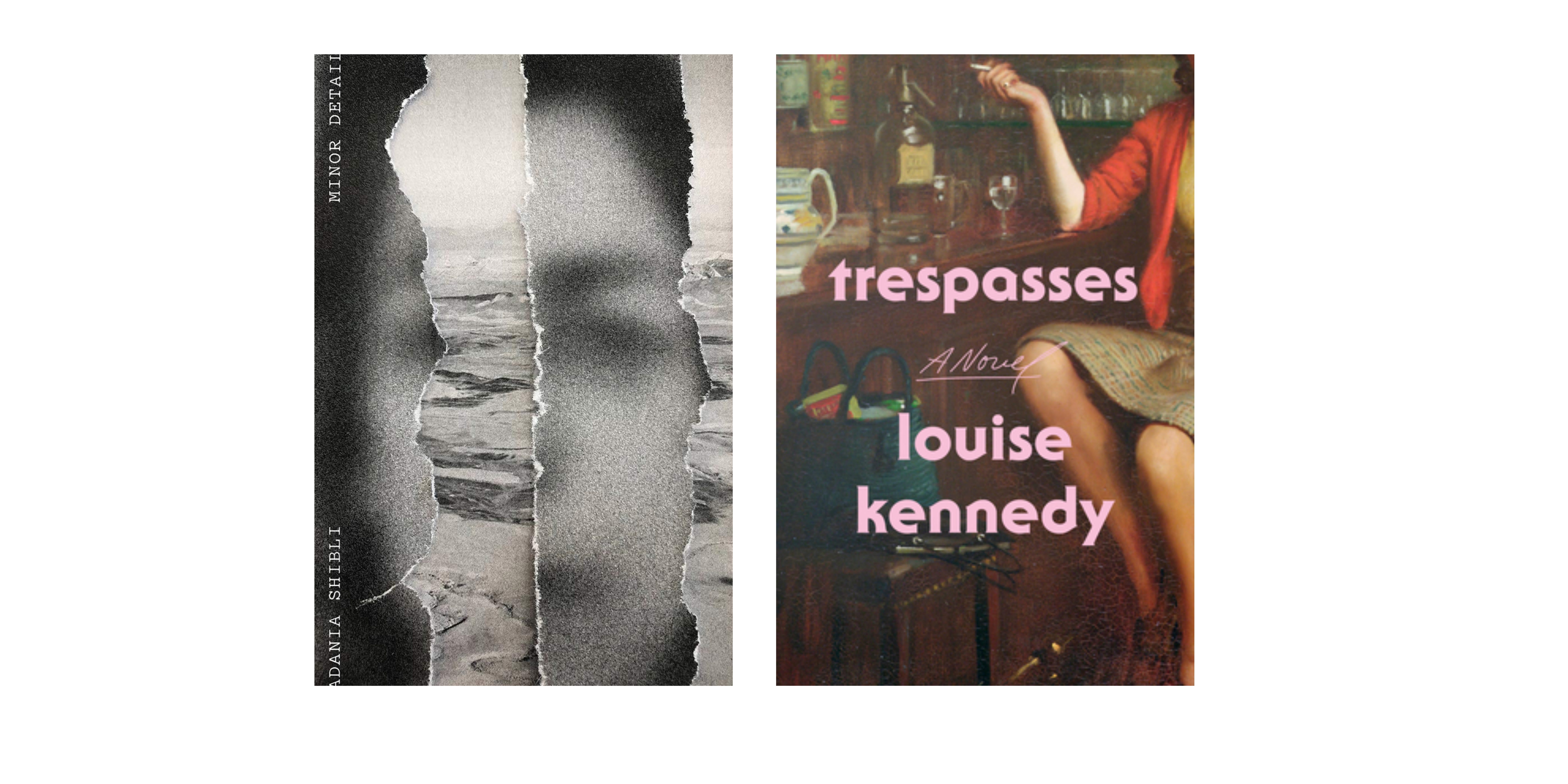
Book cover images for Minor Detail by Adania Shibli and Trespasses by Louise Kennedy

Minor Detail — Adania Shibli, translated by Elisabeth Jaquette

(CW: rape)
Another book in translation, this time from Palestinian author Adania Shibli. Coming in at just over a hundred pages, the first half of this book follows an Israeli officer in the aftermath of the Nakba in 1949, tasked with eradicating the last of the Arabs in the newly occupied territory. Over the course of these raids, the officers capture, rape, and kill a young Palestinian girl. Years later, a woman living in occupied Palestine reads of the incident and is consumed by the desire to learn more from the girl’s perspective.

This brief, haunting narrative is especially poignant when you consider that it was published in 2017, years before this latest chapter of horrific violence in the region but a product of the same conflict that has been ongoing for over seventy years. The book’s foundation is one of violence and eradication, so it’s unsurprising that the painstaking efforts of the second half to recover any personal details resembling truth are ultimately unsuccessful. There are no easy answers here, no closure, and no justice. How can answers be found when there is no one left to keep them, much less find them? This dilemma is once again unfolding in real-time, so if you haven’t written to your senators in a while about supporting a ceasefire, now would be a great time.

Trespasses — Louise Kennedy

Oh, how I love my Irish lit, depressing as it may be. Set in Belfast at the height of The Troubles, Trespasses follows Cushla, a young Catholic primary school teacher who begins an affair with an older, married Protestant barrister. I don’t usually go in for affair storylines, but for me, the romance took a backseat to the other alluring personalities that filled Cushla’s world: the eccentric regulars at her brother’s pub, the world-weary first-graders in her class, her sharp-tongued, alcoholic mother who misses absolutely nothing.

Kennedy brings this community to life in vivid color with smart, witty dialogue and a stark awareness of the boundaries drawn between themselves and the city around them, contrasting their would-be quiet lives with the persistent violence that is quite literally on their doorstep. The book is a study not merely of political conflict, but of internal and interpersonal conflict as well. All of this pushes Cushla to consider just how much she wants to ask from the life she’s been given—and whether it’s enough. I was surprised by how much I wound up enjoying the end of this one, and I’m looking forward to reading Kennedy’s short story collection, The End of the World Is a Cul de Sac, as well.


THE TIPPY TOP:

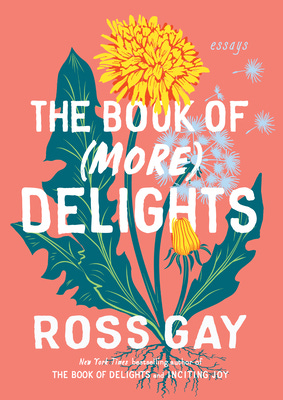
Book cover image for The Book of (More) Delights by Ross Gay

The Book of (More) Delights — Ross Gay

This book is as delightful as its title, made even more so by the author’s joyful audiobook narration. Though I haven’t read its predecessor, The Book of Delights, I believe this follow-up uses much the same format as a collection of daily musings on things the author finds delightful. The delights cover everything from hiking misadventures to gardening, gnomes, beloved family members, aging, basketball, trucks, angels, and many tender observations about the small routines and intimacies that make life precious.

About midway through the book, Gay comes to the realization that the delights are doubling as gratitudes, that they are a way of looking at the world with love and thankfulness for the gift of being able to experience them. As I listened to each delight while walking around my neighborhood, I found myself looking for—and finding—things to be grateful for in the vein of delights: the somehow as-yet unfrozen koi pond on the corner of my block; strangers who smile at you on the street in a wholesome, non-creepy way; the legion of Brooklyn Heights dogs in coats and booties; and the unexpected relief of walking out the front door and finding it warmer outside than expected.

These delights were a much-needed ray of sunshine in an otherwise tough, gray month. Being able to start my reading year off with these words of gratitude, and with the opportunity to use them as a lens for finding joy in my own life, was nothing short of a gift.


That’s all for January! I’m very excited about my February reading because the BPL gods have smiled on me (see below photo), so it’s safe to say I am BUSY for the foreseeable future (but also always down to chat in all the usual places).

Stack of hardcover books on a wooden desk, from top to bottom: Stay True by Hua Hsu, Gwen & Art Are Not in Love by Lex Croucher, The Paper Palace by Miranda Cowley Heller, Biography of X by Catherine Lacey, and Family Lore by Elizabeth Acevedo.
lucky lucky me!

Until next time, happy reading!
❤ Catherine

Lit Chat’s Best Books of 2023: Round 3

Housekeeping note: all book links go to my Bookshop storefront, where each purchase supports independent bookstores (and this newsletter, because I get a small percentage of each sale).
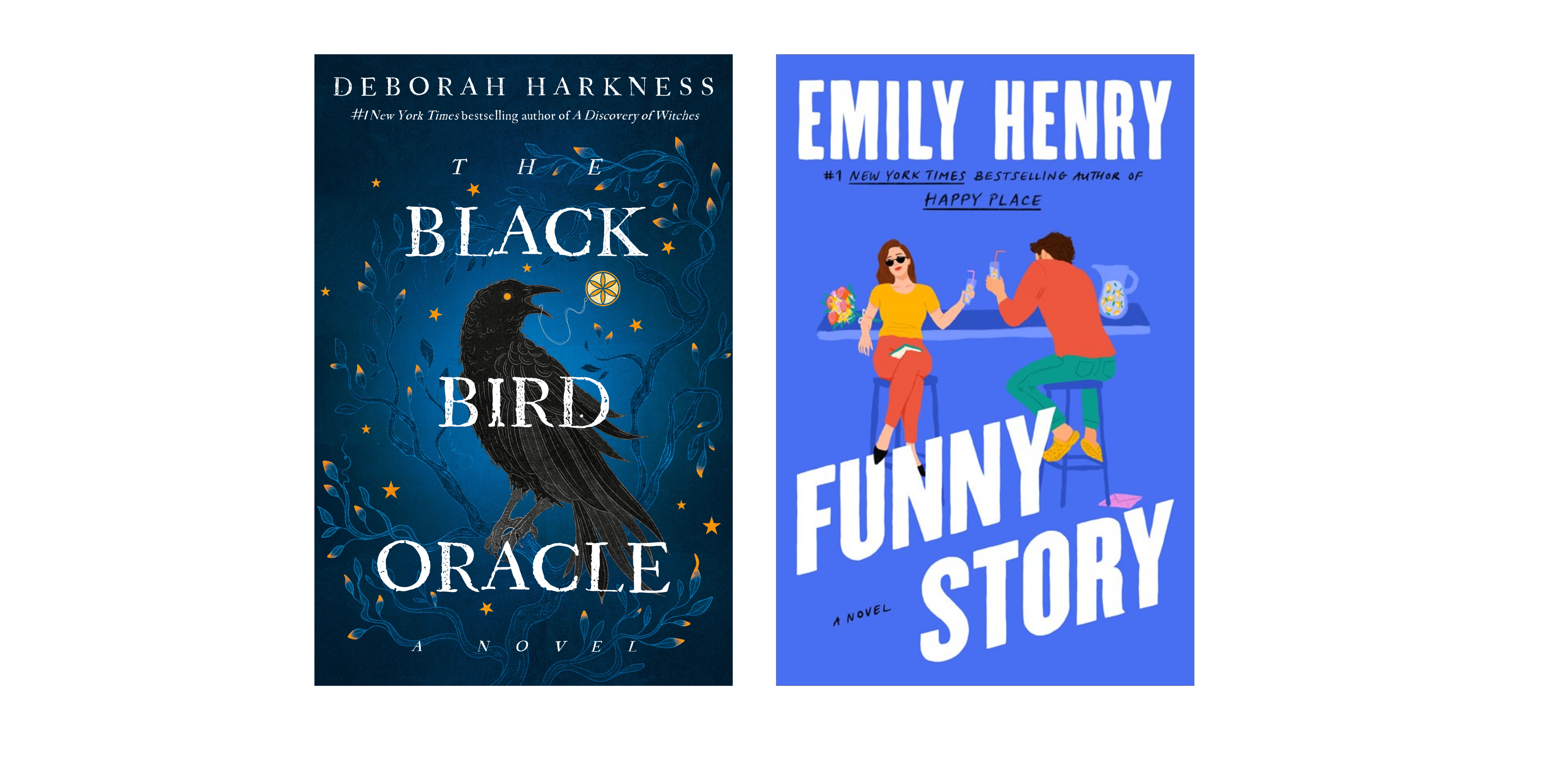

Hi friends,

I’m just as ready to put 2023 behind me as I’m sure you are by now, so let’s get this show on the road. After yesterday’s semifinals, these were our standings:

Graphic for the Best Books of 2023 bracket

Which leaves us with a top three: Gabrielle Zevin’s Tomorrow and Tomorrow and Tomorrow, R.F. Kuang’s Yellowface, and Kazuo Ishiguro’s Never Let Me Go. So without further ado, below are my official Best Books of 2023 final rankings:

Round Three:

Third Place: Yellowface by R.F. Kuang

Book cover image for Yellowface by R.F. Kuang
Read my original review here!

The fun thing about this being a bracket is that while I wouldn’t necessarily say this is my third favorite book of the year, I’m pleased that Yellowface has managed to fight its way to the top all the same. It doesn’t come close to the other two finalists in terms of lasting impact and emotional resonance, but as a satire about publishing, it has a distinct appeal to readers invested in this industry.

If you missed my initial review (and don’t feel like revisiting the August newsletter), Yellowface is about a white author who steals her late Asian-American friend’s manuscript about Chinese soldiers during WWI and passes it off as her own under a racially ambiguous pen name. As an Asian-American author writing a white protagonist, Kuang is in a unique position to call out some of the worst cycles of bias that have been perpetuated by those in positions of privilege in the industry via her narrator’s thoughts and behavior. Kuang wants us to feel shocked—she wants us to think, “Oh my God, she can’t say that,” when June thinks or speaks disparagingly about other writers and readers of color—and yet the shock comes not from the sentiment itself but the fact that it has been spoken aloud. In other words: Kuang goes there, sticks our face in the mess like an untrained dog, then washes her hands of it all. A worthy showing for this highly entertaining, if slightly niche read!

Second Place: Never Let Me Go by Kazuo Ishiguro

Book cover image for Never Let Me Go by Kazuo Ishiguro
Read my original review here!

This was so hard!! I flip-flopped a lot, but what my decision came down to is the fact that this book is ultimately SAD. Don’t get me wrong, I loved being knocked out by this book. It’s beautiful and insightful and moving and I do wholeheartedly believe there is value in experiencing the full range of human emotions through literature, but at the end of the day, I would simply prefer not to be sad! I would prefer to have a bit of hope, as a treat, and unfortunately, there is very little of that by the end of Never Let Me Go.

By no means do I mean to put anybody off from reading this—ultimately, it is #2 of the year for a reason and that reason is I believe it to be a profoundly important and impactful work of literature, but it’s heavy enough that I would recommend going into it with enough mental/emotional space to sit with the discomfort. That said, please read this one and come talk to me about it! Let’s be devastated together :’).

First Place: Tomorrow and Tomorrow and Tomorrow by Gabrielle Zevin

Book cover image for Tomorrow and Tomorrow and Tomorrow by Gabrielle Zevin
Read my original review here!

This book, on the other hand!!! The aforementioned full range of human emotions is undeniably present, and I would be lying if I said this one didn’t also make me sad—there may even have been tears! But what makes this one the ultimate winner of my Best Books of 2023 bracket is that the sadness is balanced out by an overwhelming amount of love. In fact, it wouldn’t even be sad if so much love had not preceded the sadness. And there are so many different kinds of love present, including friendship love, romantic love, familial love, creative love, and the ultimate respect that comes from experiencing so many facets of love within the same relationship.

Often when I think back on a book, my first thought is the memory of how I felt when it was over. Tomorrow and Tomorrow and Tomorrow had one of my favorite endings of all time, because (and this isn’t a spoiler!) it ends almost exactly how it begins. Thematically, this restart was the perfect ending for a book about video games, but emotionally, the suggestion that the story was only just beginning anew was everything I wanted for the two main characters. I didn’t need to know how their story ended because I didn’t want it to end—I wanted them to remain open to a whole lifetime of friendship and creative potential and mutual respect borne of years and years of loving each other in different ways. With this ending, we get to believe that this is true. So for the sake of this bracket (and for always), I hereby declare that love WINS!!!


Honorable Mentions:

Book cover images for Assembly by Natasha Brown, Red at the Bone by Jacqueline Woodson, Happy All the Time by Laurie Colwin, The Hurting Kind by Ada Limon, Time is a Mother by Ocean Vuong, Hello Beautiful by Ann Napolitano, Edinburgh by Alexander Chee, Eileen by Ottessa Moshfegh, The Song of Achilles by Madeline Miller, Pew by Catherine Lacey, Fourth Wing by Rebecca Yarros, and So Late in the Day by Claire Keegan.

Above are some of my favorite runners-up from the year! Though all of these books fell short of the official monthly top spot, let’s just say this year’s bracket would have looked a lot different had some of these been in play. Maybe I’ll do a bigger one next year? In the meantime, I’ll do one last push for you to check out the Lit Chat archives for reading inspiration if one of these covers catches your eye, and I’ll also remind everyone that all of these books are neatly organized by month on my Bookshop storefront! And if you want these posts straight to your inbox, then go ahead and click the button below to subscribe on Substack.


Thanks so much to everyone for reading with me in 2023, especially those of you who have reached out to chat about these and other books or who have shared this newsletter with other fellow readers. I so appreciate you!

ALSO I almost forgot, but I will be sending an email out soon to those interested in joining my little in-person reading show & tell club! If you’re local to NYC and haven’t already let me know you wanna come, reach out! Tentative date is Saturday, January 20th with more details to follow.

Until next time, happy reading and cheers to many more good books in 2024!
❤ Catherine

Lit Chat’s Best Books of 2023: Round Two

Housekeeping note: all book links go to my Bookshop storefront, where each purchase supports independent bookstores (and this newsletter, because I get a small percentage of each sale).
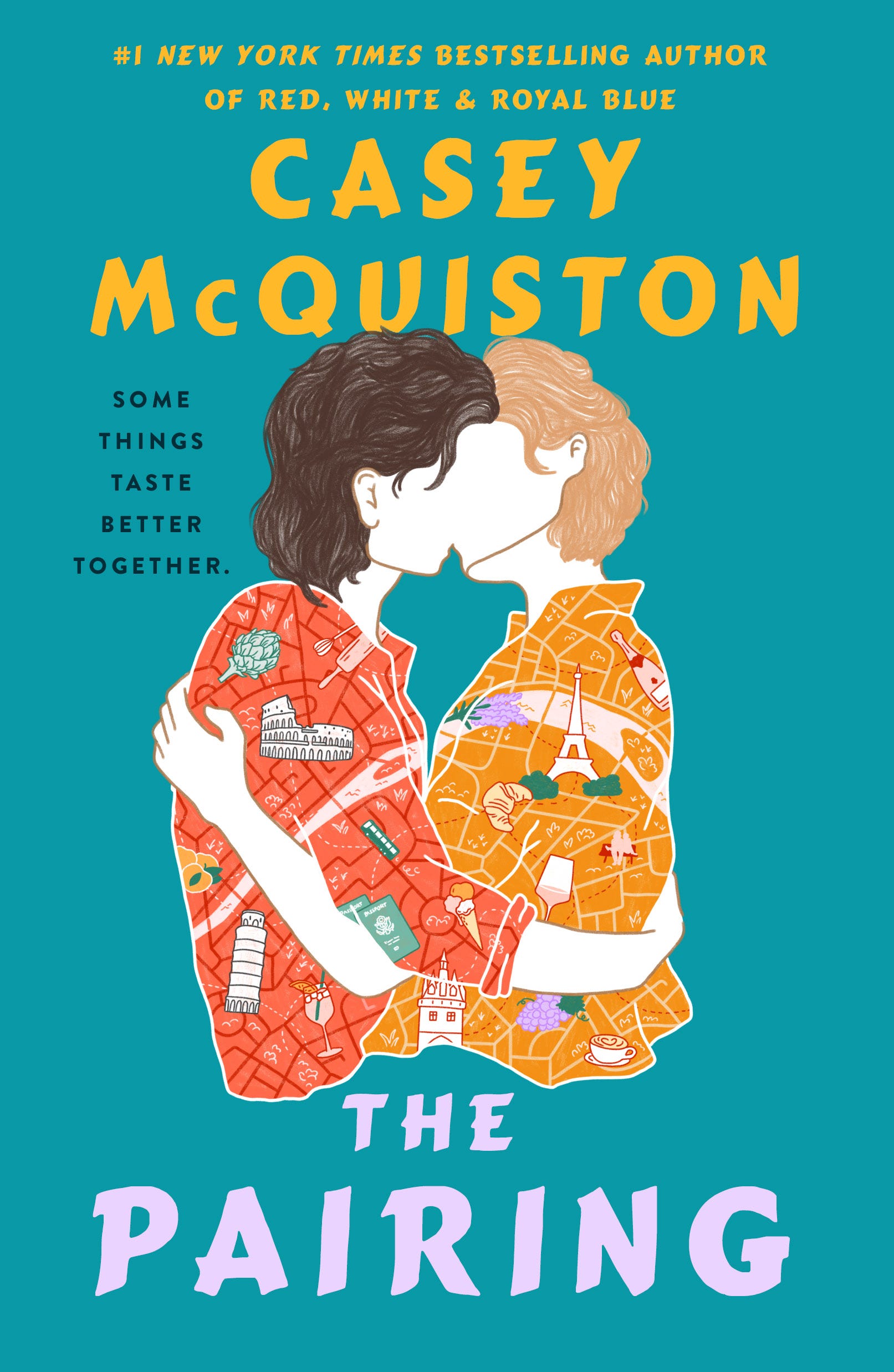

Hi friends,

Welcome back for another round of my highly subjective Best Books of 2023 bracket! Today, we have six titles facing off for the honor of making it to the top three, which makes this the semifinals already! Here’s where we stand so far:

Best Books of 2023 bracket image

Also, a quick reminder that you can get this post directly to your inbox if you subscribe to my Substack!

All right, it’s a gloomy day in Brooklyn; let’s talk about some books.
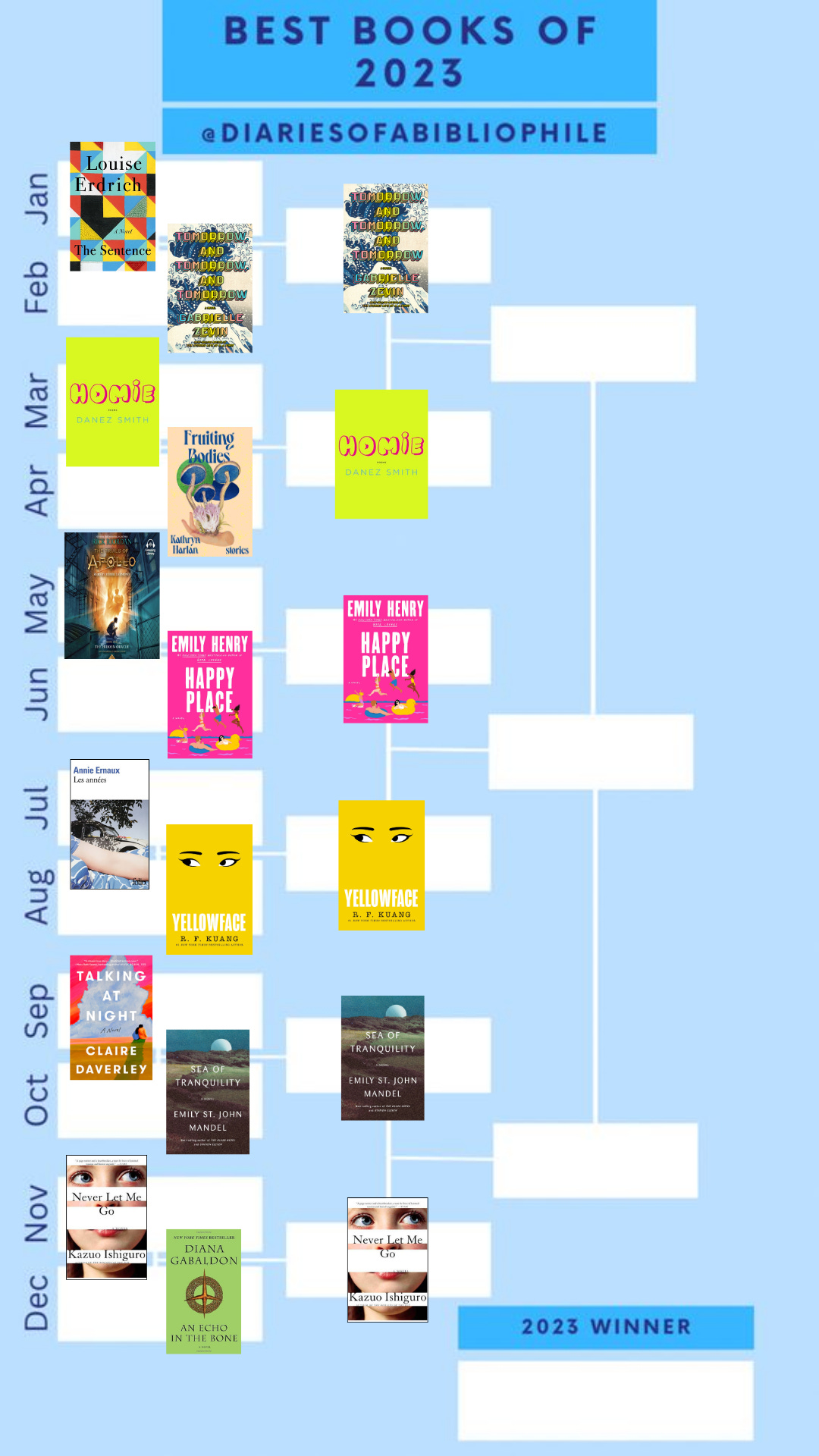

ROUND TWO:

Book cover images for Tomorrow and Tomorrow and Tomorrow by Gabrielle Zevin and Homie by Danez Smith

Tomorrow and Tomorrow and Tomorrow by Gabrielle Zevin vs. Homie by Danez Smith

I so wish I didn’t have to put these two head to head because they are truly in leagues of their own, but so it goes. When I think of comparing these two books, I think of scope: Homie, though completely wonderful, simply feels small in comparison to the sprawling saga that is Tomorrow and Tomorrow and Tomorrow. What I love about Homie is how it does so much emotionally with such a small space, as a testament to all the people and places the poet loves, but we don’t necessarily get to know those people as closely as we do when we follow their lives for decades like we do in Tomorrow and Tomorrow and Tomorrow. At their core, both books are centered around friendship, which is why this feels slightly unfair because a novel is a completely different vehicle for exploring the nuances of that friendship and, in this case, the worlds that are created as a result. While I loved feeling like a witness to Danez Smith’s highly personal world, I felt fully inside not only Sam and Sadie’s real lives, but also each of the worlds they created in their games. This expansiveness is why I’m moving Tomorrow and Tomorrow and Tomorrow forward, though it’s with a heavy heart that I leave Homie behind.

Book cover images for Happy Place by Emily Henry and Yellowface by R.F. Kuang

Happy Place by Emily Henry vs. Yellowface by R.F. Kuang

Something I’ve learned about myself and my media consumption habits lately is that fundamentally, I am not a hater but a liker. I like to enjoy things, and I am fairly easily pleased! Unless I am specifically approaching something with skepticism, I’m more than happy to turn the critical thinking part of my brain off for the sake of entertainment. Some books are better suited for this than others—in my initial read of Happy Place, I was perfectly happy to be along for the ride. I love stories that feature big friend groups, particularly ones in the same phase of life as me, so I was content to overlook the fact that the secondary characters often fell a little flat. I also love rooting for a good romance, especially when we’re more concerned with the characters’ chemistry than the fact that it’s completely insane to (spoiler) abandon a neurosurgery degree that you’re hundreds of thousands of dollars in debt for to become a…potter? Details, details! Suspend disbelief for love! I still had a great time with Happy Place, but as many of my more critical friends were quick to point out, there are definitely some holes.

Yellowface, on the other hand, is meant to be insane. Yellowface is written from the perspective of a hater and a grasper and an all-around kind of terrible person, and there’s something so delicious about being inside her head and watching from behind your fingers as she continues to make shocking decisions. As a commentary on race and privilege in the publishing industry, Yellowface ultimately also has more to say in general than an unconcerned-with-reality rom-com. I have more I want to say about Yellowface still, which is why I’m officially moving it forward to the finals.

Book cover images for Sea of Tranquility by Emily St. John Mandel and Never Let Me Go by Kazuo Ishiguro

Sea of Tranquility by Emily St. John Mandel vs. Never Let Me Go by Kazuo Ishiguro

This one is TOUGH. The hard thing about this bracket is that a book like Sea of Tranquility would have easily beat out so many others on this list, but against Never Let Me Go it’s a lot less of a wash. These two are similar in genre, and both stayed on my mind for a long time after reading, though for different reasons. As a time-travel story, I spent days puzzling through the events of Sea of Tranquility and how each action seemed perfectly placed to affect not just the story, but also our understanding of time, space, and free will. It presented a fascinating intellectual question that, in its narrative execution, could also be appreciated as a masterful work of literature. It’s still one of my favorite books of the year, but its impact isn’t quite on the scale of Never Let Me Go.

The way that Never Let Me Go continues to take up space in my brain can only be described as a haunting. For a sci-fi/speculative fiction novel, it’s eerie how easily the reader finds themselves settling into daily life at Hailsham, how normalized and almost comfortable it is as a setting in which we’re happy to ignore the many, many red flags about the world beyond. And though a world in which (spoilers!!!) clone children are raised and groomed for the sole purpose of donating their organs does still feel far-fetched (for now), their treatment by society is all too familiar: othered, subhuman, and ultimately disposable. One of the most terrifying parts is realizing how easily we might agree with this thinking had we not spent the whole book watching these characters grow up, and yet the central question of whether or not the children have a soul is still not one I feel fully prepared to answer by the end of the book. It’s a question I’m not sure I’ll ever have a definitive answer for, but one I know I’ll be pondering for a very long time.


There you have it, my top three finalists! Come back tomorrow to see how the final three rank and check out a brief list of honorable mentions for books that I loved in 2023 but which didn’t make the bracket.

Thanks for reading, chat more soon!
❤ Catherine