Those claws, those claws, those claws

Lit Chat Vol. 35—May and June in Review
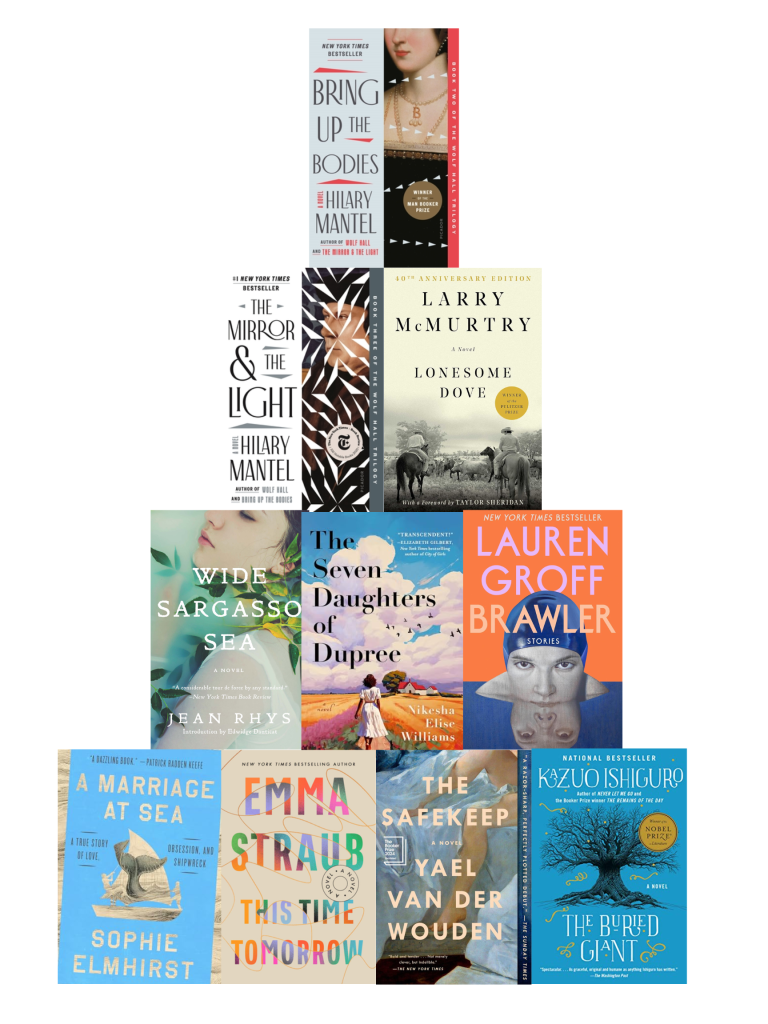
Pyramid of book cover images with  A Marriage at Sea by Sophie Elmhirst, This Time Tomorrow by Emma Straub, The Safekeep by Yael Van Der Wouden, and The Buried Giant by Kazuo Ishiguro on the bottom; Wide Sargasso Sea by Jean Rhys, The Seven Daughters of Dupree by Nikesha Elise Williams, and Brawler by Lauren Groff in the third row; The Mirror & the Light by Hilary Mantel and Lonesome Dove by Larry McMurtry in the second row, and Bring Up the Bodies by Hilary Mantel on top

Hi friends,

I have a confession to make: I’ve forgotten how to read.

Okay, obviously not actually, but I am in a big ol’ reading slump. This happens to me sometimes in the summer. I start off hot and excited about summer reading, and then somewhere between the heat waves and the excessive travel and the wildfire smoke, all I want to do by mid-July is lay flat on the couch and mainline Love Island UK.

What gets you out of a reading slump? I’m hoping this newsletter will reset me, because I did read quite a lot in May and June before the inclination to do anything cerebral exited my brain. This is actually going to be a pretty big one to compensate, so bear with me! The top few are worth it.

If you’d rather get this post straight to your inbox, subscribe to my Substack here!


THE FOUNDATION
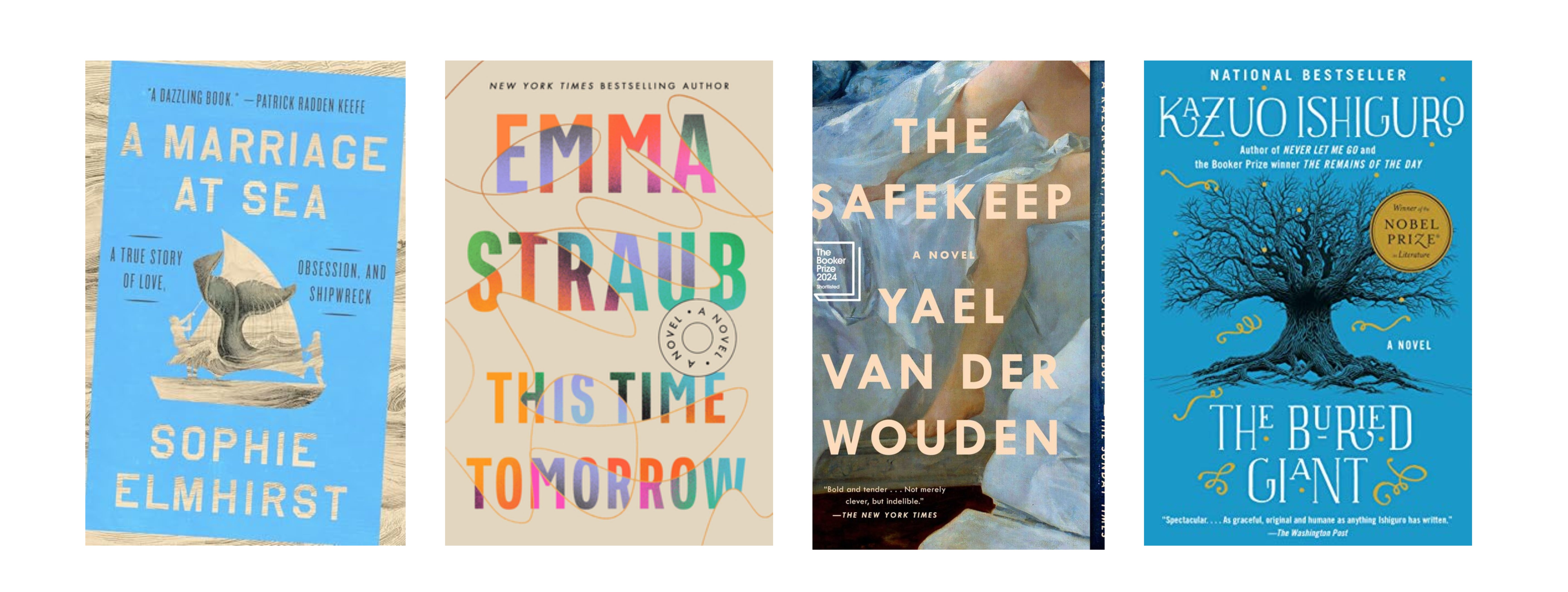
Book cover images for A Marriage at Sea by Sophie Elmhirst, This Time Tomorrow by Emma Straub, The Safekeep by Yael Van Der Wouden, and The Buried Giant by Kazuo Ishiguro

A Marriage at Sea — Sophie Elmhirst

If you’re planning a sea voyage anytime soon, this is not the book for you. However! If you’re interested in real-life survival stories that double as an examination of a relationship, then definitely add this one to your list. A Marriage at Sea tells the true story of Maurice and Maralyn Bailey, a British couple who survive being shipwrecked in the Pacific Ocean for 118 days in 1973. However, the shipwreck part is only about a third of the book, as the rest follows Maurice and Maralyn’s journey both before and after the voyage that made them famous. Although not as exciting or interesting as the actual emergency, understanding both of their personalities and their dynamic together is essential for understanding how they’re able to survive as a unit as long as they do—both before and after the rescue. I recommend this one on audio!

This Time Tomorrow — Emma Straub

It’s no secret that we’re big fans of time travel stories over here at Lit Chat HQ, and I’m always looking to see how different authors handle the mechanics. In this one, 40-year-old Alice discovers she can go back and relive her sixteenth birthday whenever she wants, and starts experimenting with how making different decisions on that day alters her life in the future. Her ultimate hope is that she can somehow figure out a way to make her dad, hospitalized in the present, well again. I enjoyed getting a feel for 90s New York in the time travel scenes, but it lost me for a bit in the middle with all the different iterations of Alice’s potential lives. The real heart of the story lies in the time spent exploring her relationship with her dad, reliving her teenage days with the younger, healthier version of the father she is on the brink of losing in the present. Their relationship brought me back into the story and ultimately landed the emotional plane for me.

The Safekeep — Yael van der Wouden

Real ones also know I love a good historical fiction novel, and The Safekeep delivers in unexpectedly novel and satisfying ways. Set in the outskirts of Amsterdam in the aftermath of World War II, it follows a young woman forced to host her brother’s girlfriend at her family home for an indeterminate amount of time. Though initially strained, the connection between the two women takes on a depth that has farther-reaching impacts than either of them could have imagined. I also learned something new about WWII history, which I can’t fully get into here for fear of spoilers, but which added an unexpected layer of significance and emotional impact to the novel. Fast-paced and just gorgeously written, this novel would be a great addition to your tote bag this summer.

The Buried Giant — Kazuo Ishiguro

I picked this up in Exile in Bookville when I was in Chicago for a conference in April and had lots of time to kill, and I didn’t even realize that it was an Ishiguro book at first because it doesn’t look like any of his other Penguin covers. This one checks a lot of my boxes as a historical-ish novel that reads like a fairytale about ancient heroes, forgotten glory, and gentle, persistent love. Set in medieval Britain, it follows an elderly Saxon couple as they journey across the land to visit their son, but they and everyone else around them are thwarted by a fog that has stolen most of their memories. Ishiguro’s style is elegant and ethereal, evocative of legend and the simplicity of times past—perhaps not as they actually were, but as we imagine them to have been. If A24 gave this The Green Knight treatment, I’d watch the hell out of it.


SOLID SUPPORTS PART ONE
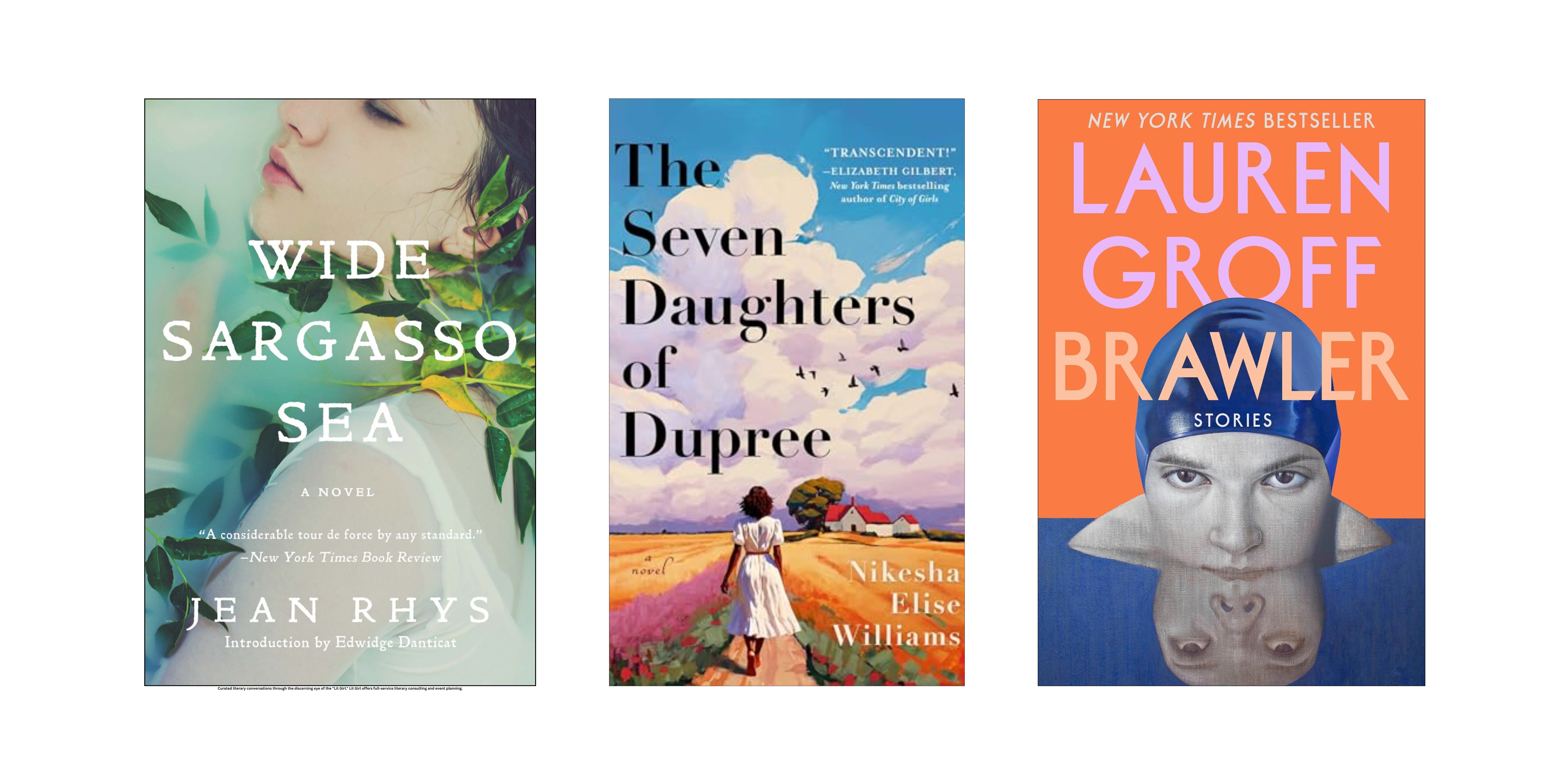
Book cover images for Wide Sargasso Sea by Jean Rhys, The Seven Daughters of Dupree by Nikesha Elise Williams, and Brawler by Lauren Groff

Wide Sargasso Sea — Jean Rhys

I picked this one up during a Reading Club field trip to Liz’s Book Bar in April. Side note: look how cute everybody is!
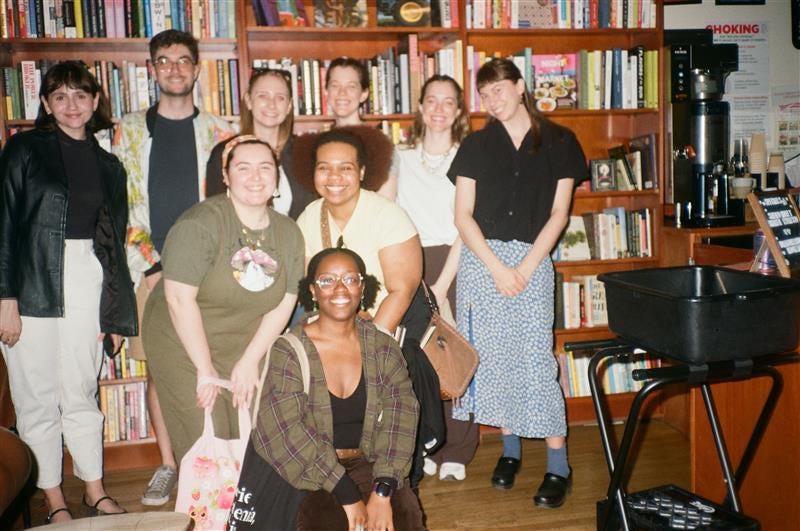
A group of adult friends in front of a large bookshelf in Liz's Book Bar
shoutout to Sarah’s film camera!

Apparently Jean Rhys, who was born in the Caribbean, took issue with the fact that all we knew of Mr. Rochester’s unstable wife in Jane Eyre was that she was also from the Caribbean, so she took it upon herself to write the story of that first wife. In Rhys’s hands, Bertha Mason becomes Antoinette, a white Creole girl growing up in poverty on a post-slavery Jamaican plantation. Rhys’s descriptions of her homeland are full of color and spirit, dominated by an inherent wildness that Antoinette’s eventual, unnamed English husband refuses to understand and seems to fear as much as he does the resentment from their emancipated neighbors. As Edwidge Danticat writes in the introduction, the result is a deliberately misunderstood woman who would likely have gotten along quite well with Jane Eyre, and had plenty to talk about, if only they’d been given the chance.

The Seven Daughters of Dupree — Nikesha Elise Williams

I was given a PDF of this book to read in evaluation for the Center For Fiction’s First Novel Prize, but eventually switched over to the audiobook for the sake of time and because the narrator turned out to be fantastic. This is a multi-generational story of one family of Black women, spanning from 1861 Alabama to 1995 Chicago. Descendants of an enslaved woman and a white plantation master, each generation of women seeks answers to the “curse” of their generational trauma, culminating in the reveal of a long-buried secret about their ancestor’s violent fate. Well-balanced and driven by each character’s unique voice, I loved how each generation seemed to explore the same questions of identity, family, and fate in ways that were particular to their time and place, yet very much part of the ongoing conversation of their family history. I really hope this debut sees some recognition from the CFF!

Brawler — Lauren Groff

I’ve read a couple of Groff’s books before, so, obviously, I knew she could write, but I didn’t realize she could physically hurt me with her words. This collection was gut punch after gut punch of short stories, nearly all of them following characters either in a crisis or on the brink of one, exploring the humanity revealed in the way they dealt with their circumstances. Reading these stories made me feel like I was in back in school, like I wanted to sit down and copy her sentences out for myself just to see how they were working. I wonder, sometimes, why writers feel the need to create characters just to make them suffer, but Groff’s stories do more than that. They invite us to suffer with them, to experience a full range of human emotion, to ask ourselves what we would do in their position and would we be able to see the beauty in it, as we can as a reader? I’m actually still reeling about this one a little, if you couldn’t tell.


SOLID SUPPORTS PART TWO
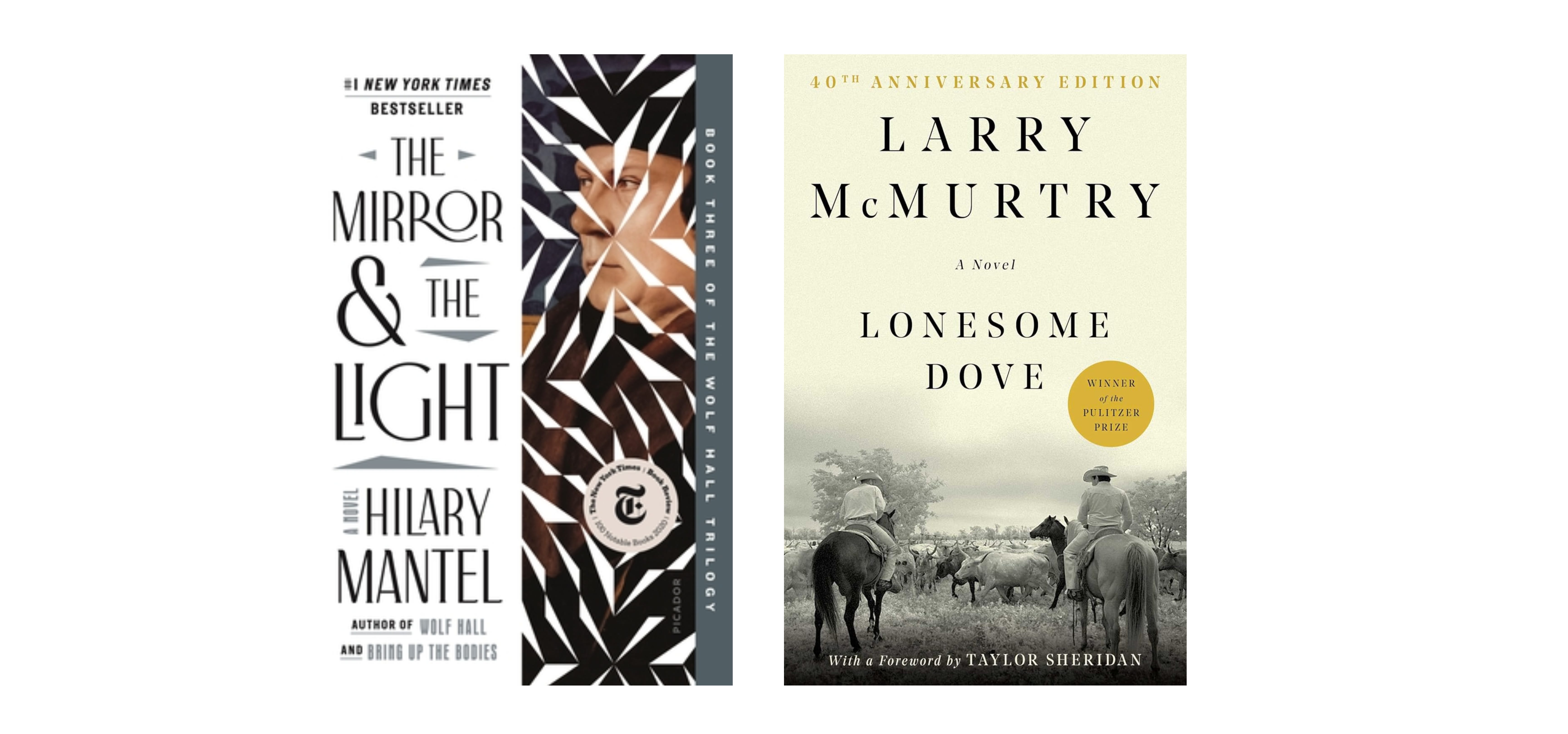
Book cover images for The Mirror & the Light by Hilary Mantel and Lonesome Dove by Larry McMurtry
ohhhh boy, now we’re getting into the big guns

The Mirror & the Light — Hilary Mantel

Now, I know what you’re thinking. Yes, this is the third book of the trilogy. Yes, we have not discussed book #2 yet. I considered combining books two and three because I read them pretty much back to back and as a whole, they provided the most superior reading experience of my summer so far. HOWEVER. Both books were also completely different reading experiences, and I will get more into this in just a moment!

Suffice it to say that I finished book #3 of the trilogy while sick in bed after too much travel, devastated by the inevitability of events that already came to pass nearly five hundred years ago, but which you can’t help but hope will somehow be stopped. The injustice of it all! The hubris of kings and would-be kings!! Power is a wheel of fortune from whose turning no one is safe, etc. etc. The real reason I’m ceding the top spot to the second volume is because it is simply much more fun to read about somebody coming into their power than falling from grace, and also because the title phrases of the mirror and the light were referenced just a few too many times for my liking. We get it! It’s the title!

Lonesome Dove — Larry McMurtry

If you had told me in January how deeply invested I would become in the logistics of an 800-page cross-country cattle drive by June, I would have been confused but honestly, not surprised. What did surprise me was how fast each week’s fifty or so assigned book club pages seemed to fly by, and how difficult it was to put it down and pace myself over the course of several months. For a book about a bunch of mostly white guys who have difficulty expressing their feelings, they sure made me feel a whole lot!!

Historical (in)accuracies aside, I was charmed by the idea of a young America still so vastly undeveloped by white settlers, of large expanses of land that are probably now Walmart parking lots but were once wild and dangerous and beautifully untouched. Just as charming were the cowboys themselves, from the youngest ranch hand to the oldest former Texas Rangers past their prime, in search of a little more glory.

Their quest for purpose and legacy, their sense of honor and duty, and their respect for nature and the unpredictable twists of fate that governed their journey made me feel—similar to The Buried Giant—nostalgic for a time and place that may or may not have ever existed outside of our collective imagining. And yet, by the end of the book, one is left with the feeling that something intangible has been lost with the completion of their journey, an era officially ended and its heroes gone with it. One is also left with an extremely questionable Facebook Marketplace algorithm.


THE TIPPY TOP
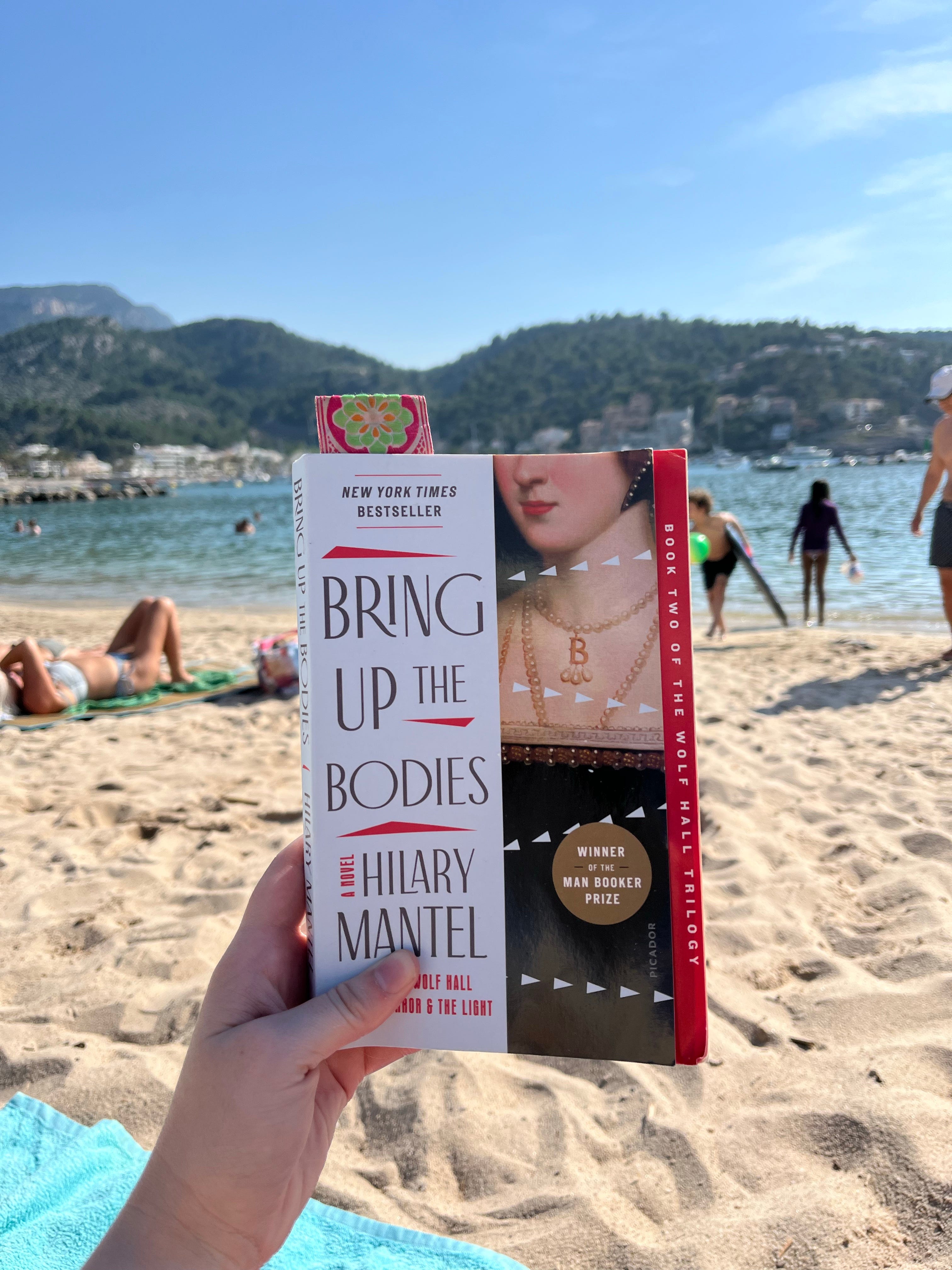
A hand holding up the book Bring Up the Bodies by Hilary Mantel in front of the water on a Mallorcan beach
obviously, the Mallorcan beach was going to be the superior reading experience

Bring Up the Bodies — Hilary Mantel

Okay, just so we’re all caught up: Bring Up the Bodies picks up where Wolf Hall left off, with Henry VIII growing suspicious of Anne Boleyn’s inability to give him a son and starting to get the hots for Jane Seymour. Who but Thomas Cromwell, the architect of Henry’s first divorce from Katherine of Aragon, should be the man to make his king’s dreams come true again? Bring Up the Bodies chronicles the downfall of Anne Boleyn and her supporters, and the rise in favor of Thomas Cromwell as the man who makes it all happen.

I’ve long been fascinated by the mechanisms and intricacies of power: who has it, who doesn’t, who can learn to speak its language before being silenced by it. This is not simply the story of a king in love and his humble servant; it’s the story of a world power seeking to position itself to its advantage against other world powers, via the scheming of someone who has lived enough lives across the continent to be deeply familiar with the inner workings and key players of each empire. Europe is Thomas Cromwell’s chess board, and Henry’s court is a game of checkers where Cromwell seems poised to king himself.

There’s a reason Anne Boleyn’s story persists with more mythos than the rest of Henry’s wives: it’s juicy! Her ladies sold her out! Was she a witch? Did she have sex with her brother? We’ll never actually know. What we do know, we’ve pieced together from what the other game players left behind: the laws they wrote, the trials they recorded, and of course, the graves they dug. The Mirror & the Light concludes Cromwell’s story the only way it can, but Bring Up the Bodies is the best of the trilogy, in my opinion, because it shows him at his best. Fluent in intrigue, master manipulator, always three steps ahead and never blind to how he and those he loves may benefit.

Was he right? Was he just? It’s morally gray at best. But was he good at what he did? Hilary Mantel gives us the pleasure of witnessing that for ourselves


Can you see now how the Wolf Hall trilogy has ruined me for other summer reading? I spent almost 2,000 pages of feasting on gorgeous prose with the guy just for him to lose his head. It’s been a month and I’m still in mourning for Thomas Cromwell, but I have been eyeing the four-in-one Elena Ferrante I got for Christmas lately, so maybe it’s time to trade one saga for another.

In the meantime, I’d love to hear about how your summer reading is going. Inspire me, I’m begging you! You can find me in all the usual places.

Until next time, happy reading!
❤ Catherine


Housekeeping note: all book links go to my Bookshop storefront, where each purchase supports independent bookstores (and this newsletter, because I get a small percentage of each sale).
Lit Chat’s Best Books of 2023: Round 3

Housekeeping note: all book links go to my Bookshop storefront, where each purchase supports independent bookstores (and this newsletter, because I get a small percentage of each sale).


Hi friends,

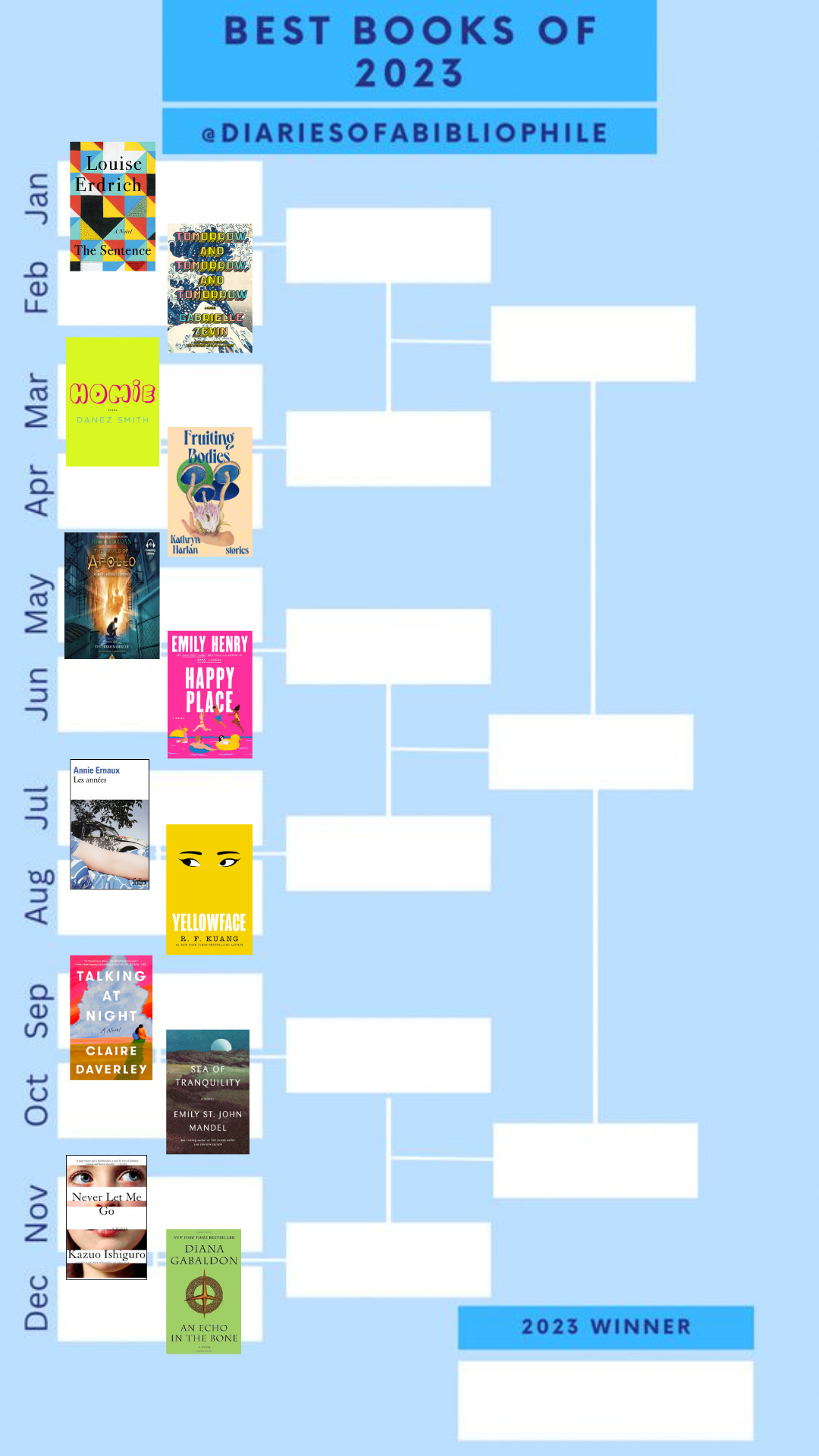
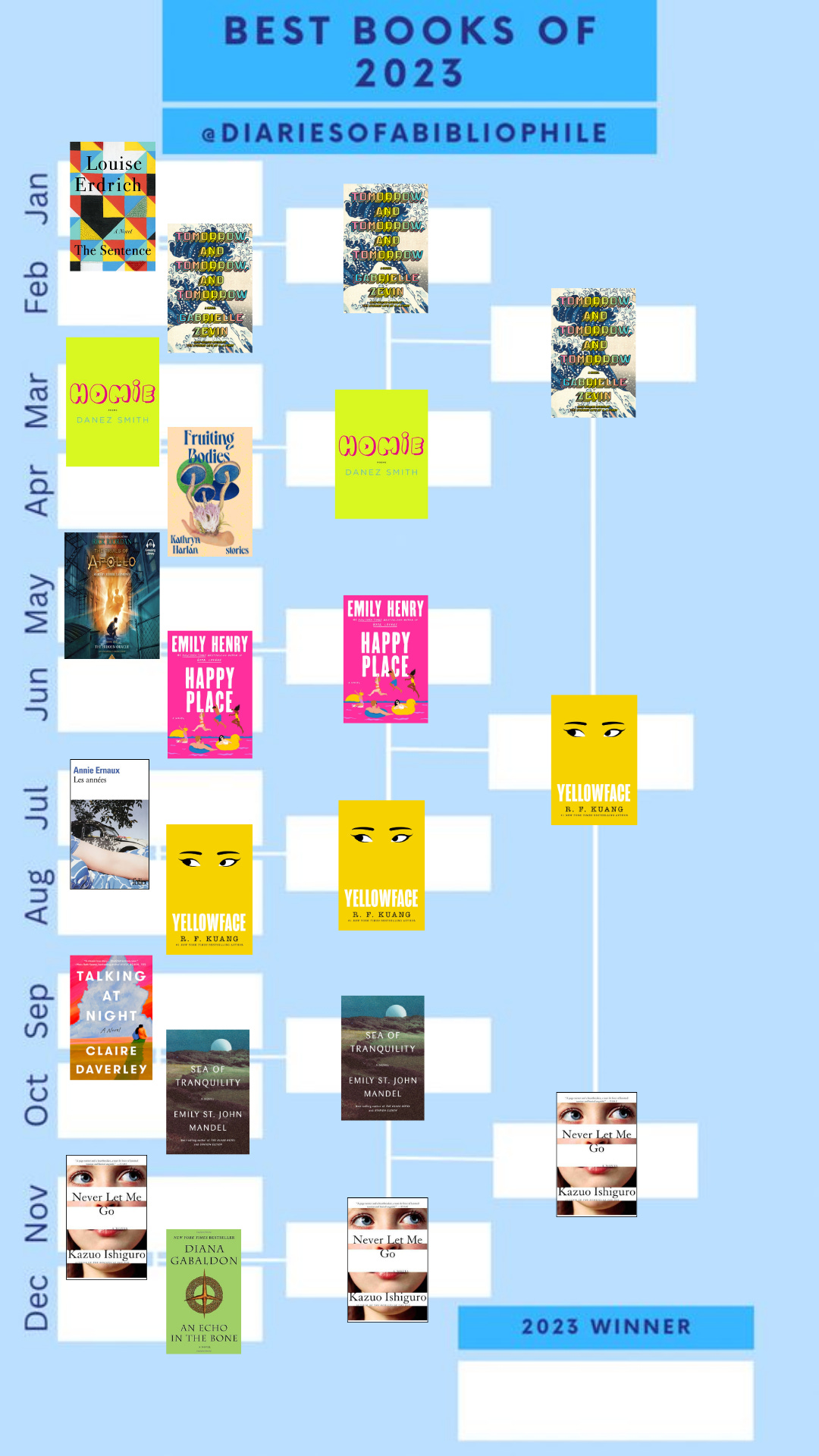
I’m just as ready to put 2023 behind me as I’m sure you are by now, so let’s get this show on the road. After yesterday’s semifinals, these were our standings:

Graphic for the Best Books of 2023 bracket

Which leaves us with a top three: Gabrielle Zevin’s Tomorrow and Tomorrow and Tomorrow, R.F. Kuang’s Yellowface, and Kazuo Ishiguro’s Never Let Me Go. So without further ado, below are my official Best Books of 2023 final rankings:

Round Three:

Third Place: Yellowface by R.F. Kuang

Book cover image for Yellowface by R.F. Kuang
Read my original review here!

The fun thing about this being a bracket is that while I wouldn’t necessarily say this is my third favorite book of the year, I’m pleased that Yellowface has managed to fight its way to the top all the same. It doesn’t come close to the other two finalists in terms of lasting impact and emotional resonance, but as a satire about publishing, it has a distinct appeal to readers invested in this industry.

If you missed my initial review (and don’t feel like revisiting the August newsletter), Yellowface is about a white author who steals her late Asian-American friend’s manuscript about Chinese soldiers during WWI and passes it off as her own under a racially ambiguous pen name. As an Asian-American author writing a white protagonist, Kuang is in a unique position to call out some of the worst cycles of bias that have been perpetuated by those in positions of privilege in the industry via her narrator’s thoughts and behavior. Kuang wants us to feel shocked—she wants us to think, “Oh my God, she can’t say that,” when June thinks or speaks disparagingly about other writers and readers of color—and yet the shock comes not from the sentiment itself but the fact that it has been spoken aloud. In other words: Kuang goes there, sticks our face in the mess like an untrained dog, then washes her hands of it all. A worthy showing for this highly entertaining, if slightly niche read!

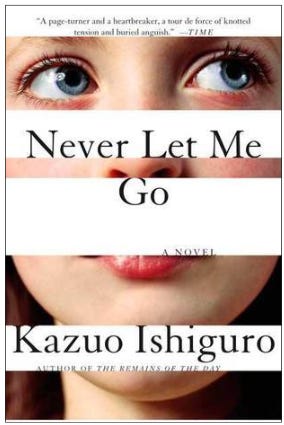
Second Place: Never Let Me Go by Kazuo Ishiguro

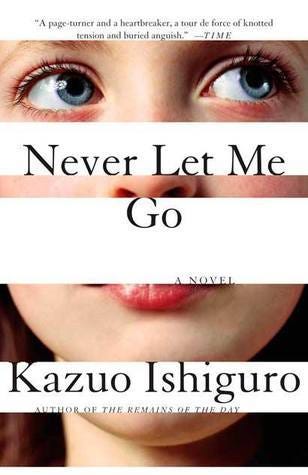
Book cover image for Never Let Me Go by Kazuo Ishiguro
Read my original review here!

This was so hard!! I flip-flopped a lot, but what my decision came down to is the fact that this book is ultimately SAD. Don’t get me wrong, I loved being knocked out by this book. It’s beautiful and insightful and moving and I do wholeheartedly believe there is value in experiencing the full range of human emotions through literature, but at the end of the day, I would simply prefer not to be sad! I would prefer to have a bit of hope, as a treat, and unfortunately, there is very little of that by the end of Never Let Me Go.

By no means do I mean to put anybody off from reading this—ultimately, it is #2 of the year for a reason and that reason is I believe it to be a profoundly important and impactful work of literature, but it’s heavy enough that I would recommend going into it with enough mental/emotional space to sit with the discomfort. That said, please read this one and come talk to me about it! Let’s be devastated together :’).

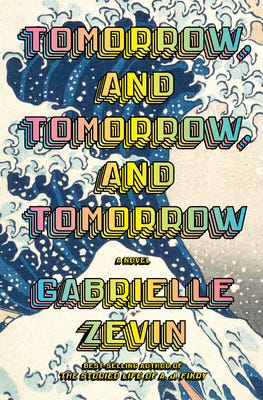
First Place: Tomorrow and Tomorrow and Tomorrow by Gabrielle Zevin

Book cover image for Tomorrow and Tomorrow and Tomorrow by Gabrielle Zevin
Read my original review here!

This book, on the other hand!!! The aforementioned full range of human emotions is undeniably present, and I would be lying if I said this one didn’t also make me sad—there may even have been tears! But what makes this one the ultimate winner of my Best Books of 2023 bracket is that the sadness is balanced out by an overwhelming amount of love. In fact, it wouldn’t even be sad if so much love had not preceded the sadness. And there are so many different kinds of love present, including friendship love, romantic love, familial love, creative love, and the ultimate respect that comes from experiencing so many facets of love within the same relationship.

Often when I think back on a book, my first thought is the memory of how I felt when it was over. Tomorrow and Tomorrow and Tomorrow had one of my favorite endings of all time, because (and this isn’t a spoiler!) it ends almost exactly how it begins. Thematically, this restart was the perfect ending for a book about video games, but emotionally, the suggestion that the story was only just beginning anew was everything I wanted for the two main characters. I didn’t need to know how their story ended because I didn’t want it to end—I wanted them to remain open to a whole lifetime of friendship and creative potential and mutual respect borne of years and years of loving each other in different ways. With this ending, we get to believe that this is true. So for the sake of this bracket (and for always), I hereby declare that love WINS!!!


Honorable Mentions:

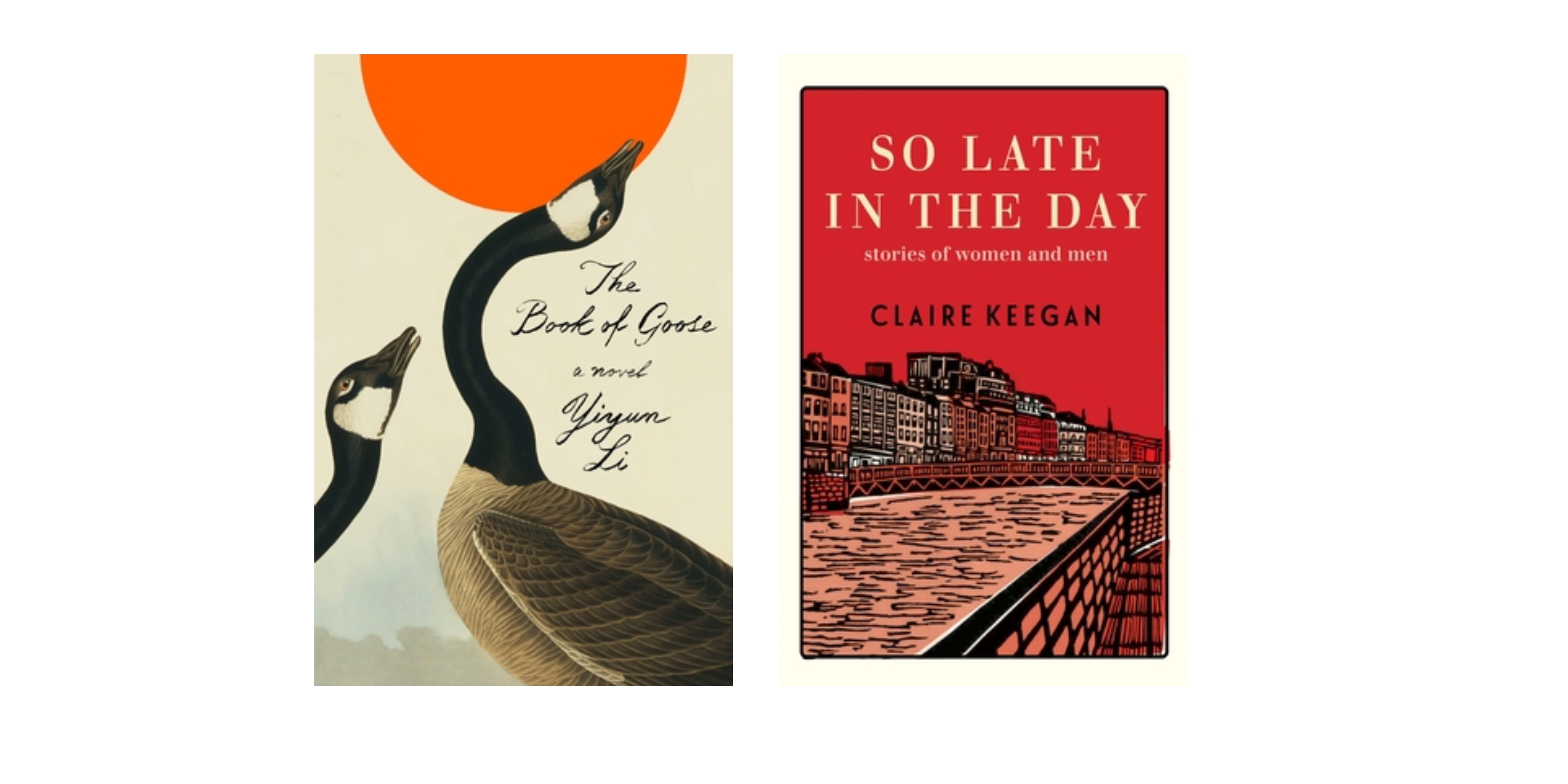
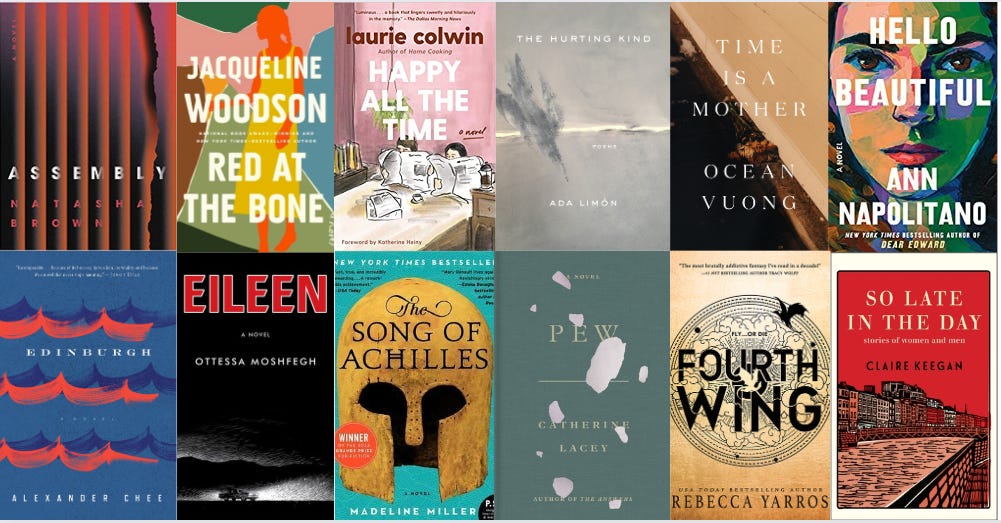
Book cover images for Assembly by Natasha Brown, Red at the Bone by Jacqueline Woodson, Happy All the Time by Laurie Colwin, The Hurting Kind by Ada Limon, Time is a Mother by Ocean Vuong, Hello Beautiful by Ann Napolitano, Edinburgh by Alexander Chee, Eileen by Ottessa Moshfegh, The Song of Achilles by Madeline Miller, Pew by Catherine Lacey, Fourth Wing by Rebecca Yarros, and So Late in the Day by Claire Keegan.

Above are some of my favorite runners-up from the year! Though all of these books fell short of the official monthly top spot, let’s just say this year’s bracket would have looked a lot different had some of these been in play. Maybe I’ll do a bigger one next year? In the meantime, I’ll do one last push for you to check out the Lit Chat archives for reading inspiration if one of these covers catches your eye, and I’ll also remind everyone that all of these books are neatly organized by month on my Bookshop storefront! And if you want these posts straight to your inbox, then go ahead and click the button below to subscribe on Substack.


Thanks so much to everyone for reading with me in 2023, especially those of you who have reached out to chat about these and other books or who have shared this newsletter with other fellow readers. I so appreciate you!

ALSO I almost forgot, but I will be sending an email out soon to those interested in joining my little in-person reading show & tell club! If you’re local to NYC and haven’t already let me know you wanna come, reach out! Tentative date is Saturday, January 20th with more details to follow.

Until next time, happy reading and cheers to many more good books in 2024!
❤ Catherine

Lit Chat’s Best Books of 2023: Round Two

Housekeeping note: all book links go to my Bookshop storefront, where each purchase supports independent bookstores (and this newsletter, because I get a small percentage of each sale).

Hi friends,

Welcome back for another round of my highly subjective Best Books of 2023 bracket! Today, we have six titles facing off for the honor of making it to the top three, which makes this the semifinals already! Here’s where we stand so far:

Best Books of 2023 bracket image

Also, a quick reminder that you can get this post directly to your inbox if you subscribe to my Substack!

All right, it’s a gloomy day in Brooklyn; let’s talk about some books.


ROUND TWO:

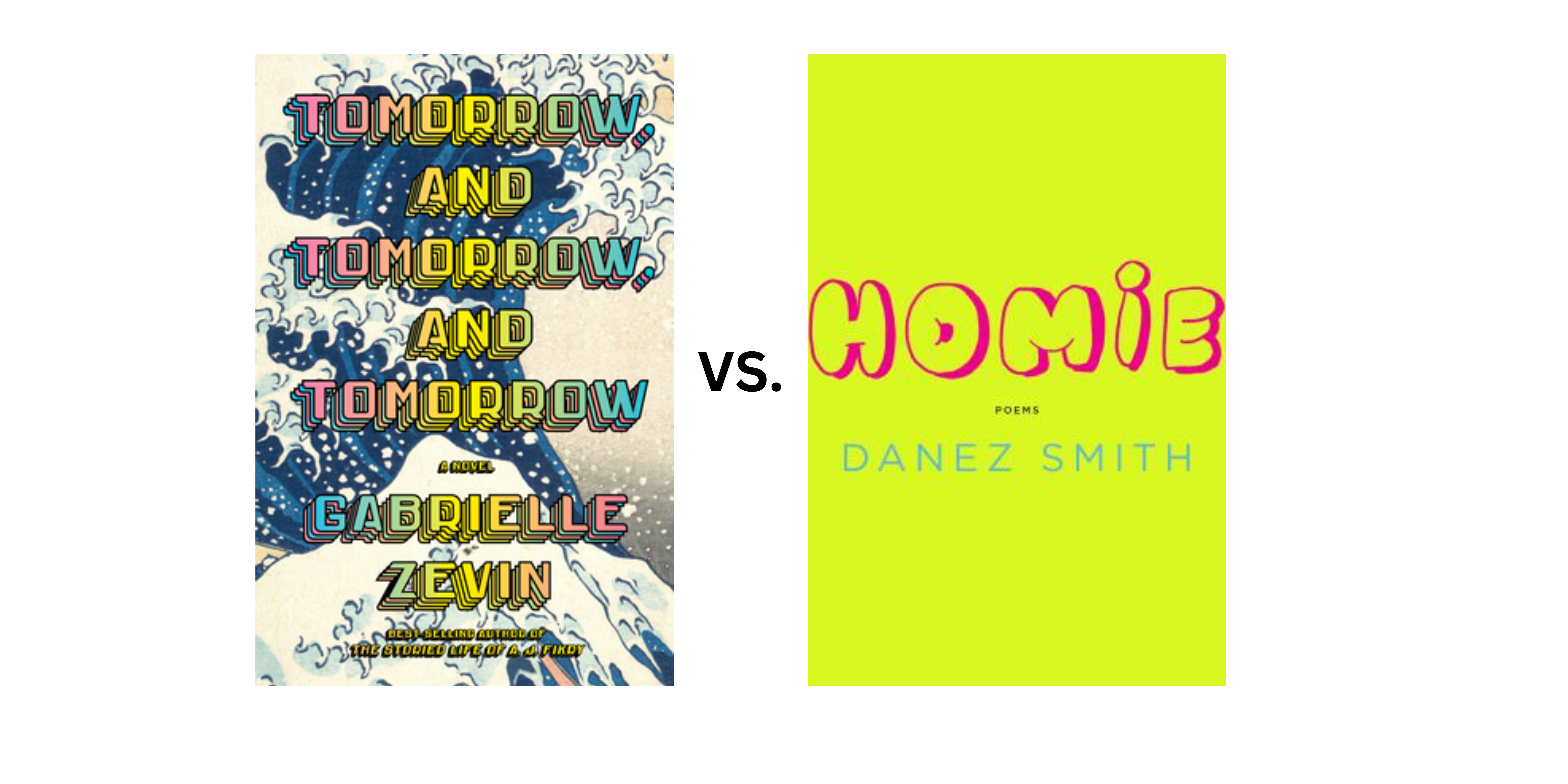
Book cover images for Tomorrow and Tomorrow and Tomorrow by Gabrielle Zevin and Homie by Danez Smith

Tomorrow and Tomorrow and Tomorrow by Gabrielle Zevin vs. Homie by Danez Smith

I so wish I didn’t have to put these two head to head because they are truly in leagues of their own, but so it goes. When I think of comparing these two books, I think of scope: Homie, though completely wonderful, simply feels small in comparison to the sprawling saga that is Tomorrow and Tomorrow and Tomorrow. What I love about Homie is how it does so much emotionally with such a small space, as a testament to all the people and places the poet loves, but we don’t necessarily get to know those people as closely as we do when we follow their lives for decades like we do in Tomorrow and Tomorrow and Tomorrow. At their core, both books are centered around friendship, which is why this feels slightly unfair because a novel is a completely different vehicle for exploring the nuances of that friendship and, in this case, the worlds that are created as a result. While I loved feeling like a witness to Danez Smith’s highly personal world, I felt fully inside not only Sam and Sadie’s real lives, but also each of the worlds they created in their games. This expansiveness is why I’m moving Tomorrow and Tomorrow and Tomorrow forward, though it’s with a heavy heart that I leave Homie behind.

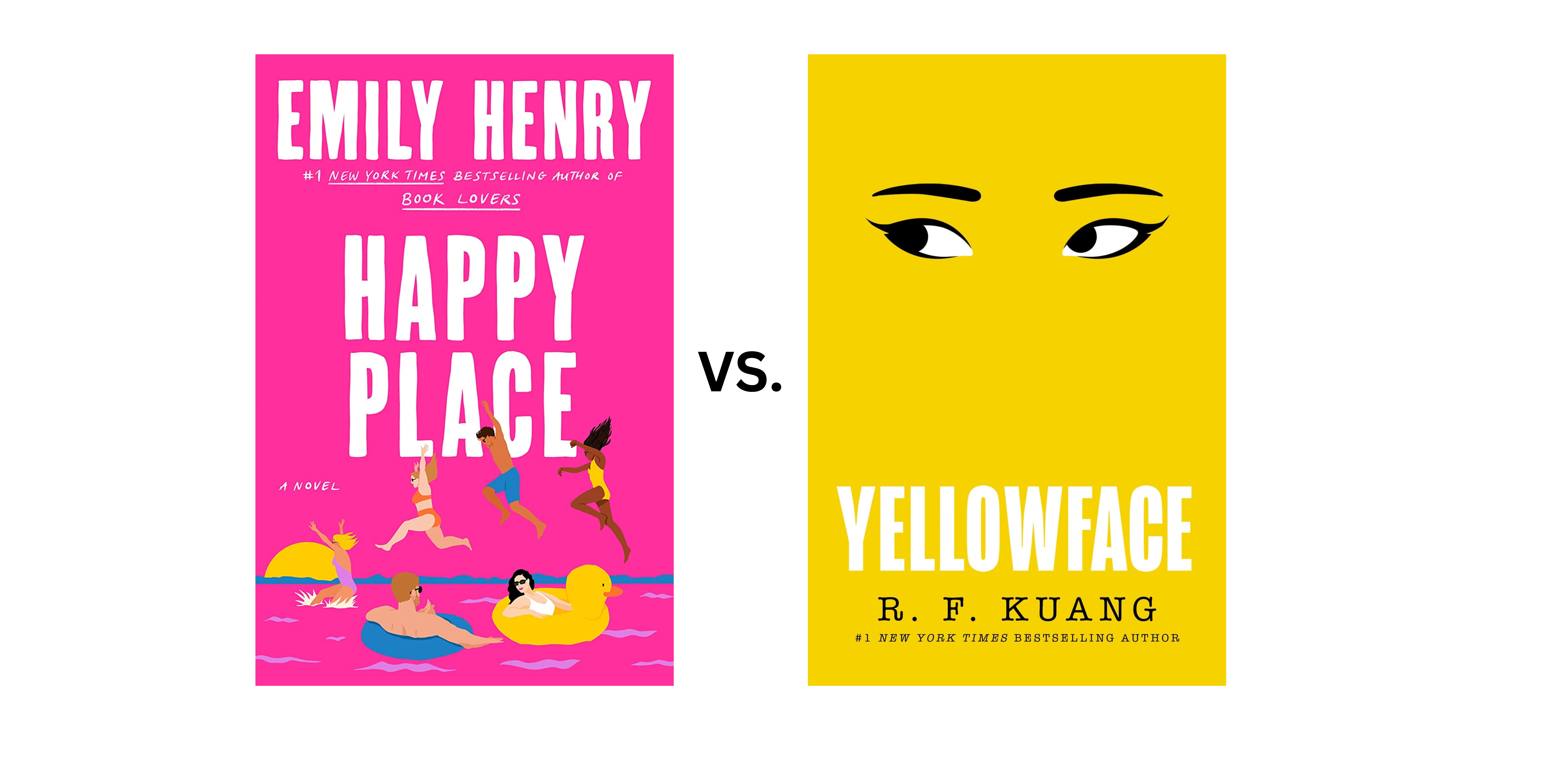
Book cover images for Happy Place by Emily Henry and Yellowface by R.F. Kuang

Happy Place by Emily Henry vs. Yellowface by R.F. Kuang

Something I’ve learned about myself and my media consumption habits lately is that fundamentally, I am not a hater but a liker. I like to enjoy things, and I am fairly easily pleased! Unless I am specifically approaching something with skepticism, I’m more than happy to turn the critical thinking part of my brain off for the sake of entertainment. Some books are better suited for this than others—in my initial read of Happy Place, I was perfectly happy to be along for the ride. I love stories that feature big friend groups, particularly ones in the same phase of life as me, so I was content to overlook the fact that the secondary characters often fell a little flat. I also love rooting for a good romance, especially when we’re more concerned with the characters’ chemistry than the fact that it’s completely insane to (spoiler) abandon a neurosurgery degree that you’re hundreds of thousands of dollars in debt for to become a…potter? Details, details! Suspend disbelief for love! I still had a great time with Happy Place, but as many of my more critical friends were quick to point out, there are definitely some holes.

Yellowface, on the other hand, is meant to be insane. Yellowface is written from the perspective of a hater and a grasper and an all-around kind of terrible person, and there’s something so delicious about being inside her head and watching from behind your fingers as she continues to make shocking decisions. As a commentary on race and privilege in the publishing industry, Yellowface ultimately also has more to say in general than an unconcerned-with-reality rom-com. I have more I want to say about Yellowface still, which is why I’m officially moving it forward to the finals.

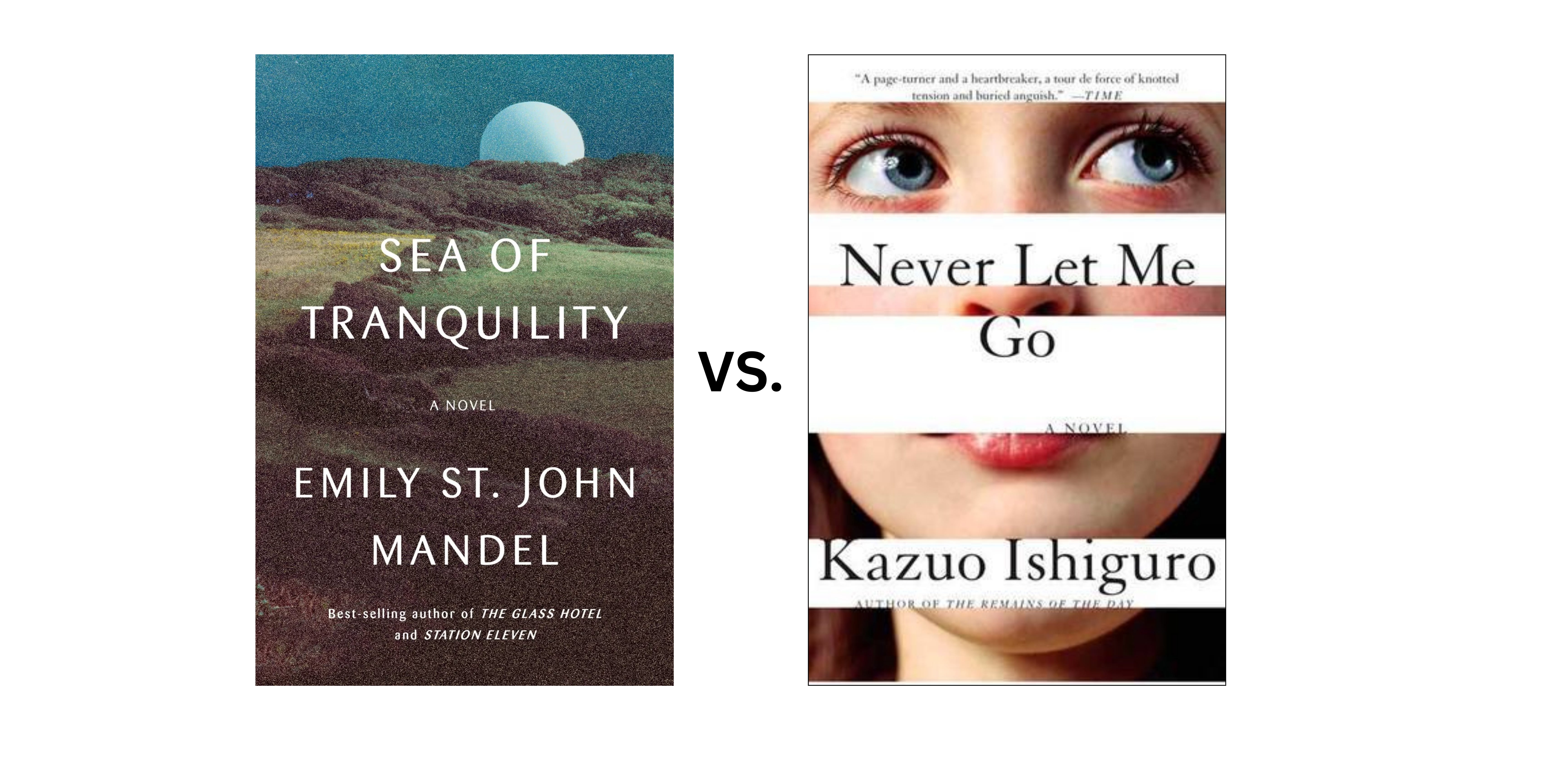
Book cover images for Sea of Tranquility by Emily St. John Mandel and Never Let Me Go by Kazuo Ishiguro

Sea of Tranquility by Emily St. John Mandel vs. Never Let Me Go by Kazuo Ishiguro

This one is TOUGH. The hard thing about this bracket is that a book like Sea of Tranquility would have easily beat out so many others on this list, but against Never Let Me Go it’s a lot less of a wash. These two are similar in genre, and both stayed on my mind for a long time after reading, though for different reasons. As a time-travel story, I spent days puzzling through the events of Sea of Tranquility and how each action seemed perfectly placed to affect not just the story, but also our understanding of time, space, and free will. It presented a fascinating intellectual question that, in its narrative execution, could also be appreciated as a masterful work of literature. It’s still one of my favorite books of the year, but its impact isn’t quite on the scale of Never Let Me Go.

The way that Never Let Me Go continues to take up space in my brain can only be described as a haunting. For a sci-fi/speculative fiction novel, it’s eerie how easily the reader finds themselves settling into daily life at Hailsham, how normalized and almost comfortable it is as a setting in which we’re happy to ignore the many, many red flags about the world beyond. And though a world in which (spoilers!!!) clone children are raised and groomed for the sole purpose of donating their organs does still feel far-fetched (for now), their treatment by society is all too familiar: othered, subhuman, and ultimately disposable. One of the most terrifying parts is realizing how easily we might agree with this thinking had we not spent the whole book watching these characters grow up, and yet the central question of whether or not the children have a soul is still not one I feel fully prepared to answer by the end of the book. It’s a question I’m not sure I’ll ever have a definitive answer for, but one I know I’ll be pondering for a very long time.


There you have it, my top three finalists! Come back tomorrow to see how the final three rank and check out a brief list of honorable mentions for books that I loved in 2023 but which didn’t make the bracket.

Thanks for reading, chat more soon!
❤ Catherine

Lit Chat’s Best Books of 2023: Round 1

Housekeeping note: all book links go to my Bookshop storefront, where each purchase supports independent bookstores (and this newsletter, because I get a small percentage of each sale).

Hi friends,

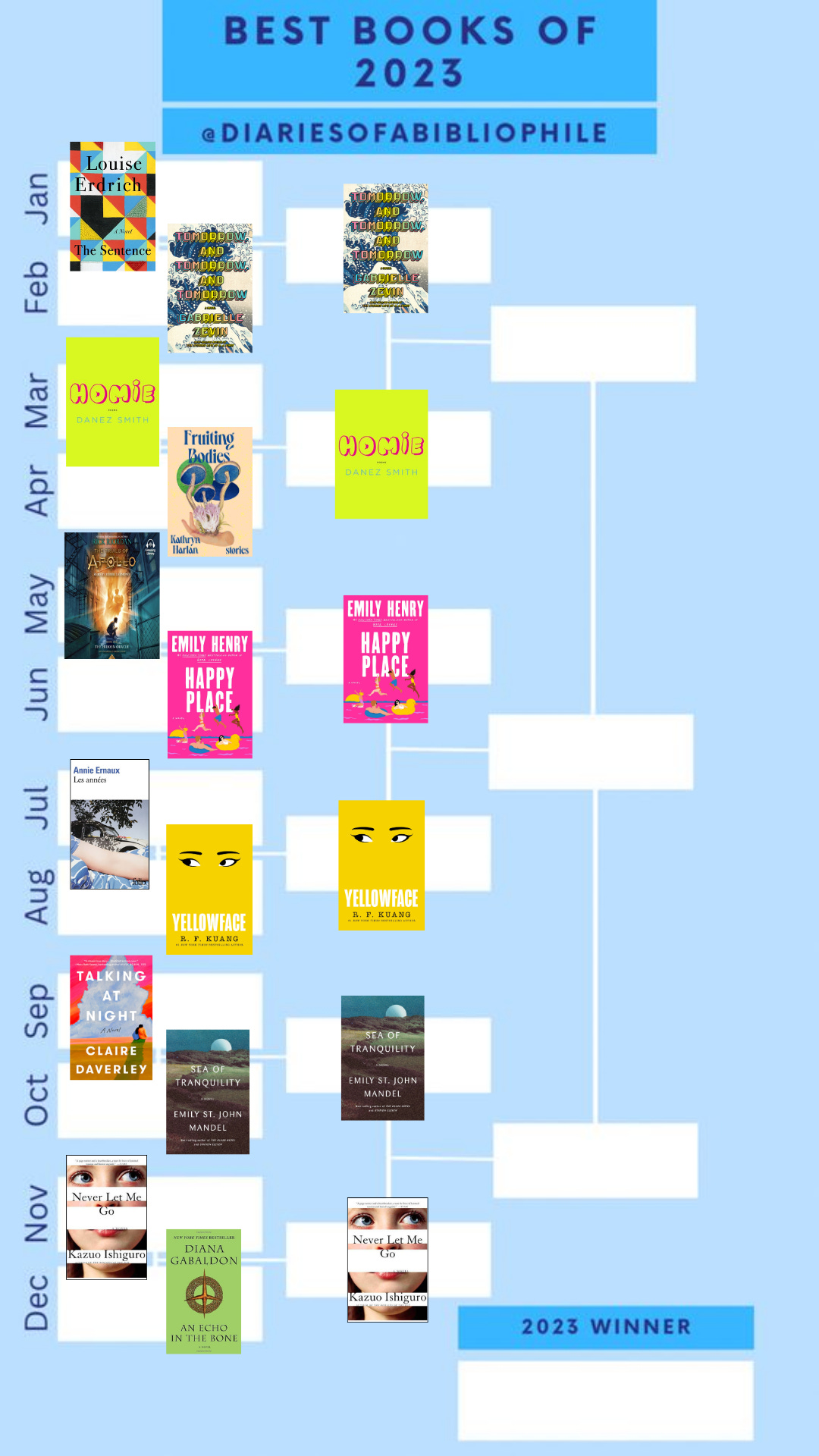
Happy New Year! Bet you thought you were done with end-of-year recaps in your inbox, huh? Lucky for you, the new year has done nothing to cure my pathological procrastination, so here we are a week later! Below is the start to my Best Books of 2023 bracket, courtesy of this graphic I found on Pinterest (thanks, @diariesofabibliophile, whoever you are!) and my very rudimentary Canva skills:

Bracket of book cover images for each calendar month of 2023.

In terms of rating criteria, we’re mostly going for vibes here: how I felt while reading, what’s stuck with me after I’ve finished, and overall impact (on me as a person, my tastes, my interests, my emotions, etc.). You may disagree—in fact, I hope you do and I hope you tell me about it! I love hearing from friends who have had different reading experiences than me.

This year was a particularly strong reading year, and some of my favorites didn’t even make this list by nature of coming in second to another rockstar book that month. I’d encourage you to check out the Lit Chat archives or poke around on my Bookshop storefront for other reading inspiration! I also love nothing more than giving a personal recommendation, so feel free to reach out if you’re in the mood for something specific but don’t know what that is yet.

Without further ado, let’s begin!


ROUND ONE:

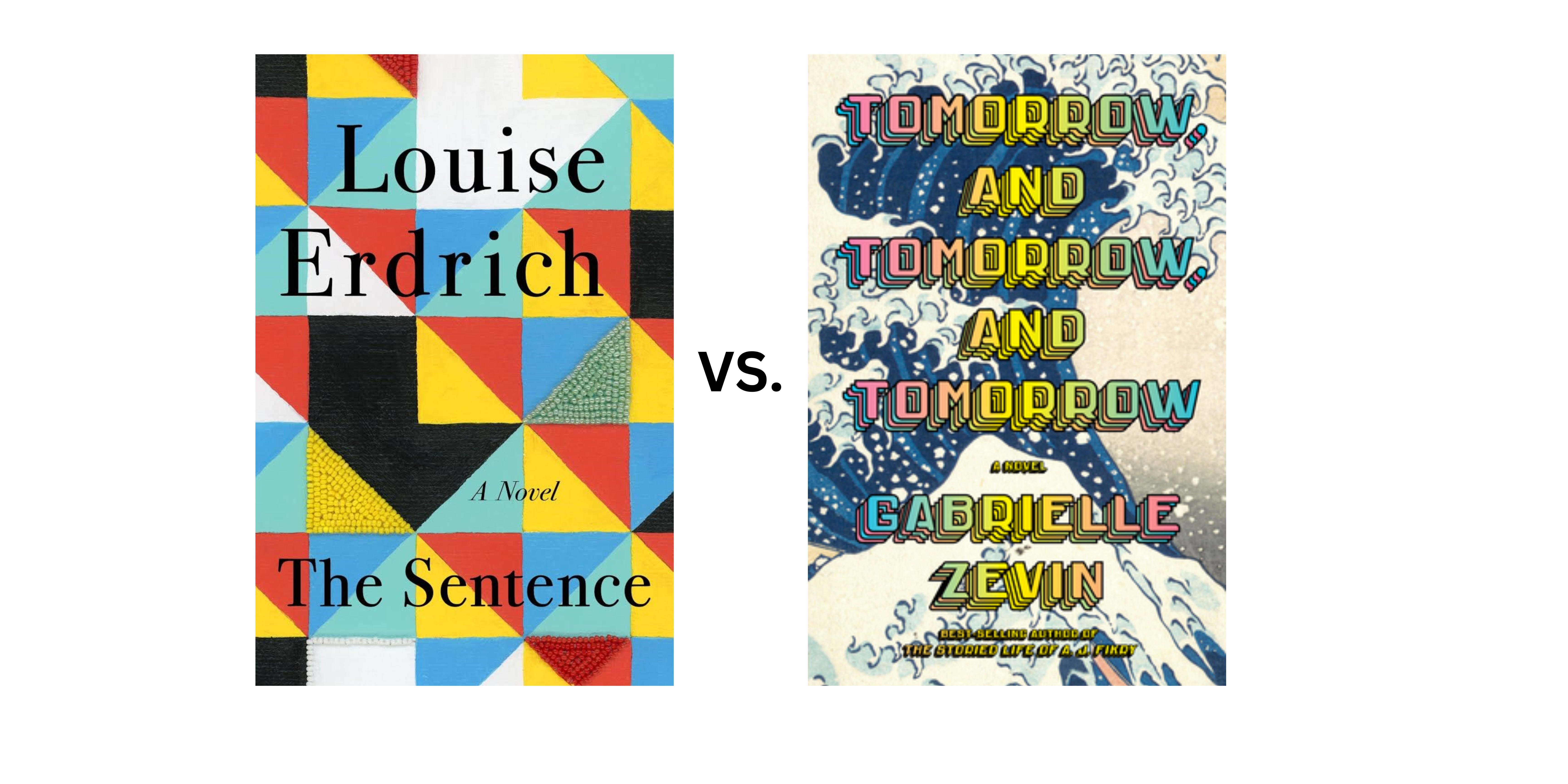
Book cover images for The Sentence by Louise Erdrich and Tomorrow and Tomorrow and Tomorrow by Gabrielle Zevin

The Sentence by Louise Erdrich vs. Tomorrow and Tomorrow and Tomorrow by Gabrielle Zevin

I’m upset about this already because it feels unfair to drop one of these phenomenal books so early. The Sentence was the first book I read in 2023 and set the bar high for its unique characters, sense of community, and portrayal of resilience in the face of so many personal and political upheavals (I was wrong last month when I said Tom Lake was my first Covid book; it was The Sentence!). The Sentence left me energized and inspired for my reading year ahead, whereas Tomorrow and Tomorrow and Tomorrow was so emotionally all-encompassing that it left me with one of the worst book hangovers I’ve had in a long time. To have that happen so early in the year was daunting, to say the least. Ultimately, this is why Tomorrow and Tomorrow and Tomorrow is going to move forward this round, although it pains me to say goodbye to The Sentence so early in the game.

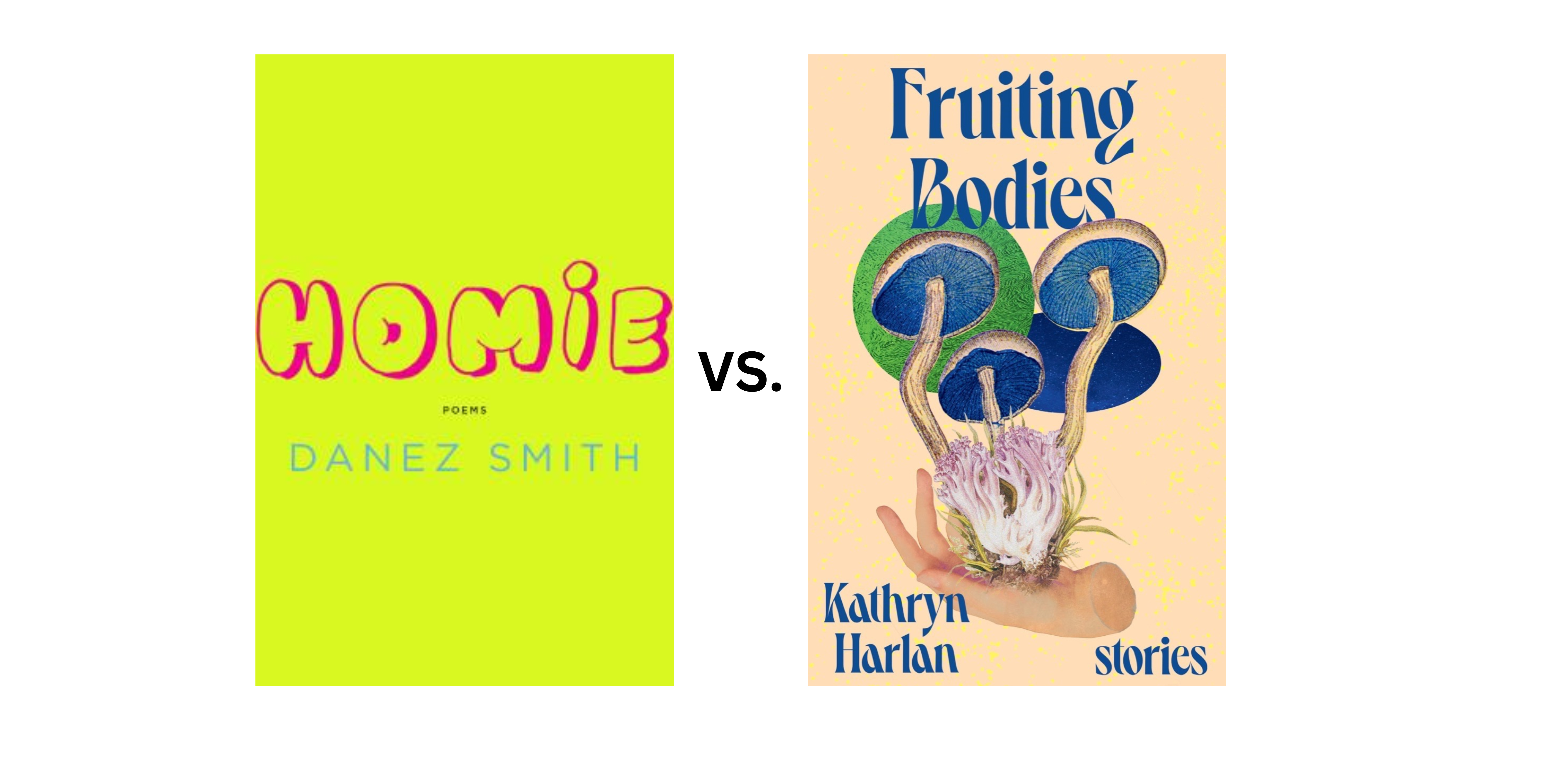
Book cover images for Homie by Danez Smith and Fruiting Bodies by Kathryn Harlan

Homie by Danez Smith vs. Fruiting Bodies by Kathryn Harlan

Another tough but very different match-up! Listening to Danez Smith narrate the audiobook for Homie was one of the highlights of my winter, eclipsed only by getting to see Danez perform live at the New York City Poetry Festival on Governors Island this summer. Likewise, Kathryn Harlan’s collection of eerily enchanting, female-centric short stories has also lingered with me this year, and I recently recommended it to a friend just last month. While Fruiting Bodies renewed my interest in short fiction and magical realism, there’s just something about listening to poems like my president, for Andrew, and waiting for you to die so i can be myself read aloud by the poet, feeling the raw emotion, joy, and vulnerability that exists in these exultations of friendship and community that feels timeless and transcendent. Homie wins this round!

Book cover images for The Hidden Oracle by Rick Riordan and Happy Place by Emily Henry

The Hidden Oracle by Rick Riordan vs. Happy Place by Emily Henry

This might be the silliest match-up of them all, but honestly, it’s still a real contest. The Hidden Oracle was top-notch mythological fun, and with the new Percy Jackson adaptation now streaming, I’m even more favorably inclined to move it along than I might have been a month ago. But to be fair, I forgot I even read this one, whereas I’ve had so many conversations with friends about Happy Place since reading that it’s stayed all too present in my mind. It’s one that I’ve found surprisingly controversial, and though I have plenty more thoughts, I’ll save them for the next round. Happy Place moves forward on the merit of being a thoroughly enjoyable read that is only slightly more relevant to my life as a late twenty-something than the book about fallen gods turned awkward teenagers. (Note to self: finish listening to the Trials of Apollo books in 2024.)

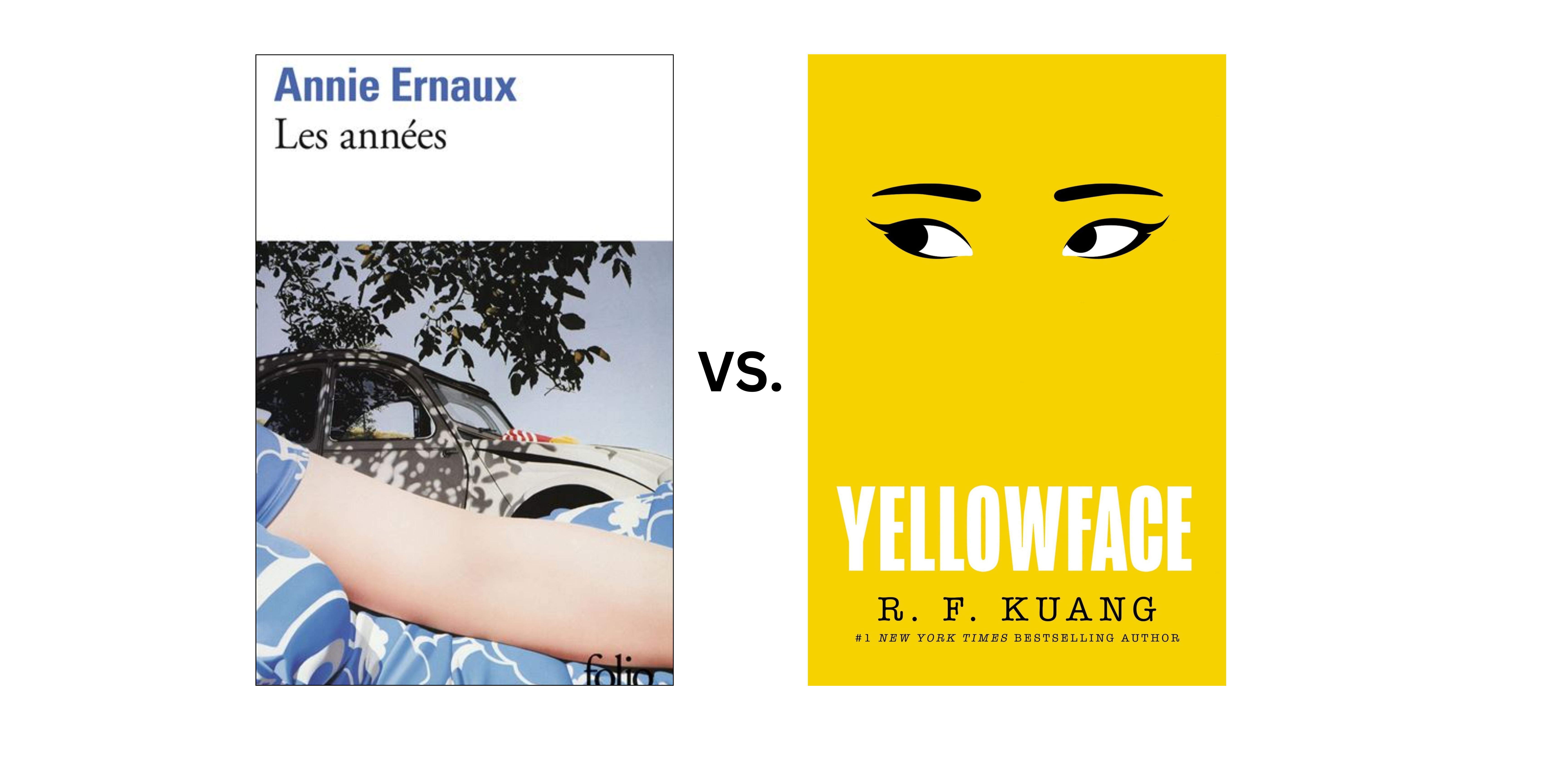
Book cover images for Les annees by Annie Ernaux and Yellowface by R.F. Kuang

Les Années (The Years) by Annie Ernaux vs. Yellowface by R.F. Kuang

You may remember that I didn’t actually finish a single book in July because of moving apartments and traveling, but I’m putting Annie Ernaux forward as the book I spent all of July reading when I had the time. While I spent almost a whole month trying to get through this one in the original French, I flew through Yellowface and its scandalously delightful satire of the publishing industry in a matter of days. I know Les Années is brilliant and I will return to it in English someday, but man, it made my brain so tired. Yellowface moves on to the next round!

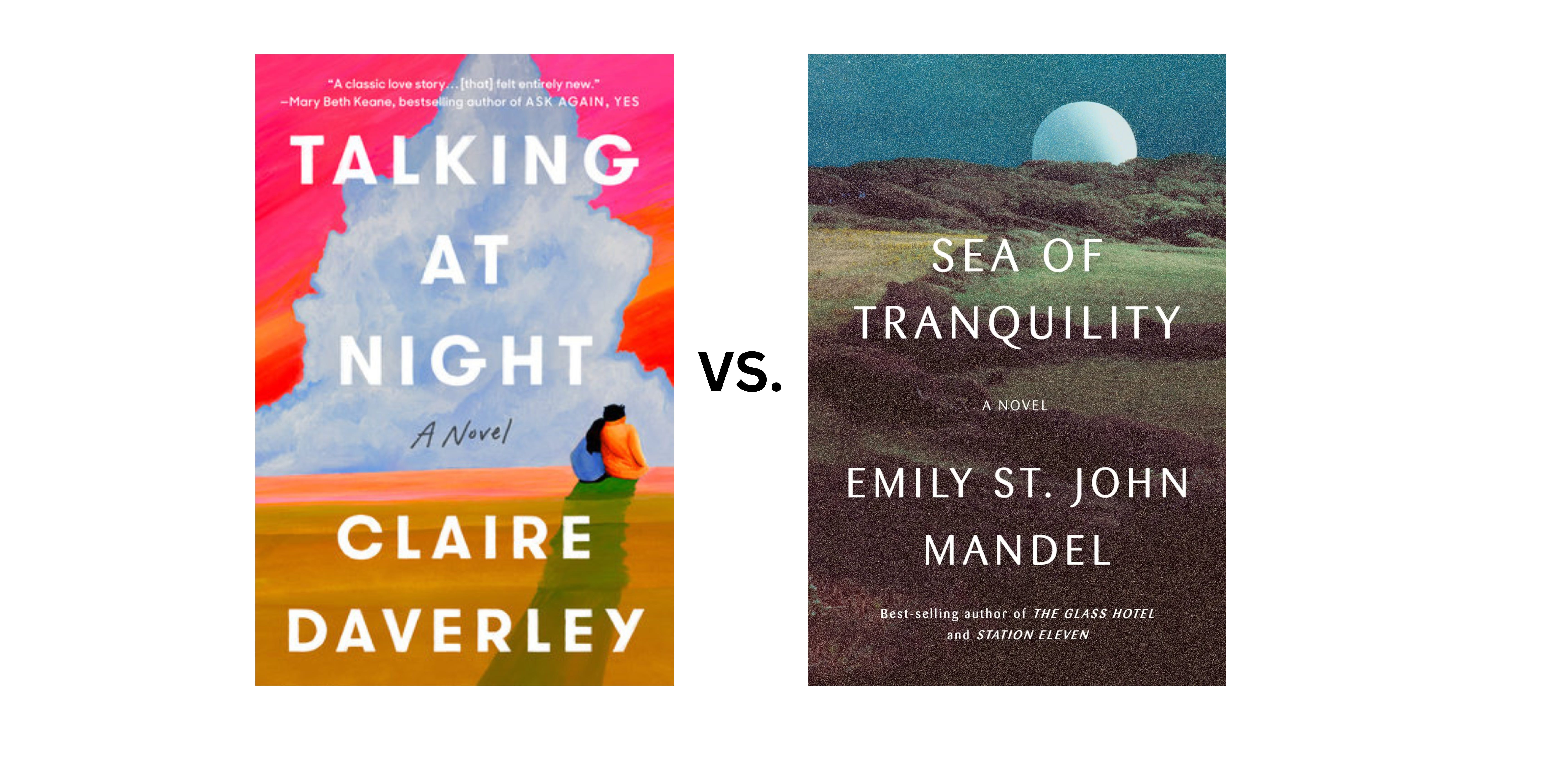
Book cover images for Talking at Night by Claire Daverley and Sea of Tranquility by Emily St. John Mandel

Talking at Night by Claire Daverley vs. Sea of Tranquility by Emily St. John Mandel

This one is so hard!!! I love love loved Talking at Night, which had me smiling and crying and yearning my little heart out during my last international flight of the year. On the other hand, I read almost all of Sea of Tranquility in one sitting on my couch and thought about it for weeks after. Hell, I’m still thinking about it. Sea of Tranquility has buried itself in my brain in a way that was completely unexpected, and which has piqued my curiosity in terms of exploring other kinds of soft sci-fi. For this reason, I think it does ultimately beat out Talking at Night, but I will keep recommending that one to all my Sally Rooney girlies who love a slow-burn, long-game relationship story.

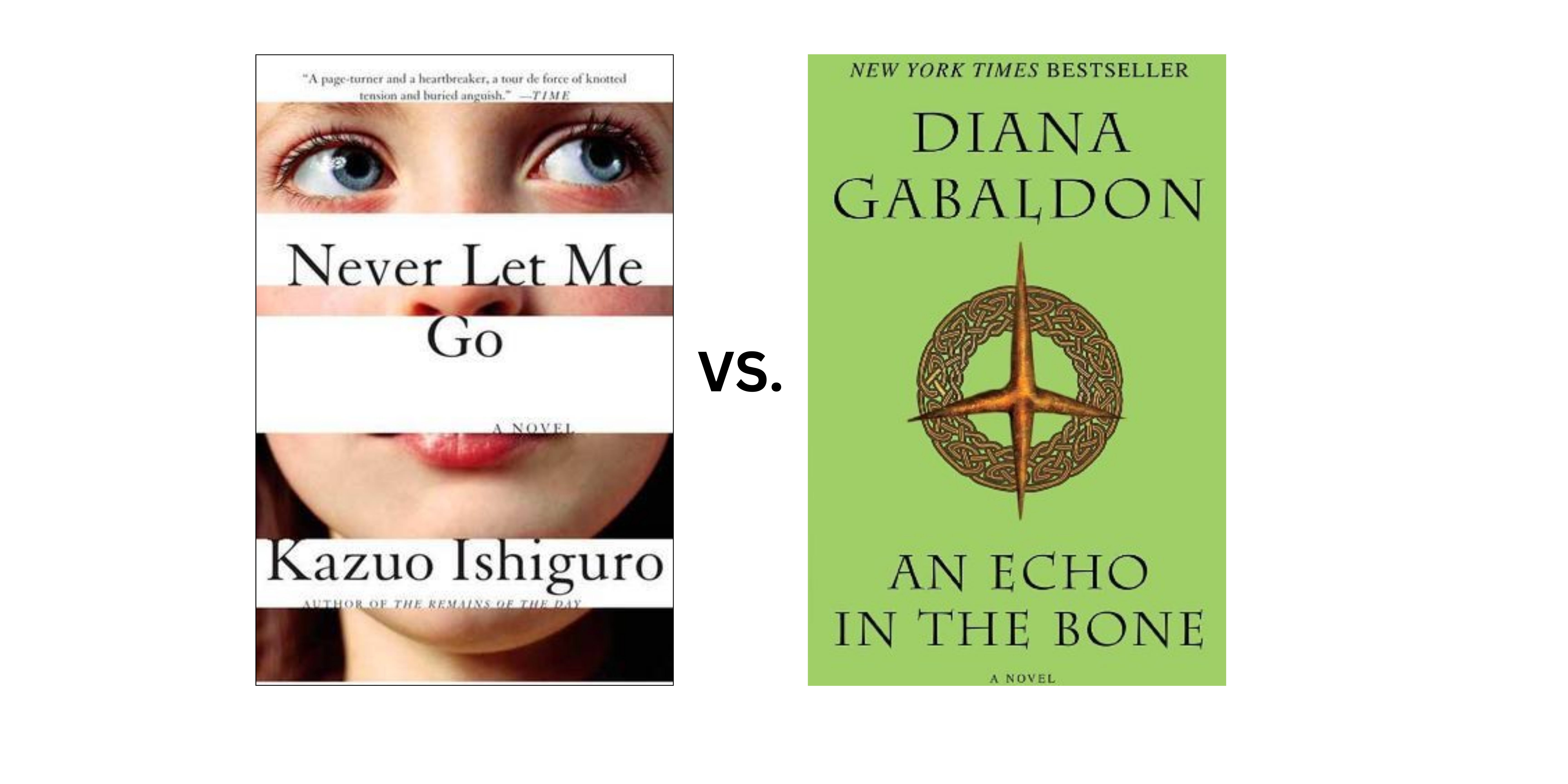
Book cover images for Never Let Me Go by Kazuo Ishiguro and An Echo in the Bone by Diana Gabaldon

Never Let Me Go by Kazuo Ishiguro vs. An Echo in the Bone by Diana Gabaldon

Finally, an easy one! There’s no contest here. I love the Outlander books, and diving into this one was a thoroughly enjoyable way to spend my December, but in terms of literary prowess and lasting impact, I have a feeling Never Let Me Go is going to go a long way in this bracket. While I will say this was one of the least stressful and most satisfying Outlander books in terms of character reunions, new relationships, and surprisingly positive outcomes to ill-fated mishaps, there is still simply no reason for these books to be as long as they are. I’ll keep reading them (and watching the show now that I’m caught up), but HOW does this woman get away with cranking out doorstopper after doorstopper!? That’s beside the point. Never Let Me Go wins, obviously.


And that’s a wrap on Round One! Come back tomorrow for Round Two as we narrow it down from the six semifinalists to the top three!

See you there,
❤ Catherine

You think love is so simple?

November in Review — Lit Chat, Vol. 14

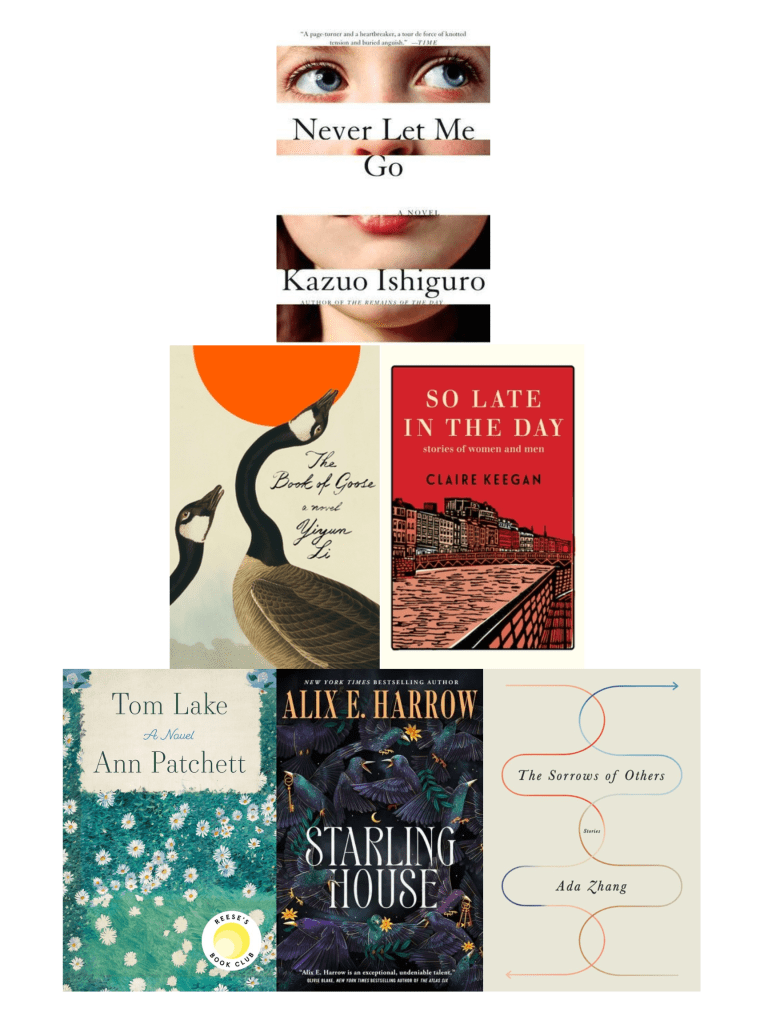
Pyramid of book cover images with Never Let Me Go by Kazuo Ishiguro on top, The Book of Goose by Yiyun Li and So Late in the Day by Claire Keegan in the middle, and Tom Lake by Ann Patchett, Starling House by Alix E. Harrow, and The Sorrows of Others by Ada Zhang on the bottom.

Housekeeping note: all links go to my Bookshop storefront, where each purchase supports independent bookstores (and this newsletter, because I get a small percentage of each sale). Buy your holiday gifts through Bookshop!!

Hi friends,

We made it to December! For me, this means that my brain has started craving hibernation mode: I don’t want to work, or think, or move my body any further than from the bedroom to the kitchen and back. I want to sleep in and eat grilled cheese and play Stardew Valley on the couch under a pile of blankets.

I’m even feeling lazy about reading: I’m nowhere near my original lofty Goodreads goal of 72 books in a year, so I’ve decided that I’m going to take December to indulge in the last 600 pages of the Outlander book I’ve been reading off and on since October. If I finish it and get around to something else this month, great! If not, I will simply enjoy the all-plot-no-thoughts vibes for as long as they last.

However! To atone for this laziness, I’ve decided to do a little end-of-year bracket, pitting the top books from each month against each other to see which one will officially be crowned my favorite book of the year. Start placing your bets now, folks! You’ll be hearing from me a bit more often in the coming weeks as I work through my completely subjective rankings.

One final housekeeping note for my local friends: I’m thinking of starting an informal reading club in the new year, where instead of all reading the same book at a time, everyone just brings one book/story/poem/article they’ve read and loved recently and we all take a turn to show and tell while eating snacks/drinking wine. If that sounds like fun and you’re in the NYC area, reach out!

Okay, okay, before we get too far ahead of ourselves, we still have November to discuss. Let’s get into it.


THE FOUNDATION:

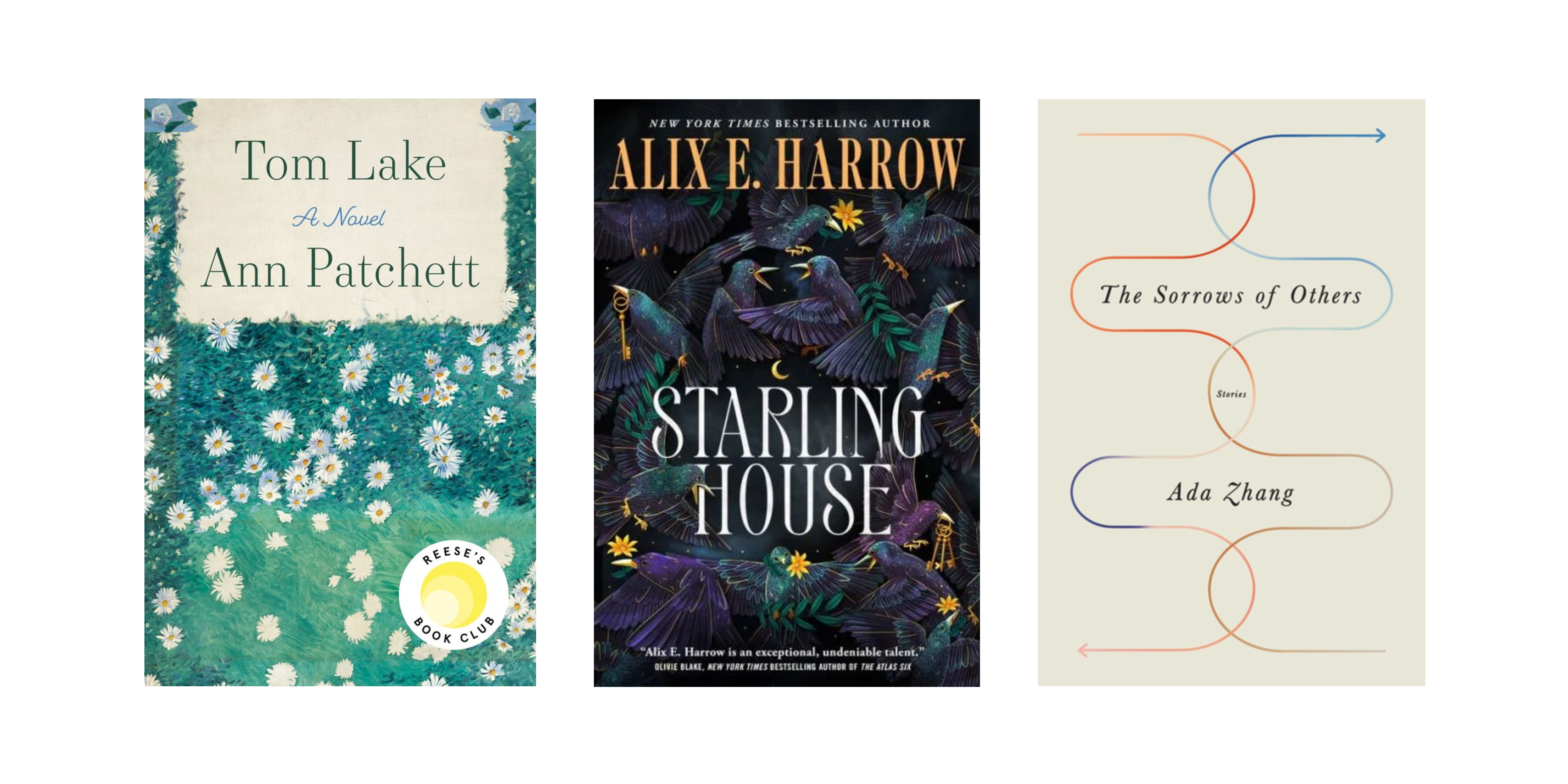
Book cover images for Tom Lake by Ann Patchett, Starling House by Alix E. Harrow, and The Sorrows of Others by Ada Zhang

Tom Lake — Ann Patchett

My first Ann Patchett, and I think my first official Covid-19 novel? Tom Lake is the name of the summer stock theater where young actress Lara Kenison falls for soon-to-be movie star, Peter Duke. Decades later, Lara is now retelling this story to her three adult daughters, who have all come home to help work their family’s Michigan cherry farm during the pandemic. The escapism of a nostalgic summer fling works to soothe the pandemic-related anxieties of both reader and characters, but personally, I realized I’m not quite ready to revisit this time in fiction just yet. That said, I think a lot of the moms in my life will relate to Lara’s conflicted happiness over having her family all unexpectedly under one roof again. A good book club book; Reese is onto something here!

Starling House — Alix E. Harrow

Regular readers of this newsletter know that I am simply a sucker for a mysterious, potentially magical old house! In this case, Starling House is the historic home of an eccentric children’s book author, whose eerie stories of a realm called Underland have fascinated orphan Opal McCoy since childhood. When Opal gets offered a job as a cleaner at the now derelict Starling House, it’s more than just an opportunity to support herself and her teenage brother in an unfriendly and unlucky Rust Belt town; it’s the answer to a calling she’s felt her entire life. Throw in a brooding love interest, a cursed family of greedy oligarchs, and a shady corporate antagonist, and you’ve got a perfectly vibey, gothic mystery to curl up with on the couch this winter.

The Sorrows of Others — Ada Zhang

I was first introduced to this collection when I read “Julia” in Electric Lit’s Recommended Reading, a barbed yet beautiful story about a woman preparing to leave the city and reflecting on the breakdown of a once-treasured friendship. I was initially drawn in by Zhang’s emotional precision, particularly the spot-on representation of the grief that comes from reckoning with the past selves you’ve outgrown. This reckoning is a recurrent theme in Zhang’s debut collection, which hops between China and America to feature the tangled stories of immigrants and the children of immigrants: husbands and wives, mothers and daughters, sisters and granddaughters, each of them struggling to reconcile their sense of self against their needs and desires and those of their families. “Julia” is a fantastic entry point to Zhang’s work, but the entire collection is one to be savored, each story sharper and more poignant than the last.


SOLID SUPPORTS:

Book cover images for The Book of Goose by Yiyun Li and So Late in the Day by Claire Keegan

The Book of Goose — Yiyun Li

This is a little weirdo of a book, but one that I thoroughly enjoyed. In a small provincial town in the post-war French countryside, childhood best friends Fabienne and Agnès decide to play at writing a book together inspired by their lives. With Fabienne as the creative mastermind, Agnès’s name on the cover, and a little help from the local postman, the book captivates the French literary world—catapulting an unprepared Agnès into the spotlight.

It sounds so much simpler than it is. The narrative is told in the present day by Agnès, now an adult living in America, who feels free to tell her story in her own words only after learning that Fabienne has died in childbirth. Even then, the voice of Fabienne’s ghost is ever-present in Agnès’s mind. The Book of Goose is an intricate portrait of female friendship and an insightful exploration of fame, power, influence, and the fleeting nature of it all. @CB, you have redeemed yourself with this rec!

So Late in the Day — Claire Keegan

I read Claire Keegan’s Small Things Like These around the same time last year, and I’m thinking of making reading her work something of a seasonal tradition. This slim little volume is a compilation of three previously published short stories: the first, about a man on his would-be wedding day, reflecting on where he went wrong; the second, about a woman on a writing retreat forced to host an unwelcome guest; and the third, about a married woman who decides to have sex with a stranger and gets far more than she bargained for.

I really wrestled with whether or not to give this one the top spot because the last story in particular, “Antarctica,” has positively haunted me. The other two stories are masterful, don’t get me wrong, but “Antarctica” is a whole masterclass in character, pacing, and atmosphere. I’m obsessed with the way Keegan lulls you into a false sense of security alongside the protagonist, denying the instinctual sense of dread steadily creeping in around the edges until the danger becomes chillingly obvious. A week later, it still gives me shivers just thinking about it.


THE TIPPY TOP:

Book cover image for Never Let Me Go by Kazuo Ishiguro

Never Let Me Go — Kazuo Ishiguro

Surprise, surprise, the Nobel Prize winner comes out on top! As I said, it was a real struggle between this and So Late in the Day, but ultimately, this one has managed to haunt me longer and more completely as a novel rather than a single story in a collection.

Most of Never Let Me Go takes place at Hailsham, a seemingly idyllic English boarding school where its students are cloistered from the broader world while learning everything they will need to one day go out into it as (organ) “donors.” Kath, a former student, narrates the book as an adult reflecting on her childhood while she cares for other donors in preparation for becoming one herself.

What struck me the most about this book is not the ultimate revelation, unsettling as it is (no spoilers!), but how successfully Ishiguro manages to shield us from the disturbing truth for as long as he does. In this way, we are as sheltered as the Hailsham students—we always know there is more to this story, something that likely has broader and more sinister implications for our understanding of this alternate future, but it feels so far removed from the routine of daily life at Hailsham and the intimacies of Kath’s relationships with the other students that you can easily bury the niggling suspicion that something is not quite right.

For such a quiet book, it’s a fairly scathing take on how easily society can become inured to human rights abuses when those being abused are perceived as less than or unhuman, especially when this abuse becomes accepted as the norm. (Sound familiar? It should.) Never Let Me Go was published in 2005, and yet Ishiguro’s warning to society is as timely as ever. He offers no panacea to Kath’s and the other students/donors’ plight, but he does force the reader to bear witness, with full knowledge of the wrong that is being done. It’s up to us to decide at what point we look away.


All right friends, that’s all for today! If you need me, I’ll be in Revolutionary War-era America with Jamie Fraser for the foreseeable future, so don’t call or text (unless it’s to talk about any of the above books or to give me a rec for my 2024 TBR—those texts are always welcome).

Until next time, happy reading!
❤ Catherine

Atmospheric AF: October in Review

In past Octobers, I’ve been really into spooky classics like Dracula and Frankenstein, but this year I opted instead for a wider range of eerie, speculative, and fantastic reads, most of them quite new. I finished out the month with a total of seven books, so the bonus Honorable Mention pyramid tier (which is exclusive to this blog!) includes some shows and movies I’ve been watching this month as well.

Now, since we are quite literally losing daylight hours here, I’ll go ahead and dive right into the books. But first! If you haven’t already subscribed to the Substack version of this blog, which sends these monthly reviews straight to your inbox, please do so below!


The Top:

The Rabbit Hutch — Tess Gunty

Do you ever experience a piece of art that’s so well executed, it makes you despair a little bit because you feel like you’ll never be able to make anything as good? That’s what this book did to me. I first came across The Rabbit Hutch in Chicago’s Exile in Bookville, where I read the prologue standing right there on the shop floor because the shelf talker told me to. I’ve said it before and I’ll say it again: indie booksellers know their shit. 

The Rabbit Hutch follows the intertwined stories of the residents of La Lapinière, a run-down apartment building set in the fictional dying rust belt town of Vacca Vale, Indiana. Populated with characters such as an obituary website moderator, a young mother afraid of her son’s eyes, the slightly deranged son of a late famous actress, and an apartment of former foster kids, including a high school drop-out obsessed with twelfth-century mystic Hildegard von Bingen, it runs the gamut of humanity in a searingly sharp, achingly astute way. I found myself stopping to reread sentences that were not only gorgeous, but also so poignantly and accurately captured a specific emotion or experience that it quite literally made me stop in my tracks. While there is a rotating cast of characters, the main story revolves around eighteen-year-old Blandine, an enigmatic, almost otherworldly character whose quest to emulate her favorite female saints by leaving her body is fulfilled on the very first page (note: while there is violence here, it’s not sexual violence, if that helps anyone else’s anxious brains to know ahead of time). 

Many of these storylines are not particularly original, but what I admire most about Gunty’s writing is how deftly she toes the line between cliché pitfalls and true, genuine depictions of vulnerability. Illicit student/teacher relationships are not groundbreaking, nor are the anxieties of new mothers, lonely widowers and spinsters, or the children of narcissistic parents. Yet Gunty manages to reflect each of these stories off of each other in a way that makes them feel true and new and human, finding holiness in the mundane and tenderness in the anonymity of strangers who all live under the same roof. I’ll echo that shelf-talker in Chicago and say: just read the first page. Then come talk to me when you’ve blazed through the rest. 

Solid Supports

Mexican Gothic — Silvia Moreno-Garcia 

As a Library Bitch™, I tend not to get around to super-hyped books until a couple years after they’re pubbed, when the holds waitlist dies down a bit. This month, I finally got my hands on a Kindle copy to get me through a long flight and let me tell you: this book was the perfect plane read. Mexico City socialite Noemí’s quest to save her cousin Catalina from a mysterious illness at the remote family estate of Catalina’s new English husband is fast-paced, delightfully chilly, and teeming with Gothic dread. A surprising twist places the novel more firmly in magical realism territory than I’d expected, and there’s also some powerful anti-colonialism rhetoric behind the pulpy Gothic romance façade. I get the hype now and am excited to read Moreno-Garcia’s newest book, The Daughter of Doctor Moreau (in another three years, probably).

Klara and the Sun — Kazuo Ishiguro

It’s a good thing I had no idea what this book was about before I started, because I would’ve been skeptical about just how heartbreakingly human a narrative told through the eyes of a self-aware robot could be. Klara is an AF (Artificial Friend), chosen to be the companion and protector of a young girl named Josie who is often unwell, and it becomes Klara’s mission to make Josie well again no matter the cost. While often frustratingly vague in terms of the socio-political context of this dystopianish near-future, I was captivated by Ishiguro’s focus on the clinical uniqueness of the human soul, and by the unexpectedly primitive performance of worship and prayer from its most technologically advanced character. Klara’s consciousness will go on living in my brain for quite some time. 

The Foundation:

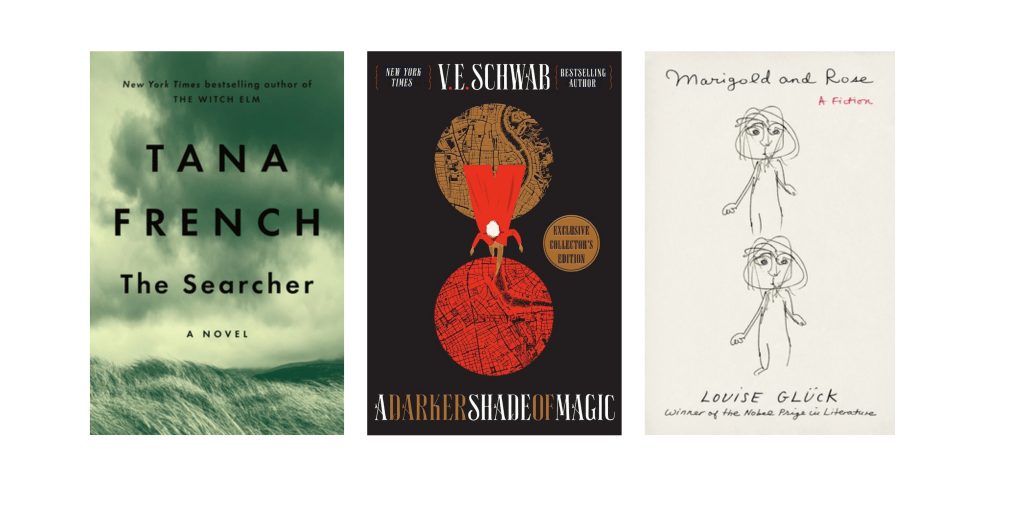
The Searcher —Tana French

This was my first book of October, aptly picked as the first gloomy week of rain and mist matched the moodiness of the Irish countryside where retired Chicago cop Cal Hooper moves for some peace and quiet. Except, because this is a Tana French book, Cal is quickly roped into an unofficial missing person case that he can’t refuse. To be honest, this wasn’t my favorite of the Tana French books I’ve read (I prefer the Dublin Murder Squad books), but it was still sufficiently cozy and scratched the atmospheric murder mystery itch, which is why we come to French in the first place.

A Darker Shade of Magic — V.E. Schwab

I was really craving an escapist fantasy à la Schwab’s most recent novel, The Invisible Life of Addie LaRue, so I picked up the first in her Shades of Magic series. In theory, it should’ve hooked me: four alternate universe Londons with varying levels of magic inside them all stacked on top of each other, and two of the only three people who can move between worlds are a grumpy sorcerer and a fearless lady pirate/thief. I think if I’d been more focused on the book instead of reading a page at a time while my Duolingo ads played then I would’ve gotten into it faster, but even when I was focusing it didn’t truly enthrall me like Addie LaRue did. That said, it was still a solid portal fantasy and I’ll likely read the rest of the series eventually.

Marigold and Rose — Louise Glück

This tiny, fifty-two page novella from Nobel Prize-winning poet Louise Glück asks the question: what if a baby wrote a book? No, really. Glück’s first work of fiction explores the rich inner lives of a pair of infant twins as they mature through their first year of life as chronicled by baby Marigold, an aspiring author who dreams of writing a book as soon as she knows words. Don’t be deceived by its diminutive size or strange premise, this was a surprisingly profound meditation on time, language, and family that’s more than worth the hour it’ll take you to read.

Honorable Mention:

The Mark of Athena — Rick Riordan

Yes, I am still listening to the Heroes of Olympus audiobooks and no, I am not okay after that cliffhanger!!! The gang goes to Rome in this one, accomplishing various side quests to stave off the rise of Gaia and rescue a kidnapped Nico di Angelo. Meanwhile, Annabeth has been given a special quest of her own—one that no child of Athena has ever come back from. BRB, queuing up Book #4.

Derry Girls — Lisa McGee

Dear God, I love this show and am so devastated that it’s over. If you’ve been living under a rock, it’s about a group of Northern Irish teenage girls (and one English boy) living in Derry during the Troubles. It is without a doubt one of the funniest shows I’ve ever seen and had me giggling through every single episode. Come for the Irish Catholic shenanigans and the impeccable nineties soundtrack, stay for the heartwarming moments of love and friendship that have a special place in each episode. I’ll be rewatching this show from the beginning (plus the holiday Bake Off special) very soon.

The Banshees of Inisherin — Martin McDonagh

I’m really on an Irish kick here, huh? I’ve been a Martin McDonagh fan ever since seeing The Pillowman at the Gaiety Theatre in Dublin back in 2015, and I’ll also watch Colin Farrell and Brendan Gleason in absolutely anything. This movie had me crying laughing one moment and then wanting to throw up mere minutes later. (If you’re squeamish about blood/self-mutilation…maybe skip this one.) It’s darkly hilarious, equal parts charming and devastatingly bleak, and gorgeously shot on the Aran Islands. The former Irish Lit student in me is dying to analyze every part of this movie, but for now, I’ll leave it with the prediction that Colin Farrell nabs an Oscar for this role.

Duolingo — la petite chouette, Duo

I probably could have read at least one other book in the time I’ve spent on Duolingo these past couple of weeks, but I’m simply having too much fun being humbled by this silly little owl every day. At least studying a language makes me feel more productive about my increased screen time, even if whispering sweet French nothings into my phone on the subway platform is highly embarrassing.


That does it for October! Drop a comment if you want to chat about any of these or leave me a recommendation for November! And don’t forget to subscribe to my newsletter below to get the email version right in your inbox next month.