Still full of beans

Lit Chat Vol. 32 — November in Review

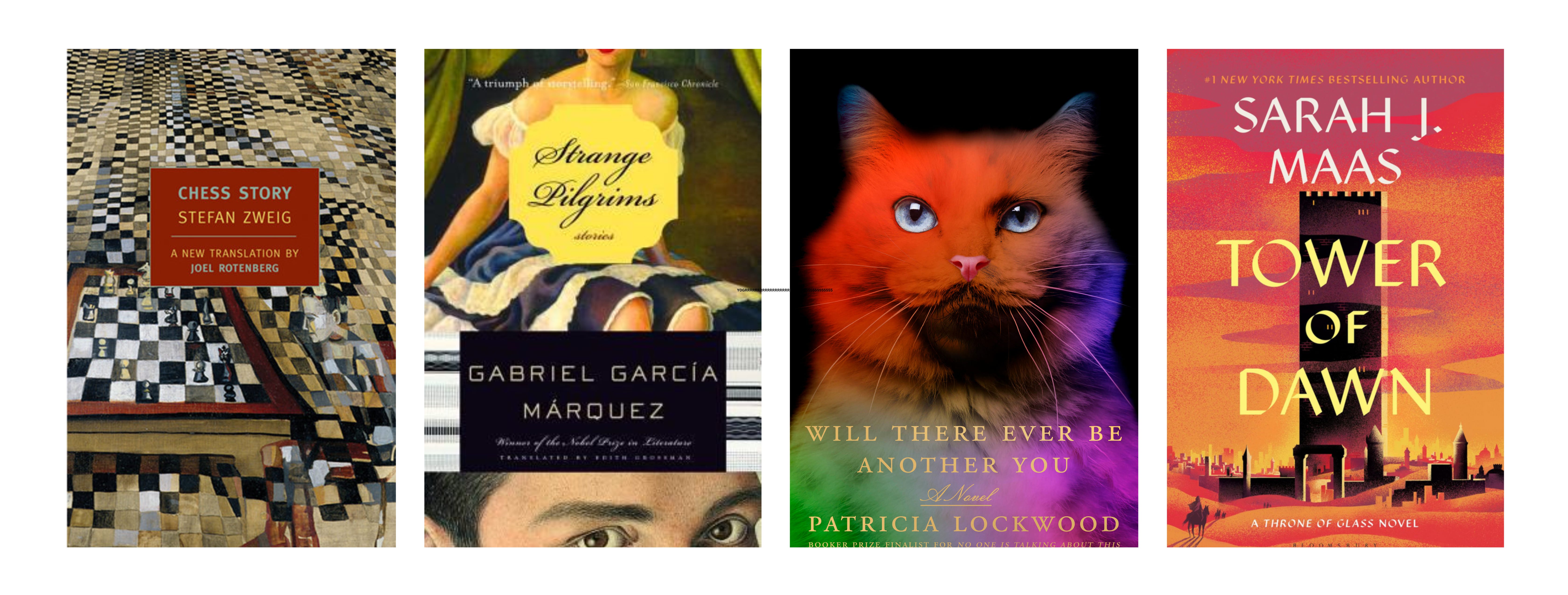
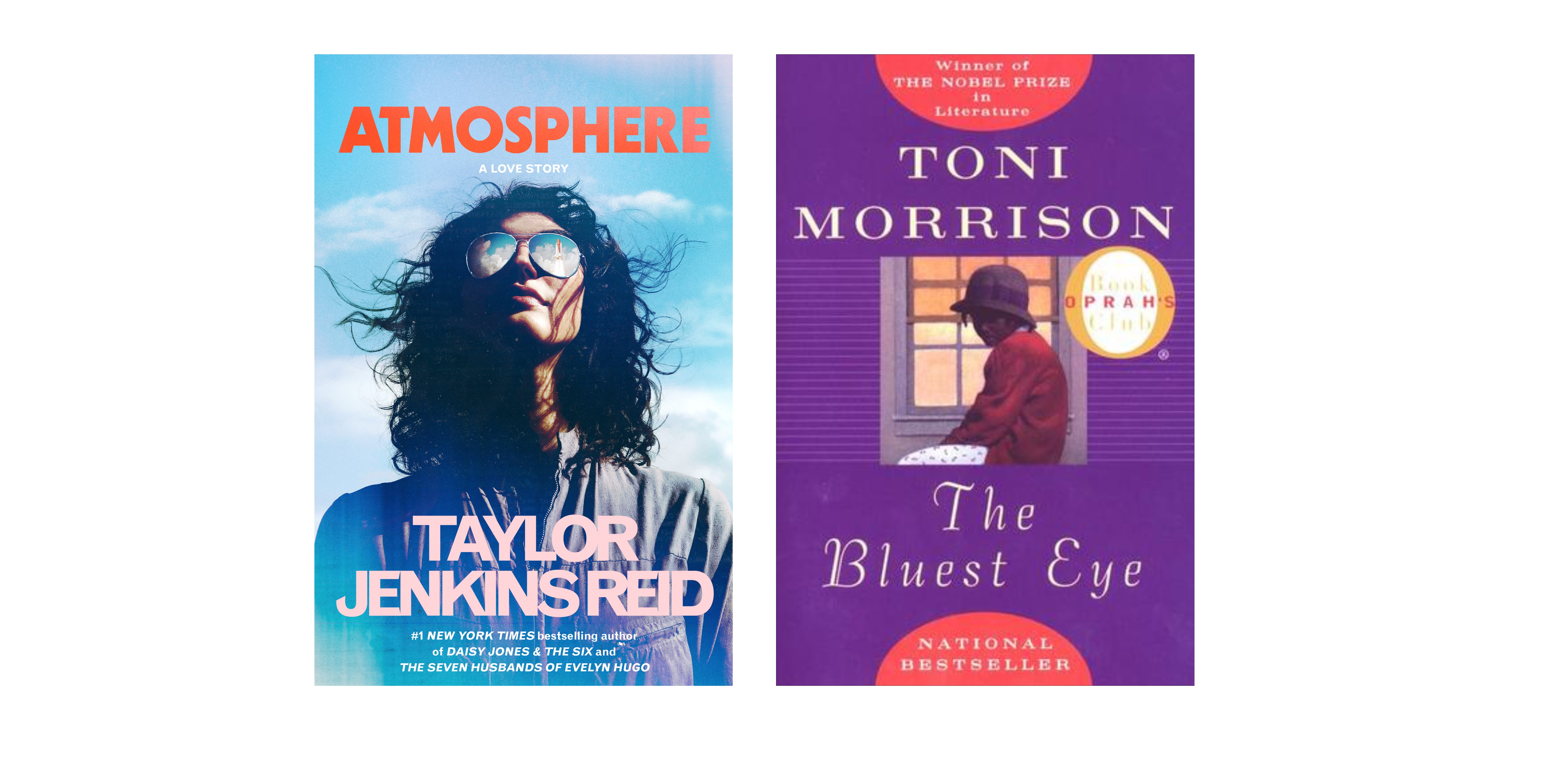
Pyramid of book cover images, bottom row: Chess Story by Stefan Zweig, Strange Pilgrims by Gabriel Garcia Marquez, Will There Ever Be Another You by Patricia Lockwood, and Tower of Dawn by Sarah J. Maas; middle row: Atmosphere by Taylor Jenkins Reid and The Bluest Eye by Toni Morrison; top: Red Bird by Mary Oliver

Hi friends,

We’ve approached my least favorite/favorite time of year. It’s cold, it’s dark, everybody you know is perpetually a little sick. Really, the only thing this time of year is good for is reading.

But we’re also approaching a reflective time of year, and I think I still have a little gratitude hangover from Thanksgiving. As I looked back at past pyramids this week to check whether I’ll meet the goals I set for myself in January, I was overwhelmed by how low-key stellar this reading year has been.

Not only were there so many bangers I’m already anxious that they won’t all get a fighting chance in the Best Of bracket due to seeding, but this year also left me so excited to keep reading: finishing series I’ve started, exploring more authors and genres I’ve discovered in a myriad of languages, wondering what I’ll unexpectedly fall in love with next year.

Overall, I’m just grateful that I’ve had so much time to spend with these words and worlds this past year. I know my life won’t always have the space to accommodate so much reading time like it does now, which makes this era of relative freedom and abundance of literary community to share it with feel extra precious. Not taking any of it for granted!!!

Anyway, TLDR:

Substack note posted on November 27 by Catherine Thoms that reads:
"grateful for all the books I've read in 2025
grateful for all the books I'll read in 2026"

But the year’s not over yet! We’ve still got November and December to chat about, baby, so let’s dive on in. And a reminder that you can get these posts straight to your inbox by subscribing to Lit Chat on Substack:


THE FOUNDATION:

Book cover images for Chess Story by Stefan Zweig, Strange Pilgrims by Gabriel Garcia Marquez, Will There Ever Be Another You by Patricia Lockwood, and Tower of Dawn by Sarah J. Maas

Chess Story — Stefan Zweig, tr. Joel Rotenberg

Work book club strikes again! This is a story of madness, told within the deceptively simple frame narrative of a man witnessing a chess match onboard a ship traveling from New York to Buenos Aires. The players are a world champion and a former Nazi prisoner, who taught himself chess to cope with the isolation of solitary confinement. The latter’s relapse of “chess sickness” is the climax of the novella, but it’s almost overshadowed by the historical context of its publication: Zweig, an Austrian living in exile in Brazil in 1942, committed suicide the day after turning in this manuscript. These circumstances can’t be separated from those of the novella, which is defined by the as-yet-vague but inevitable horror of the war to come, and the irrevocable estrangement from one’s home and former way of life. Highly recommend the Lit Century podcast ep on this novella as a companion listen to this haunting story.

Strange Pilgrims — Gabriel García Márquez, tr. Edith Grossman

I enjoyed dipping in and out of Márquez’s weird little worlds over Thanksgiving break, so near to our own but always with his signature twist of magical realism. Much like Zweig, Márquez was an expat writing about expats, and there’s a sense of displacement and unbelonging that permeates the stories in this collection. Most of the stories feature Latin Americans gone astray in Europe, e.g., a young wife accidentally stranded in a women’s asylum, a family on holiday trapped by supernatural winds, and a pair of ill-fated newlyweds separated by a strange injury. There’s a sense of wrongness, an encroaching sinisterness beneath the façade of civility and culture in each story that ties them all together, despite their being written over the course of two decades. I find it fascinating when authors revisit the same themes and ideas over the course of their career, and this is a perfect example of that kind of lifelong creative exploration.

Will There Ever Be Another You — Patricia Lockwood

The first and only word I could think of to describe this book upon finishing it was: wackadoo. I’m tempted to leave things there, but I can elaborate by explaining that this “novel” is a product of the author’s brain-scrambling experience with long Covid, which made me feel similarly disoriented and unstable just reading her attempts at translating that experience into words. And yet, there are also profound moments of grief and anxiety, as the author simultaneously deals with episodes of tragic loss and illness within her family. Having read Lockwood’s prior novel, Will There Ever Be Another You, (and having once been an avid Twitter follower), I know much of this work draws from real life. The trick of the novel is that you’re never quite sure what’s real and what’s not; truth and reality become somehow immaterial.

Tower of Dawn — Sarah J. Maas

Yes, we are still cruising through the Throne of Glass series!! I blew through book six in three days while I was home for Thanksgiving, reliving my childhood glory days of staying up past my bedtime to cram the last hundred pages in before midnight. What’s cool about this one is that it takes a complete detour from the previous book, following a couple of side characters to a whole different continent, and introducing new characters and cultures that expand and enrich the world of the series in a complex yet refreshing way. I expect we’ll catch up with the main crew in the next and final book of the series in approximately…eight weeks, when my Libby hold comes in.


SOLID SUPPORTS:

Book cover images for Atmosphere by Taylor Jenkins Reid and The Bluest Eye by Toni Morrison

Atmosphere — Taylor Jenkins Reid

Being an astronaut was one of my many short-lived childhood career dreams, so I was especially excited for TJR’s latest. Set in the early 1980s, this book follows the second-ever group of NASA astronaut candidates to include women, and features a slow-burn romance between two of the women, Joan Goodwin and Vanessa Ford.

I’ve been describing it as Apollo 13 but with lesbians, which means it’s not a spoiler to tell you that the book opens with disaster striking during a space mission. In the span of minutes, Vanessa becomes the only surviving astronaut capable of bringing the ship home, with the help of Joan’s coaching from Houston. The rest of the story is told in intermittent flashbacks to their selection and training, including the development of their relationships with the other astronauts in their class.

I resented this structuring a bit because I knew it was going to make me care about characters that just die in the first chapter, and I don’t appreciate that kind of emotional manipulation!! But I still raced through it and thought it was not only a beautiful love story, but also drove home just how impactful—and not guaranteed!—it was for women to succeed in this field at that time, securing a future for entire decades of women in STEM.

The Bluest Eye — Toni Morrison

I read this book in the span of my travel day from Chicago back to New York, finishing just as the plane touched down at LaGuardia. Although it didn’t take me very long to read, the heaviness of its subject material ensures that it’s not an “easy” read by any means. The opening pages prepare you for a story of child sexual abuse, and the rest of the novel unfolds through the eyes of the classmates, family members, and neighbors of the victim: a little Black girl who makes a wish for blue eyes.

What I found almost even more interesting than the novel itself was Morrison’s Afterword. First published in 1970 and reissued with the Afterword in 1994, I was surprised to see Morrison express dissatisfaction with the structure of the novel as a means of engaging with themes of internalized and structural racism. She acknowledges what she was trying to do and the shortcomings of her approach, compounded with the difficulty of striking the right tone in the language itself, in the pursuit of “race-specific yet race-free prose.”

I was surprised and impressed by this admission, at how Morrison was still finding ways to engage with and challenge her work by the changing standards of the time and her own skill level, decades after its publication. The choice to publish these thoughts as an Afterword is not one of a more experienced author excusing the failures of a younger self, but of an artist continually in conversation with all versions of herself, her work, and her world, challenging her readers to stay in that conversation, too. Cool as hell, in my humble opinion!


THE TIPPY TOP:

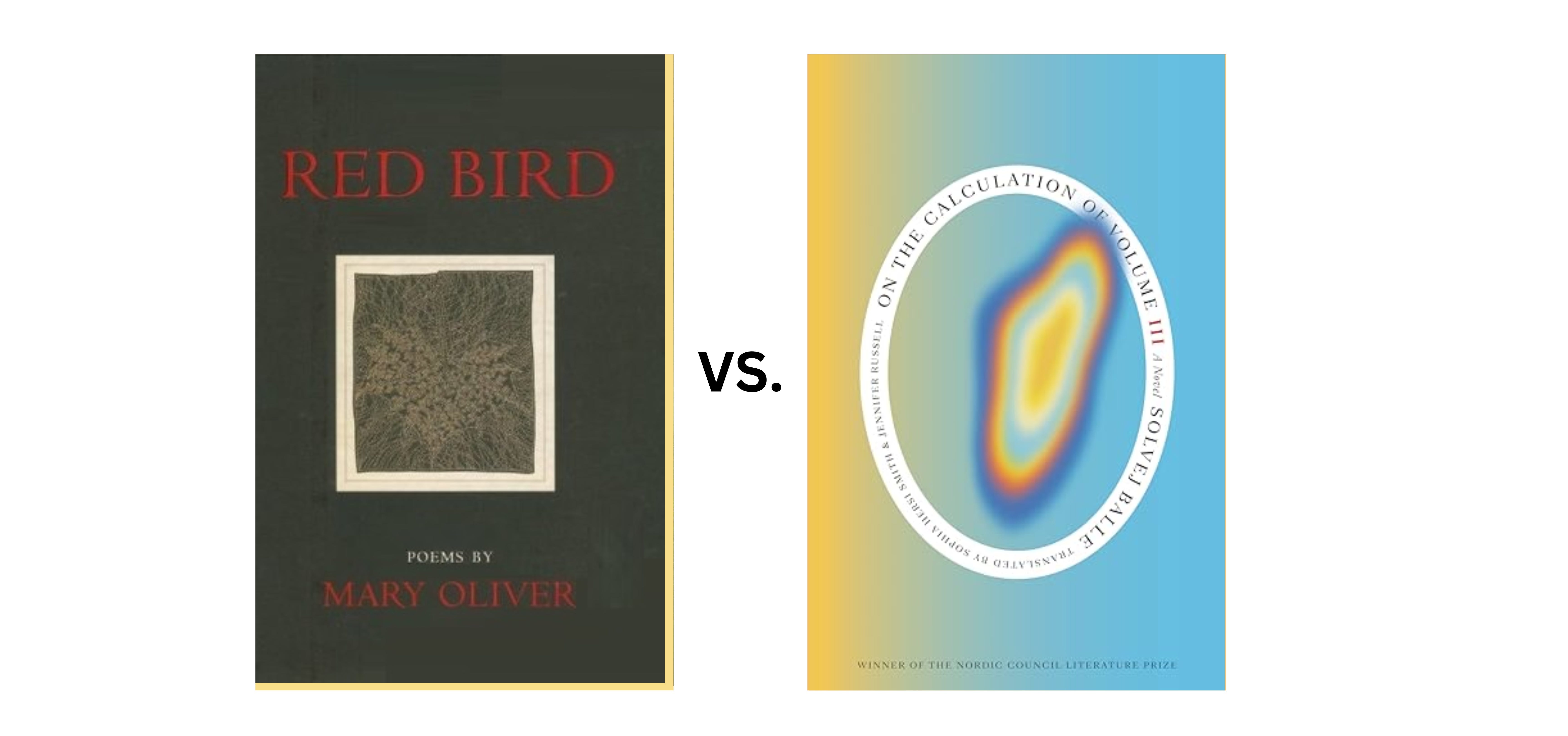
Book cover image for Red Bird by Mary Oliver

Red Bird — Mary Oliver

What can’t an afternoon spent with Mary Oliver fix? I had requested this volume specifically from the library because it’s the book Coyote Sunrise searches for in Coyote, Lost and Found by Dan Gemeinhart, which I read back in August.

The titular red bird opens and closes the collection and pops up throughout, often serving as a go-between for the physical and spiritual world. The collection features Oliver’s signature awe and wonder for the natural world, but there’s an undertone of grief and distress that can be attributed to a number of factors: the loss of Oliver’s long-term partner in 2005, three years before this volume was published, the Iraq war, the melting of the ice caps. To love the natural world as Oliver does is to feel all of its suffering, but also to see God everywhere in its beauty.

I’ll leave you with some of my favorites, because everybody needs a little more poetry in their lives, and because this was my only five-star book of the month for a reason:

  • The poem Coyote seeks is “Mornings at Blackwater,” which made me a little teary remembering the emotional release of encountering it for the first time in Gemeinhart’s novel.
  • Self-Portrait” made me laugh and so charmed me that it inspired this newsletter heading.
  • Love Sorrow” is the kind of poem you keep in your back pocket, to return to in inevitably difficult times.
  • I don’t want to live a small life” is one you may have seen before, a classic Oliver love poem disguised as inspirational nature poem.
  • Oliver wrote a whole series of poems about her dog, Percy. If you pick just one of these poems to read today, let it be this one: “I Ask Percy How I Should Live My Life.”

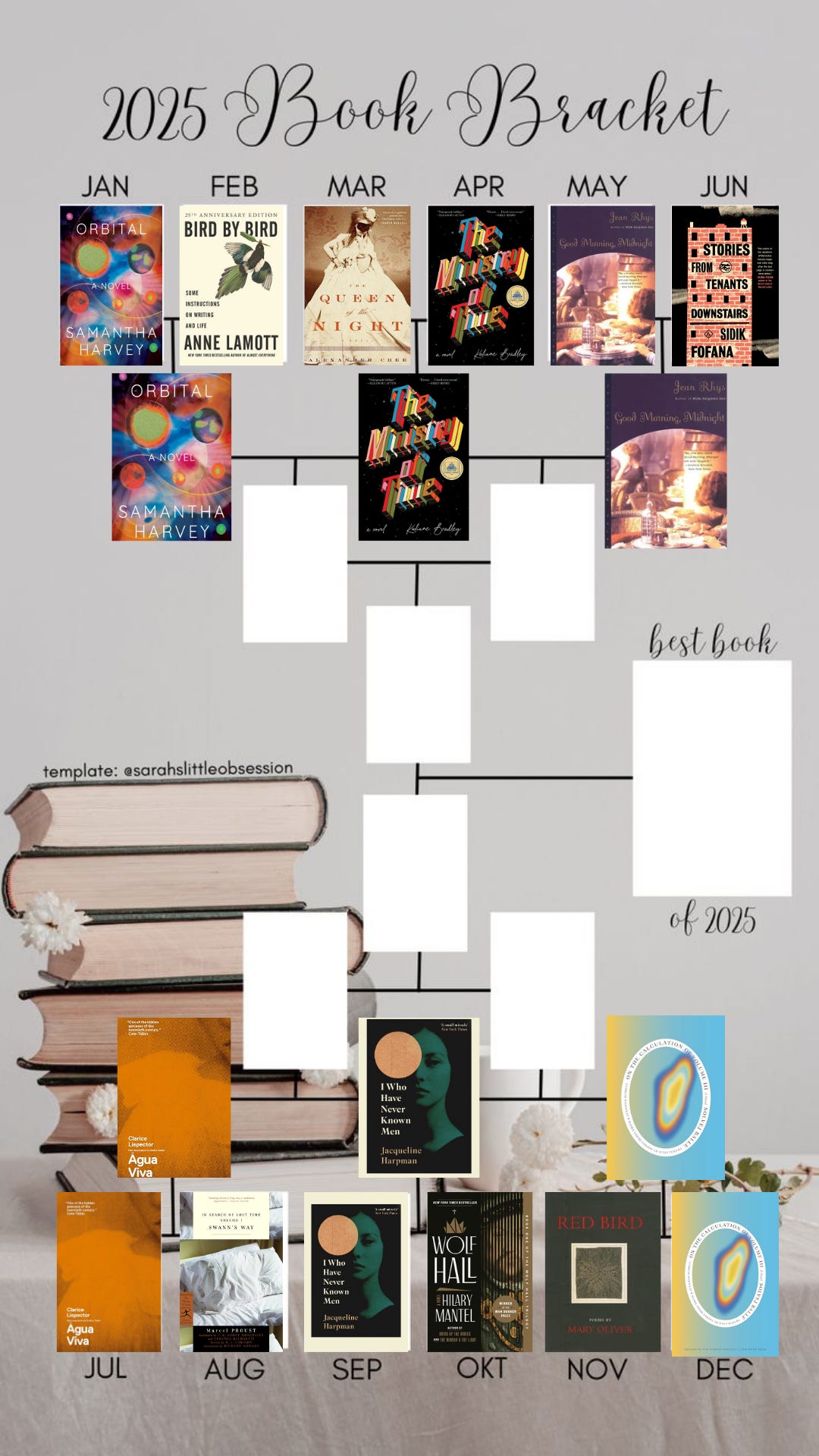
One more month to go! Historically, I’ve wound down my reading in December so I don’t have to do both a December recap and an EOY bracket, but there is simply too much to read, and it’s still anybody’s game (although On the Calculation of Volume III just might come out swinging).

Time will tell, so stay tuned, and as always, thanks for being here! Grateful for this lil circle of book lovers—you know where to find me if you ever want to chat more about these or any other books.

Until next time, happy reading!
❤ Catherine


Housekeeping note: all book links go to my Bookshop storefront, where each purchase supports independent bookstores (and this newsletter, because I get a small percentage of each sale).

Always try to keep a patch of sky above your life

Lit Chat Vol. 29 — August in Review

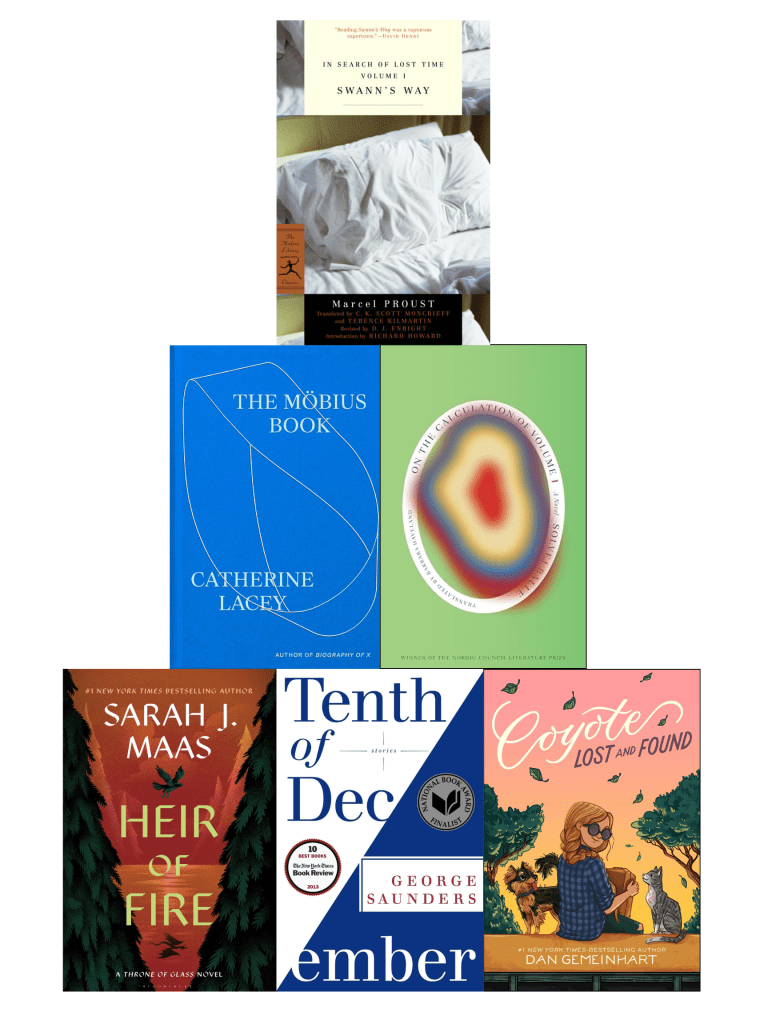
Pyramid of book cover images with Heir of Fire by Sarah J. Maas, Tenth of December by George Saunders, and Coyote Lost and Found by Dan Gemeinhart on the bottom; The Mobius Book by Catherine Lacey and On the Calculation of Volume I by Solvej Balle in the middle; and Swann's Way by Marcel Proust on top.

Hi friends,

I have good news and bad news. The bad news is: this newsletter officially marks the end of summer reading time.

I know, I know, technically we still have another week, I’m over it. Here’s where the good news comes in: I hereby declare it officially Back to School/Cozy Fall reading season! Put on a scarf and re-read The Secret History on a park bench to celebrate.

But before I get too far ahead of myself seasonally, I do have one more month of summer reads left to share. I’m not sure my summer brain is less discerning than usual, but I gave every book in this newsletter four stars on Goodreads. Some probably could have been half stars if Goodreads had that option, but since they don’t, this pyramid is organized purely on vibes and a little bit of recency effect.

I’d love to hear if you had any favorite summer reads or surprise highlights of the season, or if there’s anything in particular that’s on your TBR as the weather starts to cool down and the era of cozy reading is almost upon us. Let me know!

And of course, if you’d rather get this in an email straight to your inbox, you can subscribe to my Substack here:


THE FOUNDATION:

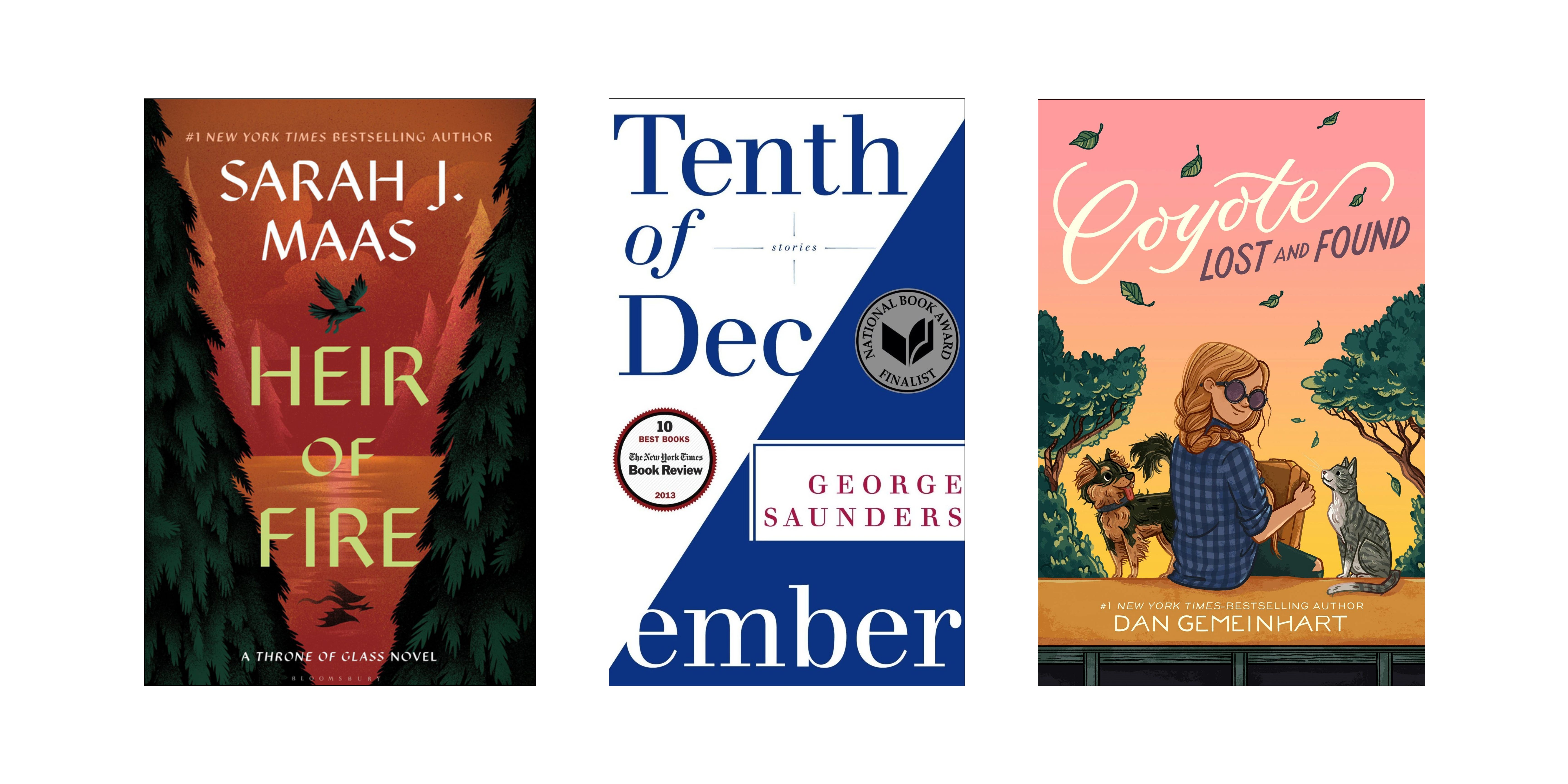
Book covers for Heir of Fire by Sarah J. Maas, Tenth of December by George Saunders, and Coyote Lost and Found by Dan Gemeinhart

Heir of Fire — Sarah J. Maas

Another Throne of Glass book! Not much to say about this one without spoilers, except for the fact that this was the first one that I listened to as an audiobook, and I enjoyed that experience more than I thought I would. It’s also the first book in the series to jump around with POVs beyond just those immediately involved in Celaena’s story, expanding the world to include concurrent storylines from other characters and continents, new and old. Consider this my formal request for Libby to add the fourth audiobook to their catalog (please)!!!

Tenth of December — George Saunders

George Saunders, certified weirdo and probable genius, is a master of the short story. There’s a conversation with David Sedaris included at the end of the book, in which Saunders talks about how he likes to push his characters to their breaking points. This can sometimes make the stories seem cruel, but it’s this cruelty that forces his characters into a crisis, triggering the intrigue and emotional complexity that we expect from Saunders.

You can trace this strategy through each of the stories in this collection, which all live somewhere on a sliding scale of bizarreness: whether it’s the teen boy deciding to intervene in an assault on his neighbor in “Victory Lap,” or the learned desensitization in the world of “Semplica Girl,” which is a story that still haunts me. Even in the strangest, most dystopian settings, Saunders’ characters hold up a mirror to our most mundane and authentically human motivations and desires.

Coyote Lost and Found — Dan Gemeinhart

The first book featuring this character, The Remarkable Journey of Coyote Sunrise, was one of my favorite middle-grade titles to hand-sell when I worked at Books of Wonder in 2019. This sequel sees the return of Coyote, her dad Rodeo, and Yager, the outfitted school bus they lived in for the six years following the accidental death of Coyote’s mom and two sisters. This time, we’re on the road again in search of a lost book that contains a final message from Coyote’s mother.

Gemeinhart manages to infuse these quirky characters with so much heart it actually hurts—the first book made me ugly cry, so at least I was prepared for it this time around. It also handles the pandemic in a way that feels natural and respectful while also portraying the dangers and frustrations of the time in a way that young readers can process and understand, regardless of whether they remember it first-hand. (How wild that we now live in a world where kids may not remember Covid? Oh, to be so lucky.)


SOLID SUPPORTS:

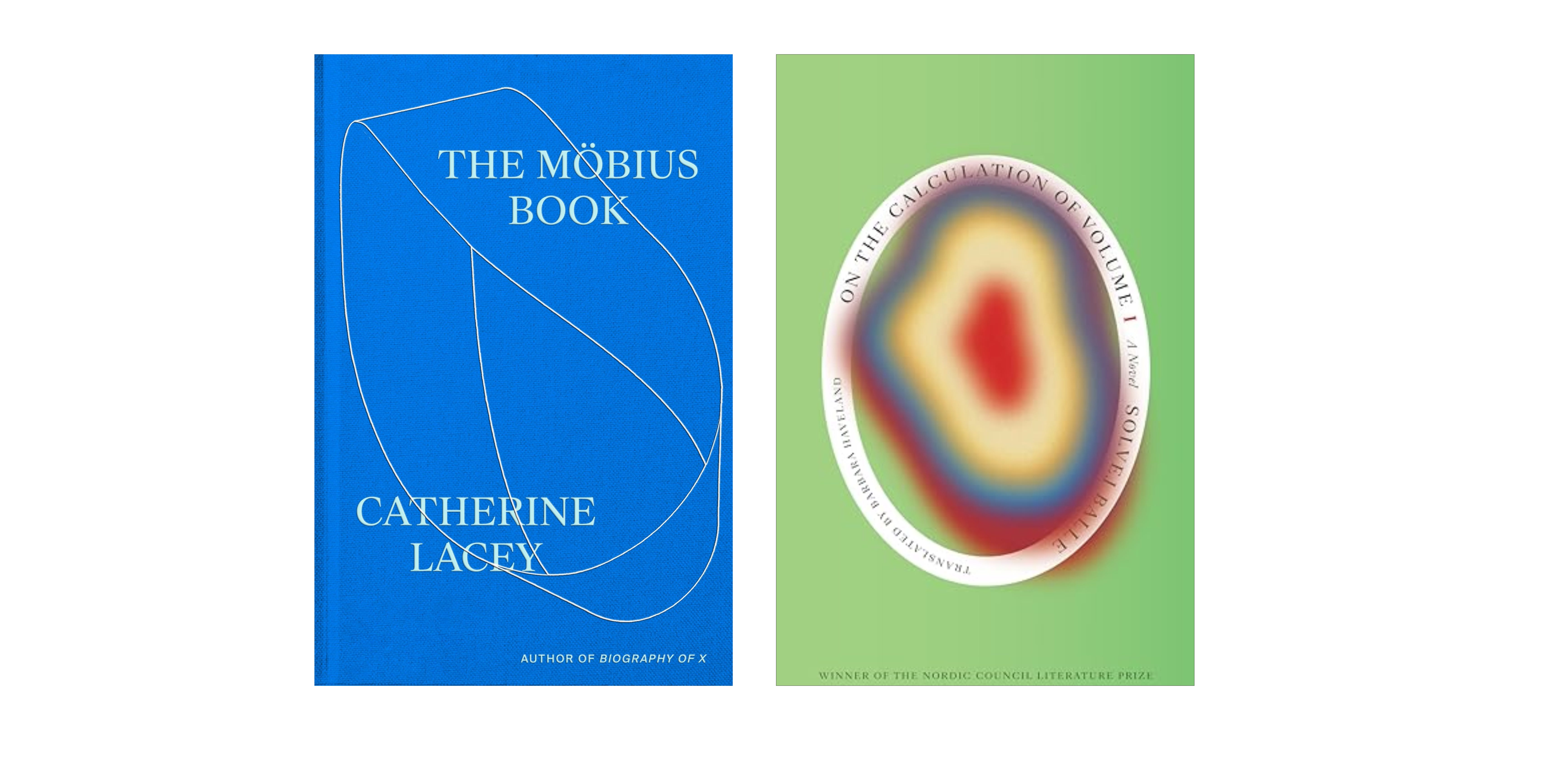
The Möbius Book — Catherine Lacey

A new weird-ass book from Catherine Lacey, thank god! The Möbius Book is a hybrid memoir/fiction experiment, and I didn’t fully understand the title until I finished both halves and realized that you could continue going back and forth between the two sides and discovering new ways that each has seeped into the other, likely indefinitely.

It’s a captivating look at the author’s loss of a relationship and her struggle to rebalance her world and her other relationships in its wake, and these themes of grief, loss, and identity pop up in sneaky ways in the accompanying work of fiction. It’s obvious which section is which, but they’re not marked. The front and back of the book appear exactly the same; you just have to pick a side and start reading. There’s no wrong way to read this book—you’ll find yourself returning to the beginning again no matter where you start.

On the Calculation of Volume I — Solvej Balle, tr. Barbara Haveland

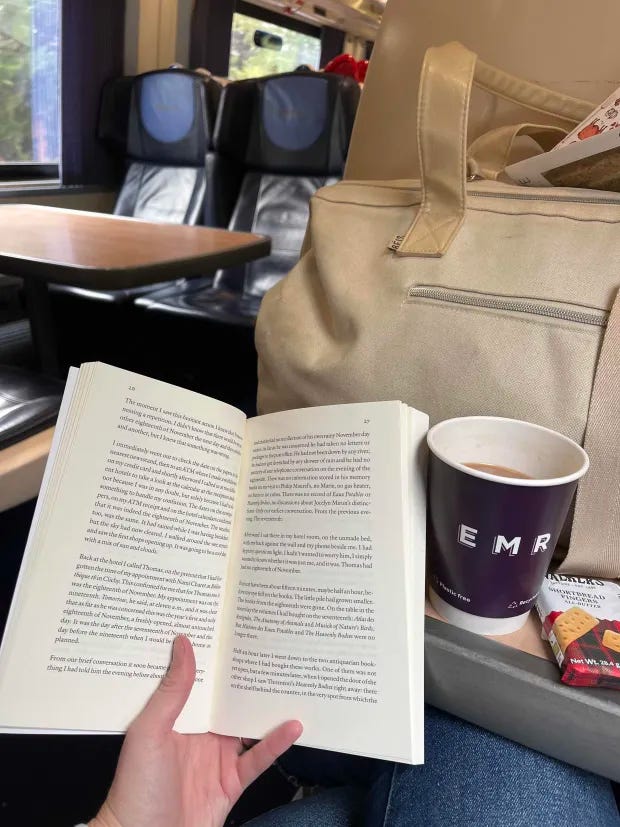
I read most of this book on the train from London to Sheffield for a conference, complimentary tea and biscuits at hand, which was an elite reading experience!!

Hand holding a paperback book open next to a paper cup of tea and packet of shortbread biscuits. Travel bag and train car in the background.
this one goes out to the East Midlands Railway

How engrossing can a novel about a woman reliving the same day over and over again really be? The answer is: VERY. I could not stop thinking about this book once I’d started, and finished it within 24 hours.

The premise is basic: a woman wakes up to the same calendar day every day for a year. The same events happen around her each day, but she seems to be the only one who remembers them. I don’t want to say too much and spoil anything because it’s such a short book and I think most of the wonder comes from truly not knowing what to expect, BUT! I can say that I found the protagonist’s exploration of her new reality and its limitations and opportunities completely engrossing. This is the first of SEVEN volumes, and the third will be released in English in November. I can’t wait to see how this world can possibly continue expanding.

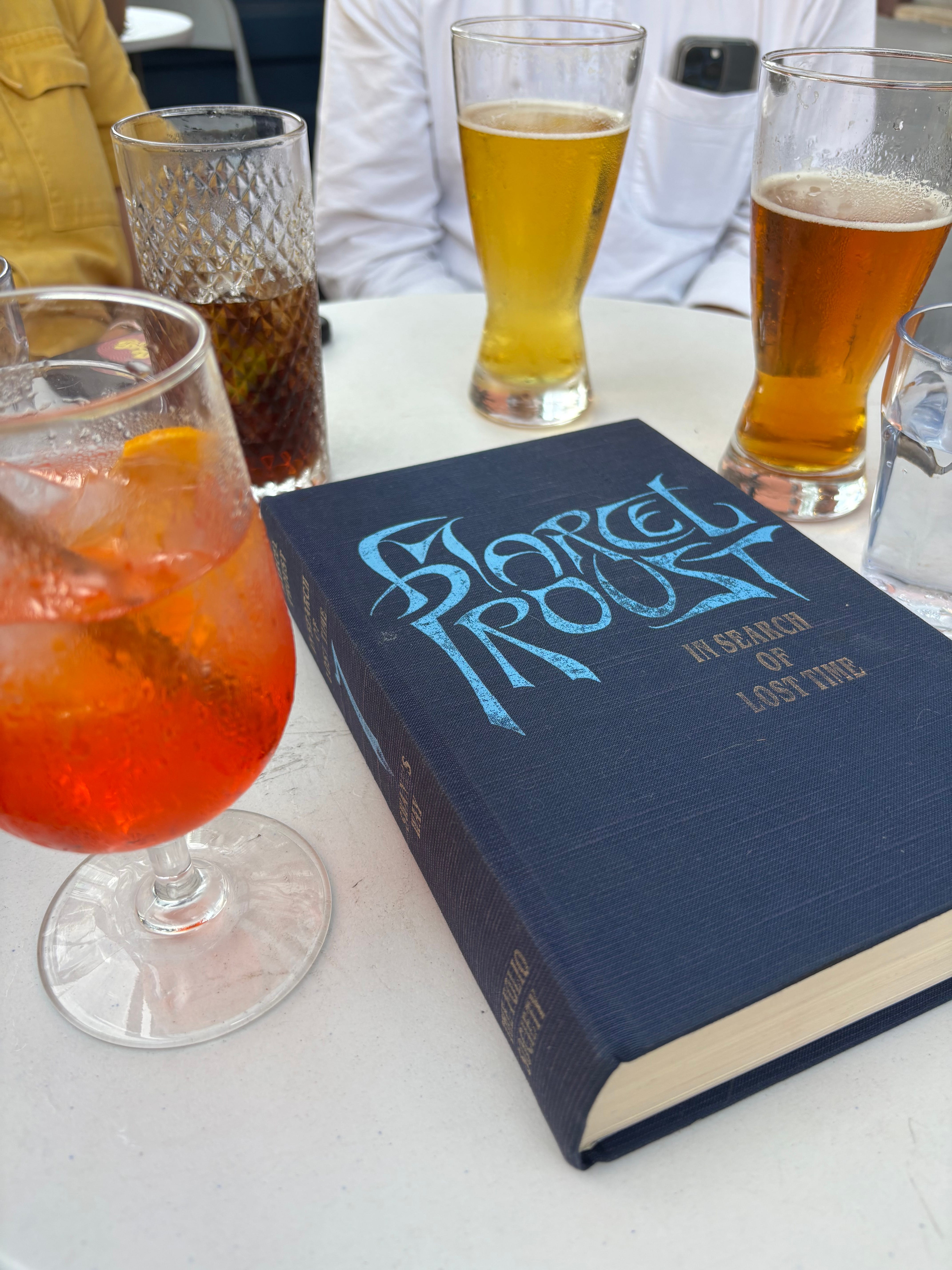
Swann’s Way — Marcel Proust, tr. C.K. Scott Moncrieff and Terence Kilmartin, revised by D.J. Enright

Blue hardcover of Marcel Proust's Swann's Way in the middle of a white table, surrounded by half-full drink glasses
from our lovely halfway point chat a few weeks ago!

As you may be aware, I’ve been reading Proust this summer along with a few brave friends and documenting it on Substack! Over the course of eight(ish) weeks, we read Swann’s Way, the first volume of In Search of Lost Time—which is no small feat when you look at how long the paragraphs are.

While the writing style certainly took some getting used to (that man never met a comma he didn’t love), I found myself genuinely enjoying disappearing first into the world of his family’s country home in Combray, and then into Belle Époque Paris. Although the plots (if you can call them that) of each section could not have been more different, similar themes of time, memory, and love were easily trackable through each storyline. Its social commentary was so much funnier than I expected, and taking the time to turn my former English major brain on each week to do a little analysis was deeply refreshing. Getting to talk about it with friends and discover new layers to the text together has been even better!

Though this maybe wasn’t the most “fun” read I had this summer, it’s the one I’m most proud of, and therefore deserves the top spot. Finishing this book and keeping up with the weekly updates felt like a true achievement, and while I definitely need a break before trying my hand at any future volumes, at least now I know that I’m absolutely up to the task.


Summer reading, you were fun! I’m now very excited to lean into the dark academia vibes for fall: I honestly might do a Secret History re-read, and I’m also hoping to get my hands on R.F. Kuang’s newest, Katabasis. Plus, V.E. Schwab’s latest, Bury Our Bones in the Midnight Soil, looks deliciously dark and vibey, per usual.

What will you be reading this fall? I want to hear about it! Always down to chat in all the usual places.

Until next time, happy reading!
❤ Catherine


Housekeeping note: all book links go to my Bookshop storefront, where each purchase supports independent bookstores (and this newsletter, because I get a small percentage of each sale).
Out of the deep, dark river

Lit Chat Vol. 27 — May in Review

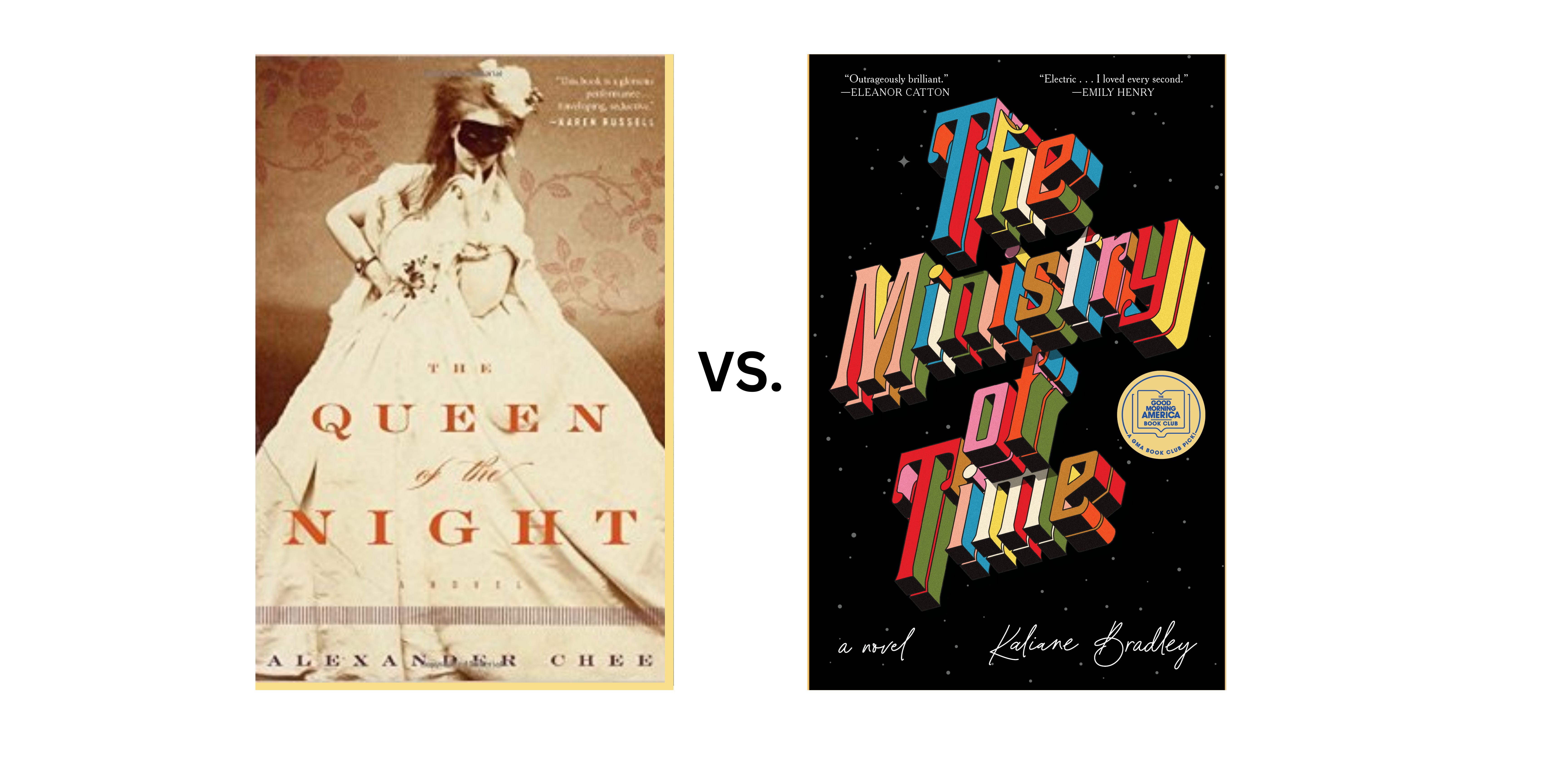
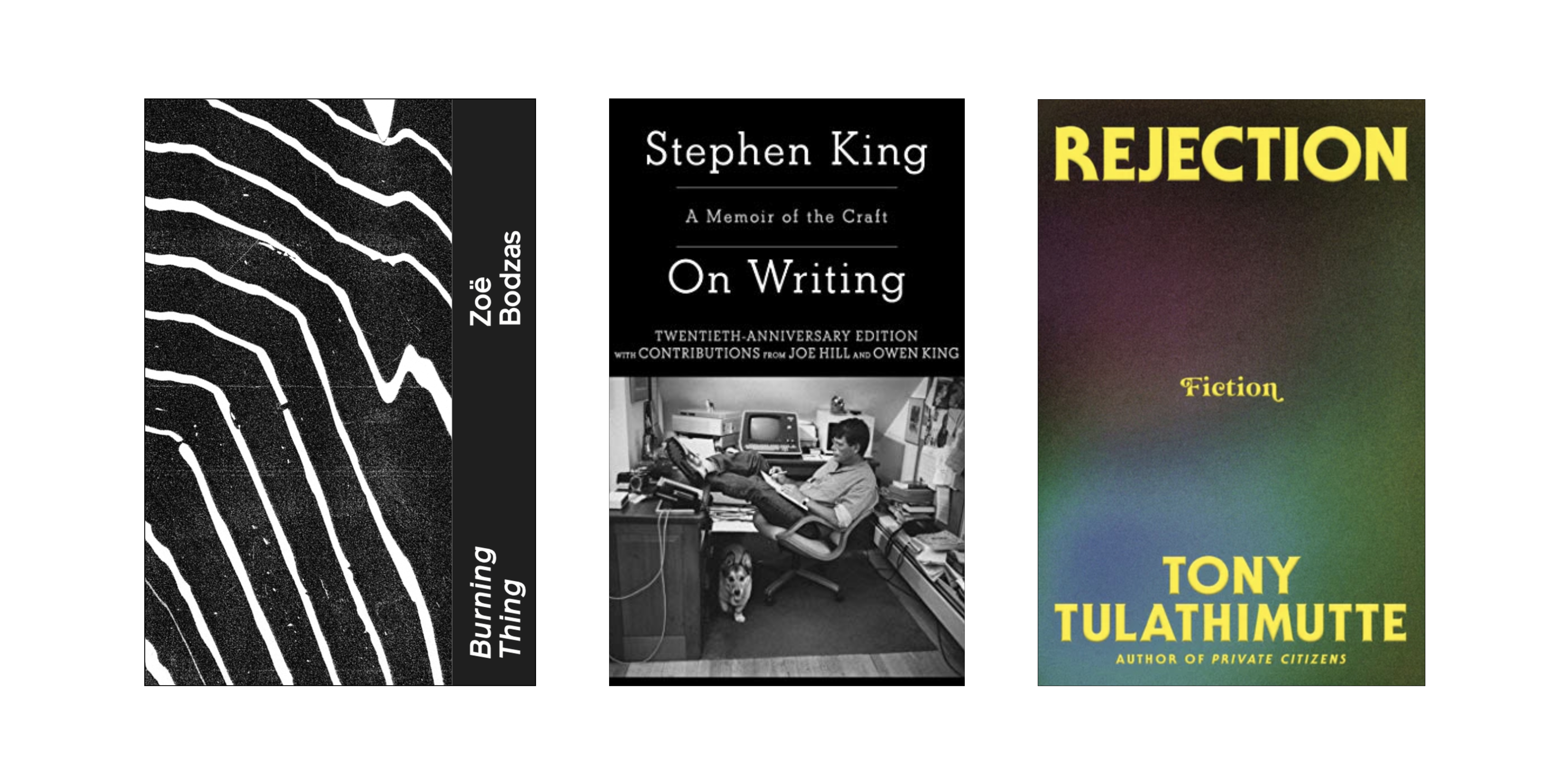
Pyramid of book cover images with Good Morning, Midnight by Jean Rhys at the top and Burning Thing by Zoë Bodzas, On Writing by Stephen King, and Rejection by Tony Tulathimutte on the bottom.

Hi friends,

Happy Father’s Day to all the dads out there, but especially to mine, because he’s the very best!

I’ve got another mini for you this month because May was BUSY, but I’ll make up for that brevity with two announcements:

First: my next in-person reading club will be Sunday, June 29th! If you’re new around here, this is when I invite all my friends over to my apartment (or maybe somewhere with better air conditioning this time around, TBD), and everyone comes prepared to chat about something (book/story/poem/article) they’ve read recently. More info on the Partiful here, hope to see you there!

If you’re interested in a more structured reading group, my second announcement is that I’m launching a little summer book club to read Swann’s Way, the first volume of Marcel Proust’s In Search of Lost Time.

Since enough of you nerds have expressed interest in tackling Proust with me, I’m planning to experiment with a hybrid format that combines a couple in-person meetings with a weekly Substack note from me about the pages covered, including some questions for reflection/discussion!

I will most likely throw the weekly posts behind a (very small) paywall, and I’m also planning on using Substack’s Chat feature as an ongoing discussion center, but open to feedback/other ideas if we try it and don’t love it. This is very much a trial run to see how a project like this could work!

With the rough schedule I have, it should take about seven weeks to read, starting the second week of July (7/7). If you’d like to join, make sure you’re subscribed to my Substack below and keep an eye out for the official launch email coming in a couple weeks!

Okay, now onto the books!


SOLID SUPPORTS:

Book covers for Burning Thing by Zoë Bodzas, On Writing by Stephen King, and Rejection by Tony Tulathimutte

Burning Thing — Zoë Bodzas

Zoë is a dear friend whose talent and wisdom I have admired since our very first online writing workshop all the way back in 2020. I’ve had the distinct pleasure of getting to watch so many of the poems collected here evolve from products of a biannual poem-a-day challenge to being published in national magazines, and to now celebrate their recent publication in chapbook form with No, Dear!

Zoë’s abundant curiosity and keen focus are applied with equal generosity to everything from dad radio to errant space rocks, and her playfulness shines in her experimentation with form. But it’s the poems that combine nostalgia and tenderness with a sense of awe for both the vastness of our universe and the intimate minutiae of daily life that have etched themselves into my heart and brain. (I often catch myself repeating “i’m still here / you’re still here” from “eager years” like a mantra.) Nobody does wonder quite like Zoë, and it’s a wonder and a treat to know her and support her on this journey.

On Writing — Stephen King

After about a month of On Writing laying untouched on my coffee table, I was inspired to actually open it by Clara’s Jan-March reading recap in Hmm That’s Interesting. Like Clara, I had never actually read a Stephen King novel, but I enjoyed getting to know the man behind the horror machine through his own frank humor and honest accounting of his struggles and successes. Also like Clara, I didn’t learn anything necessarily new or groundbreaking, but it did force me to have a real reckoning with my adverb usage. Plus, “10% shorter” is a solid general rule of thumb for second drafts that will also be sticking with me.

Rejection — Tony Tulathimutte

My hot take on Rejection is I wanted to be more obsessed with it than I was! Rarely is a short story collection quite so buzzy, and I think the shock factor of depravity in so many of these stories accounts for most of that buzz. Tulathimutte’s characters experience myriad forms of social and romantic rejection, for reasons that mostly boil down to the characters just kind of sucking. This feels fun and salacious in an almost voyeuristic way at first, and I especially enjoyed the opening stories that lambaste the “good guy” trope and the toxic potential of the group chat, but it lost me when it started to take things to the extreme around the middle/end of the collection (iykyk). That said, I think as a whole, it’s a wild satire on modern relationships and the question of what we owe each other as individuals within a morally fraught society.


THE TIPPY TOP:

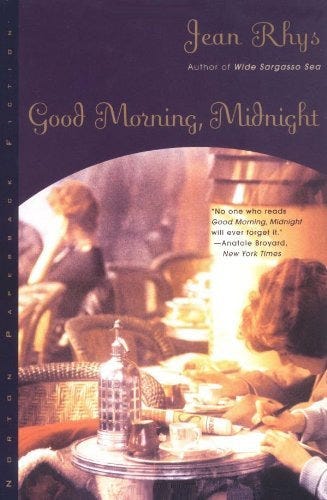
Book cover image for Good Morning, Midnight by Jean Rhys

Good Morning, Midnight — Jean Rhys

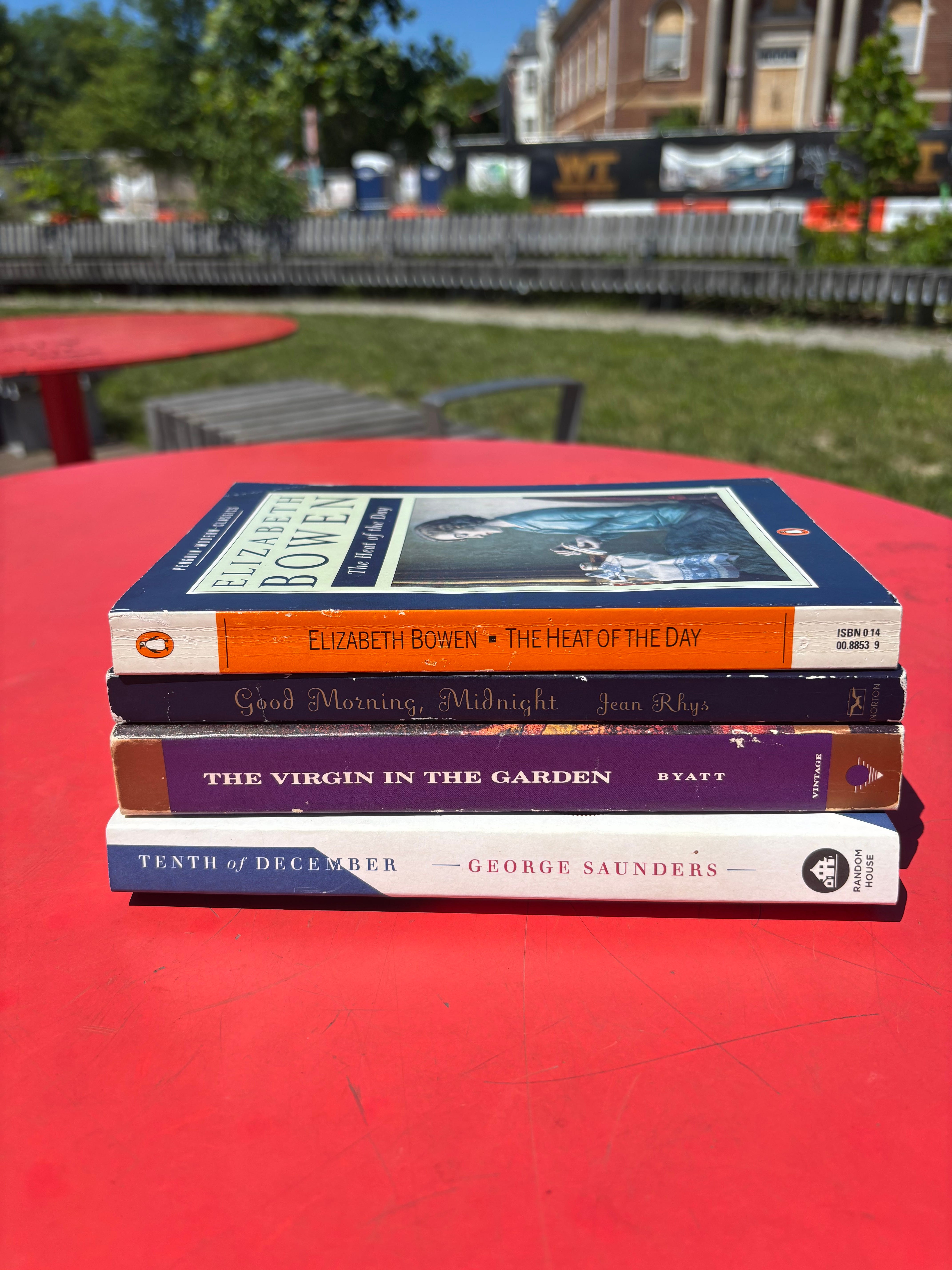
I emerged from the D.C. Metro over Memorial Day Weekend to find a library book sale waiting right at the station exit, which felt like a fairy trap laid explicitly for me. I picked up Good Morning, Midnight, (along with The Heat of the Day, Tenth of December, and The Virgin in the Garden), and proceeded to read the entire thing in one sitting on my Amtrak home that afternoon.

Stack of books (The Heat of the Day by Elizabeth Bowen, Good Morning, Midnight by Jean Rhys, The Virgin in the Garden by A.S. Byatt, and Tenth of December by George Saunders) on top of a red table
thank you, Eastern Market Station!

Good Morning, Midnight is the story of a woman who has returned to interwar Paris in search of a fresh start, despite the ghosts of lost loves and past traumas that seem to lurk around every once-familiar corner. It’s a portrait of a woman in physical and psychological decline, which only escalates when she is targeted by a charming young man who believes she has something more to give.

I was fascinated by the way Rhys layers the Paris of Sasha’s past—as a young girl in love, a soon-to-be mother, and then a single, devastated woman on her own—with the Paris of her present, full of disappointed potential. Sasha’s first-person narration is Mrs. Dalloway-esque, slipping in and out of memory as she goes about her daily errands, purchasing new clothes and cutting her hair in pursuit of a reinvention that can never truly be. Yet it’s Joyce’s Ulysses that is clearly evoked in the “Yes – yes – yes…” of the final line, when Sasha meets her fate with questionable relish: is she a victim or a manipulator? Was there ever really a choice? These are the questions that haunt my Amtrak rides!


And that’s May! I’m looking forward to next month, when I’ll be doing a check-in on the reading goals I set for myself in the beginning of the year. In the meantime, you can find me in all the usual places if you’d like to chat about these or any other books!

Until next time, happy reading!
❤ Catherine


Housekeeping note: all book links go to my Bookshop storefront, where each purchase supports independent bookstores (and this newsletter, because I get a small percentage of each sale).
Why demand a map for uncharted territory?

Lit Chat, Vol. 26 — April in Review

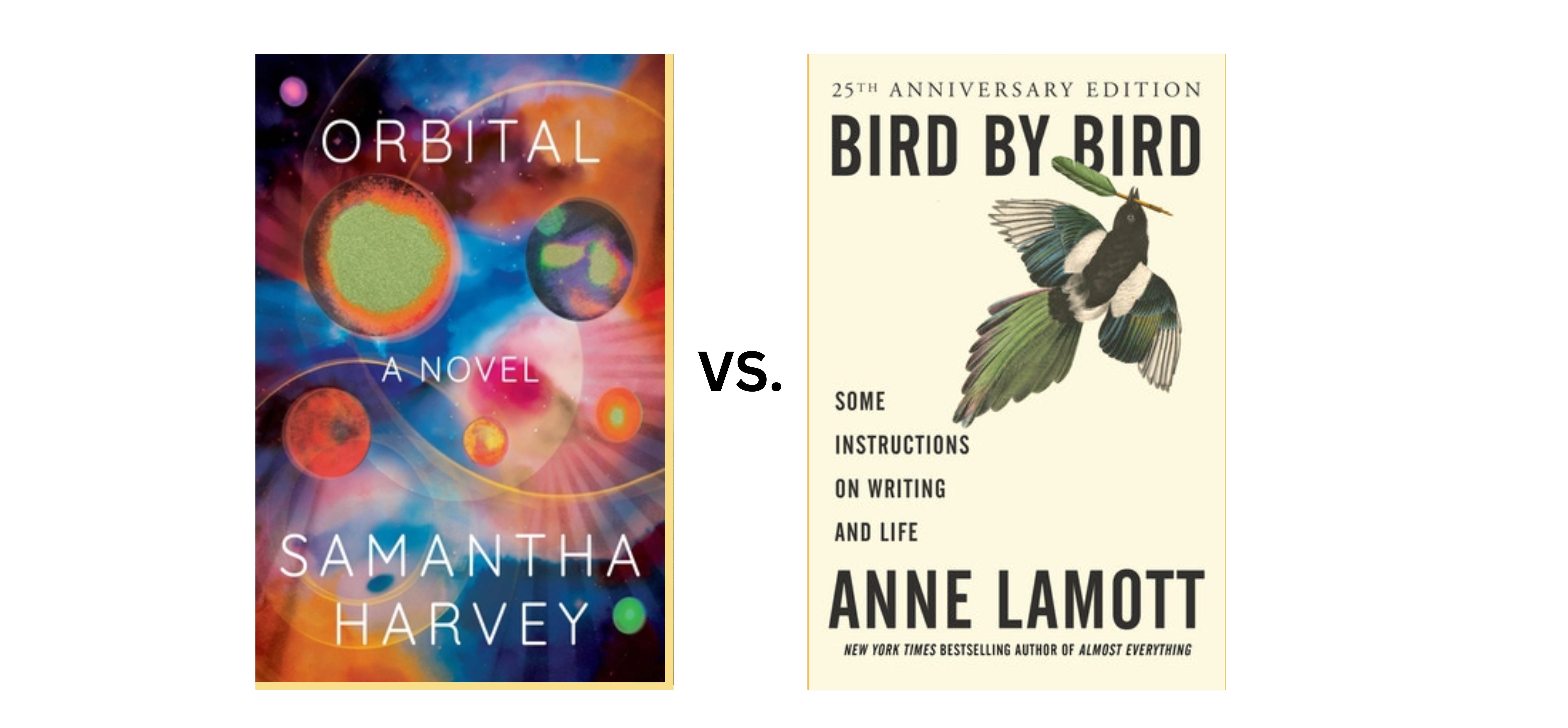
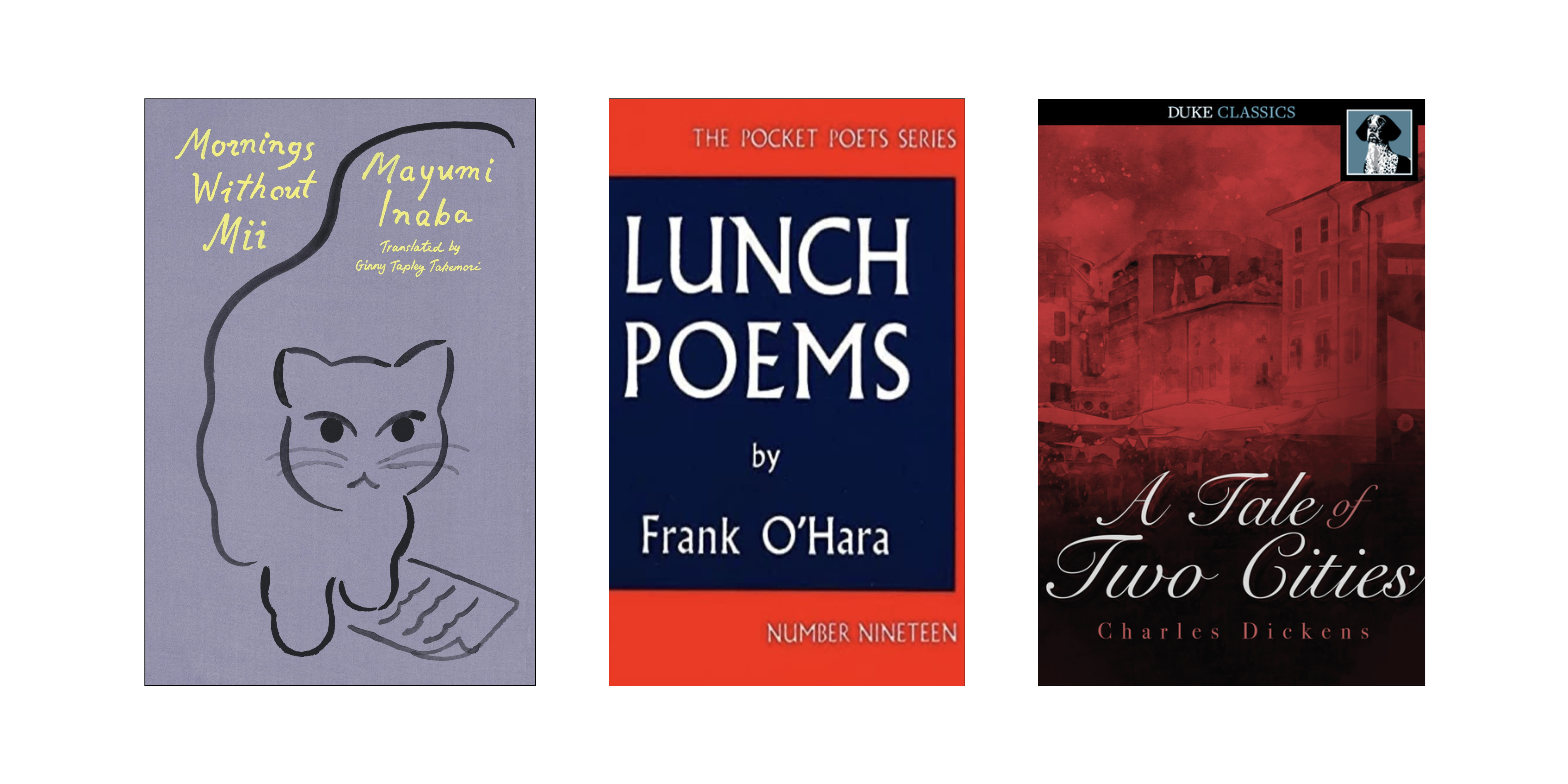
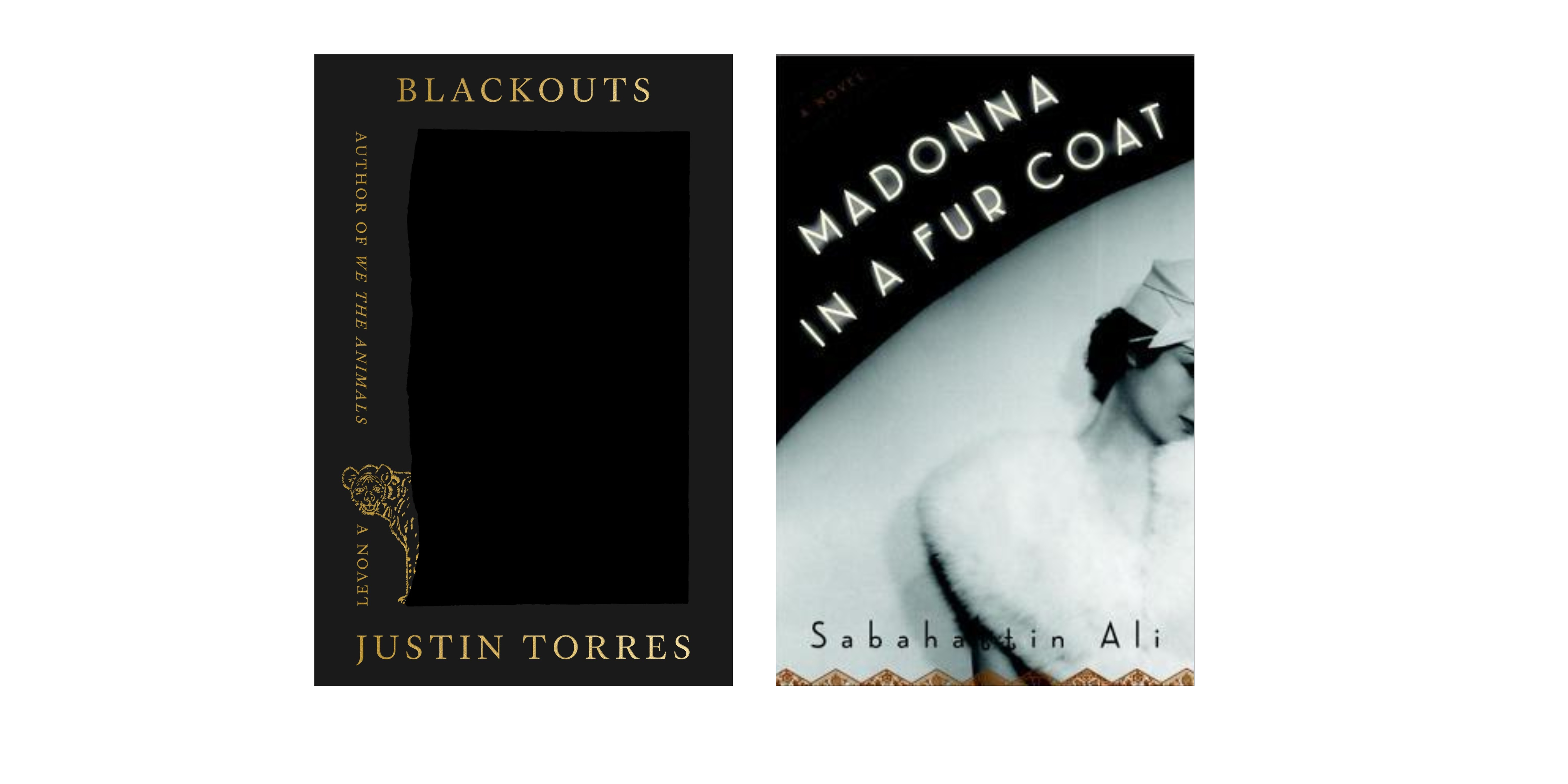
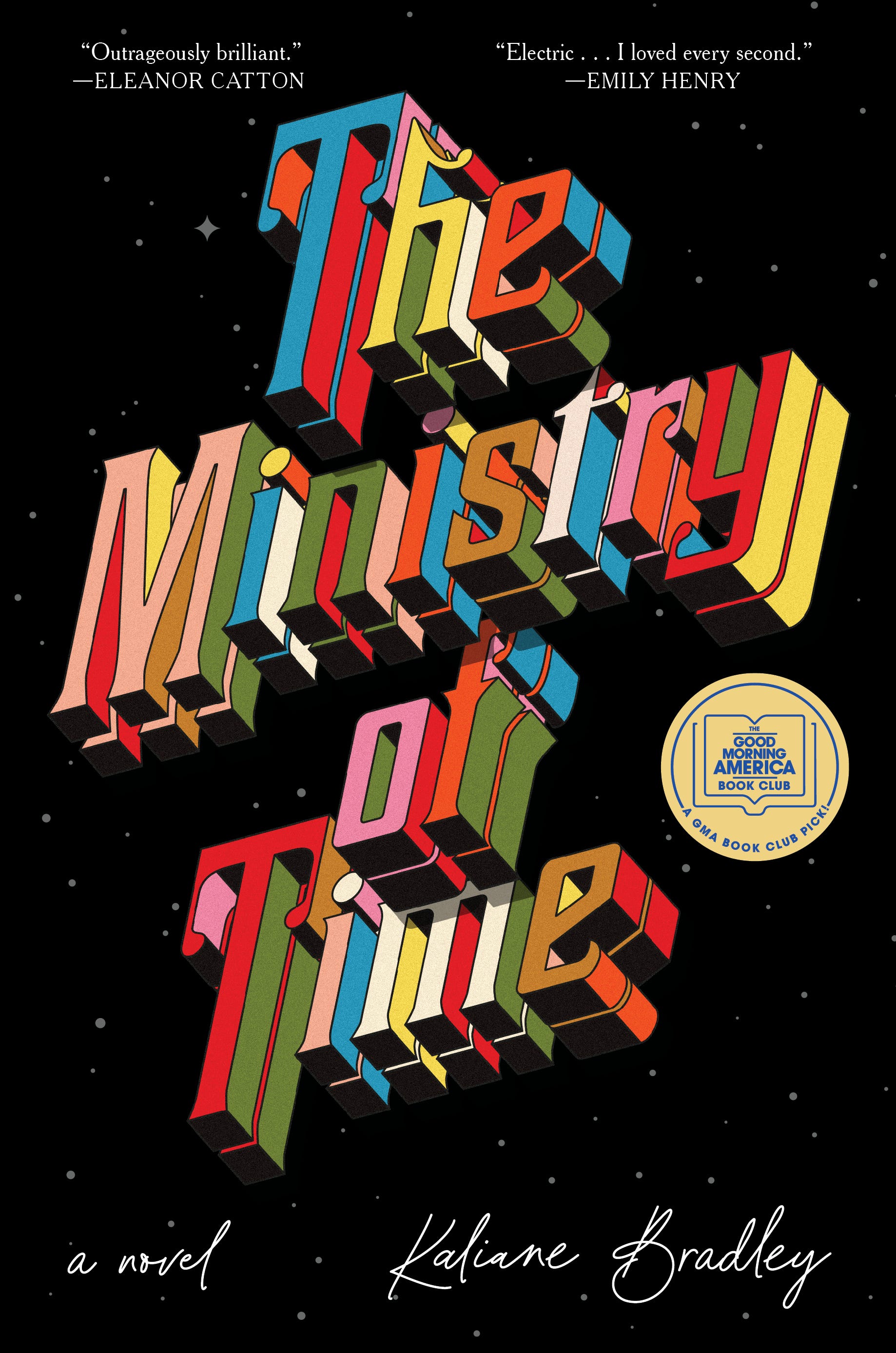
Pyramid of book cover images with The Ministry of Time by Kaliane Bradley on the top, Blackouts by Justin Torres and Madonna in a Fur Coat by Sabahattin Ali in the middle, and Mornings Without Mii by Mayumi Inaba, Lunch Poems by Frank O'Hara, and A Tale of Two Cities by Charles Dickens on the bottom

Hi friends,

While I certainly sympathize with those who feel maligned by April’s traditional cruelty, I had kind of a great month?

We started strong with a double-whammy afternoon of Reading Club at my place followed by the second Heat Lightning poetry series reading at Anaïs, which left me positively glowing with appreciation for such a warm and talented community.

This feeling was sustained by a return to an in-person writing workshop group later in the month, a fabulous first-time visit to the Ripped Bodice in Park Slope for a book event, and the launch party for my dear friend Zoë’s truly incandescent chapbook with No, Dear, which you’ll hear me chat (rave) about more in a future letter.

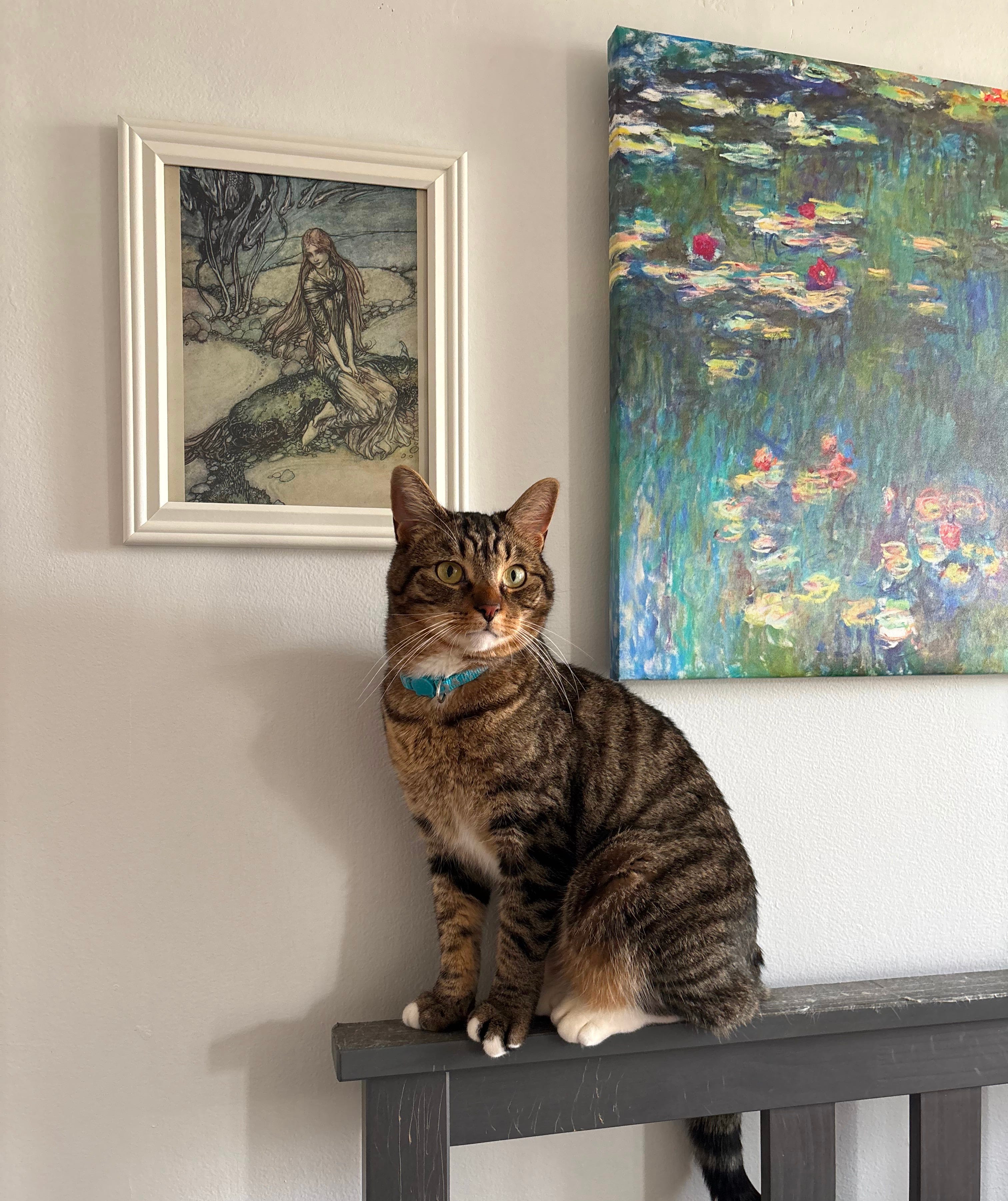
Oh, and we adopted another cat! His name is Ollie (Oliver) and we love him a whole lot. He likes to climb my bookshelves and take all my knick-knacks with him on the way down.

Brown tabby cat with a blue collar posing regally on top of a scratched gray headboard in front of a framed print of an Arthur Rackham fairy and a portion of Monet's water lilies
new Lit Chat mascot unlocked

I also didn’t have to travel anywhere in April, which rocked because a travel-free month is rare for me and because this meant plenty of time for slow mornings on the couch with a book, which is my preferred habitat.

I’ll stop gloating now and get to those books, but in the meantime, if you would rather get this post directly to your email, make sure you subscribe to my Substack:


THE FOUNDATION:

Book cover images for Mornings Without Mii by Mayumi Inaba, Lunch Poems by Frank O'Hara, and A Tale of Two Cities by Charles Dickens

Mornings Without Mii — Mayumi Inaba, tr. Ginny Tapley Takemori

This book was a birthday gift from my sweet pal Michy, which I fittingly decided to read the week we applied to adopt Ollie. A classic in Japan since it was first published in 1999, Mornings Without Mii is a memoir of a writer’s life through the lens of her relationship with her cat, Mii. Though a devoted pet parent for nearly twenty years, I did find some of Inaba’s care choices difficult to read, especially towards the end of Mii’s life—I’d be remiss not to caution any sensitive pet lovers to be prepared for end-of-life suffering and death. That aside, this is a moving portrait of a very special, life-defining bond, and will make you want to give all the animals in your life a big smooch.

Lunch Poems — Frank O’Hara

April was National Poetry Month, and coming off the heels of a San Francisco trip in March, I was inspired to revisit the City Lights edition of Lunch Poems that I bought there last year and spend a slow morning with Frank’s poems. I love how they evoke a nostalgia for a New York I never knew, but which feels simple and familiar and right. Often written during his lunch breaks from working at the MoMA, the poems serve as an emotional time capsule of both daily minutia and breaking news (see: “The Day Lady Died” and “Poem [Lana Turner has collapsed!]”). I was especially charmed by the copies of O’Hara’s and Lawrence Ferlinghetti’s correspondence about the book, which is collected at the end of the volume.

A Tale of Two Cities — Charles Dickens

I was still riding my long audiobook kick well into April and was once again delighted to find that a new-to-me classic held up as a timeless story of intrigue, romance, and tragedy. A poorly-timed Jeopardy question did spoil the ending for me, but even with a premonition of the protagonists’ fate, I was still kept in rapt suspense the whole 18+ hours (despite the narrator’s slightly irritating pronunciation of “revolutionary,” which says a lot considering the book takes place during the French Revolution). Having listened to a few Dickens novels on audio now, it’s interesting to me how many of them revisit similar themes of loyalty and justice, madness and imprisonment, and of course, love that defies the odds. Say it with me: classics are classics for a reason! Dickens has yet to let me down.


SOLID SUPPORTS:

Book covers for Blackouts by Justin Torres and Madonna in a Fur Coat by Sabahattin Ali

Blackouts — Justin Torres

I have such a fascination with the emerging trend of incorporating mixed media into novels (see: my well-documented admiration for Catherine Lacey’s Biography of X). This time, Blackouts takes its name from a volume of blackout poetry made from an academic study of sex variants, which features prominently in the novel. The volume in question is the project of a dying man named Juan Gay, and is about to be bequeathed to our narrator, his ad hoc caretaker.

The narrative of the present day is visually broken up by pages from the book and photographs of its subjects and other artifacts from Juan’s life, bleeding into the stories that he and the narrator tell each other through the long nights of Juan’s final days. The bond between them is what captivated me the most; though both men are queer and spend most of the book in bed, theirs is primarily an intellectual companionship built on a foundation of mutual care, trust, and deep love. This was a quick read that now has me remembering it like a fever dream and already inclined to revisit.

Madonna in a Fur Coat — Sabahattin Ali, tr. Maureen Freely and Alexander Dawe

Keeping up with my goal to read more in translation, I joined a book club at my office that’s doing exactly that! Their pick this month was this 1946 Turkish novel about the intense friendship between two outsiders in 1920s Berlin, which prompted a really thoughtful debate on the definition of romance and platonic vs. romantic love. I’m gonna do something a little different with this one and send you over to the most recent Pages+Pours newsletter for my full review!

I was fortunate to be a featured reader at last week’s book swap, where I shared my review of the novel with a recommended drink pairing. Kelly has cultivated such a smart, engaging, and welcoming community there, and I felt so safe testing out my wobbly public speaking chops! I highly recommend all my fellow bookish NYC gals come join me at the next one.


THE TIPPY TOP:

Book cover image for The Ministry of Time by Kaliane Bradley

The Ministry of Time — Kaliane Bradley

This was one of those books that ticks so many of my boxes, I knew I’d be obsessed even before I started reading. Our unnamed narrator, a British civil servant, has been selected to become a “bridge” for a top-secret government program formed to extract people from the past and attempt to repatriate them into the present. (Time travel: check!) Our narrator’s assigned expat is Commander Graham Gore, a dashingly sincere naval officer plucked from a doomed Arctic expedition in 1847.

We often see characters travel back and forth in time in fiction, but I think it’s rarer for characters from other times to travel to ours like this. I found it a fascinating thought experiment to see Gore and his cohort attempt to adjust to their new surroundings while also being watched over, reported on, and subtly shaped by their bridges, who live with them and are their only link to the outside world.

Just as it seems that the chemistry building between Gore and the narrator is finally coming to a head (Victorian love interest: check!), so too, we learn, is a sinister plot that has been working its way through the highest levels of government to target bridges and their expats. (Government conspiracy: check!) Add to the mix a final twist I did not see coming, and you have a book that sent me into a deep spiral over how the choices one makes on a daily basis have the unwitting potential to shape history, the present, and the future—all in a single moment.


Thanks for reading! I will do my very best to get my May recap out in a timelier fashion, especially because I’ll have news to share soon on the next Reading Club and/or the summer Proust read-along I’ve been teasing for a while. (This is my way of holding myself accountable to actually hammering out all the details—I think I’m close!)

In the meantime, feel free to drop a comment or send me a note if any of these books are speaking to you! Always down to chat in all the usual places.

Until next time, happy reading!
❤ Catherine


Housekeeping note: all book links go to my Bookshop storefront, where each purchase supports independent bookstores (and this newsletter, because I get a small percentage of each sale).
Hope begins in the dark

Lit Chat Vol. 24 — February in Review

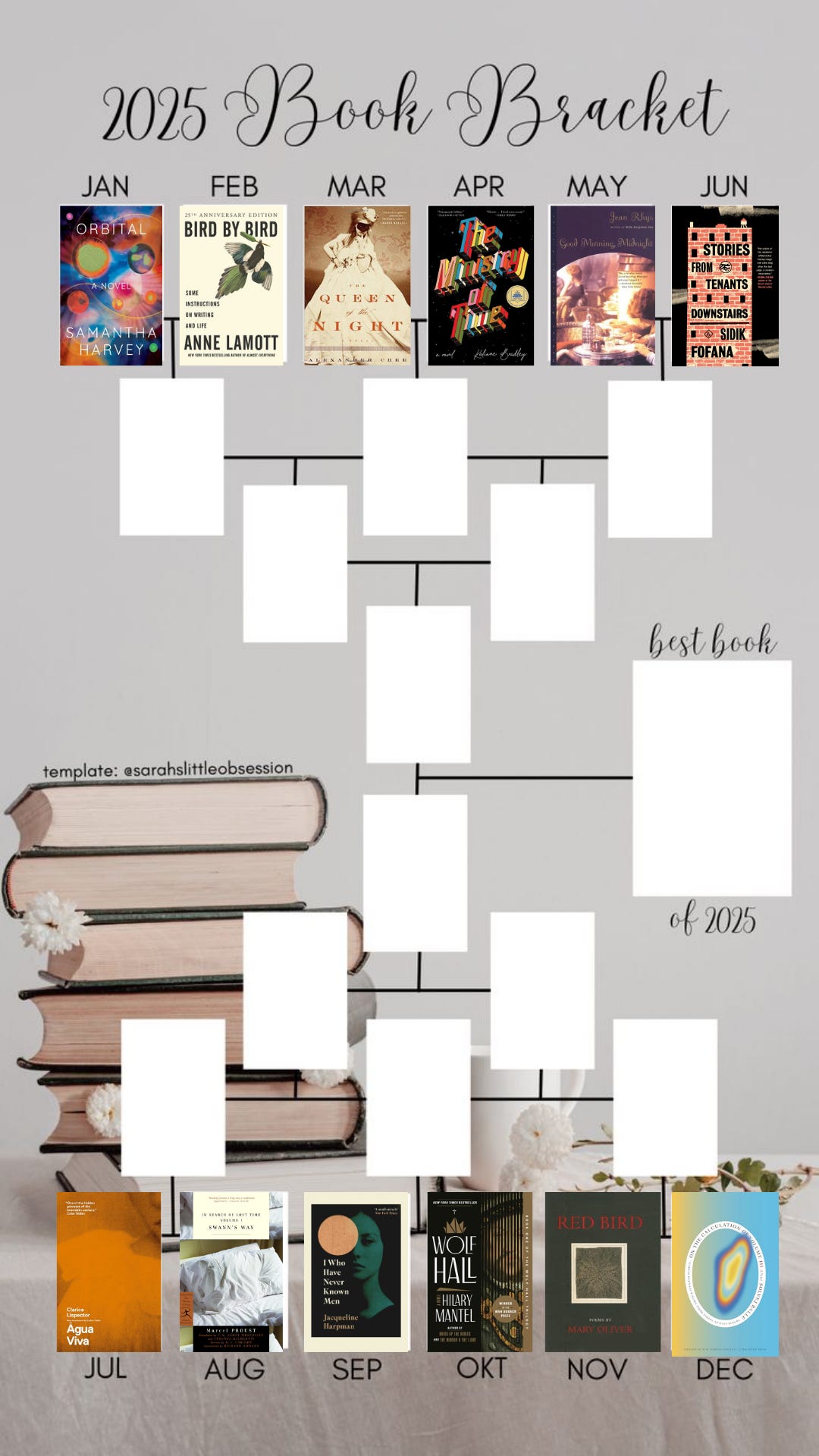
Pyramid of book cover images with Bird by Bird by Anne Lamott on top, The Nickel Boys by Colson Whitehead and The Carrying by Ada Limon in the middle, and Woman from Khao Lak by Randy F. Nelson, Onyx Storm by Rebecca Yarros, and Throne of Glass by Sarah J. Maas on the bottom.

Hi friends,

If January took forever, then February was a blip. I took a trip to New Orleans in the middle of the month for work, and had so much fun that it seems to have eclipsed everything else I did in February, because suddenly I can’t remember anything else.

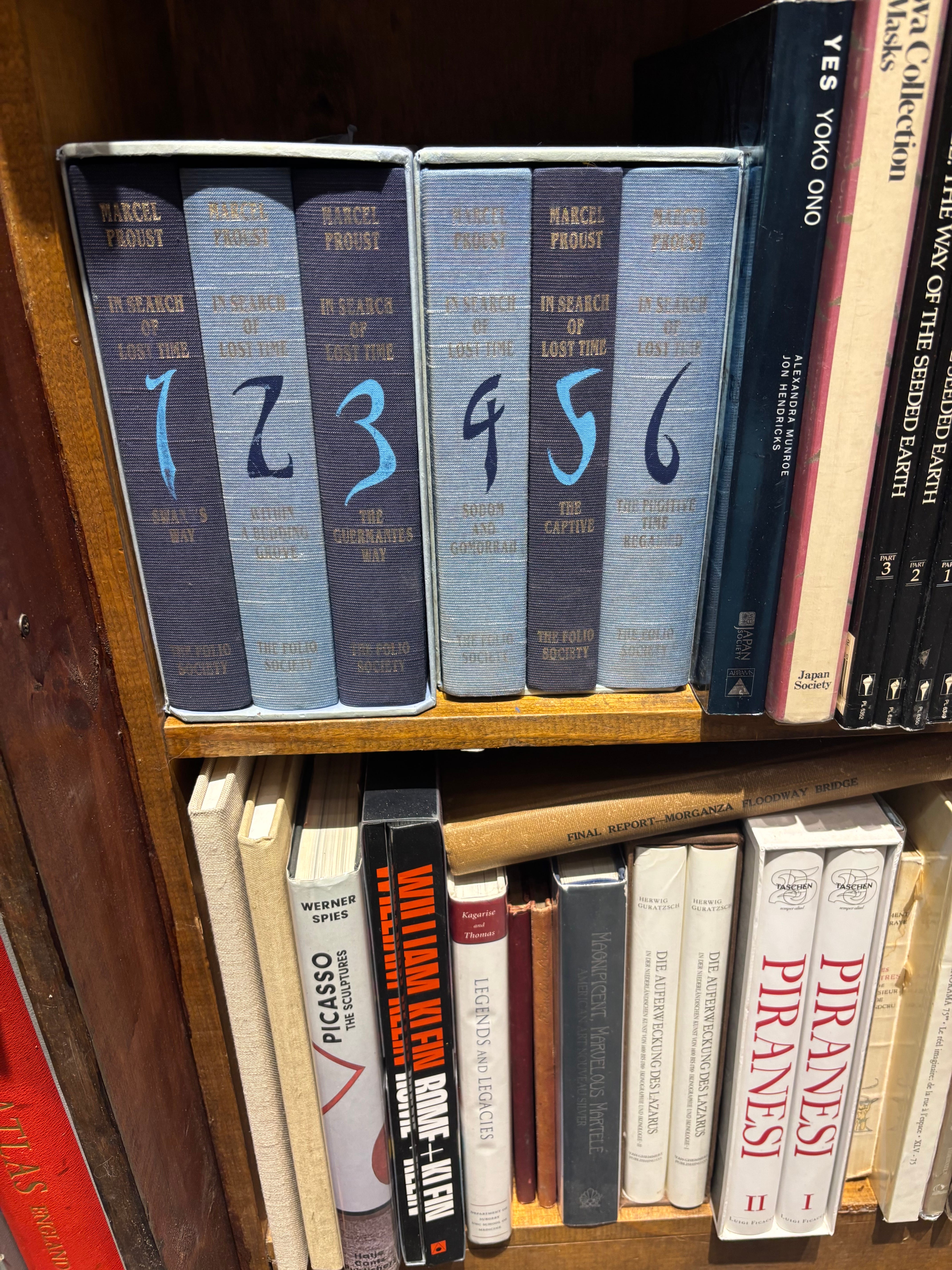
Maybe the most notable update is our acquisition of this gorgeous Folio Society box set of In Search of Lost Time, which Phillip and I spotted in Crescent City Books far too early in the day, had a minor existential crisis about the practicality of purchasing and transporting it home, and ultimately decided it was fate and that we would simply figure it out.

Box set of In Search of Lost Time by Marcel Proust on a bookstore shelf
it was on sale!

Figure it out we did, and I am now all the more inspired to make the Proust book club I mentioned in last month’s newsletter happen. I’m still puzzling out the logistics, but if you’re interested in spending your summer (and beyond??) reading Proust, let me know??

Other local housekeeping: I’ll be hosting another Reading Club on Sunday, April 6th! If you’re in the NYC area and want to join, let me know and I’ll send you the invite!

Okay, moving on, but friendly reminder to subscribe to Lit Chat on Substack if you would rather read this post in your inbox:


THE FOUNDATION:

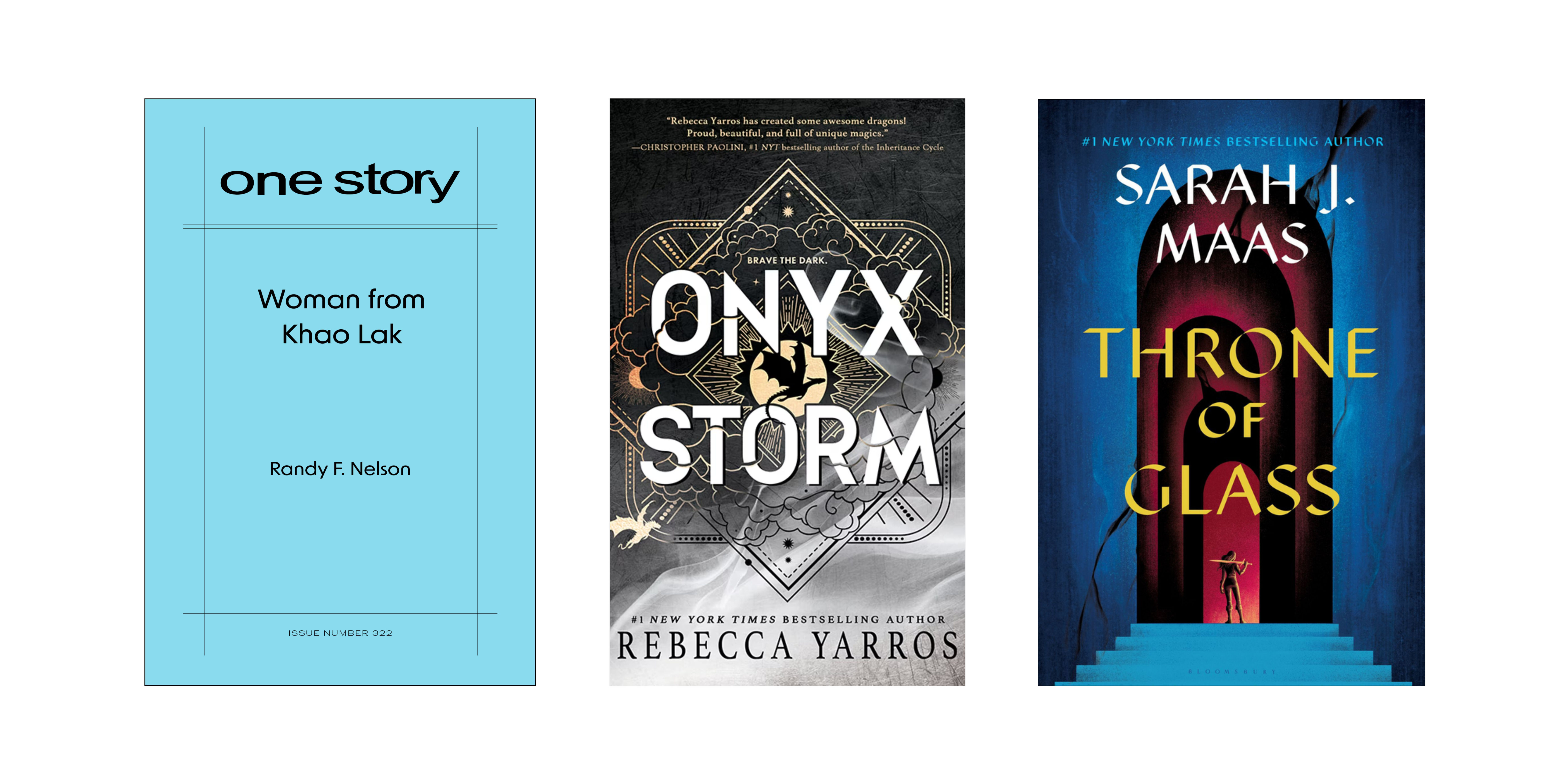
Book cover images for "Woman from Khao Lak" by Randy F. Nelson from One Story magazine, Onyx Storm by Rebecca Yarros, and Throne of Glass by Sarah J. Maas

“Woman from Khao Lak” — Randy F. Nelson

I’ve written before about how much I enjoy my One Story subscription, which delivers the cutest little printed story booklets once a month or so. This month’s story, “Woman from Khao Lak” sucked me in from the first three paragraphs, in which the narrator recounts a teenage summer spent lifeguarding. The course of the summer—and arguably, the narrator’s entire life—shifts when a strange woman starts frequenting the local municipal pool, captivating the head lifeguard and irrevocably changing the pool’s whole social ecosystem. This story manages to be both nostalgic and deeply unsettling, an undercurrent of unease always rippling just beneath the surface. Support independent presses and read it for a whole $2.50 here!!

Onyx Storm — Rebecca Yarros

Hot take, but I was underwhelmed by this third book in the Empyrean series. Part of it was the fact that it’d been over a year since I read Iron Flame and it took me a while to remember who all of the characters were, the names of their dragons, and who had which powers. Violet spends most of the book stressing about how to handle the Major Unfortunate Development that happens at the end of Book 2 (no spoilers), while everyone else is more concerned about the fast-approaching war with evil magic-draining, wyvern-riding venin. We learn some more about the world beyond Navarre’s borders, some juicy family secrets get revealed, and more major battles take place, but despite the massive cliffhanger, I didn’t feel that the ending left me with a clear sense of purpose and direction for the rest of the series. Will I still read all 500+ pages of each new book whenever it comes out? Most likely!

Throne of Glass — Sarah J. Maas

Having finished all of the available ACOTAR books, the next logical move was obviously Throne of Glass, which I zipped through in the beginning of the month and enjoyed! This definitely felt more squarely YA than the ACOTAR books, though I’ve heard they get spicier as they progress. Throne of Glass features a notorious teenage assassin as the main character, who gets plucked out of a prison camp by the country’s prince to compete in a skills contest to become the King’s Hand—and ultimately buy her freedom. Maas’s books are excessively readable, and although between this and Onyx Storm I need a little bit of a romantasy break, I’ll definitely come back around to the rest of this series.


SOLID SUPPORTS:

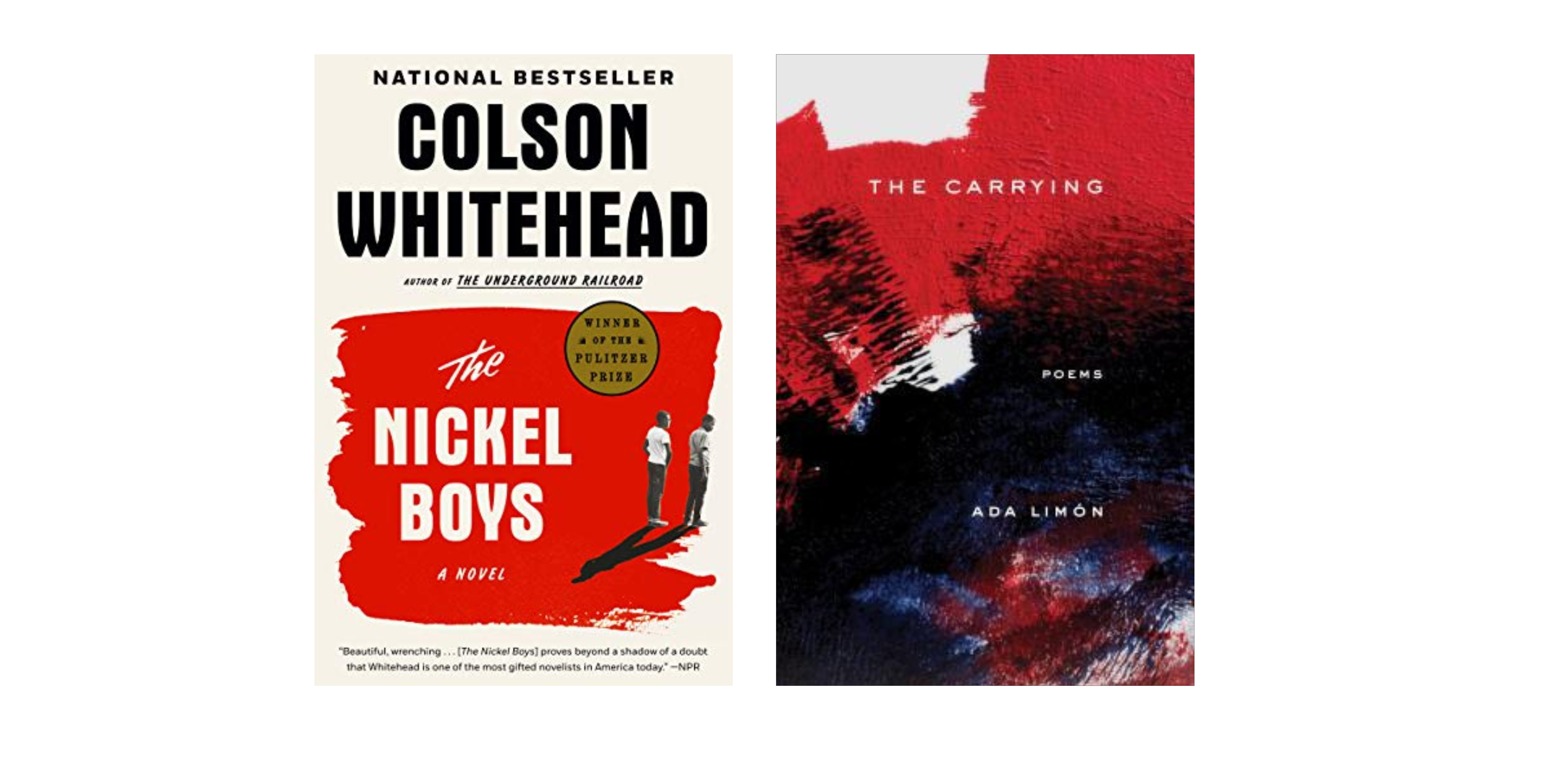
Book cover images for The Nickel Boys by Colson Whitehead and The Carrying by Ada Limon

The Nickel Boys — Colson Whitehead

Phillip and I steadily made our way through all of the Best Picture Oscar nominees this month, with Nickel Boys being one of the last movies we watched, as we both wanted to read it first. I read almost the whole book on the plane to New Orleans, and regular Lit Chat readers will know that I love plane reading for being the perfect environment to let all of a book’s secrets stay with me in a contained space before returning to the real world.

The Nickel Boys was obviously no exception, and where I think both the book and movie excelled was in the translation of its characters’ physical and emotional journeys into a visceral, firsthand experience for its readers/viewers. Inspired by real accounts of horrifying abuse at a reform school in Jim Crow Florida, The Nickel Boys haunts not only through the horror of the crimes that take place within its pages, but also through the ghosts of its characters’ lost potential. That for so many boys, their immense capacity to give and receive love and justice was so senselessly denied is what makes the tragedy of their stories unforgettable. This was the first of Whitehead’s novels that I’ve read and will certainly not be the last.

The Carrying — Ada Limón

Crossing off my first poetry collection of the year! Ada Limón is absolutely one of my favorite living poets, and it’s such a gift that she narrates her own audiobooks. While I hadn’t read this 2018 collection in its entirety before, a few poems, like “The Raincoat,” “What I Didn’t Know Before,” and “Love Poem with Apologies for My Appearance” were familiar to me, and the pleasure in recognizing them was like that of running into a friend unexpectedly on the street. This volume features Limón’s signature blend of nature-inspired confessional poetry, with recurring motifs of plants and animals that continue to grow and bloom and reproduce while Limón herself struggles with infertility.

The collection takes its title from a poem titled “The Vulture & the Body,” in which Limón asks, “What if, instead of carrying / a child, I am supposed to carry grief?” In a way, this book is a response to that question, grief running through poems about roadkill, lost loved ones, and the burden of chronic pain. And yet, my favorite poem was probably “Wonder Woman,” which recounts a moment on the Steamboat Natchez in New Orleans in which Limón, after receiving bad news from a doctor, sees a girl dressed in a Wonder Woman costume:

She strutted by in all her strength and glory, invincible,
eternal, and when I stood to clap (because who wouldn’t have),
she bowed and posed like she knew I needed a myth—
a woman, by a river, indestructible.

I loved this not just because Phillip and I had just taken that same jazz cruise on the Steamboat Natchez not a week before, but also for the poignance of this final image. This suggestion that we can be myths for each other, that someone else might find strength through just our performance of it, is a beautiful example of the hopefulness that perpetually counterbalances the heaviness in Limón’s work.


THE TIPPY TOP

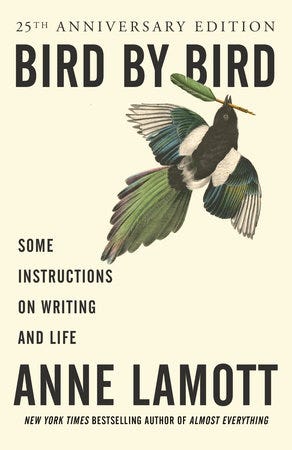
Book cover image for Bird by Bird by Anne Lamott

Bird by Bird — Anne Lamott

My second craft book of the year, and my only five star book for February! Much like The Writing Life last month, this is a book that I now feel the need to not only purchase for myself (it was a library book), but also maybe have an extra copy on hand for someone who needs it. Bird by Bird is best explained by its subtitle: Some Instructions on Writing and Life. It’s a collection of short, focused sections that cover everything from the basics of finishing a shitty first draft to the logistics of finding a writing group, and navigating the emotional journey that is tying a not insignificant amount of your self worth to your ability to consistently put a bunch of words down on paper.

Throughout the book, Lamott’s voice as both a writer and a mentor shines with wit and tenderness, using examples from her life and that of her friends to emphasize the importance of community, having grace for oneself, and of course, per Annie Dillard, simply doing the work. Though I’m sure I’ll return to some of the prescriptive exercises in the first section for advice on character, plot, and dialogue, it was the penultimate section that stayed with me the most, the one which asks you to consider the ultimate purpose for your writing. Lamott claims that everyone has one, whether it’s for some kind of outward gratification like publication, for the simple internal pleasure of being creative and finding your voice, or for a specific third party, as a gift that only you can give.

While I won’t presume so much as to call all of my writing a gift to the world, this book helped me realize that my primary motivation for writing is to connect with the people in my life. Whether that’s through the pleasure of sharing something with my writing group that I know will make them laugh, or knowing that these newsletters open a convenient little window for people from all parts of my life to pop in and say hi, I’m almost always writing with the hope that someone will read and react to what I’m saying. Reading and writing are often solitary pursuits, but there’s always the potential for them to form the basis of a connection somewhere off the page. I’ve realized that this, more than anything else, is forever my reason for doing both.


Thanks for letting me get a lil earnest on main! If you wanna chat about any of these books, or give me a recommendation for my TBR pile, or come over to my apartment in April to do both of those things in person, let me know! I’d love to hear from you.

And until next time, happy reading!
❤ Catherine


Housekeeping note: all book links go to my Bookshop storefront, where each purchase supports independent bookstores (and this newsletter, because I get a small percentage of each sale).
You think love is so simple?

November in Review — Lit Chat, Vol. 14

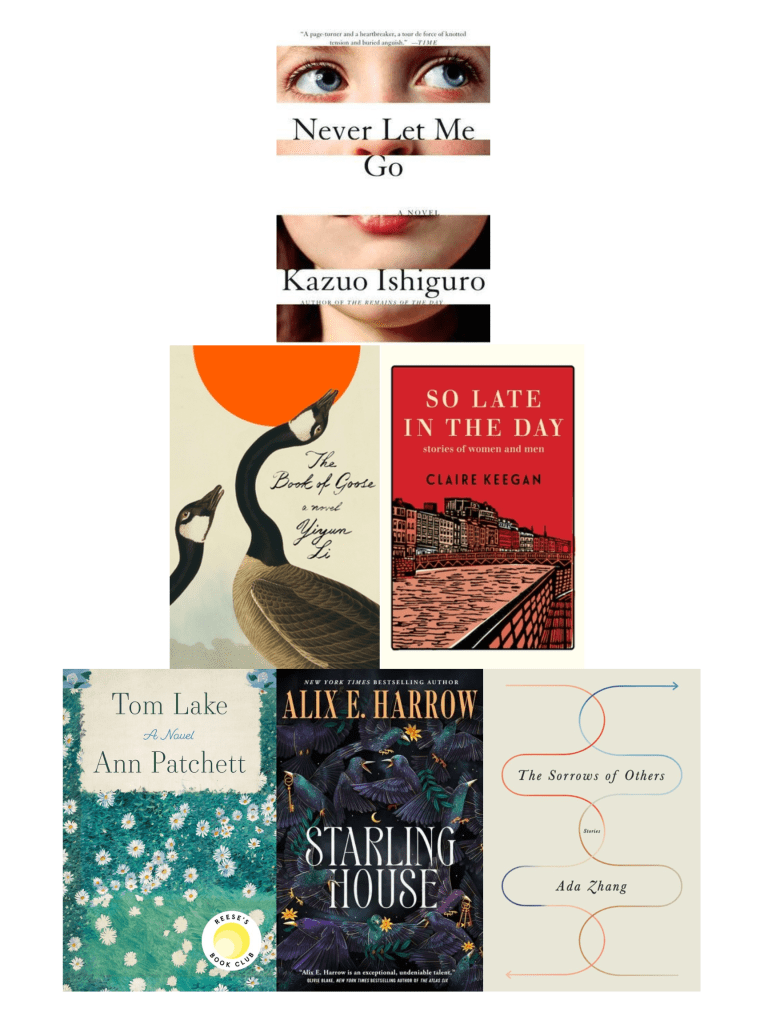
Pyramid of book cover images with Never Let Me Go by Kazuo Ishiguro on top, The Book of Goose by Yiyun Li and So Late in the Day by Claire Keegan in the middle, and Tom Lake by Ann Patchett, Starling House by Alix E. Harrow, and The Sorrows of Others by Ada Zhang on the bottom.

Housekeeping note: all links go to my Bookshop storefront, where each purchase supports independent bookstores (and this newsletter, because I get a small percentage of each sale). Buy your holiday gifts through Bookshop!!

Hi friends,

We made it to December! For me, this means that my brain has started craving hibernation mode: I don’t want to work, or think, or move my body any further than from the bedroom to the kitchen and back. I want to sleep in and eat grilled cheese and play Stardew Valley on the couch under a pile of blankets.

I’m even feeling lazy about reading: I’m nowhere near my original lofty Goodreads goal of 72 books in a year, so I’ve decided that I’m going to take December to indulge in the last 600 pages of the Outlander book I’ve been reading off and on since October. If I finish it and get around to something else this month, great! If not, I will simply enjoy the all-plot-no-thoughts vibes for as long as they last.

However! To atone for this laziness, I’ve decided to do a little end-of-year bracket, pitting the top books from each month against each other to see which one will officially be crowned my favorite book of the year. Start placing your bets now, folks! You’ll be hearing from me a bit more often in the coming weeks as I work through my completely subjective rankings.

One final housekeeping note for my local friends: I’m thinking of starting an informal reading club in the new year, where instead of all reading the same book at a time, everyone just brings one book/story/poem/article they’ve read and loved recently and we all take a turn to show and tell while eating snacks/drinking wine. If that sounds like fun and you’re in the NYC area, reach out!

Okay, okay, before we get too far ahead of ourselves, we still have November to discuss. Let’s get into it.


THE FOUNDATION:

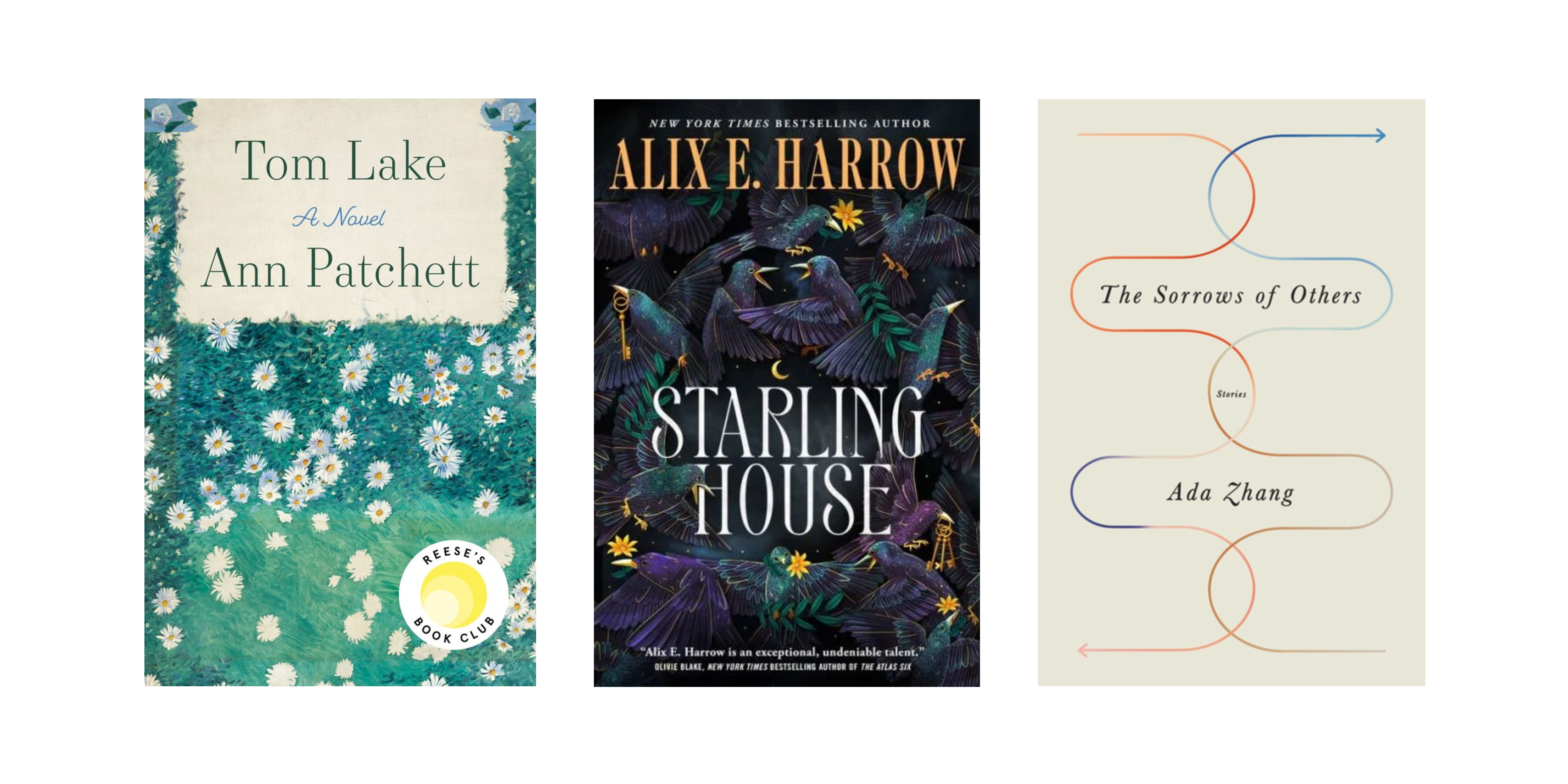
Book cover images for Tom Lake by Ann Patchett, Starling House by Alix E. Harrow, and The Sorrows of Others by Ada Zhang

Tom Lake — Ann Patchett

My first Ann Patchett, and I think my first official Covid-19 novel? Tom Lake is the name of the summer stock theater where young actress Lara Kenison falls for soon-to-be movie star, Peter Duke. Decades later, Lara is now retelling this story to her three adult daughters, who have all come home to help work their family’s Michigan cherry farm during the pandemic. The escapism of a nostalgic summer fling works to soothe the pandemic-related anxieties of both reader and characters, but personally, I realized I’m not quite ready to revisit this time in fiction just yet. That said, I think a lot of the moms in my life will relate to Lara’s conflicted happiness over having her family all unexpectedly under one roof again. A good book club book; Reese is onto something here!

Starling House — Alix E. Harrow

Regular readers of this newsletter know that I am simply a sucker for a mysterious, potentially magical old house! In this case, Starling House is the historic home of an eccentric children’s book author, whose eerie stories of a realm called Underland have fascinated orphan Opal McCoy since childhood. When Opal gets offered a job as a cleaner at the now derelict Starling House, it’s more than just an opportunity to support herself and her teenage brother in an unfriendly and unlucky Rust Belt town; it’s the answer to a calling she’s felt her entire life. Throw in a brooding love interest, a cursed family of greedy oligarchs, and a shady corporate antagonist, and you’ve got a perfectly vibey, gothic mystery to curl up with on the couch this winter.

The Sorrows of Others — Ada Zhang

I was first introduced to this collection when I read “Julia” in Electric Lit’s Recommended Reading, a barbed yet beautiful story about a woman preparing to leave the city and reflecting on the breakdown of a once-treasured friendship. I was initially drawn in by Zhang’s emotional precision, particularly the spot-on representation of the grief that comes from reckoning with the past selves you’ve outgrown. This reckoning is a recurrent theme in Zhang’s debut collection, which hops between China and America to feature the tangled stories of immigrants and the children of immigrants: husbands and wives, mothers and daughters, sisters and granddaughters, each of them struggling to reconcile their sense of self against their needs and desires and those of their families. “Julia” is a fantastic entry point to Zhang’s work, but the entire collection is one to be savored, each story sharper and more poignant than the last.


SOLID SUPPORTS:

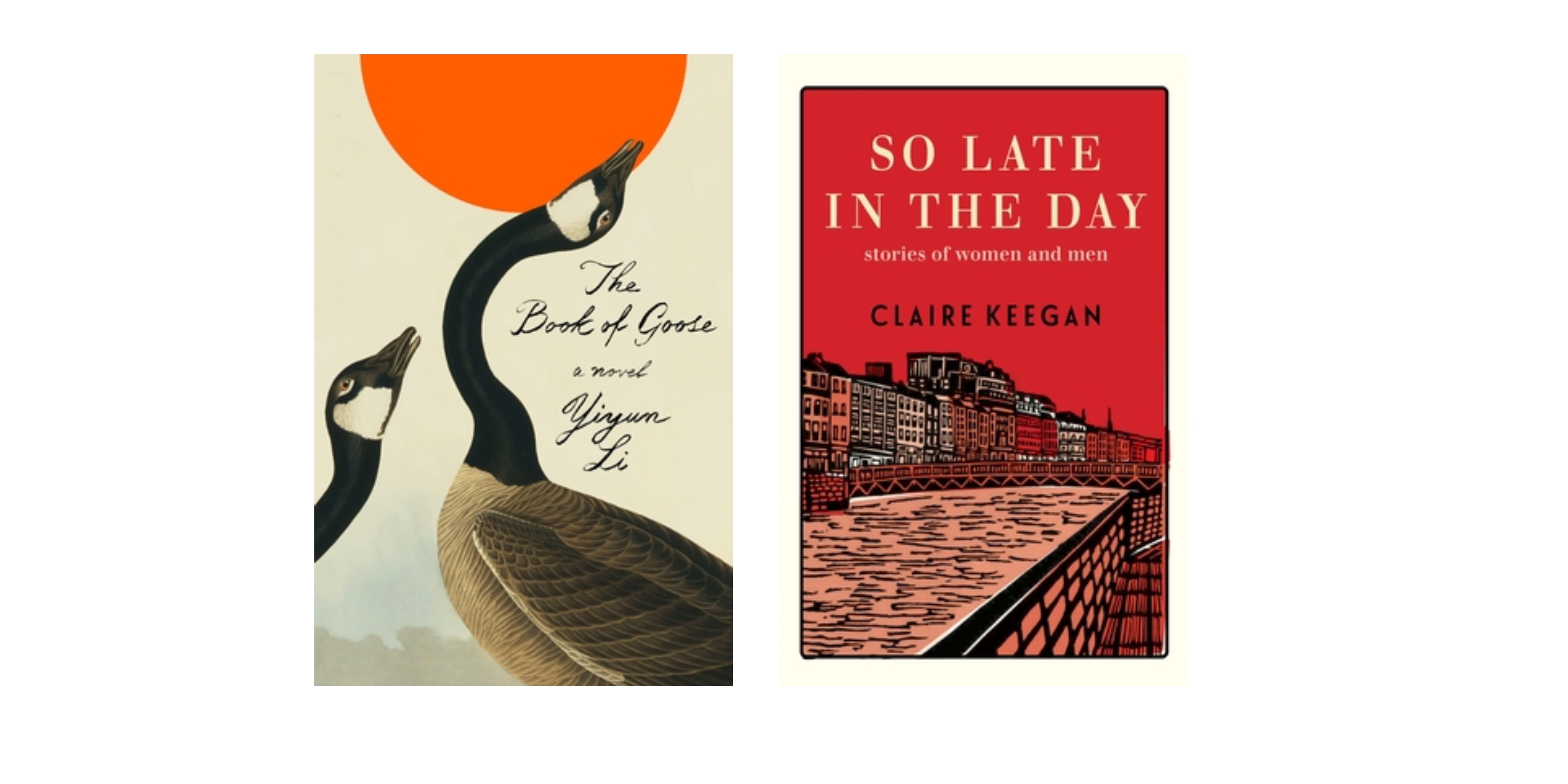
Book cover images for The Book of Goose by Yiyun Li and So Late in the Day by Claire Keegan

The Book of Goose — Yiyun Li

This is a little weirdo of a book, but one that I thoroughly enjoyed. In a small provincial town in the post-war French countryside, childhood best friends Fabienne and Agnès decide to play at writing a book together inspired by their lives. With Fabienne as the creative mastermind, Agnès’s name on the cover, and a little help from the local postman, the book captivates the French literary world—catapulting an unprepared Agnès into the spotlight.

It sounds so much simpler than it is. The narrative is told in the present day by Agnès, now an adult living in America, who feels free to tell her story in her own words only after learning that Fabienne has died in childbirth. Even then, the voice of Fabienne’s ghost is ever-present in Agnès’s mind. The Book of Goose is an intricate portrait of female friendship and an insightful exploration of fame, power, influence, and the fleeting nature of it all. @CB, you have redeemed yourself with this rec!

So Late in the Day — Claire Keegan

I read Claire Keegan’s Small Things Like These around the same time last year, and I’m thinking of making reading her work something of a seasonal tradition. This slim little volume is a compilation of three previously published short stories: the first, about a man on his would-be wedding day, reflecting on where he went wrong; the second, about a woman on a writing retreat forced to host an unwelcome guest; and the third, about a married woman who decides to have sex with a stranger and gets far more than she bargained for.

I really wrestled with whether or not to give this one the top spot because the last story in particular, “Antarctica,” has positively haunted me. The other two stories are masterful, don’t get me wrong, but “Antarctica” is a whole masterclass in character, pacing, and atmosphere. I’m obsessed with the way Keegan lulls you into a false sense of security alongside the protagonist, denying the instinctual sense of dread steadily creeping in around the edges until the danger becomes chillingly obvious. A week later, it still gives me shivers just thinking about it.


THE TIPPY TOP:

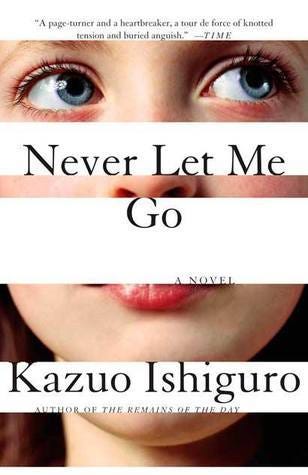
Book cover image for Never Let Me Go by Kazuo Ishiguro

Never Let Me Go — Kazuo Ishiguro

Surprise, surprise, the Nobel Prize winner comes out on top! As I said, it was a real struggle between this and So Late in the Day, but ultimately, this one has managed to haunt me longer and more completely as a novel rather than a single story in a collection.

Most of Never Let Me Go takes place at Hailsham, a seemingly idyllic English boarding school where its students are cloistered from the broader world while learning everything they will need to one day go out into it as (organ) “donors.” Kath, a former student, narrates the book as an adult reflecting on her childhood while she cares for other donors in preparation for becoming one herself.

What struck me the most about this book is not the ultimate revelation, unsettling as it is (no spoilers!), but how successfully Ishiguro manages to shield us from the disturbing truth for as long as he does. In this way, we are as sheltered as the Hailsham students—we always know there is more to this story, something that likely has broader and more sinister implications for our understanding of this alternate future, but it feels so far removed from the routine of daily life at Hailsham and the intimacies of Kath’s relationships with the other students that you can easily bury the niggling suspicion that something is not quite right.

For such a quiet book, it’s a fairly scathing take on how easily society can become inured to human rights abuses when those being abused are perceived as less than or unhuman, especially when this abuse becomes accepted as the norm. (Sound familiar? It should.) Never Let Me Go was published in 2005, and yet Ishiguro’s warning to society is as timely as ever. He offers no panacea to Kath’s and the other students/donors’ plight, but he does force the reader to bear witness, with full knowledge of the wrong that is being done. It’s up to us to decide at what point we look away.


All right friends, that’s all for today! If you need me, I’ll be in Revolutionary War-era America with Jamie Fraser for the foreseeable future, so don’t call or text (unless it’s to talk about any of the above books or to give me a rec for my 2024 TBR—those texts are always welcome).

Until next time, happy reading!
❤ Catherine