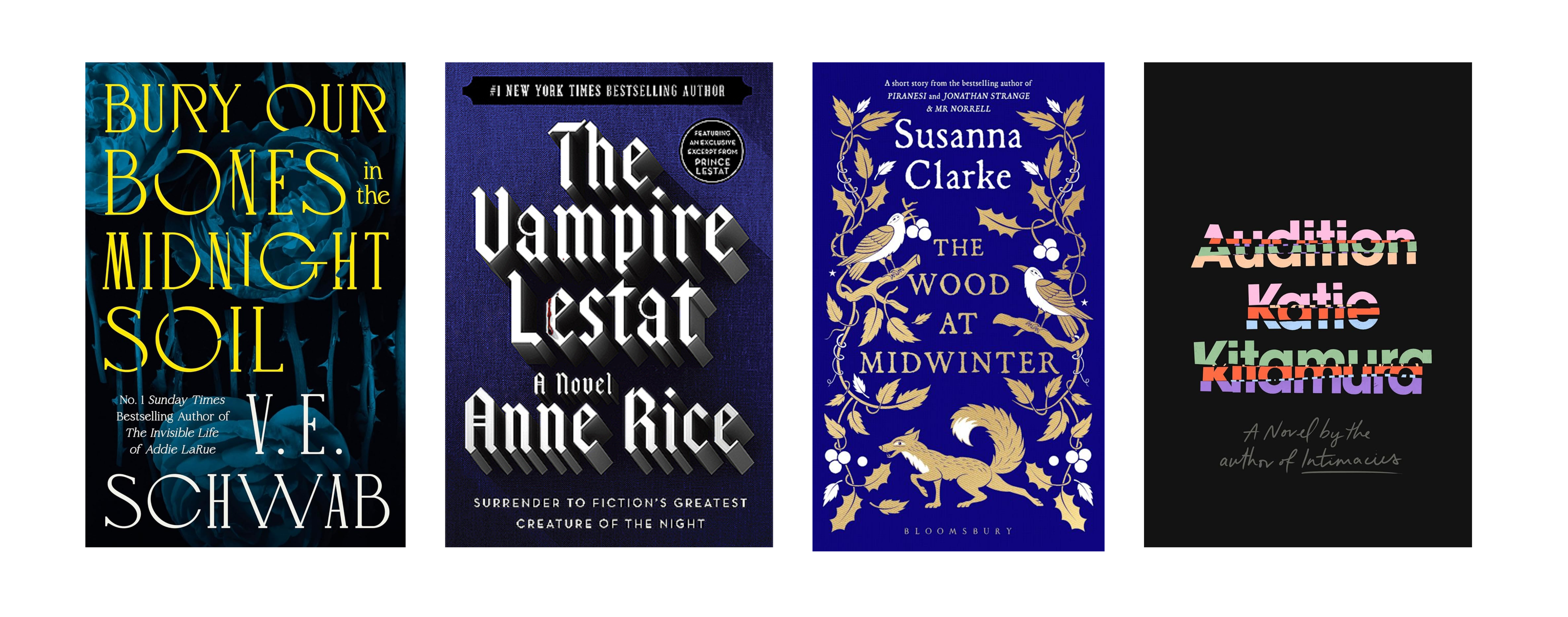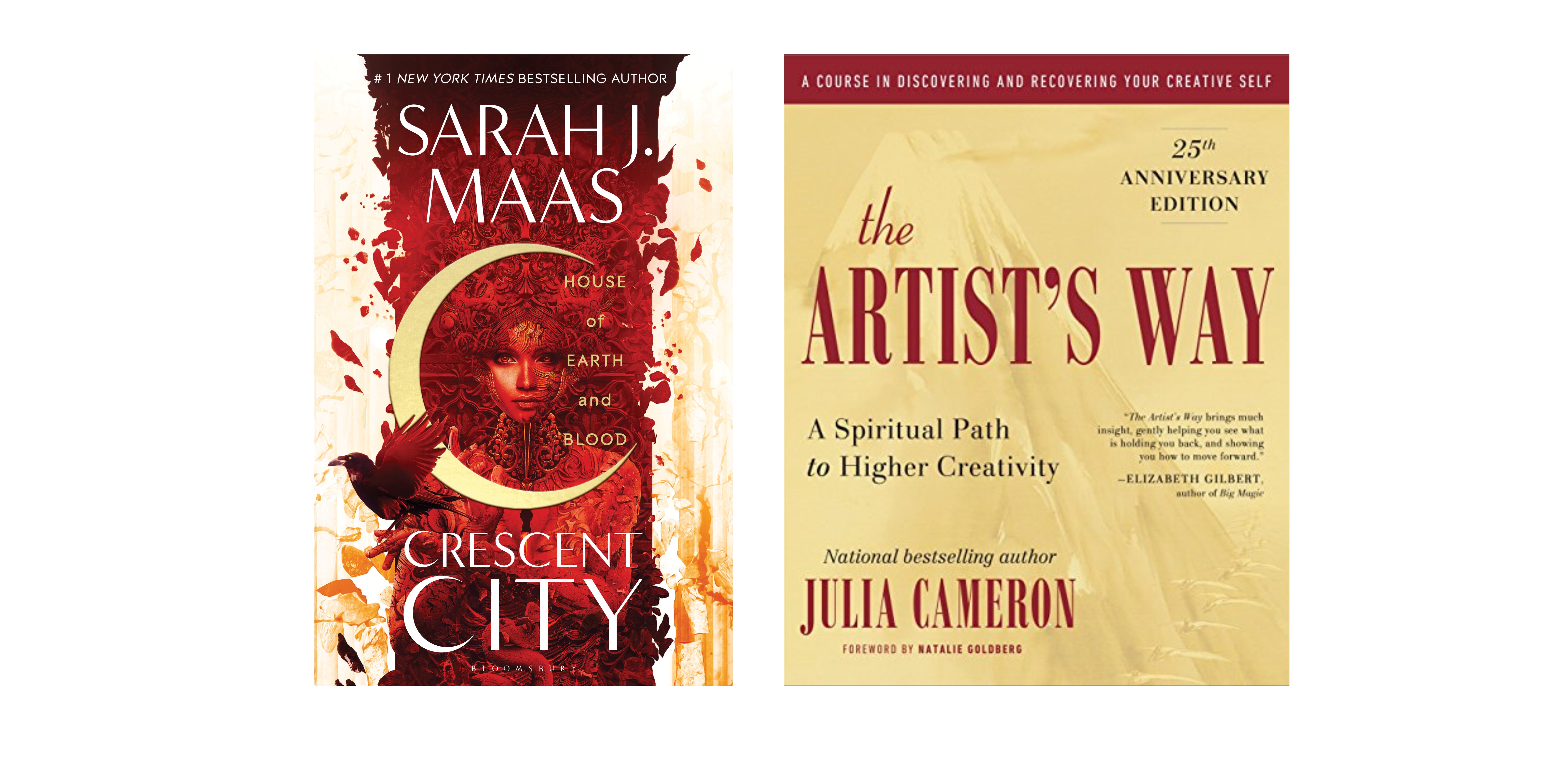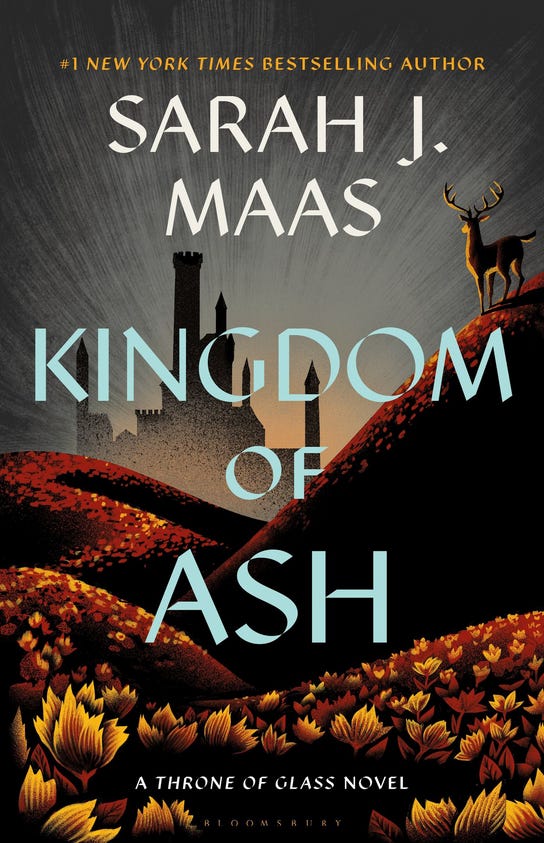
The Best Books of 2025: Round Two

Listen, I know most people come out with their end-of-the-year wraps well before the year actually ends, but personally, I need a little bit more time to stew on things. This round especially needed extra time to marinate, because I’ll be honest, I was flip-flopping on the last one up until the very end.

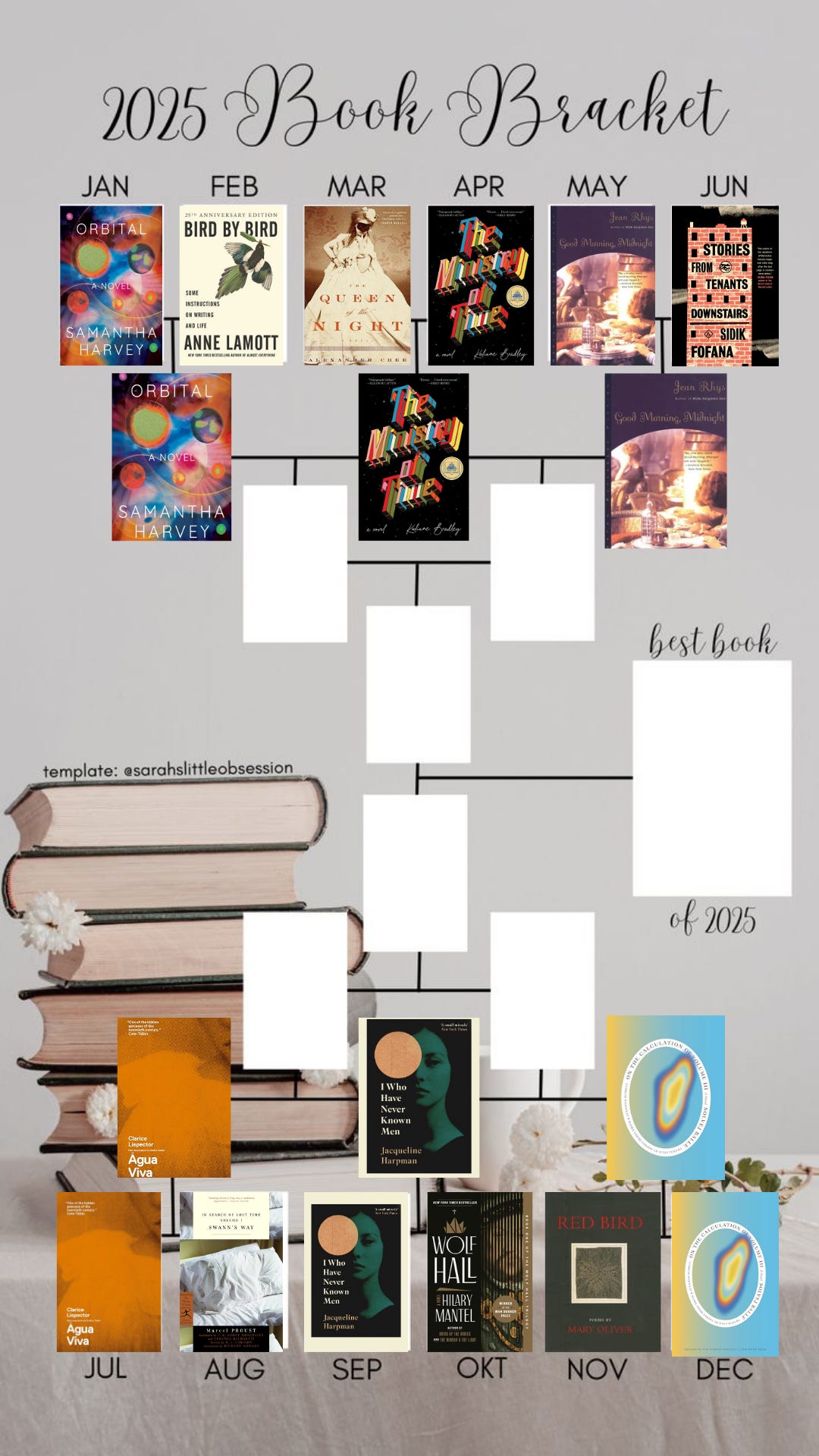
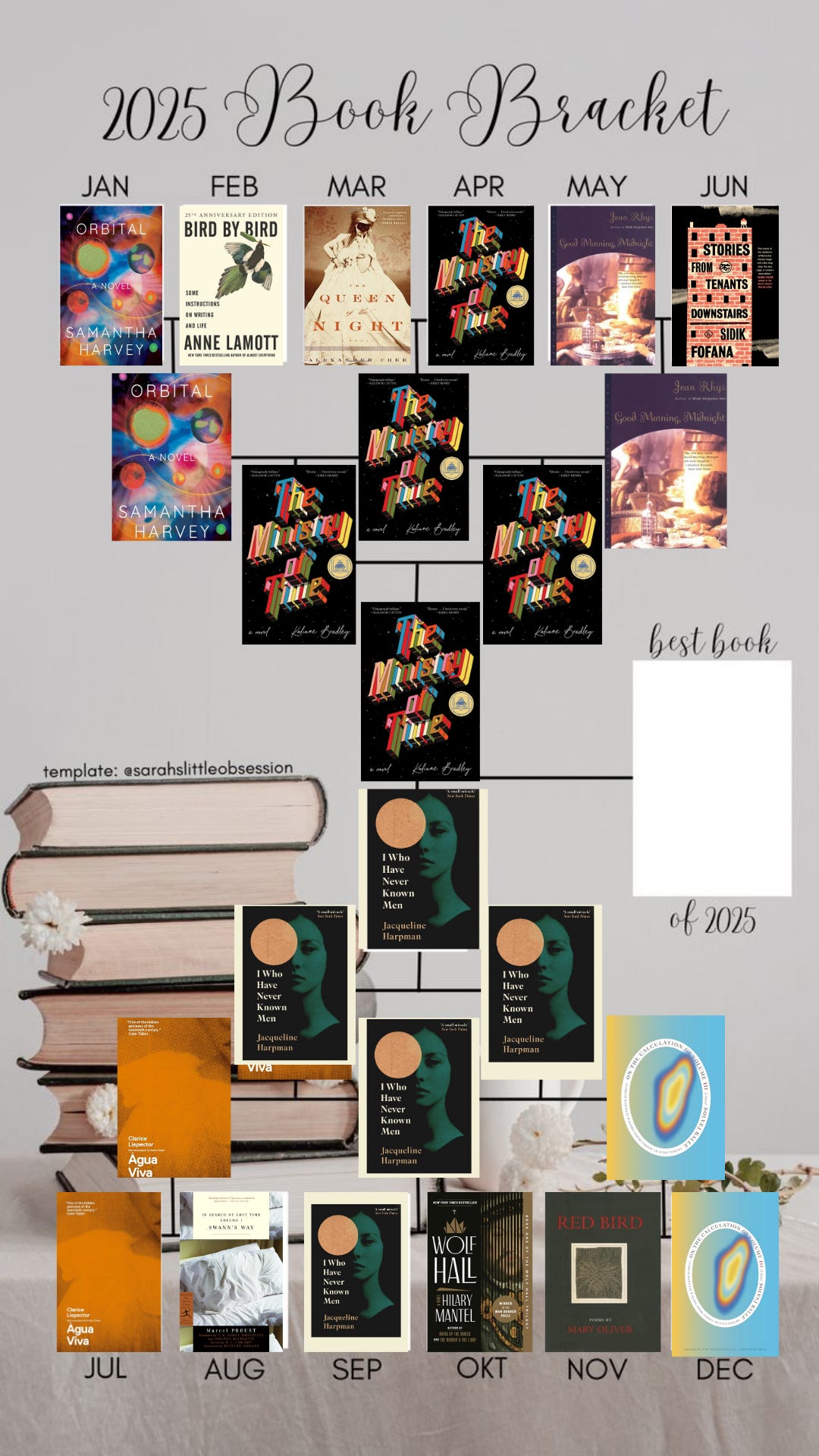
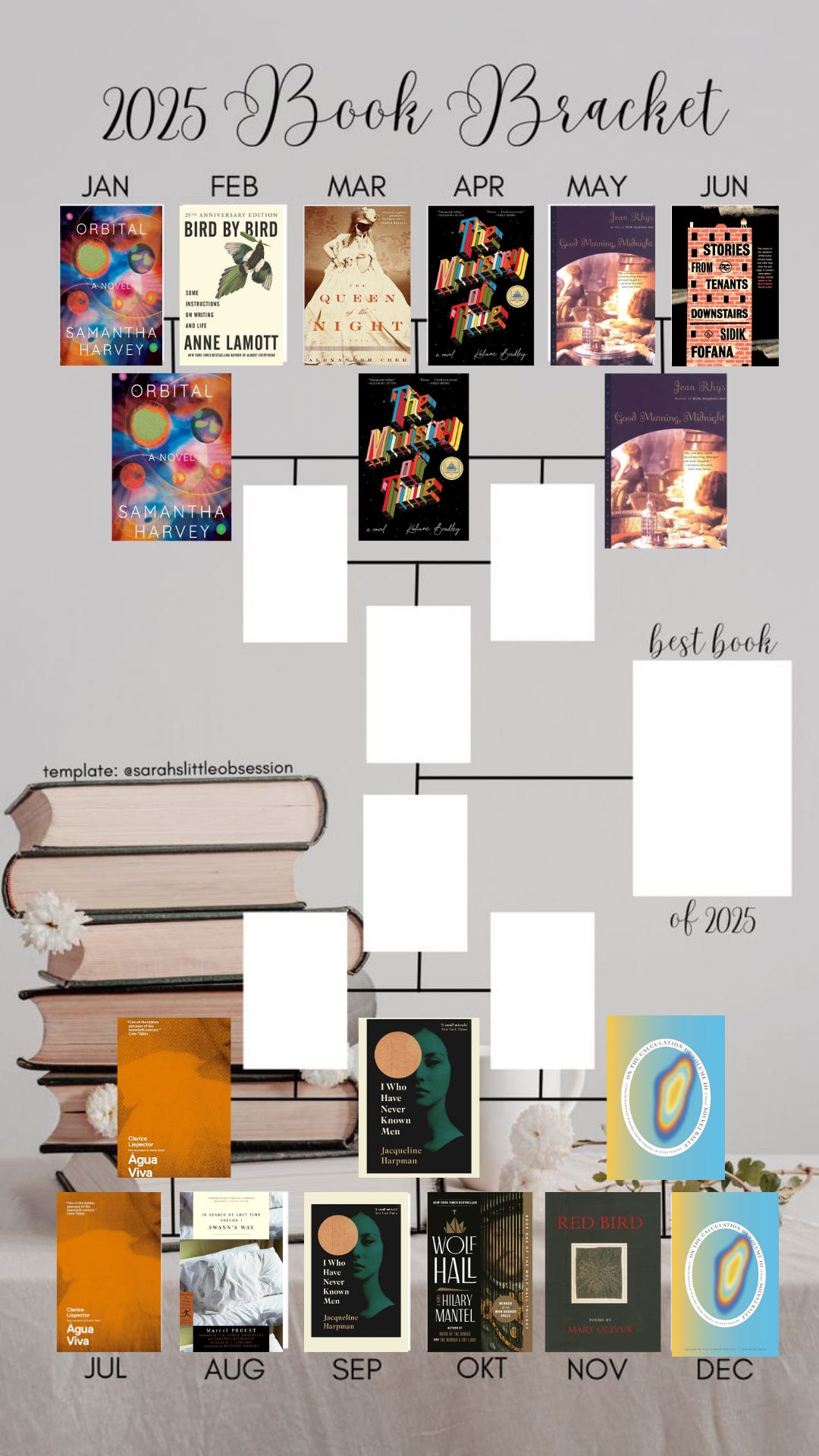
2025 Book Bracket with the first two rounds filled in with book cover images.

Before we move on, I want to say that I don’t love this bracket design (sorry sarahslittleobsession, whoever you are, it’s not personal). Instead of having the middle books duke it out twice in this round, we’re just going to have three match-ups: the Jan-Feb winner vs. the Mar-Apr winner; the May-Jun winner vs. the Jul-Aug winner; and the Sep-Oct winner vs. the Nov-Dec winner.

Essentially, we’re skipping a bracket round as it’s designed here, but you’ll see why at the end. Don’t worry about it! Just enjoy the ride. And if you’d rather enjoy it on Substack, you can do so here:


ROUND TWO:

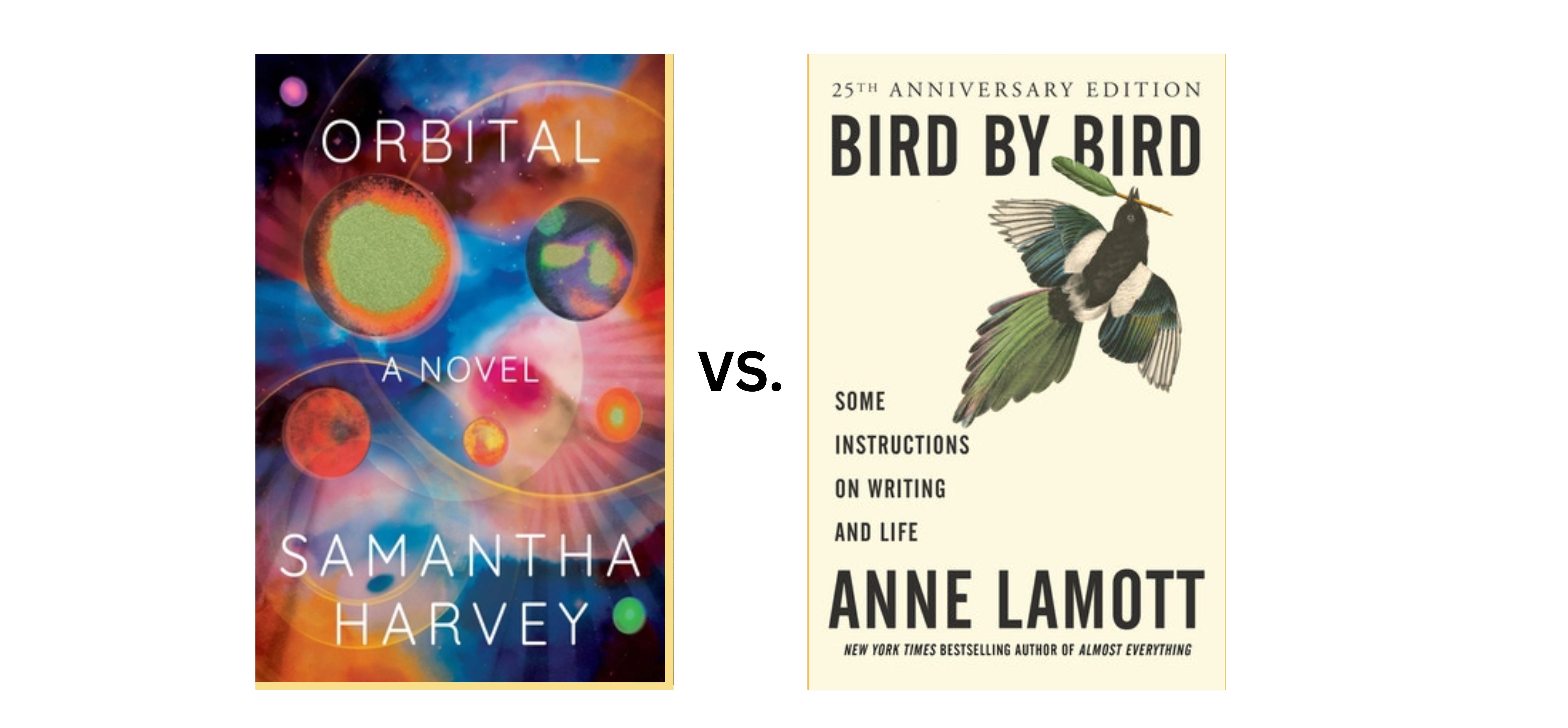
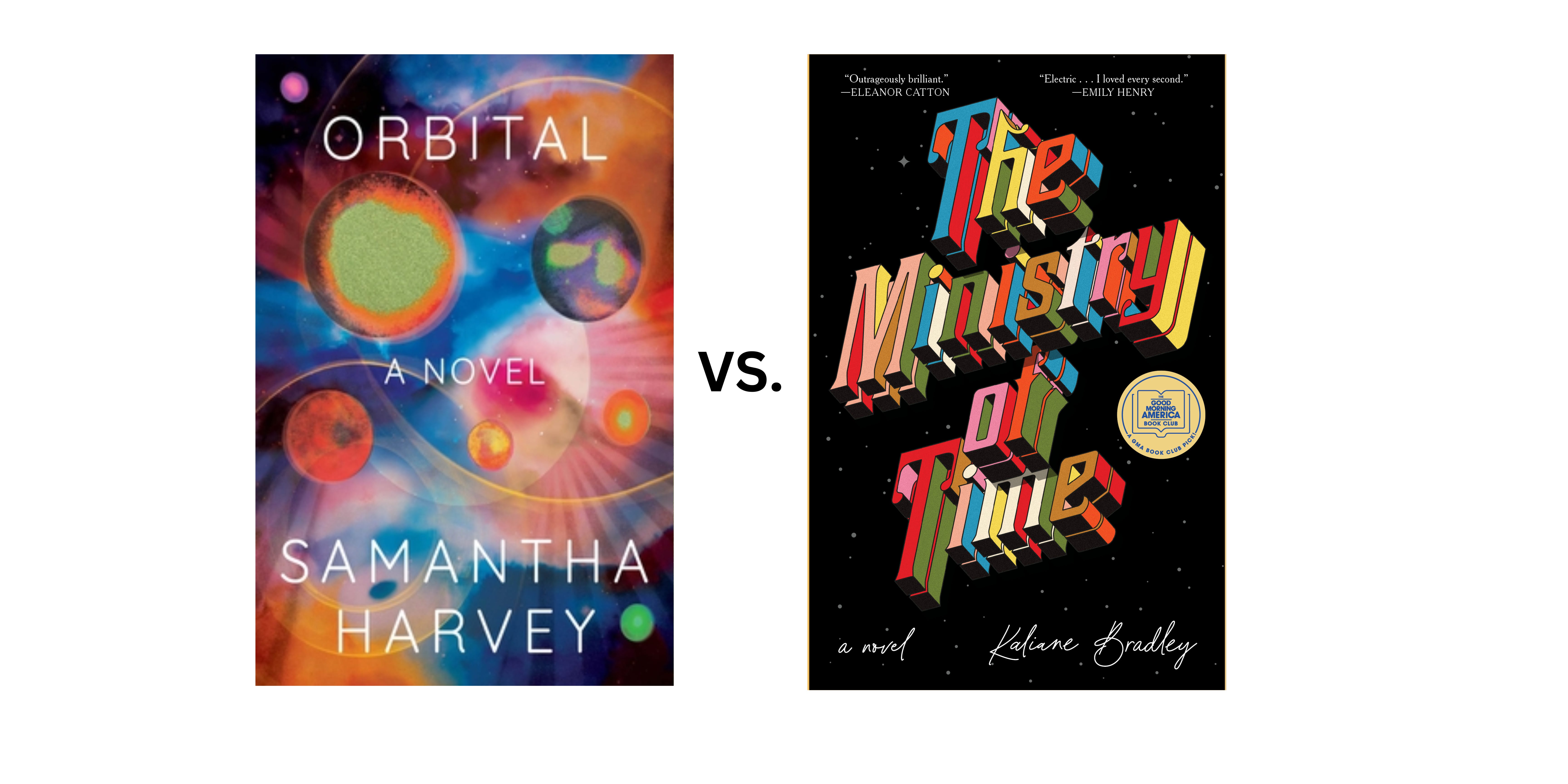
Book cover images for Orbital by Samantha Harvey and The Ministry of Time by Kaliane Bradley

Orbital by Samantha Harvey vs. The Ministry of Time by Kaliane Bradley

Ah, the classic conundrum: space travel vs. time travel. Orbital was such an ideal book to begin 2025 with, especially for me, coming off a hectic 2024. There was something so peaceful about feeling far removed from Earth and all its demands, and in being reminded of just how teeny tiny our little lives and dramas are in comparison to the big, beautiful universe. A quiet and contemplative read, Orbital was perfect for easing back into the January stratosphere.

The Ministry of Time, however, is on the opposite end of the spectrum. It’s a book that’s very much about being in the world, and the inclusion of characters from other times made the present moment feel vast and expansive and foreign without having to leave the planet. It feels reductive to say The Ministry of Time is just more exciting, but at the end of the day, it is! There’s intrigue, there’s romance, and there’s a provocation for the reader to consider their place in the world and what we owe to generations past, present, and future. The Ministry of Time advances, but with no less love for Orbital.


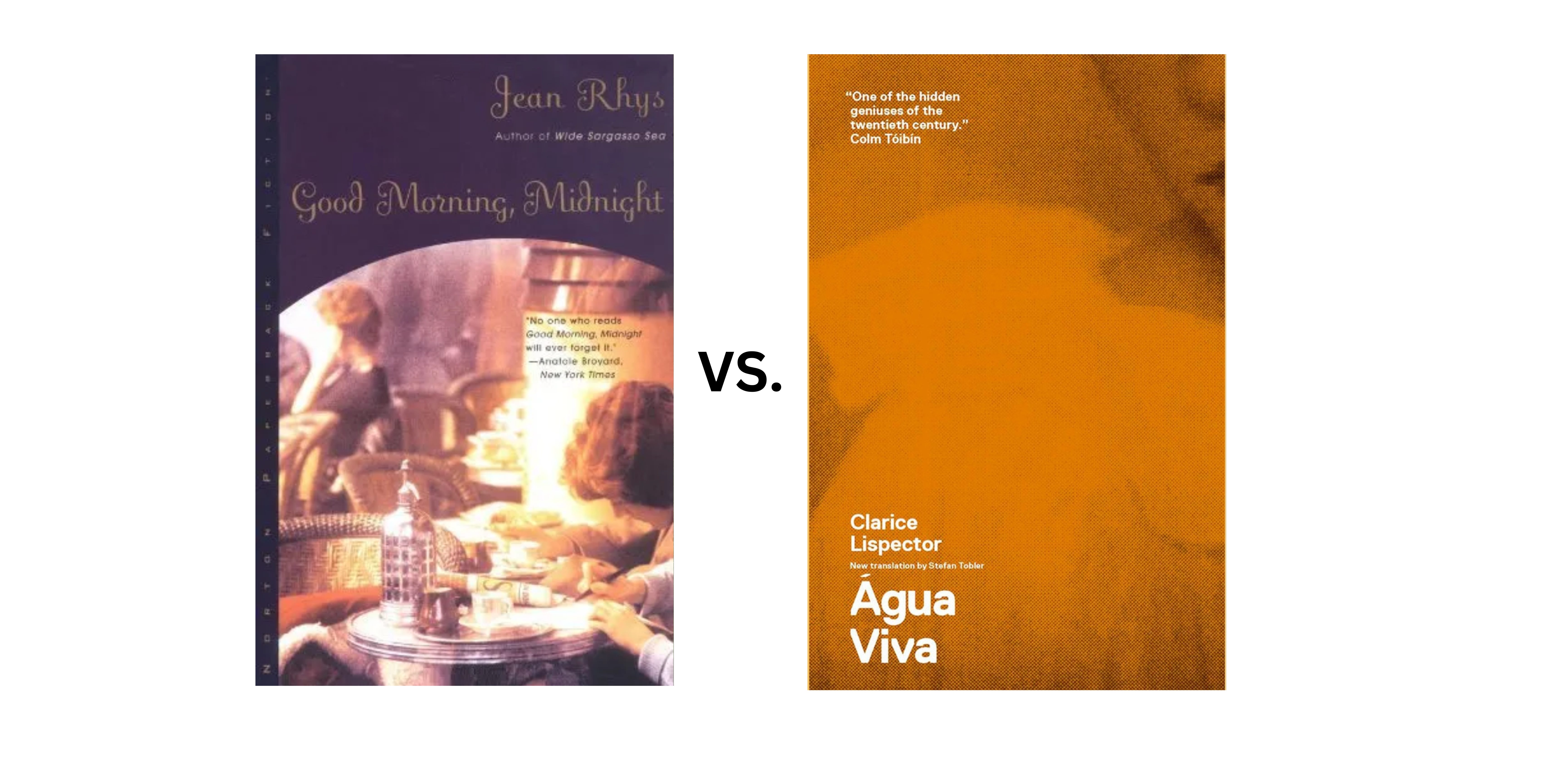
Book cover images for Good Morning, Midnight by Jean Rhys and Agua Viva by Clarice Lispector

Good Morning, Midnight by Jean Rhys vs. Água Viva by Clarice Lispector

Interesting, interesting! These books have absolutely nothing to do with each other, and must therefore be assessed by other factors because they can’t be compared like two novels can. Good Morning, Midnight has a lot going for it that Água Viva does not: a plot, for example, and characters, and a strong sense of time and place—even if that sense is fallible and ultimately unreliable.

And yet!! When I think of Água Viva, I think of a fire burning in my brain. I read both of these books in one sitting while traveling, but Água Viva is the one I came back to for seconds. Água Viva is the one I went to the bookstore to buy so I could underline it on my second read, which is something I almost never do. There was an urgency, an authenticity to Lispector’s searching that utterly possessed me. Água Viva moves forward!


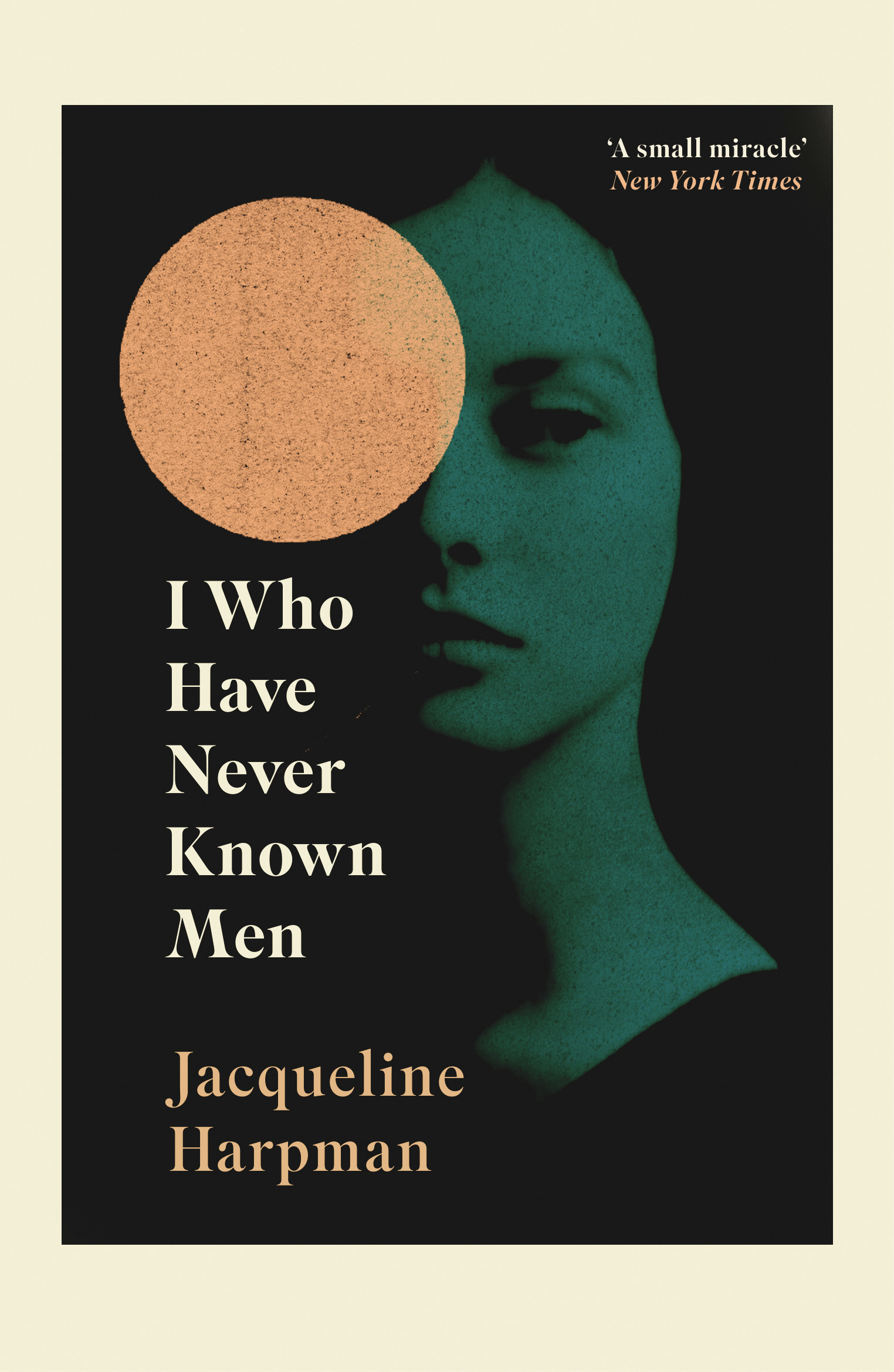
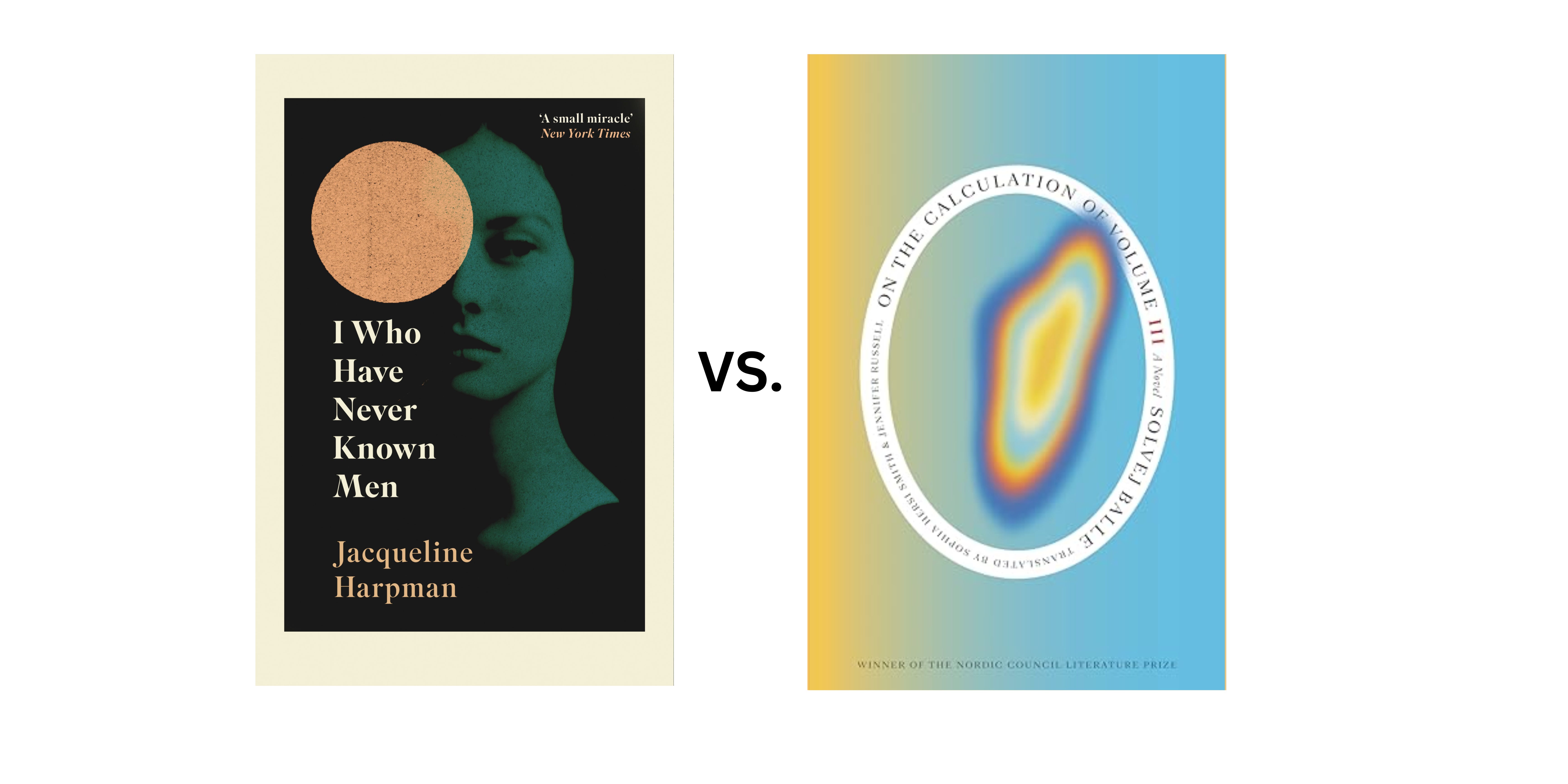
Book cover images for I Who Have Never Known Men by Jacqueline Harpman and On the Calculation of Volume III by Solvej Balle

I Who Have Never Known Men by Jacqueline Harpman vs. On the Calculation of Volume III by Solvej Balle

I find this pairing incredibly upsetting, because if you asked me to just list my top ten books of the year, all of the On the Calculation of Volume books would probably be on that list. But to pit just one of them against I Who Have Never Known Men, of all other books I read this year! Life isn’t fair.

Alas, one must be the victor. I remain deeply, deeply obsessed with the On the Calculation of Volume series, and will continue proselytizing to all of my bookish friends until we are a cult big and important enough to demand and receive a midnight indie bookstore release party for all subsequent volumes.

However.

It feels unfair to weigh the entire series against I Who Have Never Known Men. That’s not what’s in the bracket! And if we’re going off the merits of the individual book as a standalone, I don’t think Volume III holds up. I Who Have Never Known Men has an equal, if not greater amount of originality, and yet its strength is in being contained to this single volume. While we hold onto hope for answers in Volume IV, we know that answers are never coming for I Who Have Never Known Men, and we’re left to reckon with that not-knowing. The not-knowing is the point, and the not-knowing is what’s so haunting. With a conflicted heart, I Who Have Never Known Men advances to the finals.


Do you see now why it would’ve been silly to stick to the bracket as it was designed? It would’ve eliminated a round anyway, because it would’ve reduced the semifinals to just two books instead of four. This way is better because I say so.

2025 Book Bracket with the first three rounds filled in with book cover images
SILLY!

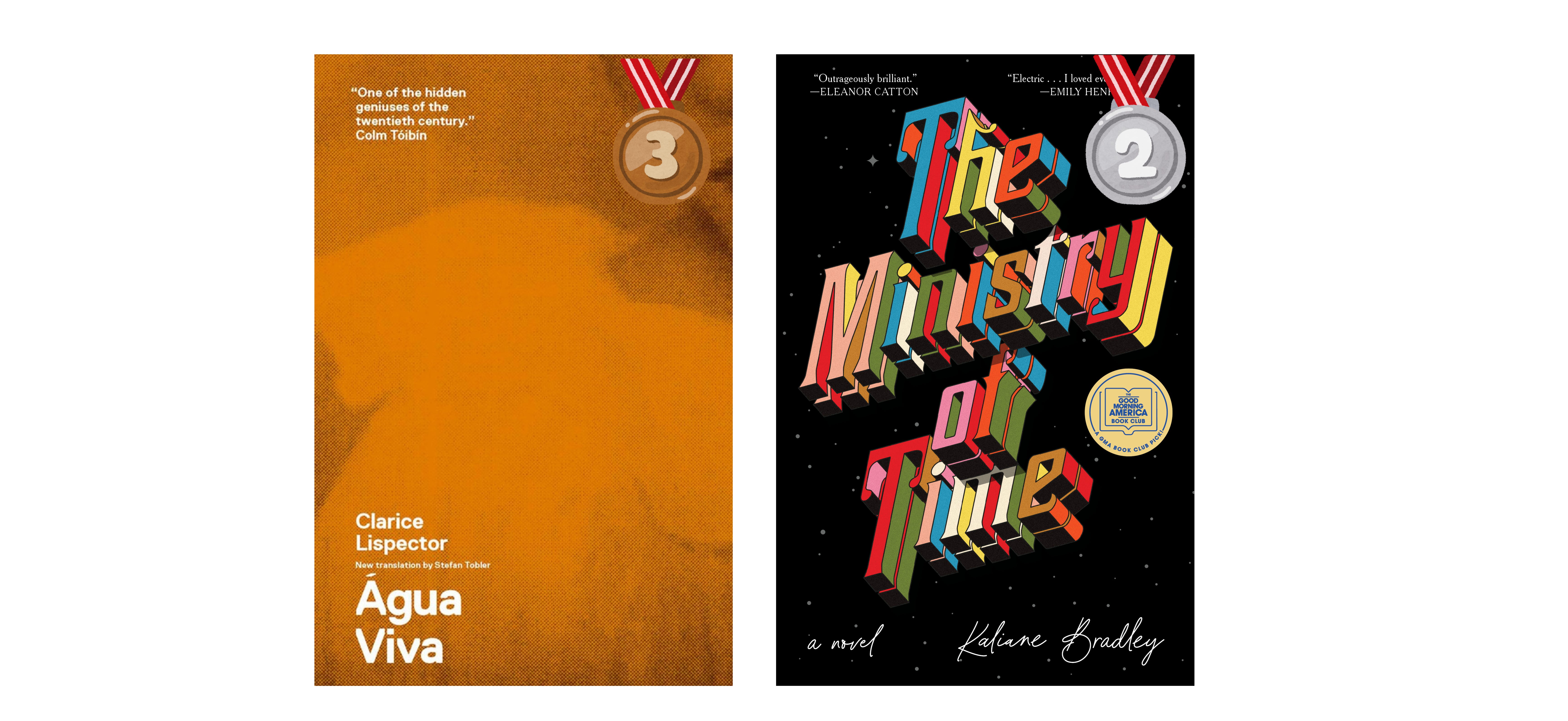
Anyway, stay tuned for the final round tomorrow, which is just a little mini pyramid ranking the top three. I’m ready to put 2025 behind us and I’m sure you are too, but in the meantime, I hope you find some inspiration for your 2026 reading.

Until then, thanks for hanging and happy reading!

❤ Catherine


Housekeeping note: all book links go to my Bookshop storefront, where each purchase supports independent bookstores (and this newsletter, because I get a small percentage of each sale.

The Best Books of 2025: Round One

Well, well, well, if it isn’t 2026 already.

If Goodreads is to be believed, I read 62 books in 2025. I smashed the goals I set for myself to read more short story collections and books in translation (7/6 and 16/4, respectively), read exactly six stellar poetry collections, and fell just short of my goal for craft books (5/6). Can’t win em all!

I also finally finished Emily Wilson’s translation of The Iliad in December, and successfully led a cute little Proust book club over the summer to read Volume One of In Search of Lost Time. All in all, it was another fabulous year for books, and I’m proud of the way I challenged myself to broaden my regular reading horizons.

But we’re not done yet.

Welcome, friends, to Round One of the Best Books of 2025 bracket! 2025 may be over, but we can’t put it to bed entirely without first crowning a winner.

2025 Book Bracket with book cover images filling the first round of spots

This is my third year running this bracket, and I’m amped to dive into these match-ups. Not only were there some absolute bangers in the top spots this year, but a lot of these books also explored many of the same themes in surprisingly complementary ways.

I think this year’s bracket is going to be a really cool reflection/accumulation of a lot of the thoughts I’ve had this year about time, space, and art, so it’s going to be interesting to see what comes out on top as a marker of my final takeaways for the year.

But enough preamble, let’s dive in! You can also read this directly on my Substack here:


ROUND ONE:

Book cover images of Orbital by Samantha Harvey vs. Bird by Bird by Anna Lamott

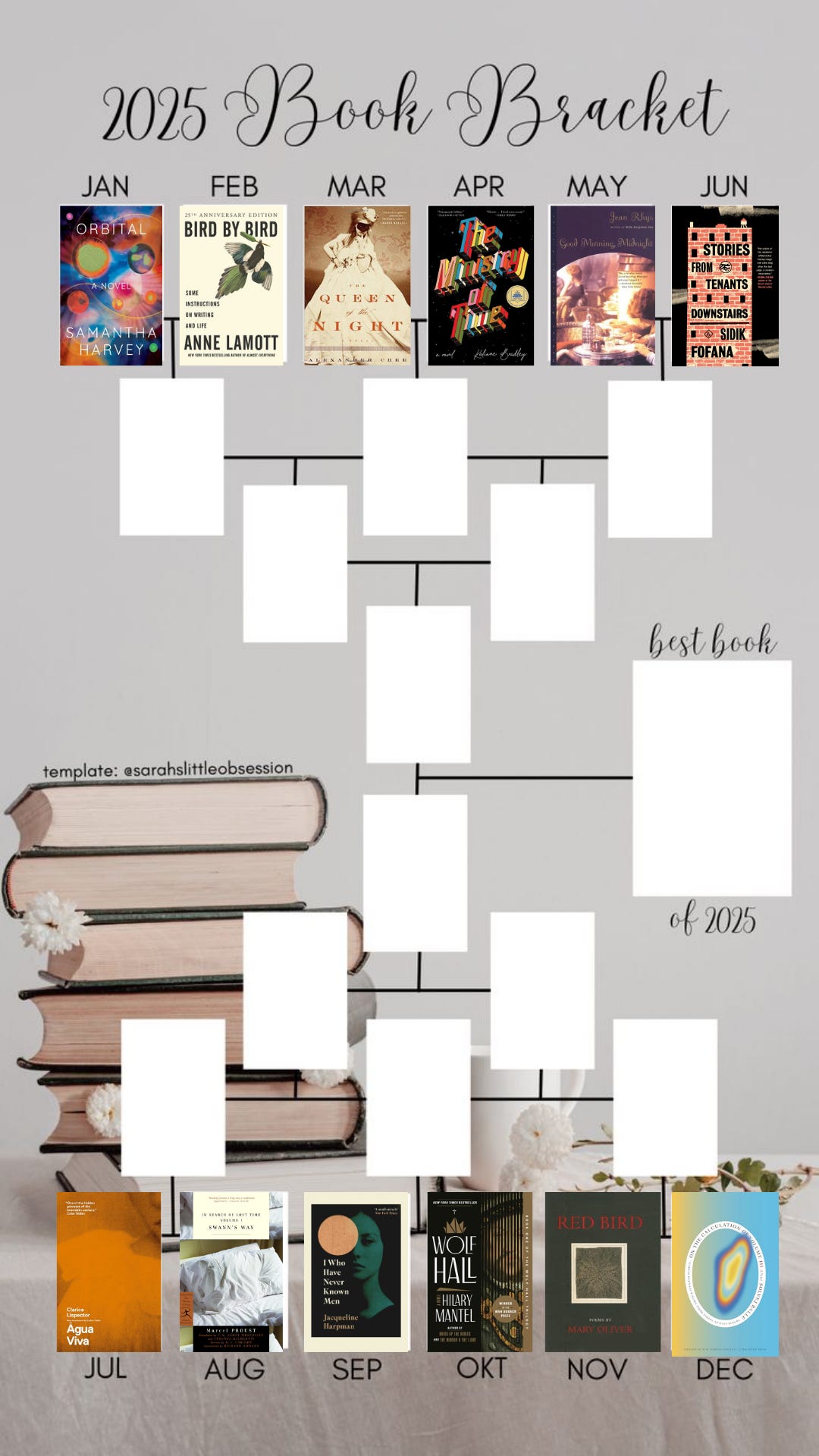
Orbital by Samantha Harvey vs. Bird by Bird by Anne Lamott

A tough one to start us off with! Two books in totally different genres that I loved for totally different reasons. As much as I enjoyed and feel that I have made good use of the wisdom that is Bird by Bird, I feel like Orbital set the tone for much of the reading I did for the rest of the year. The explorations of time and (literal) space, and how we navigate the physical and temporal spaces we have and the people inside of them, feel like defining themes for 2025. Plus, the kid version of me who wanted to be an astronaut still gets goosebumps thinking about Harvey’s descriptions of seeing Earth from space. For these reasons, Orbital advances.

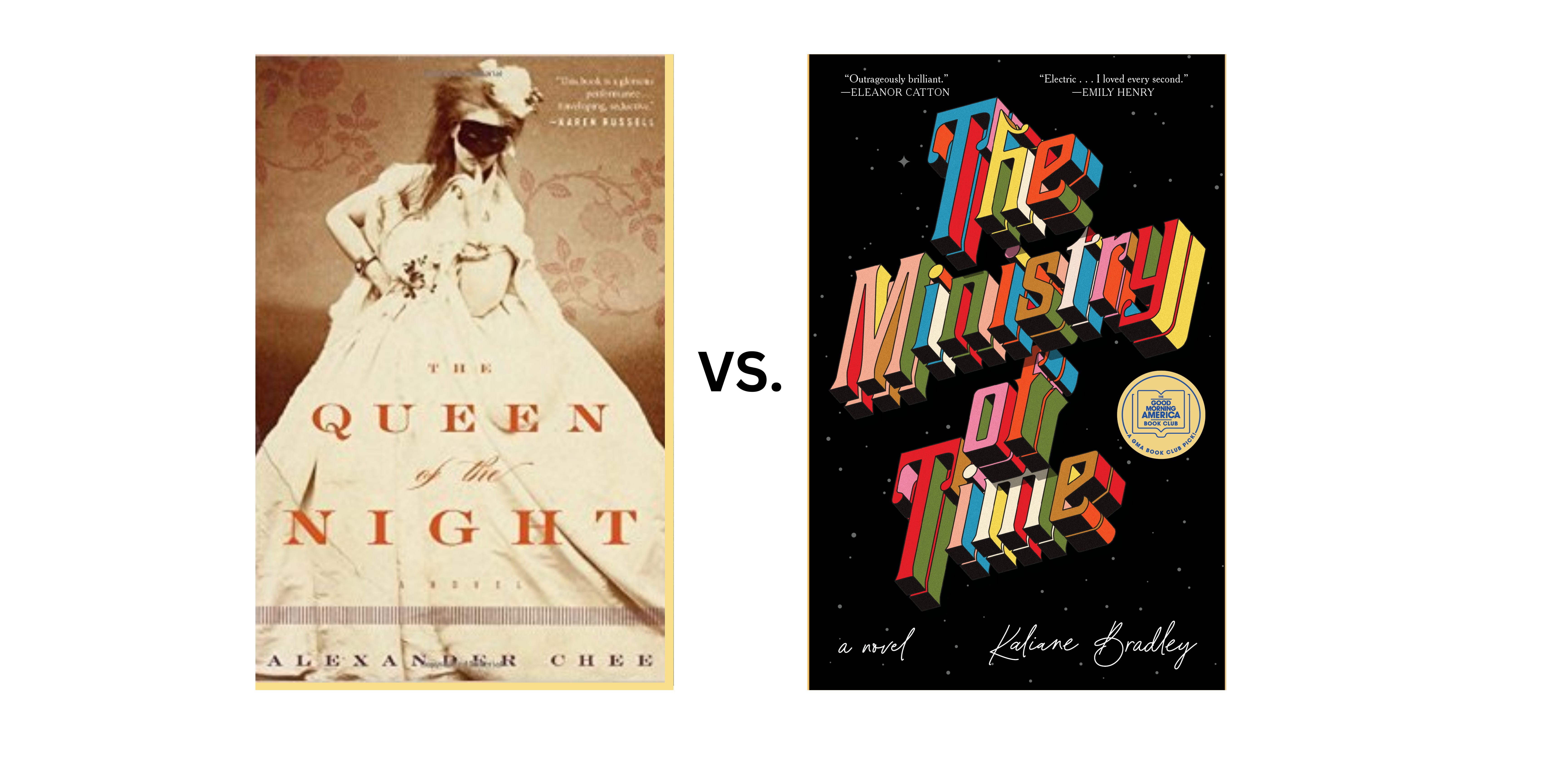
The Queen of the Night by Alexander Chee vs. The Ministry of Time by Kaliane Bradley

I’m already upset because I loved both of these books so much. The Queen of the Night was hands-down the best audiobook I listened to all year, and scores points for hitting many of my favorite elements of historical fiction: eighteenth-century Paris, theatre, the circus, romance, self re-invention. But The Ministry of Time also ticked a bunch of my boxes (namely, time travel and hot Victorian love interests).

I think what it comes down to is that The Ministry of Time took an angle I haven’t seen explored in time travel fiction before, making both its characters and readers answer the same questions about the state of our current world, how we choose to share it with those we love, and the lengths we’d go to protect our version of events. For novelty and long-term thought provocation, The Ministry of Time advances, but I will forever be recommending The Queen of the Night as one of my new all-time favorite historical fiction novels.

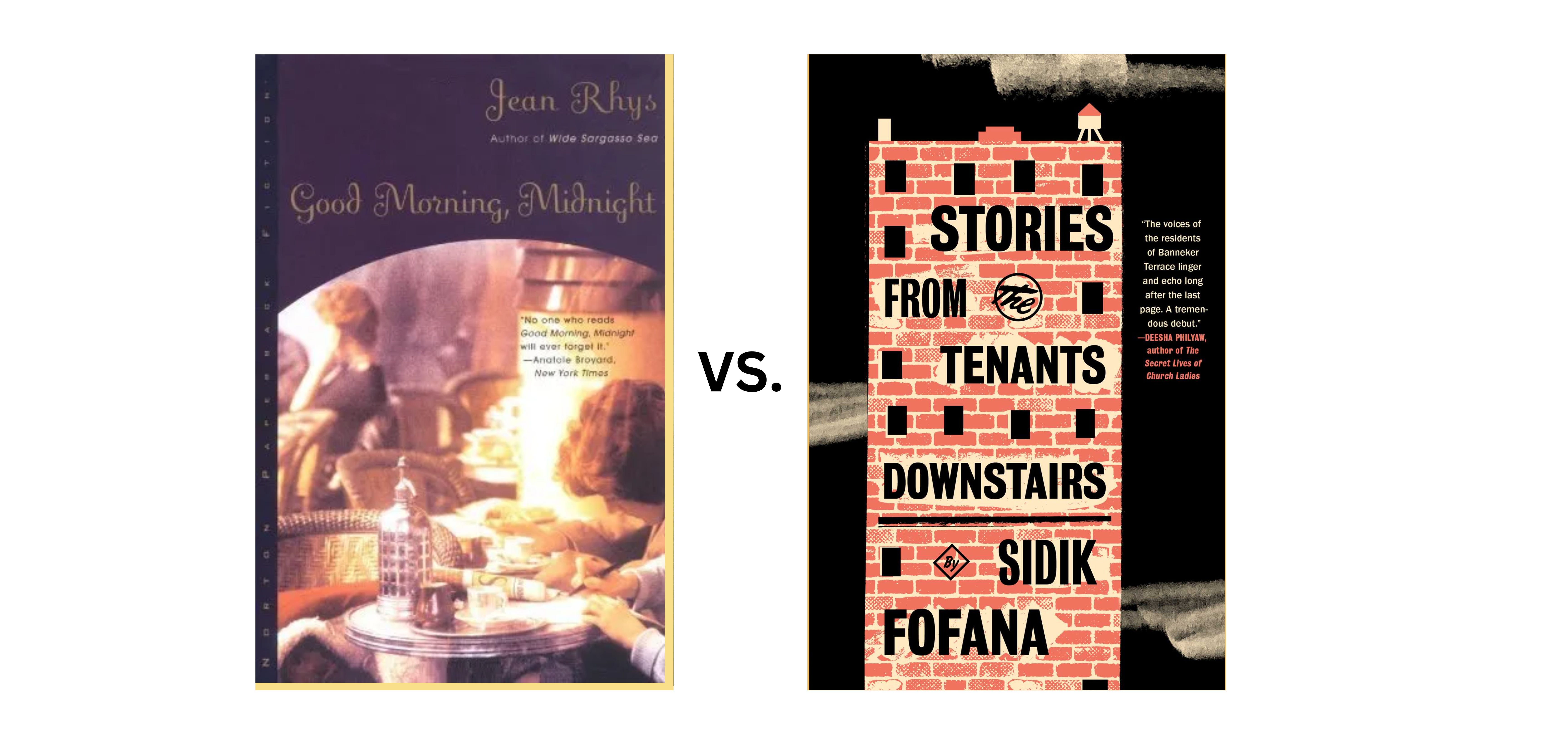
Book cover images for Good Morning, Midnight by Jean Rhys vs. Stories from the Tenants Downstairs by Sidik Fofana

Good Morning, Midnight by Jean Rhys vs. Stories from the Tenants Downstairs by Sidik Fofana

What I admire most about Stories from the Tenants Downstairs is how vividly Fofana captured all of the individual voices in a way that clearly distinguished them but also thematically united them. And yet, Good Morning, Midnight was the one that somehow stuck with me longer.

This may just be the nature of the format—I felt more emotionally connected to Rhys’s protagonist and her corner of Paris in a way that there wasn’t time to do with the individual characters in Fofana’s story collection. In a quieter, subtler sense, Good Morning, Midnight also feels on theme for the year with its exploration of how time changes people and places, rendering them unreliable at best and unrecognizable at worst. Highly recommend both again, but Good Morning, Midnight advances here!

Book cover images for Agua Viva by Clarice Lispector vs. Swann's Way by Marcel Proust

Água Viva by Clarice Lispector vs. Swann’s Way by Marcel Proust

This is such a funny match-up to me, because even though on the surface these could not seem more different, there’s a weird thematic similarity between these two books. One is bite-sized and I read it twice in one weekend, and the other I read slowly over the course of eight weeks. One expressed itself in immediacy, in short bursts of thought and feeling, and the other had long, meandering sentences that went on for entire pages.

Yet both focus on a driving sense of interiority, with the aim of rendering that interiority into something consumable, of capturing the immediate moment as thoroughly as possible with the limited means available to the artists: that is, words. Honestly, if I were a professor, I would pair these books together in the same syllabus because I think they make a surprisingly effective companion read, but for the sake of the bracket, I’m going with Água Viva because its brevity was such a relief after a summer of Proust.

Book cover images for I Who Have Never Known Men by Jacqueline Harpman and Wolf Hall by Hilary Mantel

I Who Have Never Known Men by Jacqueline Harpman vs. Wolf Hall by Hilary Mantel

Another devastating match-up, because I remain deeply obsessed with both of these books. Wolf Hall tapped into my formerly forgotten obsession with Tudor England with prose so freaking lovely and intimate you almost forget you’re witnessing the making of not one, but two notorious tyrants. It’s the best kind of historical fiction, and I’m so looking forward to finishing the trilogy in 2026. And yet I Who Have Never Known Men wasn’t just one of the best books I read this year, but maybe the past decade? It’s one I continue to think about months after reading, and that feels somehow uniquely tailored to the anxieties of our current society, despite being thirty years old. For sheer staying power, I Who Have Never Known Men advances.

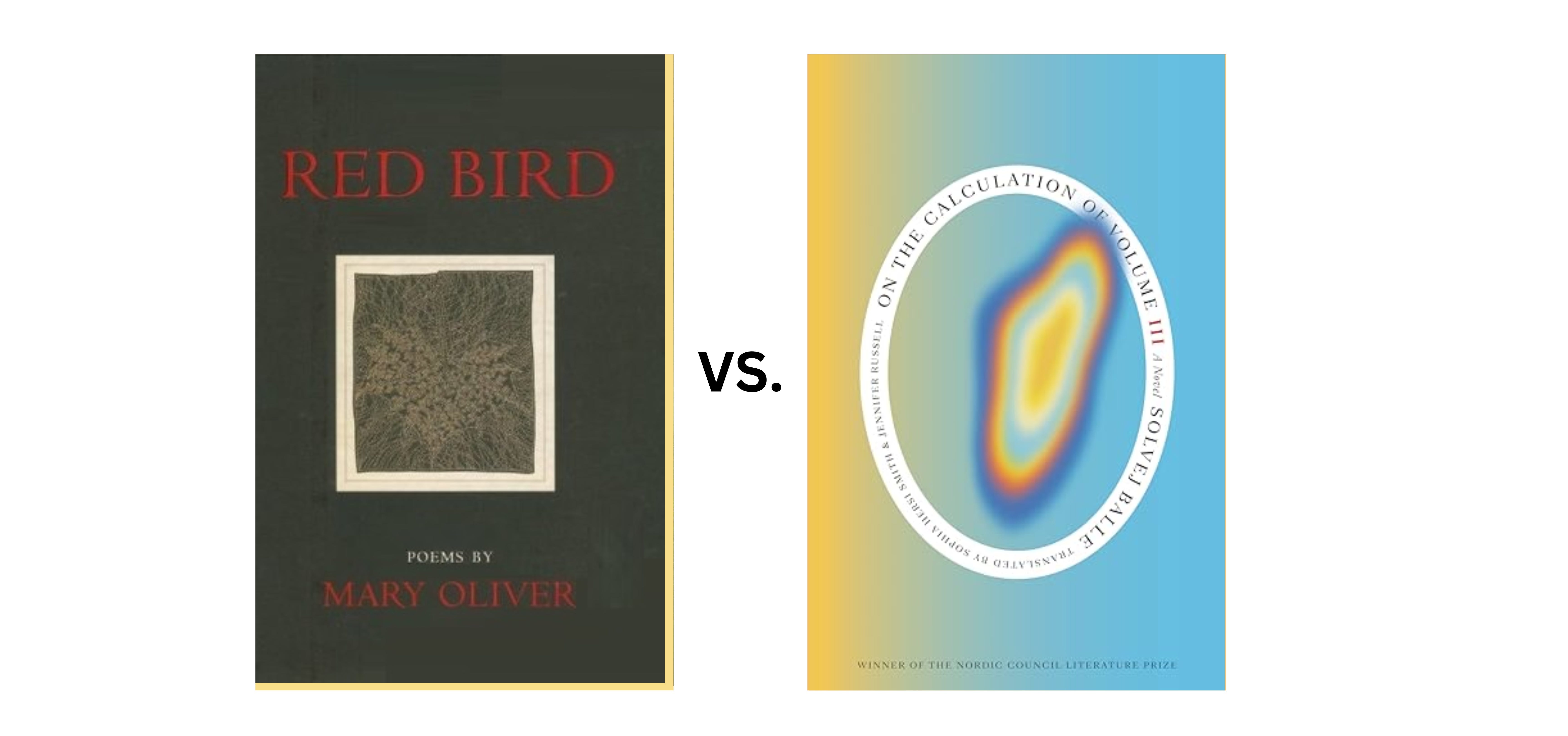
Book cover images for Red Bird by Mary Oliver vs. On the Calculation of Volume III by Solvej Balle

Red Bird by Mary Oliver vs. On the Calculation of Volume III by Solvej Balle

A tough one for sweet Mary Oliver, because as delightful as this collection of poems is, Red Bird is woefully outmatched here. The third and most recent installment of On the Calculation of Volume (and frankly, the entire series) consumed so much of my reading and thinking brain in the back half of 2025 that little else seems to stand a chance.

I loved this third installment in particular for the way it somehow managed to introduce a plot into this otherwise meditative, introspective series, and for how it continued to expand the world in a way that still left you with more questions than you started with. I’m excited to see OTCOVIII face some of the other advancing books; competition seems STIFF for book of the year, but this one is definitely one to watch.


2025 Book Bracket with book cover images filling the first and second round spots

And then there were six! Stay tuned for Round 2 coming at you later this week. Would love to hear your thoughts on the results of the first round in the meantime, especially if you’ve read any of these too!

Until next time, happy reading!
❤ Catherine


Housekeeping note: all book links go to my Bookshop storefront, where each purchase supports independent bookstores (and this newsletter, because I get a small percentage of each sale).
Still full of beans

Lit Chat Vol. 32 — November in Review

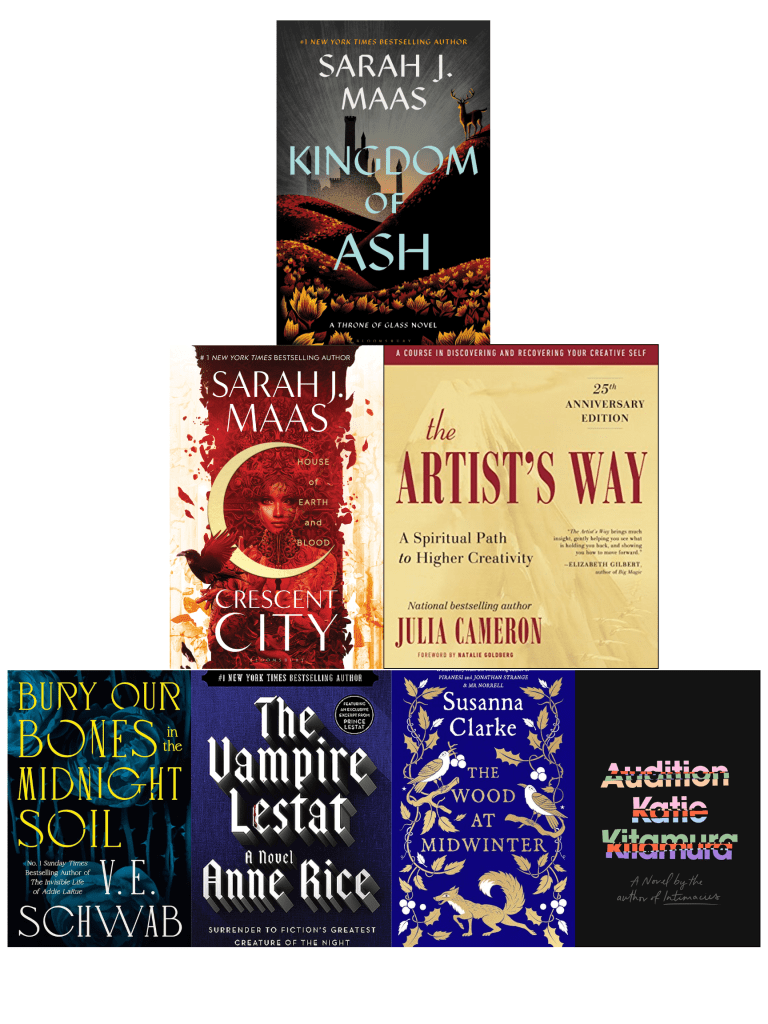
Pyramid of book cover images, bottom row: Chess Story by Stefan Zweig, Strange Pilgrims by Gabriel Garcia Marquez, Will There Ever Be Another You by Patricia Lockwood, and Tower of Dawn by Sarah J. Maas; middle row: Atmosphere by Taylor Jenkins Reid and The Bluest Eye by Toni Morrison; top: Red Bird by Mary Oliver

Hi friends,

We’ve approached my least favorite/favorite time of year. It’s cold, it’s dark, everybody you know is perpetually a little sick. Really, the only thing this time of year is good for is reading.

But we’re also approaching a reflective time of year, and I think I still have a little gratitude hangover from Thanksgiving. As I looked back at past pyramids this week to check whether I’ll meet the goals I set for myself in January, I was overwhelmed by how low-key stellar this reading year has been.

Not only were there so many bangers I’m already anxious that they won’t all get a fighting chance in the Best Of bracket due to seeding, but this year also left me so excited to keep reading: finishing series I’ve started, exploring more authors and genres I’ve discovered in a myriad of languages, wondering what I’ll unexpectedly fall in love with next year.

Overall, I’m just grateful that I’ve had so much time to spend with these words and worlds this past year. I know my life won’t always have the space to accommodate so much reading time like it does now, which makes this era of relative freedom and abundance of literary community to share it with feel extra precious. Not taking any of it for granted!!!

Anyway, TLDR:

Substack note posted on November 27 by Catherine Thoms that reads:
"grateful for all the books I've read in 2025
grateful for all the books I'll read in 2026"

But the year’s not over yet! We’ve still got November and December to chat about, baby, so let’s dive on in. And a reminder that you can get these posts straight to your inbox by subscribing to Lit Chat on Substack:


THE FOUNDATION:

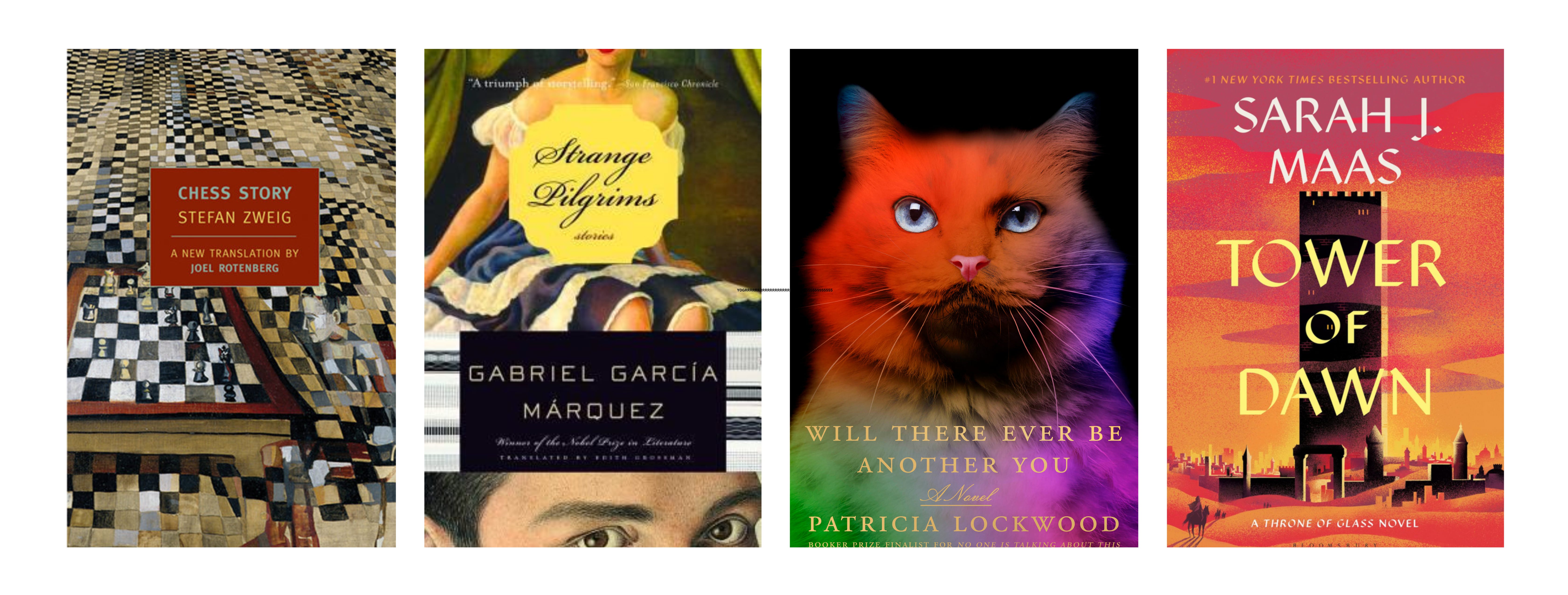
Book cover images for Chess Story by Stefan Zweig, Strange Pilgrims by Gabriel Garcia Marquez, Will There Ever Be Another You by Patricia Lockwood, and Tower of Dawn by Sarah J. Maas

Chess Story — Stefan Zweig, tr. Joel Rotenberg

Work book club strikes again! This is a story of madness, told within the deceptively simple frame narrative of a man witnessing a chess match onboard a ship traveling from New York to Buenos Aires. The players are a world champion and a former Nazi prisoner, who taught himself chess to cope with the isolation of solitary confinement. The latter’s relapse of “chess sickness” is the climax of the novella, but it’s almost overshadowed by the historical context of its publication: Zweig, an Austrian living in exile in Brazil in 1942, committed suicide the day after turning in this manuscript. These circumstances can’t be separated from those of the novella, which is defined by the as-yet-vague but inevitable horror of the war to come, and the irrevocable estrangement from one’s home and former way of life. Highly recommend the Lit Century podcast ep on this novella as a companion listen to this haunting story.

Strange Pilgrims — Gabriel García Márquez, tr. Edith Grossman

I enjoyed dipping in and out of Márquez’s weird little worlds over Thanksgiving break, so near to our own but always with his signature twist of magical realism. Much like Zweig, Márquez was an expat writing about expats, and there’s a sense of displacement and unbelonging that permeates the stories in this collection. Most of the stories feature Latin Americans gone astray in Europe, e.g., a young wife accidentally stranded in a women’s asylum, a family on holiday trapped by supernatural winds, and a pair of ill-fated newlyweds separated by a strange injury. There’s a sense of wrongness, an encroaching sinisterness beneath the façade of civility and culture in each story that ties them all together, despite their being written over the course of two decades. I find it fascinating when authors revisit the same themes and ideas over the course of their career, and this is a perfect example of that kind of lifelong creative exploration.

Will There Ever Be Another You — Patricia Lockwood

The first and only word I could think of to describe this book upon finishing it was: wackadoo. I’m tempted to leave things there, but I can elaborate by explaining that this “novel” is a product of the author’s brain-scrambling experience with long Covid, which made me feel similarly disoriented and unstable just reading her attempts at translating that experience into words. And yet, there are also profound moments of grief and anxiety, as the author simultaneously deals with episodes of tragic loss and illness within her family. Having read Lockwood’s prior novel, Will There Ever Be Another You, (and having once been an avid Twitter follower), I know much of this work draws from real life. The trick of the novel is that you’re never quite sure what’s real and what’s not; truth and reality become somehow immaterial.

Tower of Dawn — Sarah J. Maas

Yes, we are still cruising through the Throne of Glass series!! I blew through book six in three days while I was home for Thanksgiving, reliving my childhood glory days of staying up past my bedtime to cram the last hundred pages in before midnight. What’s cool about this one is that it takes a complete detour from the previous book, following a couple of side characters to a whole different continent, and introducing new characters and cultures that expand and enrich the world of the series in a complex yet refreshing way. I expect we’ll catch up with the main crew in the next and final book of the series in approximately…eight weeks, when my Libby hold comes in.


SOLID SUPPORTS:

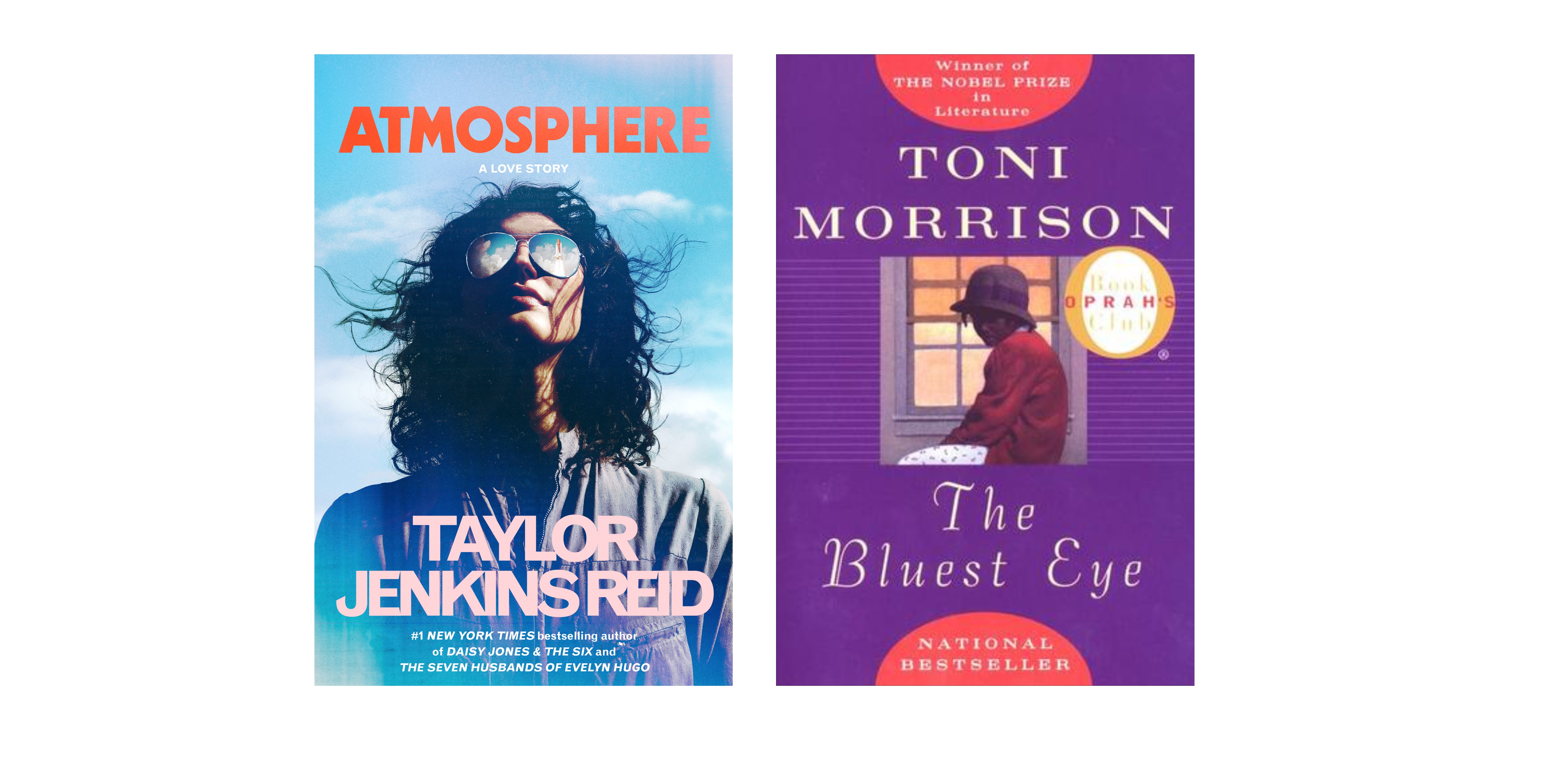
Book cover images for Atmosphere by Taylor Jenkins Reid and The Bluest Eye by Toni Morrison

Atmosphere — Taylor Jenkins Reid

Being an astronaut was one of my many short-lived childhood career dreams, so I was especially excited for TJR’s latest. Set in the early 1980s, this book follows the second-ever group of NASA astronaut candidates to include women, and features a slow-burn romance between two of the women, Joan Goodwin and Vanessa Ford.

I’ve been describing it as Apollo 13 but with lesbians, which means it’s not a spoiler to tell you that the book opens with disaster striking during a space mission. In the span of minutes, Vanessa becomes the only surviving astronaut capable of bringing the ship home, with the help of Joan’s coaching from Houston. The rest of the story is told in intermittent flashbacks to their selection and training, including the development of their relationships with the other astronauts in their class.

I resented this structuring a bit because I knew it was going to make me care about characters that just die in the first chapter, and I don’t appreciate that kind of emotional manipulation!! But I still raced through it and thought it was not only a beautiful love story, but also drove home just how impactful—and not guaranteed!—it was for women to succeed in this field at that time, securing a future for entire decades of women in STEM.

The Bluest Eye — Toni Morrison

I read this book in the span of my travel day from Chicago back to New York, finishing just as the plane touched down at LaGuardia. Although it didn’t take me very long to read, the heaviness of its subject material ensures that it’s not an “easy” read by any means. The opening pages prepare you for a story of child sexual abuse, and the rest of the novel unfolds through the eyes of the classmates, family members, and neighbors of the victim: a little Black girl who makes a wish for blue eyes.

What I found almost even more interesting than the novel itself was Morrison’s Afterword. First published in 1970 and reissued with the Afterword in 1994, I was surprised to see Morrison express dissatisfaction with the structure of the novel as a means of engaging with themes of internalized and structural racism. She acknowledges what she was trying to do and the shortcomings of her approach, compounded with the difficulty of striking the right tone in the language itself, in the pursuit of “race-specific yet race-free prose.”

I was surprised and impressed by this admission, at how Morrison was still finding ways to engage with and challenge her work by the changing standards of the time and her own skill level, decades after its publication. The choice to publish these thoughts as an Afterword is not one of a more experienced author excusing the failures of a younger self, but of an artist continually in conversation with all versions of herself, her work, and her world, challenging her readers to stay in that conversation, too. Cool as hell, in my humble opinion!


THE TIPPY TOP:

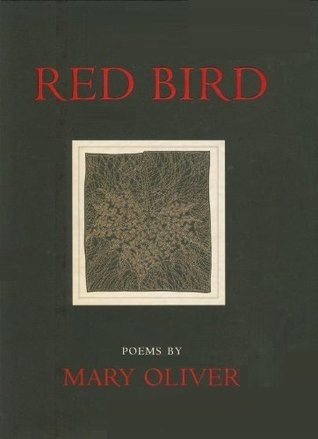
Book cover image for Red Bird by Mary Oliver

Red Bird — Mary Oliver

What can’t an afternoon spent with Mary Oliver fix? I had requested this volume specifically from the library because it’s the book Coyote Sunrise searches for in Coyote, Lost and Found by Dan Gemeinhart, which I read back in August.

The titular red bird opens and closes the collection and pops up throughout, often serving as a go-between for the physical and spiritual world. The collection features Oliver’s signature awe and wonder for the natural world, but there’s an undertone of grief and distress that can be attributed to a number of factors: the loss of Oliver’s long-term partner in 2005, three years before this volume was published, the Iraq war, the melting of the ice caps. To love the natural world as Oliver does is to feel all of its suffering, but also to see God everywhere in its beauty.

I’ll leave you with some of my favorites, because everybody needs a little more poetry in their lives, and because this was my only five-star book of the month for a reason:

  • The poem Coyote seeks is “Mornings at Blackwater,” which made me a little teary remembering the emotional release of encountering it for the first time in Gemeinhart’s novel.
  • Self-Portrait” made me laugh and so charmed me that it inspired this newsletter heading.
  • Love Sorrow” is the kind of poem you keep in your back pocket, to return to in inevitably difficult times.
  • I don’t want to live a small life” is one you may have seen before, a classic Oliver love poem disguised as inspirational nature poem.
  • Oliver wrote a whole series of poems about her dog, Percy. If you pick just one of these poems to read today, let it be this one: “I Ask Percy How I Should Live My Life.”

One more month to go! Historically, I’ve wound down my reading in December so I don’t have to do both a December recap and an EOY bracket, but there is simply too much to read, and it’s still anybody’s game (although On the Calculation of Volume III just might come out swinging).

Time will tell, so stay tuned, and as always, thanks for being here! Grateful for this lil circle of book lovers—you know where to find me if you ever want to chat more about these or any other books.

Until next time, happy reading!
❤ Catherine


Housekeeping note: all book links go to my Bookshop storefront, where each purchase supports independent bookstores (and this newsletter, because I get a small percentage of each sale).
Beneath every history, another history

Lit Chat Vol. 31 — October in Review

Pyramid of book cover images. On the bottom: Sour Cherry by Natalia Theodoridou, (Th)ings and (Th)oughts by Alla Gorbunova, and Empire of Storms by Sarah J. Maas; In the middle: How to Break Up with Your Phone by Catherine Price and The Secret History by Donna Tartt; On the top, Wolf Hall by Hilary Mantel

Hi friends,

Does anyone else feel like time has been moving suspiciously fast and loose this year? Like I blinked, and suddenly, it’s November.

I’m trying to be really intentional about my reading for the rest of the year, keeping in mind the original reading goals I set for myself, but my library holds keep delivering all at once! This is, unfortunately, the Way of the Library.

I have nine books currently checked out and one on hold to be picked up, which puts me in a bit of a reading pickle, actually. Which highly anticipated new release from six months ago will get to skip the TBR line so it can get returned in time to check out the highly anticipated new release from three months ago?? It’s getting pretty high-stakes over here.

Speaking of high stakes, I’m also starting to think about my Best Books of 2025 bracket, because there have been some absolute bangers in the top spot lately (this month, especially!!!) and I’m excited to see them duke it out.

But before I get too far ahead of myself, let’s get into October’s books! Per usual, if you prefer to get this post delivered right to your inbox, you can subscribe to my Substack here:


THE FOUNDATION:

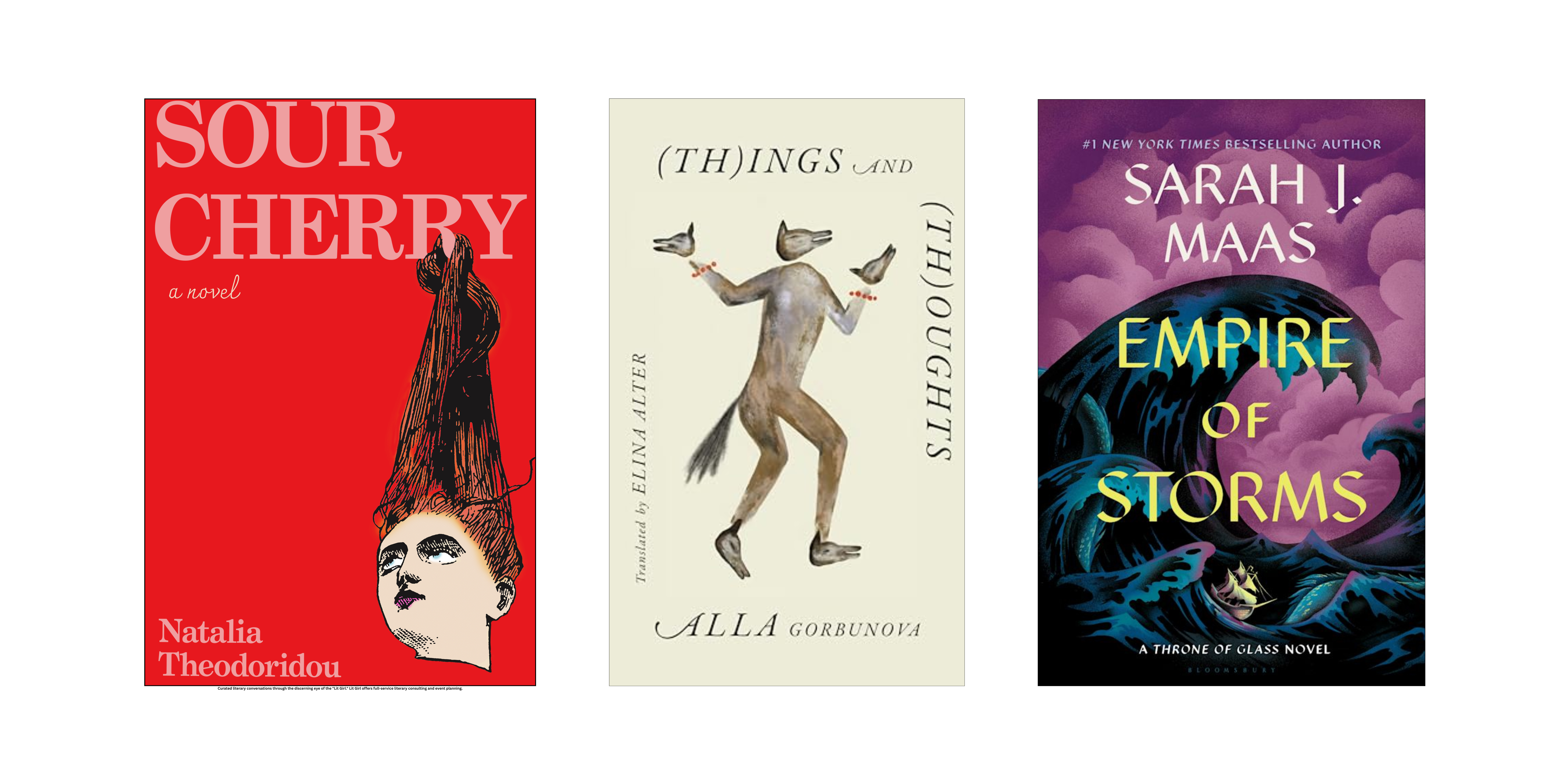
Book cover images for Sour Cherry by Natalia Theodoridou, (Th)ings and (Th)oughts by Alla Gorbunova, and Empire of Storms by Sarah J. Maas

Sour Cherry — Natalia Theodoridou

This one seemed like it would check all my boxes: fairy tales, Gothic mansions, dark curses—yes, please! Sadly, I didn’t feel this book lived up to its potential. It’s essentially a retelling of the Bluebeard fairytale, but in this version, the cursed lord doesn’t kill his wives outright, but leaches life from his surroundings until everything he touches eventually turns to rot. The prose is beautiful and dream-like, but I wanted the story to go deeper beneath the fairytale, to explore more of the characters’ interiority and the mechanics of its world. Instead, it jumps perspective too often to feel settled in one character, and the modern-day narrative throughline felt underdeveloped. I get what it was trying to do in terms of allegorizing toxic masculinity, but it felt like this was at the expense of the actual story. A miss for me, unfortunately!

(Th)ings and (Th)oughts — Alla Gorbunova, tr. Elina Alter

Shoutout to Sarah McEachern for slipping me this galley from the Deep Vellum tent at the Brooklyn Book Festival in September! These absurdist shorts were the perfect kick-off to my month, vignettes that span the weird and the tender and somehow felt both universal and definitively Russian. Often just a few pages long, each short prose piece contains an entire mini universe, filled with bumbling and bewildered characters who search for meaning in religion, nature, train stations, municipal cemeteries, folk tales, and of course, the many frustrations and fulfillments of love. I’ll admit I’m not as well-versed in Russian literature as I am in other literary traditions, but I was reminded of Gogol in the surrealism overlaid onto even the most mundane settings, transforming something as banal as a trip to the gynecologist into a profound and revelatory experience.

Empire of Storms — Sarah J. Maas

That’s right, #5 in the series! These are getting harder to write about without spoilers. However! I’ll say that what I enjoyed most from this installment was seeing all the different characters’ storylines finally intersect as Aelin begins to consolidate her allies, and I’m always just as surprised and delighted as the rest of her team to discover how her scheming ultimately pays off. I’m also perpetually interested in the mechanics of power in fiction (both magical and political/interpersonal), so the chess game that is building an army, fighting battles, and strategizing for a war is something that’s keeping and holding my interest in these later books. Onwards, to book #6, I guess!


SOLID SUPPORTS:

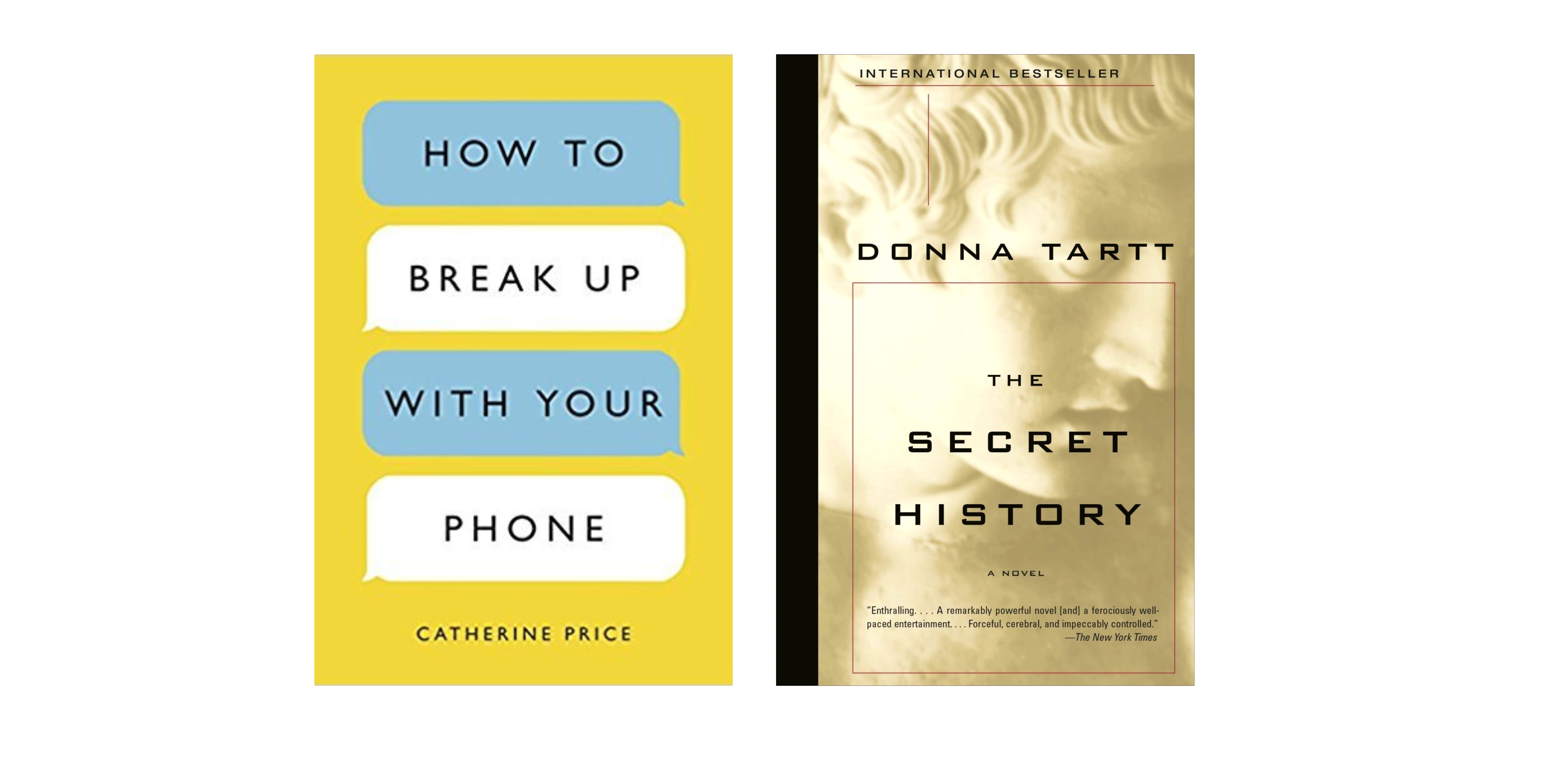
Book cover images for How to Break Up with Your Phone by Catherine Price and The Secret History by Donna Tartt

How to Break Up with Your Phone — Catherine Price

If you’ve seen me in the past month, then you’ve probably already heard me preach about this book and/or my journey to be on my phone less (and likely more than once, sorry!). Spoiler alert: we’re all addicted to our phones. Like, clinically. And it’s not okay! We’ve normalized it because we’re all doing the same thing, but if we swapped our phones out for cigarettes or alcohol in terms of our obsessive usage and the anxiety we feel around having/not having them, it’d be pretty obvious that we all have a problem.

This book does an incredible job of first opening our eyes to the fact that our time and attention are being intentionally manipulated away from us and sold to the highest bidder (aka advertisers on social media), then provides an accessible, mindfulness-based 30-day plan for reclaiming our time/memories/attention spans/lives in general. If you (like me!) are noticing a spike in tiredness, boredom, or general dissatisfaction—especially with the recent time change—or if you often catch yourself thinking you could do so much more with your day if you only had a couple extra hours: put down your phone. That’s where your extra time is. Read this book and take back your life!!!

The Secret History — Donna Tartt

This was such a funny reading experience for two main reasons. The first is that I listened to this on audio, narrated by Donna Tartt herself, and was shocked to discover that she has a little southern twang! This unfortunately meant that her voice for Bunny veered dangerously into Bugs Bunny territory, which I wasn’t sure I was going to be able to get used to, but now I can’t separate Donna’s dulcet tones from the internal monologue of Richard Papin.

The second reason this was funny is that this was technically a re-read. I first read this book in high school (on a recommendation from Kate, if I recall correctly!), but I remembered almost nothing except Bunny’s death and the bacchanal (not spoilers, trust me). The things my impressionable young brain held onto!

Reading this as an adult is a comparatively wild experience. I remember thinking the college-aged characters were such glamorous adults when I read this as a teenager, with their seemingly extensive knowledge of ancient Greek and casual alcoholism. As an adult, you realize that even the most intelligent and collected of them is just a kid in over his head. This book is an absolute master class in atmosphere and tension, and there’s something weirdly nostalgic about the pre-Internet of it all. You simply can’t kill your friends and get away with it like you used to, these days!


THE TIPPY TOP:

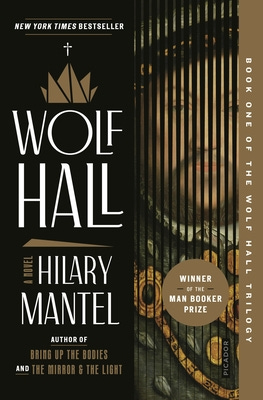
Book cover image for Wolf Hall by Hilary Mantel

Wolf Hall — Hilary Mantel

Who would have expected that my second obsession this month (next to reducing my screen time) would be the court of Henry VIII? Actually, this is likely not a surprise to anyone who knows me. I’ve been obsessed with this kind of fictional biography deep-dive, and this era in particular, since reading Margaret George’s Autobiography of Henry VIII back in high school. Returning to the Tudor court via the eyes of Thomas Cromwell was exactly what my newfound attention span was begging for.

I mentioned earlier that I’m interested in fictional explorations of power, and what better example than this book? Thomas Cromwell, the son of an abusive blacksmith, rises through the ranks of Henry VIII’s court by spreading influence throughout Europe and cultivating a network of allies and informers until he is one of the king’s most trusted advisors. He is personally responsible for many of the machinations that ultimately enable Henry to divorce Katherine of Aragon, proclaim himself head of the Church of England, and put Anne Boleyn on the throne. And that’s just book one.

I’m grateful I read this book when I did, at a time when I was putting special emphasis on retraining my brain and my attention span, because there’s a quietness and a delicacy to the language that requires you to slow down and let it all soak in. Mantel brings these notorious characters to life with such gorgeous intimacy and interiority, while at the same time fostering an atmosphere of intrigue that makes one of history’s oldest and most famous stories feel like a truly novel page turner. This is definitely going to be another contender for my top book of the year, and I can’t wait to read the rest of the trilogy.


And that’s October done! What are you trying to squeeze in before the year’s over? Personally, I will be going home to binge Patricia Lockwood’s (overdue from the library) Will There Ever Be Another You so I can return it this weekend and check out R.F. Kuang’s Katabasis, which also came in this week.

The end is in sight, folks! And there’s still so much reading time left. As always, thanks for being here, and until next time, happy reading!

❤ Catherine


Housekeeping note: all book links go to my Bookshop storefront, where each purchase supports independent bookstores (and this newsletter, because I get a small percentage of each sale).
Talking is existing

Lit Chat Vol. 30 — September in Review

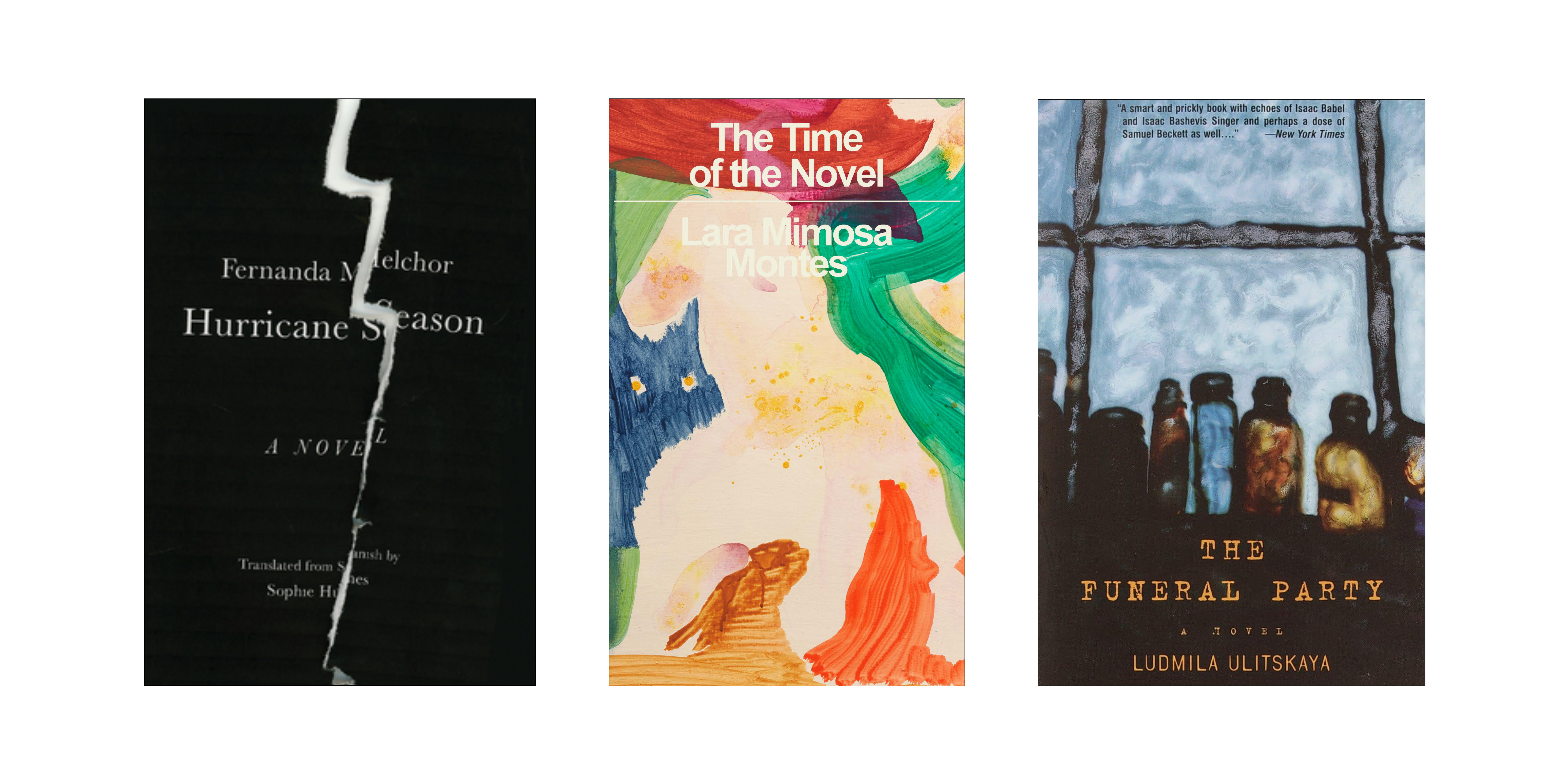
pyramid of book cover images with Hurricane Season by Fernanda Melchor, The Time of the Novel by Lara Mimosa Montes, and The Funeral Party by Ludmila Ulitskaya on the bottom; Queen of Shadows by Sarah J. Maas and On the Calculation of Volume II in the middle; I Who Have Never Known Men by Jacqueline Harpman on the top

Hi friends,

October already! I love this time of year because I feel like I fall back in love with reading every fall. Part of it, this year, is that I’m on a journey to drastically reduce my screen time, which I’ll talk more about next month when that journey is complete. But part of it has also been embracing the slowdown of the year by indulging in books and genres I already know I’m going to like.

I was overjoyed to hear at yesterday’s Reading Club that nearly half of the other attendees were feeling the same way, having finally broken out of their reading ruts by leaning into books that were just fun. By reconnecting with genres that were childhood favorites, diving into weird and campy series, or settling in for a couple of excellent page-turners, my friends were finally excited about reading again. Truly nothing makes me happier!!

If you’d like to check out some of the rut-busting books that were shared, I’ve put them in a Bookshop list here:

My reading advice for you today: lean into what you love. Don’t stress about whether it’s lowbrow or uncool. If it gets you off your phone and out of a rut, pick up that YA fantasy or pulpy detective novel and let yourself enjoy it. There’s no bad way to be a reader.

Okay, now that I’ve told you about what my friends have been reading, it’s my turn!! I read a bunch of bangers in September, and 4/6 of them were translations, which seems to be the unintentional theme of this reading year. If you’d like to read this post on Substack, you can do so here:

Otherwise, if you’re sticking around here, buckle up and let’s get this show on the road.


THE FOUNDATION:

Book cover images for Hurricane Season by Fernanda Melchor, The Time of the Novel by Lara Mimosa Montes, and The Funeral Party by Ludmila Ulitskaya

Hurricane Season — Fernanda Melchor, tr. Sophie Hughes

What I’m enjoying most about my office’s translation book club is how it prompts me to read books I never would have picked up on my own. This book opens in a small, rural Mexican town, with the discovery of the town “witch” dead in a local river. Each of the following chapters is narrated by a different community member, but they all revolve around the witch, her influence on the town, and the circumstances of her death. There’s quite a bit more physical and sexual violence than I usually prefer, so this definitely isn’t a book I’d recommend to everyone, but it inspired a thoughtful conversation about how fear and power are so often inextricably linked with gender and social norms. Translated from the Spanish, the prose is vivid and immediate, with long yet momentous sentences that capture your attention and drop you right into the headspace of its characters, making it almost impossible to look away.

The Time of the Novel — Lara Mimosa Montes

I picked this one up at Greenlight Bookstore’s kick-off party to the Brooklyn Book Festival because I simply can’t say no to a slim volume with a colorful cover! At just 88 pages, this funky little novella captures the narrator’s attempt to become just that: the narrator of the story. She quits her job and sublets a temporary apartment in an attempt to remove herself from the world and focus on translating her experiences into narration. A little meta, a little self-indulgent, this would make a great gift for any writers in your life looking to hit their Goodreads goal before the end of the year!

The Funeral Party — Ludmila Ulitskaya, tr. Cathy Porter

I have to confess: for the first time I think ever, I forgot a book in last month’s newsletter! This was actually the August pick for my office book club, and I think because I read it on a plane and then returned it to the library early in the month, it slipped my mind. This forgetfulness is not at all reflective of how much I enjoyed this book, though. Set in a sweltering Manhattan apartment in the middle of summer, the book chronicles the last few days of a dying artist’s life, in which his friends and lovers (all mostly Russian émigrés) have gathered to keep vigil. The eccentric cast of characters is the main delight of this novel, as they range from the angsty to the absurd, united despite their differences by their love for the artist. It’s a moving portrait of immigrant community and an intimate snapshot of 1990s New York, and it handles heady questions of faith and identity with humor and generosity.


SOLID SUPPORTS:

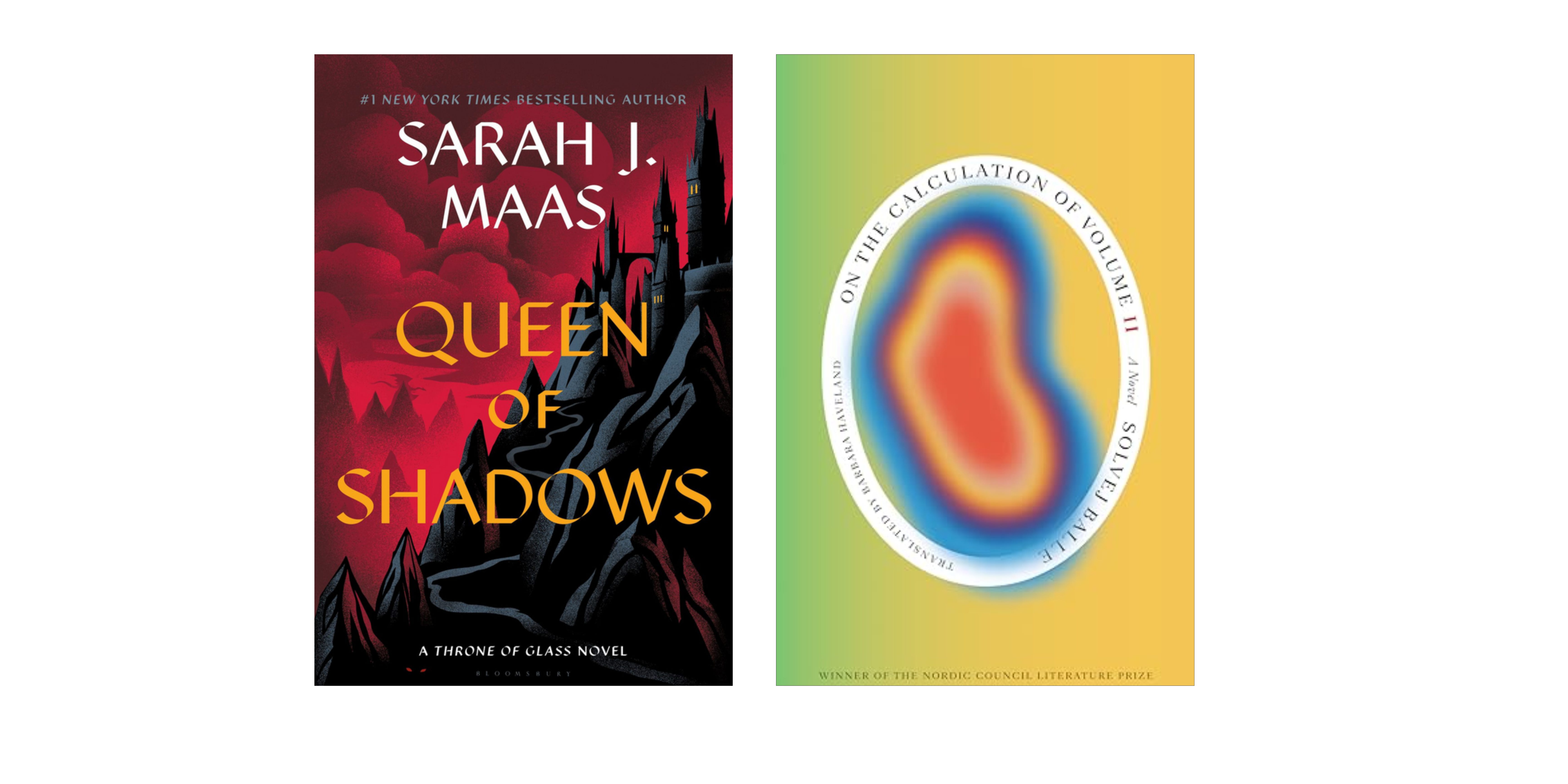
Book cover images for Queen of Shadows by Sarah J. Maas and On the Calculation of Volume II by Solvej Balle

Queen of Shadows — Sarah J. Maas

I am positively cruising through this series despite the fact that each book seems to be 100 pages longer than the last. They’re technically YA, so it’s fast-paced and easy reading, but also kind of the perfect escapism for these times? Idk, something about the combination of magic, friendship, hot people, and good old-fashioned scheming to take down a big bad villain is really speaking to me right now.

This is book #4 out of 7, so no spoilers, but the deeper we get, the more invested I am in seeing how all the different storylines intersect in the battle for the soul of Erilea. Highlights from this installment include the introduction of new allies and a satisfying series of emotionally charged rescues, reunions, and revenge plots. I’m now committed to finishing the series by the end of the year and am most looking forward to seeing more of the continent beyond Rifthold and Morath in the volumes to come!

On the Calculation of Volume II — Solvej Balle, tr. Barbara Haveland

It was a real fight between this book and the next one for the top spot this month, because both are books that I have consistently been unable to stop thinking about. *Mild spoilers ahead!*

This second volume picks up right where the first left off—still on November 18th. The narrator’s belief that time will reset after a full year of November 18ths has been proven false, so she embarks on a journey to fashion her own year by traveling in pursuit of different seasons.

I really loved the way this book tested both the boundaries of the world as we have come to understand them, as well as our own perceptions of time and seasonality as markers of change and novelty in our own (assumedly still changing) worlds. More often than not, this only created more questions to be answered in future volumes, which I am so deeply here for. I’m obsessed with how complex and far-reaching the implications of this simple idea of a single repeating day have turned out to be, and am truly on the edge of my seat for the next volume to be published on—you guessed it—November 18th, 2025.


THE TIPPY TOP:

Book cover image for I Who Have Never Known Men by Jacqueline Harpman

I Who Have Never Known Men — Jacqueline Harpman, tr. Ros Schwartz

Everyone and their mother seemed to be reading this book this summer, so I snagged it from Daunt Books when I was in London last month and bumped it to the top of my list. In the new 2025 afterword by Nick Skidmore, Publishing Director of Vintage Classics, this book is described as The Handmaid’s Tale meets The Road. I think this perfectly encapsulates the specific brand of dystopian haunting this book manages to effect, and explains why it’s now particularly appealing to contemporary readers thirty years after its original French publication.

The teenage narrator of the book does not remember life outside of the underground cage she shares with forty other women, defined by the constant supervision of male guards who dictate their daily routines and interactions. When the guards one day disappear and the women find themselves suddenly and inexplicably freed, they ascend to discover a barren landscape unlike any country any of them can remember.

The journey that follows is one of tragic discovery that produces no real answers to any of the women’s (or the reader’s) questions about where they are or why they’re there. The narrator, having never known any other life, serves as a fascinating yet horrifying foil to the taken-for-granted simplicity of our normal lives, calling into question everything that we have come to accept as truth about love and purpose, the power of community, and the meaning of legacy in an uninhabited world. I know I say this a lot, but this is a book that I genuinely don’t think I will ever be able to stop thinking about, and will probably be up there for one of the best of the year.


And that’s a wrap on our first leg of fall books! I don’t know about you, but October is where my seasonal reading truly begins to shine. So far, I have The Secret History queued up on audio, and I’ve also pulled Wolf Hall off our bookshelf, inspired by my recent visit to Hilary Mantel’s alma mater, The University of Sheffield. I’m in the market for one good (not too scary!) thriller/horror book to round out the month, and then I think I’ll be satisfied.

What’s on your October reading docket? Anything spooky? Let me know what’s on your TBR in the comments below or in any of the usual places—I’m always down to chat!

Until next time, happy reading!
❤ Catherine


Housekeeping note: all book links go to my Bookshop storefront, where each purchase supports independent bookstores (and this newsletter, because I get a small percentage of each sale).
Always try to keep a patch of sky above your life

Lit Chat Vol. 29 — August in Review

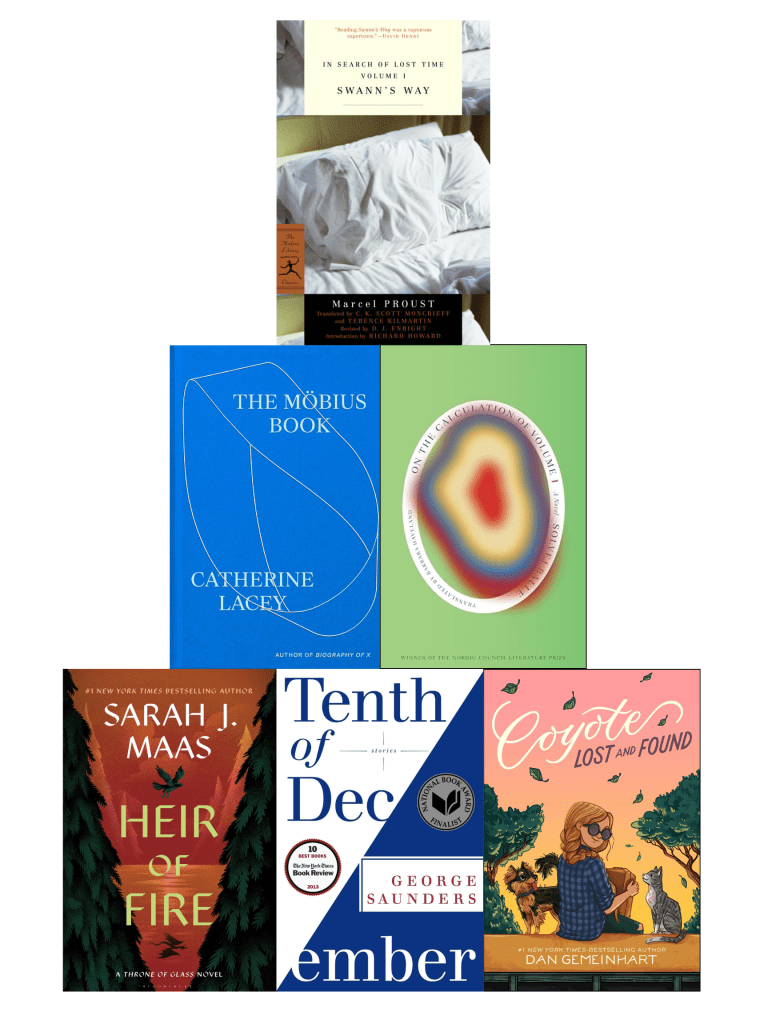
Pyramid of book cover images with Heir of Fire by Sarah J. Maas, Tenth of December by George Saunders, and Coyote Lost and Found by Dan Gemeinhart on the bottom; The Mobius Book by Catherine Lacey and On the Calculation of Volume I by Solvej Balle in the middle; and Swann's Way by Marcel Proust on top.

Hi friends,

I have good news and bad news. The bad news is: this newsletter officially marks the end of summer reading time.

I know, I know, technically we still have another week, I’m over it. Here’s where the good news comes in: I hereby declare it officially Back to School/Cozy Fall reading season! Put on a scarf and re-read The Secret History on a park bench to celebrate.

But before I get too far ahead of myself seasonally, I do have one more month of summer reads left to share. I’m not sure my summer brain is less discerning than usual, but I gave every book in this newsletter four stars on Goodreads. Some probably could have been half stars if Goodreads had that option, but since they don’t, this pyramid is organized purely on vibes and a little bit of recency effect.

I’d love to hear if you had any favorite summer reads or surprise highlights of the season, or if there’s anything in particular that’s on your TBR as the weather starts to cool down and the era of cozy reading is almost upon us. Let me know!

And of course, if you’d rather get this in an email straight to your inbox, you can subscribe to my Substack here:


THE FOUNDATION:

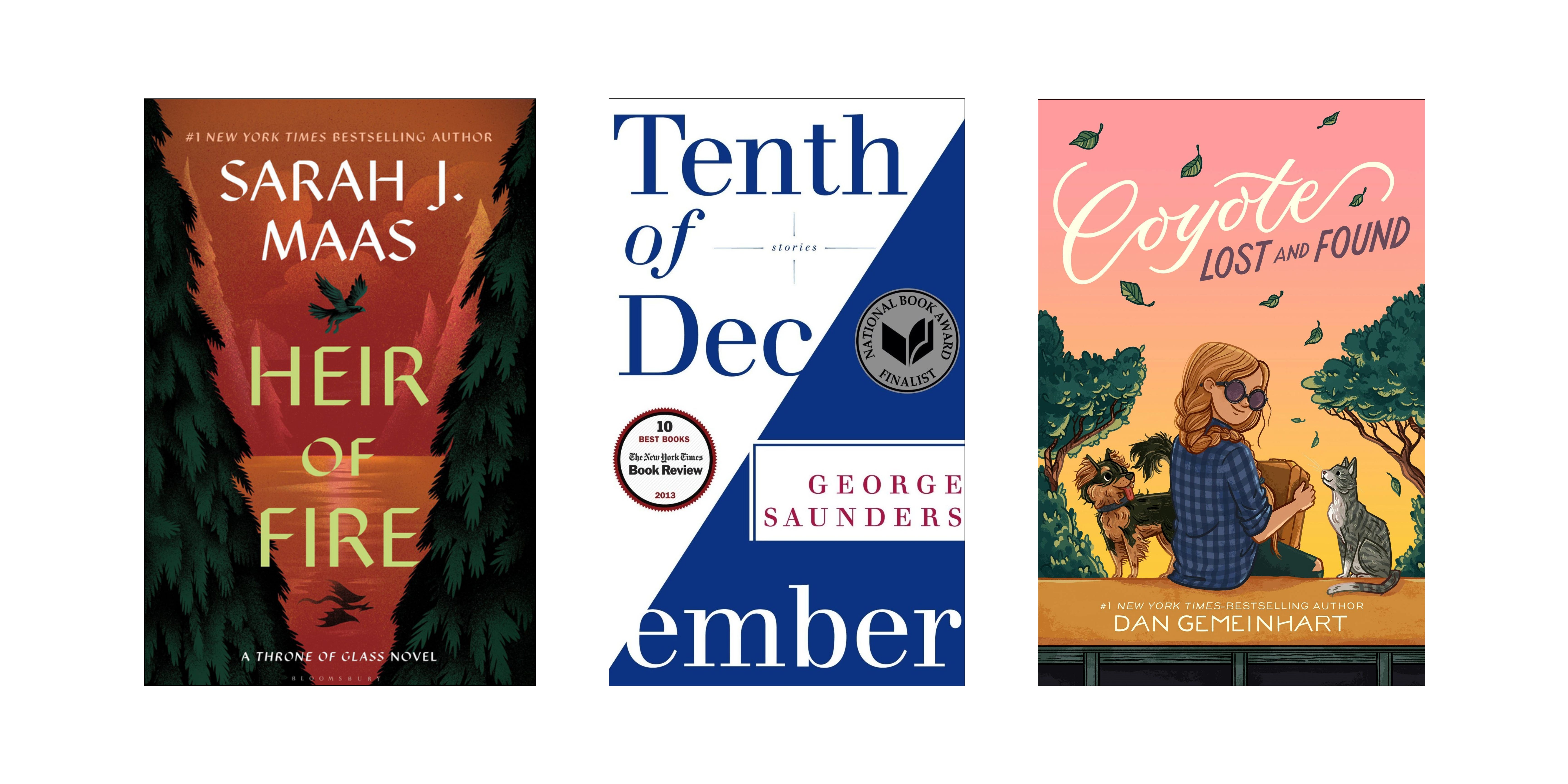
Book covers for Heir of Fire by Sarah J. Maas, Tenth of December by George Saunders, and Coyote Lost and Found by Dan Gemeinhart

Heir of Fire — Sarah J. Maas

Another Throne of Glass book! Not much to say about this one without spoilers, except for the fact that this was the first one that I listened to as an audiobook, and I enjoyed that experience more than I thought I would. It’s also the first book in the series to jump around with POVs beyond just those immediately involved in Celaena’s story, expanding the world to include concurrent storylines from other characters and continents, new and old. Consider this my formal request for Libby to add the fourth audiobook to their catalog (please)!!!

Tenth of December — George Saunders

George Saunders, certified weirdo and probable genius, is a master of the short story. There’s a conversation with David Sedaris included at the end of the book, in which Saunders talks about how he likes to push his characters to their breaking points. This can sometimes make the stories seem cruel, but it’s this cruelty that forces his characters into a crisis, triggering the intrigue and emotional complexity that we expect from Saunders.

You can trace this strategy through each of the stories in this collection, which all live somewhere on a sliding scale of bizarreness: whether it’s the teen boy deciding to intervene in an assault on his neighbor in “Victory Lap,” or the learned desensitization in the world of “Semplica Girl,” which is a story that still haunts me. Even in the strangest, most dystopian settings, Saunders’ characters hold up a mirror to our most mundane and authentically human motivations and desires.

Coyote Lost and Found — Dan Gemeinhart

The first book featuring this character, The Remarkable Journey of Coyote Sunrise, was one of my favorite middle-grade titles to hand-sell when I worked at Books of Wonder in 2019. This sequel sees the return of Coyote, her dad Rodeo, and Yager, the outfitted school bus they lived in for the six years following the accidental death of Coyote’s mom and two sisters. This time, we’re on the road again in search of a lost book that contains a final message from Coyote’s mother.

Gemeinhart manages to infuse these quirky characters with so much heart it actually hurts—the first book made me ugly cry, so at least I was prepared for it this time around. It also handles the pandemic in a way that feels natural and respectful while also portraying the dangers and frustrations of the time in a way that young readers can process and understand, regardless of whether they remember it first-hand. (How wild that we now live in a world where kids may not remember Covid? Oh, to be so lucky.)


SOLID SUPPORTS:

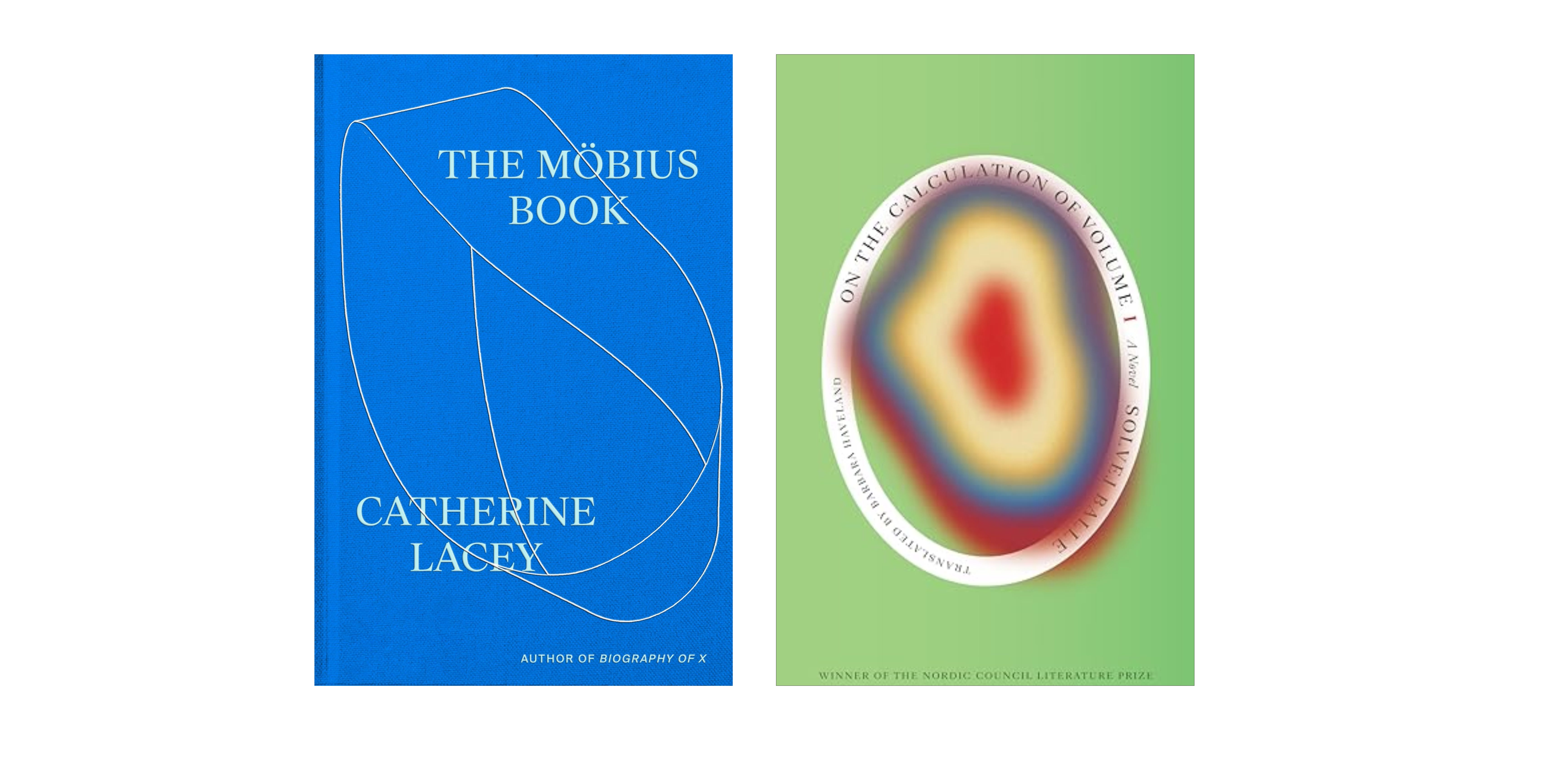
The Möbius Book — Catherine Lacey

A new weird-ass book from Catherine Lacey, thank god! The Möbius Book is a hybrid memoir/fiction experiment, and I didn’t fully understand the title until I finished both halves and realized that you could continue going back and forth between the two sides and discovering new ways that each has seeped into the other, likely indefinitely.

It’s a captivating look at the author’s loss of a relationship and her struggle to rebalance her world and her other relationships in its wake, and these themes of grief, loss, and identity pop up in sneaky ways in the accompanying work of fiction. It’s obvious which section is which, but they’re not marked. The front and back of the book appear exactly the same; you just have to pick a side and start reading. There’s no wrong way to read this book—you’ll find yourself returning to the beginning again no matter where you start.

On the Calculation of Volume I — Solvej Balle, tr. Barbara Haveland

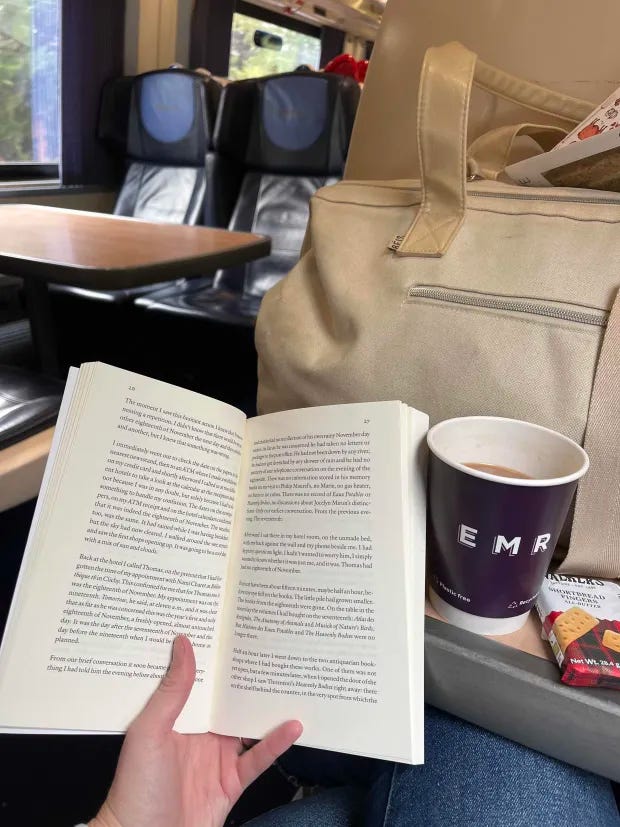
I read most of this book on the train from London to Sheffield for a conference, complimentary tea and biscuits at hand, which was an elite reading experience!!

Hand holding a paperback book open next to a paper cup of tea and packet of shortbread biscuits. Travel bag and train car in the background.
this one goes out to the East Midlands Railway

How engrossing can a novel about a woman reliving the same day over and over again really be? The answer is: VERY. I could not stop thinking about this book once I’d started, and finished it within 24 hours.

The premise is basic: a woman wakes up to the same calendar day every day for a year. The same events happen around her each day, but she seems to be the only one who remembers them. I don’t want to say too much and spoil anything because it’s such a short book and I think most of the wonder comes from truly not knowing what to expect, BUT! I can say that I found the protagonist’s exploration of her new reality and its limitations and opportunities completely engrossing. This is the first of SEVEN volumes, and the third will be released in English in November. I can’t wait to see how this world can possibly continue expanding.

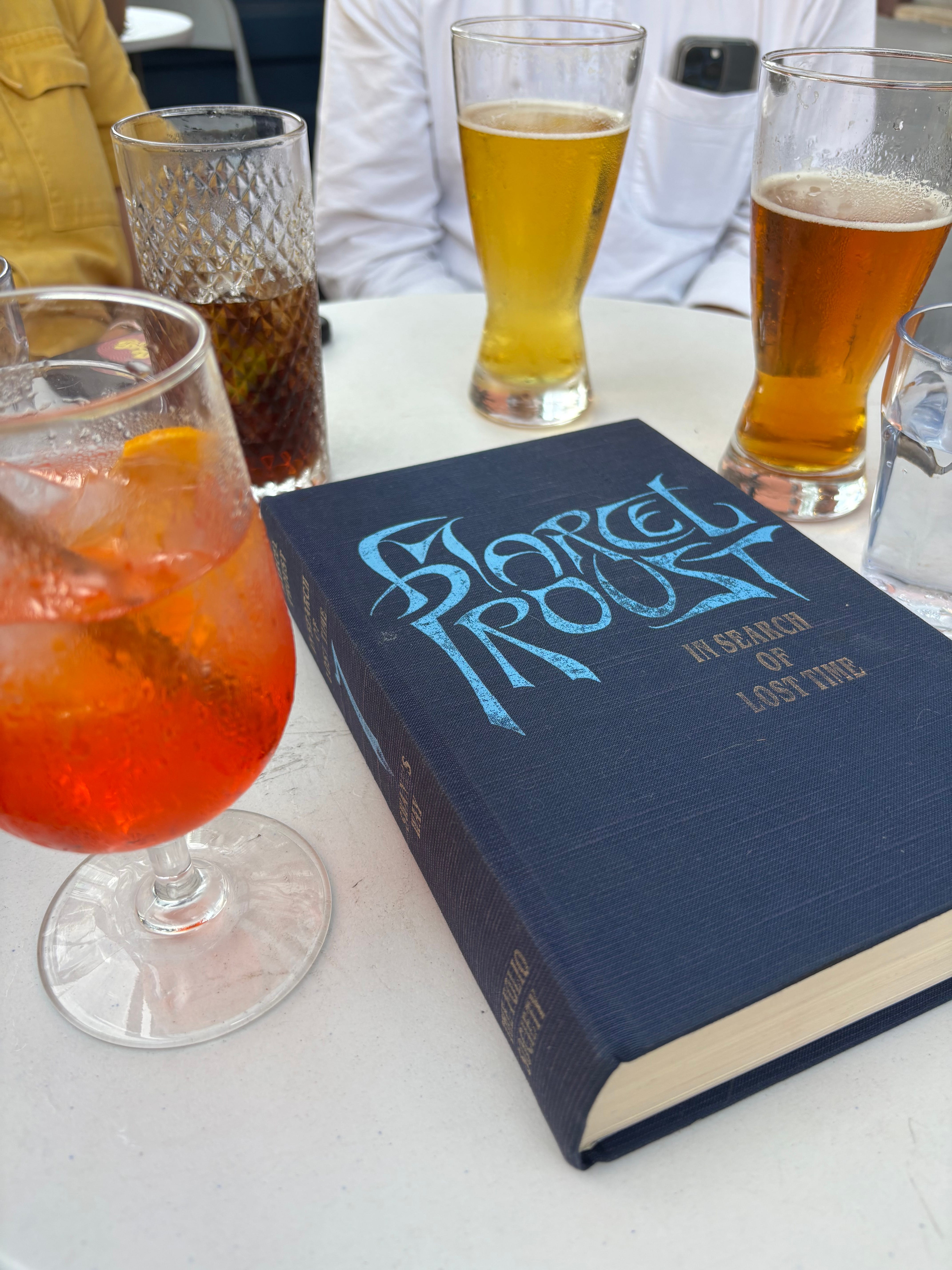
Swann’s Way — Marcel Proust, tr. C.K. Scott Moncrieff and Terence Kilmartin, revised by D.J. Enright

Blue hardcover of Marcel Proust's Swann's Way in the middle of a white table, surrounded by half-full drink glasses
from our lovely halfway point chat a few weeks ago!

As you may be aware, I’ve been reading Proust this summer along with a few brave friends and documenting it on Substack! Over the course of eight(ish) weeks, we read Swann’s Way, the first volume of In Search of Lost Time—which is no small feat when you look at how long the paragraphs are.

While the writing style certainly took some getting used to (that man never met a comma he didn’t love), I found myself genuinely enjoying disappearing first into the world of his family’s country home in Combray, and then into Belle Époque Paris. Although the plots (if you can call them that) of each section could not have been more different, similar themes of time, memory, and love were easily trackable through each storyline. Its social commentary was so much funnier than I expected, and taking the time to turn my former English major brain on each week to do a little analysis was deeply refreshing. Getting to talk about it with friends and discover new layers to the text together has been even better!

Though this maybe wasn’t the most “fun” read I had this summer, it’s the one I’m most proud of, and therefore deserves the top spot. Finishing this book and keeping up with the weekly updates felt like a true achievement, and while I definitely need a break before trying my hand at any future volumes, at least now I know that I’m absolutely up to the task.


Summer reading, you were fun! I’m now very excited to lean into the dark academia vibes for fall: I honestly might do a Secret History re-read, and I’m also hoping to get my hands on R.F. Kuang’s newest, Katabasis. Plus, V.E. Schwab’s latest, Bury Our Bones in the Midnight Soil, looks deliciously dark and vibey, per usual.

What will you be reading this fall? I want to hear about it! Always down to chat in all the usual places.

Until next time, happy reading!
❤ Catherine


Housekeeping note: all book links go to my Bookshop storefront, where each purchase supports independent bookstores (and this newsletter, because I get a small percentage of each sale).
The best is between the lines

Lit Chat Vol. 28 — June & July in Review

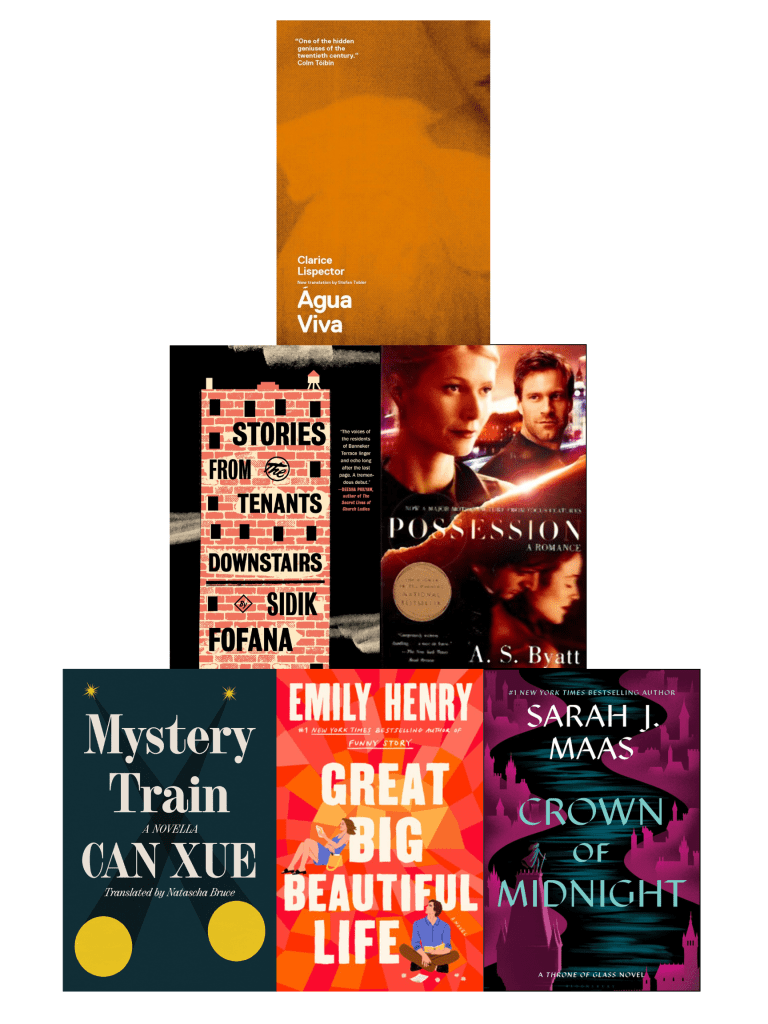
Book cover pyramid with Mystery Train by Can Xue, Great Big Beautiful Life by Emily Henry, and Crown of Midnight b Sarah J. Maas on the bottom row; Stories from the Tenants Downstairs by Sidik Fofana and Possession by A.S. Byatt in the middle row, and Agua Viva by Clarice Lispector on top.

Hi friends,

We’re back after a little summer break! I’ve been letting myself take things slow this summer, and that includes my reading. However! As we are now somehow over halfway through the year, I wanted to take a moment to check in on the reading goals I set for myself in January and see how much progress I’ve made:

My 2025 Reading Goals:

  • read 6 poetry collections
    • 2/6! Time to pick up the pace—now accepting recommendations!
  • read 6 short story collections
    • 4/6! On track and currently in the middle of #5.
  • read 6 craft/writing books
    • 3/6! On track with my next one on hold at the library, but might need to do some thinking about what I want my last two to be.
  • read 4 books in translation
    • 4/4! I joined a literature in translation book club in my office, which has been so much fun. Now it’s something that’s just built into my reading schedule without having to be as intentional about it, which is perfect.
  • read Emily Wilson’s translation of The Iliad
    • Behind on this! I did read all the introductory materials and the first two or three parts at the beginning of the year, but lost steam when I had to clean my desk and put the book up on a shelf. Maybe taking it back off the shelf will help motivate me to come back to it by the end of the year? Or maybe I should just pick a month and say, “This is the month that I read The Iliad.” TBD!
  • read Marcel Proust’s In Search of Lost Time
    • In progress and thrilled about it!! If you didn’t know, I’ve been working my way through the first volume, Swann’s Way, with a few other brave souls behind the paywall on my Substack. We’ve just finished reading Part One, and I’m loving the structure of assigned reading and the weekly space to sit and use my brain for a little bit of analysis. Thank you to all who are currently on this journey with me, and if you’re interested in catching up (or just reading the paywalled posts), you can do so below:

Okay, all in all, pretty proud of how things are going! Even if my reading pace has been slower and I haven’t been reading as many books as in previous years, I do feel like I’ve been engaging with what I read more deeply.

Especially considering the number of opportunities I’ve had to be in literary community over the past six months, I’d say this has already been an especially rich reading year! I’m so grateful for everyone who reads this newsletter and/or has come over to my apartment to talk about books or gone to a book event with me out in the city.

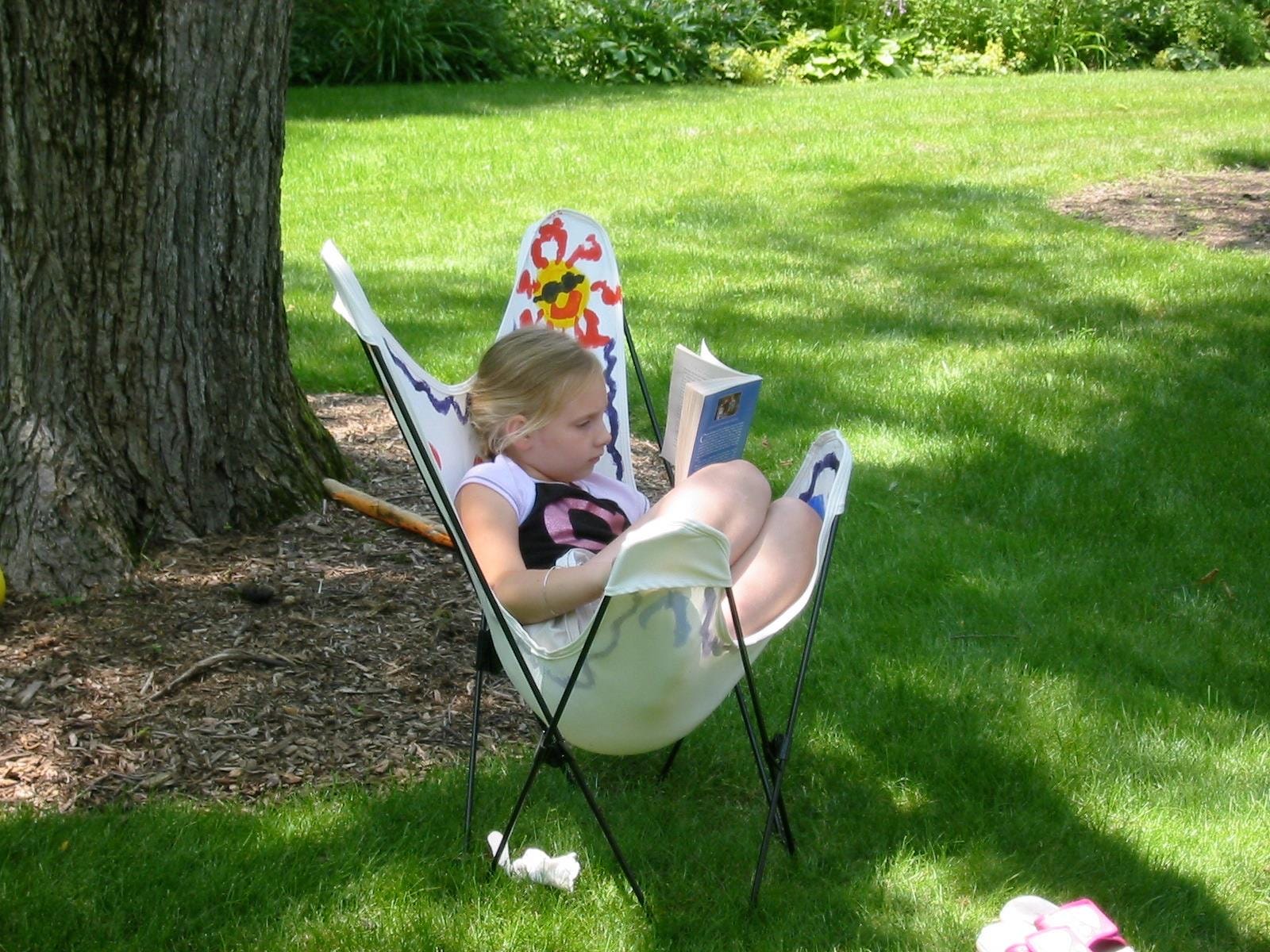
I recently shared this photo of 9-year-old me reading behind the Proust Read-along paywall, but I can’t stop thinking how happy this lil bookworm would be that reading is still such a big part of her life, so I’m sharing it again here:

Young girl curled up in a hand-painted canvas butterfly chair, reading a book in a backyard under a large elm tree
this is still my preferred reading position

Okay! Now with that long preamble over, let’s get to the books of June and July. If you prefer to get this post delivered straight to your inbox, make sure you subscribe to my Substack here:


THE FOUNDATION:

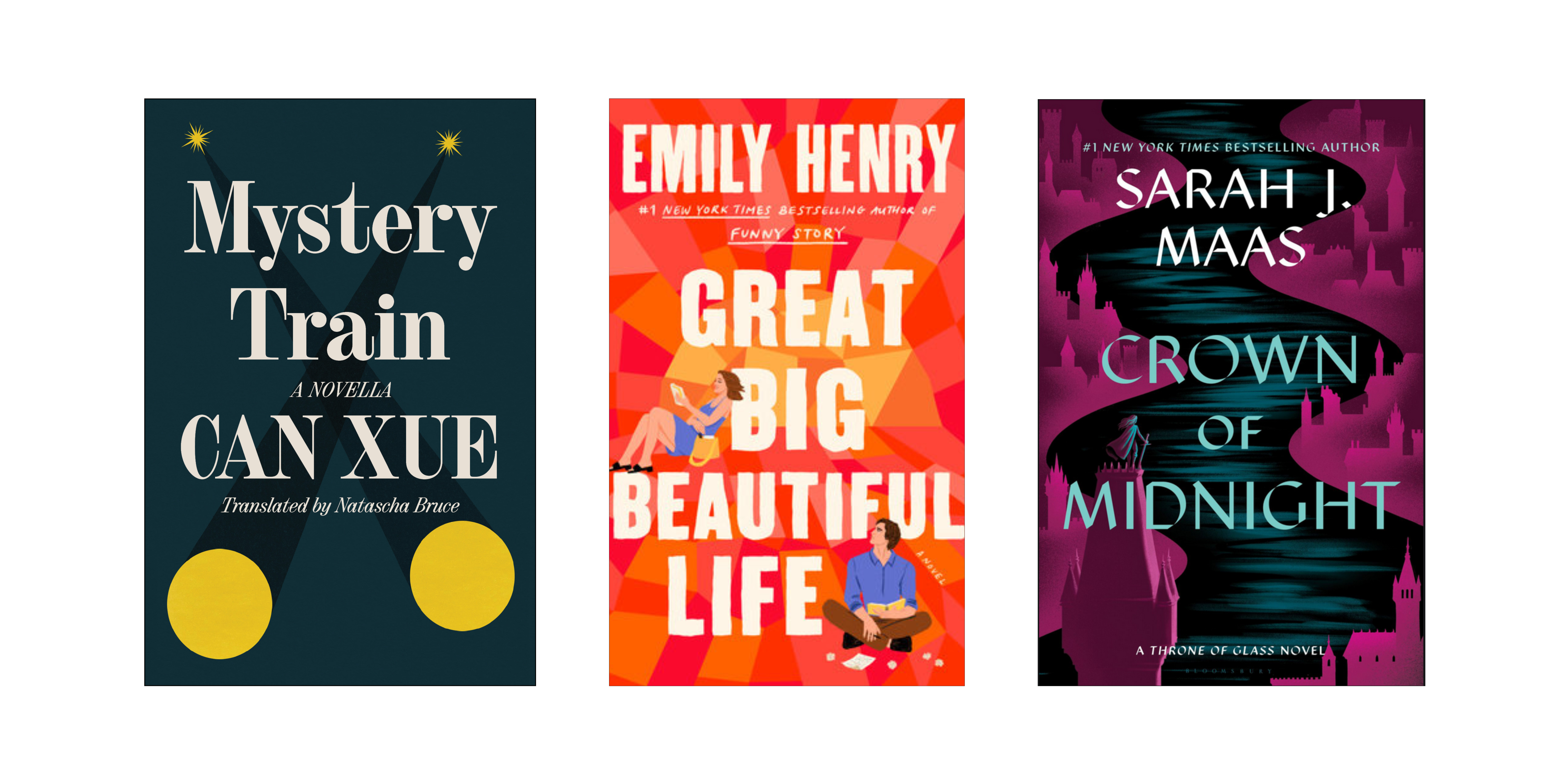
Book cover images for Mystery Train by Can Xue, Great Big Beautiful Life by Emily Henry, and Crown of Midnight by Sarah J. Maas
sidenote: how gorgeous are these covers together??

Mystery Train — Can Xue, translated by Natasha Bruce

This was July’s translation book club pick, and our discussion ended up taking almost as wild a journey as the titular mysterious train. It’s the story of a chicken farmer named Scratch who is sent on a journey to buy chicken feed by his boss, only to realize that this journey is unlike any of the trips he’s ever taken before, and there might not actually be a way off the train. This is a fever dream of a novella, and had us debating questions of life and death, desire and fate, metaphors of light and darkness, and the prerequisites for embracing the unknown. I’ll definitely be looking to pick up more of Xue’s work in the future.

Great Big Beautiful Life — Emily Henry

Okay, I am still very much an Emily Henry stan, but this one didn’t fully do it for me! I loved all of the things I always love about her books: e.g., the unique, cozy setting of small-town coastal Georgia, the witty banter, the sexy love interest with a gruff exterior just begging to be chipped away. I think what didn’t work for me was that it felt like she was trying to write two books at once: the love story of two journalists vying for the chance to write the biography of a famously reclusive former media darling, and the life story of said darling and her media empire family. It was giving The Seven Husbands of Evelyn Hugo, but shoehorned into an EH romance. My opinion is that whatever book-a-year publishing schedule she’s on is starting to take a toll, but this book still does everything it sets out to do and is an easy, fun summer read.

Crown of Midnight — Sarah J. Maas

I would have ranked this higher, but honestly, it’s been less than a month since I finished and I could barely remember what happened in this second Throne of Glass book when I sat down to write this. Since I’ve started listening to the third book, more details about Celaena’s attempts to subvert the king’s plans for her to eliminate resistance in Adarlan have come back to me, and I remembered that I did enjoy leaning into the new romance and the expanded lore found in this sequel. So far, I still prefer the ACOTAR series, but these books have consistently been a good palate cleanser for when I need to get back into a reading groove.


SOLID SUPPORTS:

Book cover images for Stories from the Tenants Downstairs by Sidik Fofana and Possession by A.S. Byatt

Stories from the Tenants Downstairs — Sidik Fofana

I picked this up as a “blind date with a book” from Transom bookstore in Tarrytown, which did a perfect job of reeling me in with its no-spoilers pitch. The blind date bio was: “a voicey, bombastic mosaic of a novel full of vibrant characters, real drama, and sharp social commentary on modern urban development,” and I think the Transom bookseller hit the nail on the head with that description.

This story collection is set at Banneker Terrace, a housing project in Harlem facing the looming threat of rent hikes and gentrification. Each chapter focuses on a different tenant, spotlighting single mothers, young entrepreneurs, an aspiring hairdresser, an elderly chess player, and more. A microcosm of New York community, everyone is fighting to support themselves and each other as best they can, and I found myself invested in all the ways the different storylines intersected and diverged. A quick but impactful read, these stories left me wanting to check back up on the characters like they were real people, and had me thinking for a long time about hope and grit and the complicated relationship between identity and home.

Possession — A.S. Byatt

I had to look at this silly-ass book cover every day, so I’m making you look at it too. Well over 500 pages, this book took me a loooong time to get through, but I ultimately appreciated the way it forced me to slow down and lengthen my attention span. The story is split between that of two modern-day British literature scholars investigating a potential affair between two Victorian poets, and the affair itself, pieced together from letters, diary entries, and their poems themselves. When the modern-day scholars’ quest catches the interest of other academics with a stake in the game, it becomes a race through time to uncover—and claim possession of—the truth.

As a novel about literature, this ticked a lot of boxes for the former English major in me. I love a scandalous literary mystery! That said, I definitely think the POV-hopping affects the pacing, and apparently some people (Goodreads reviewers) take issue with the amount of real estate that the poems introducing each chapter take up. However! If you’re paying close attention, the poems actually have little clues and Easter eggs relevant to the narrative, which I think is very cool!! Also, can we take a moment to appreciate how impressive it is that the author not only wrote a whole novel, but multiple poems in distinct styles and voices, attributed to different characters? This is the kind of showing off that wins you a Booker Prize.


THE TIPPY TOP:

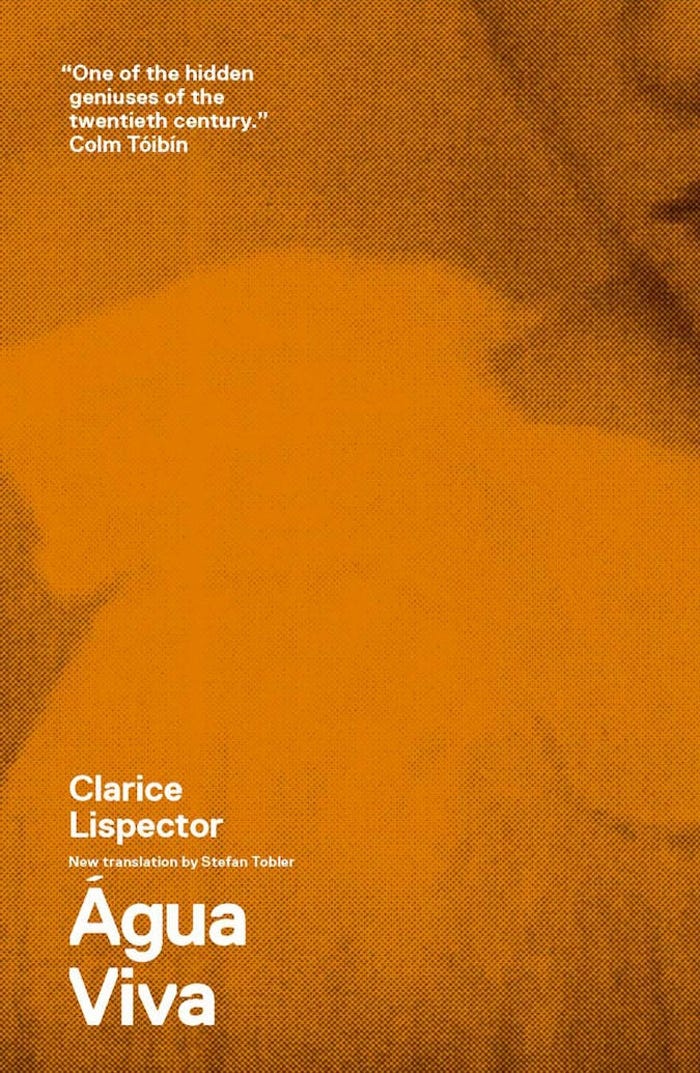
book cover image for Água Viva by Clarice Lispector

Água Viva — Clarice Lispector, translated by Stefan Tobler

I don’t even know where to begin with this tiny, crazy book. I can’t remember who recommended it to me, but after waiting months to get it from the library, I read it in one sitting, returned it to the library, bought a copy, and re-read it with a pen in hand so I could underline my favorite lines—something I rarely do! It reminded me a lot of Maggie Nelson’s Bluets for its snippet-like, philosophical-leaning experimentation with form, and because both are journeys of artistic self-exploration in the wake of an ended love.

Água Viva is Lispector’s quest to capture each instant moment as it passes to discover the fundamental truth of what is. She attempts to surpass that which can be expressed through words to reach an experience that exists “beyond thought,” often comparing these forays into the inexpressible to the effect art and music have on the brain. Phillip read it after me and said it was like reading from the perspective of an atom, which I thought was both brilliant and accurate.

Her playful experimentation with language becomes a vehicle for excavating the truest self, transfiguring the reality of our mundane world into symbols that represent shared experiences of emotion and sensation. What ensues is a kind of birth, a reborn Lispector speaking from the instant of the page to both her lost love and all her future readers, transcending the boundaries of time and space and form to preserve her inimitable, unmistakable voice. This is one of those books you could read again and again and get something new out of it every time, and I fully plan to do so.


That’s a wrap on the first half of summer reading! I’d love to hear from you about how your reading goals are going, what’s left on your summer TBR, and if you have any thoughts on the books above. Feel free to drop a comment below or send me a message in all the usual places—I’m always down to chat!

Until next time, happy reading!
❤ Catherine


Housekeeping note: all book links go to my Bookshop storefront, where each purchase supports independent bookstores (and this newsletter, because I get a small percentage of each sale).
Out of the deep, dark river

Lit Chat Vol. 27 — May in Review

Pyramid of book cover images with Good Morning, Midnight by Jean Rhys at the top and Burning Thing by Zoë Bodzas, On Writing by Stephen King, and Rejection by Tony Tulathimutte on the bottom.

Hi friends,

Happy Father’s Day to all the dads out there, but especially to mine, because he’s the very best!

I’ve got another mini for you this month because May was BUSY, but I’ll make up for that brevity with two announcements:

First: my next in-person reading club will be Sunday, June 29th! If you’re new around here, this is when I invite all my friends over to my apartment (or maybe somewhere with better air conditioning this time around, TBD), and everyone comes prepared to chat about something (book/story/poem/article) they’ve read recently. More info on the Partiful here, hope to see you there!

If you’re interested in a more structured reading group, my second announcement is that I’m launching a little summer book club to read Swann’s Way, the first volume of Marcel Proust’s In Search of Lost Time.

Since enough of you nerds have expressed interest in tackling Proust with me, I’m planning to experiment with a hybrid format that combines a couple in-person meetings with a weekly Substack note from me about the pages covered, including some questions for reflection/discussion!

I will most likely throw the weekly posts behind a (very small) paywall, and I’m also planning on using Substack’s Chat feature as an ongoing discussion center, but open to feedback/other ideas if we try it and don’t love it. This is very much a trial run to see how a project like this could work!

With the rough schedule I have, it should take about seven weeks to read, starting the second week of July (7/7). If you’d like to join, make sure you’re subscribed to my Substack below and keep an eye out for the official launch email coming in a couple weeks!

Okay, now onto the books!


SOLID SUPPORTS:

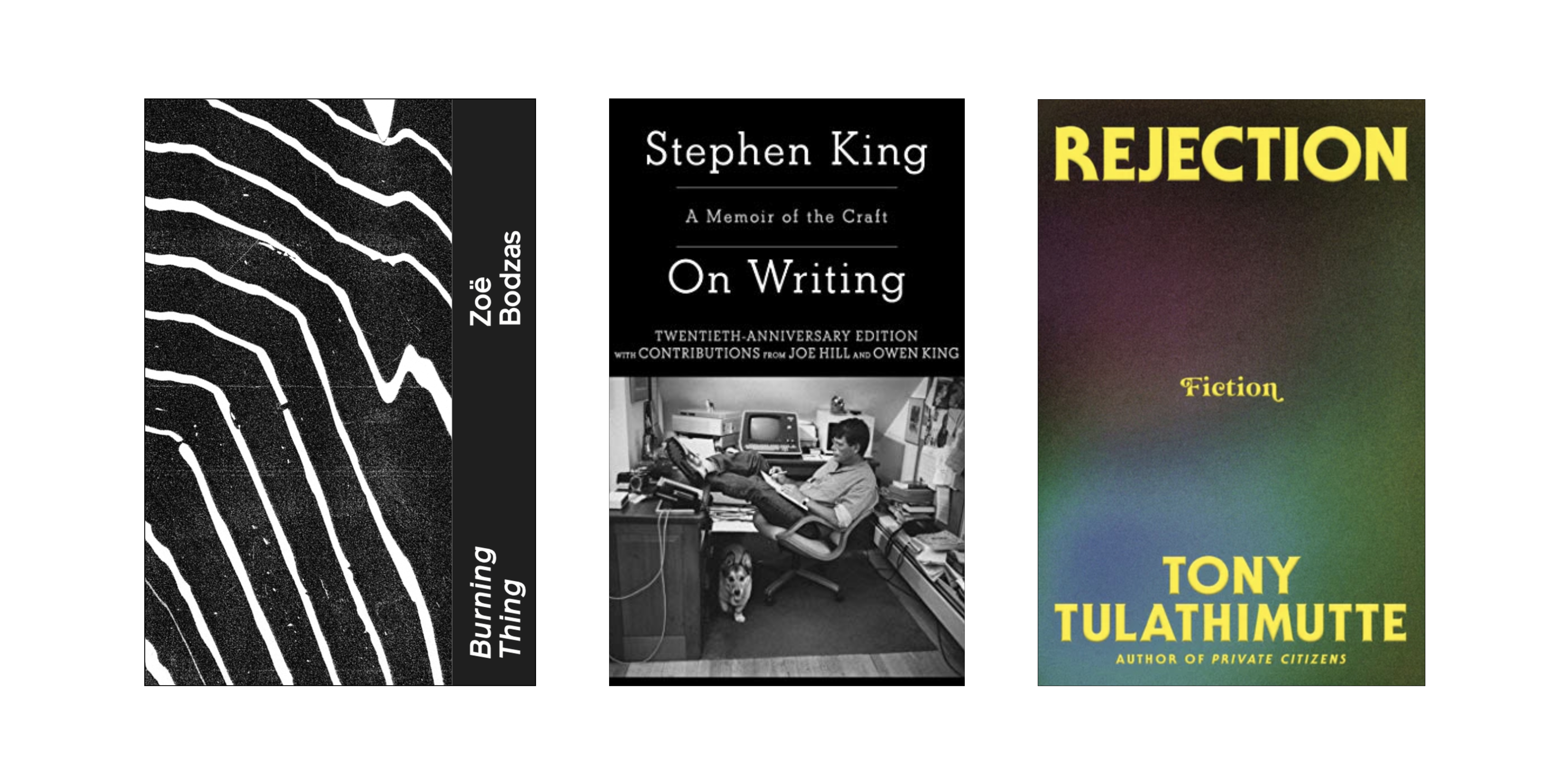
Book covers for Burning Thing by Zoë Bodzas, On Writing by Stephen King, and Rejection by Tony Tulathimutte

Burning Thing — Zoë Bodzas

Zoë is a dear friend whose talent and wisdom I have admired since our very first online writing workshop all the way back in 2020. I’ve had the distinct pleasure of getting to watch so many of the poems collected here evolve from products of a biannual poem-a-day challenge to being published in national magazines, and to now celebrate their recent publication in chapbook form with No, Dear!

Zoë’s abundant curiosity and keen focus are applied with equal generosity to everything from dad radio to errant space rocks, and her playfulness shines in her experimentation with form. But it’s the poems that combine nostalgia and tenderness with a sense of awe for both the vastness of our universe and the intimate minutiae of daily life that have etched themselves into my heart and brain. (I often catch myself repeating “i’m still here / you’re still here” from “eager years” like a mantra.) Nobody does wonder quite like Zoë, and it’s a wonder and a treat to know her and support her on this journey.

On Writing — Stephen King

After about a month of On Writing laying untouched on my coffee table, I was inspired to actually open it by Clara’s Jan-March reading recap in Hmm That’s Interesting. Like Clara, I had never actually read a Stephen King novel, but I enjoyed getting to know the man behind the horror machine through his own frank humor and honest accounting of his struggles and successes. Also like Clara, I didn’t learn anything necessarily new or groundbreaking, but it did force me to have a real reckoning with my adverb usage. Plus, “10% shorter” is a solid general rule of thumb for second drafts that will also be sticking with me.

Rejection — Tony Tulathimutte

My hot take on Rejection is I wanted to be more obsessed with it than I was! Rarely is a short story collection quite so buzzy, and I think the shock factor of depravity in so many of these stories accounts for most of that buzz. Tulathimutte’s characters experience myriad forms of social and romantic rejection, for reasons that mostly boil down to the characters just kind of sucking. This feels fun and salacious in an almost voyeuristic way at first, and I especially enjoyed the opening stories that lambaste the “good guy” trope and the toxic potential of the group chat, but it lost me when it started to take things to the extreme around the middle/end of the collection (iykyk). That said, I think as a whole, it’s a wild satire on modern relationships and the question of what we owe each other as individuals within a morally fraught society.


THE TIPPY TOP:

Book cover image for Good Morning, Midnight by Jean Rhys

Good Morning, Midnight — Jean Rhys

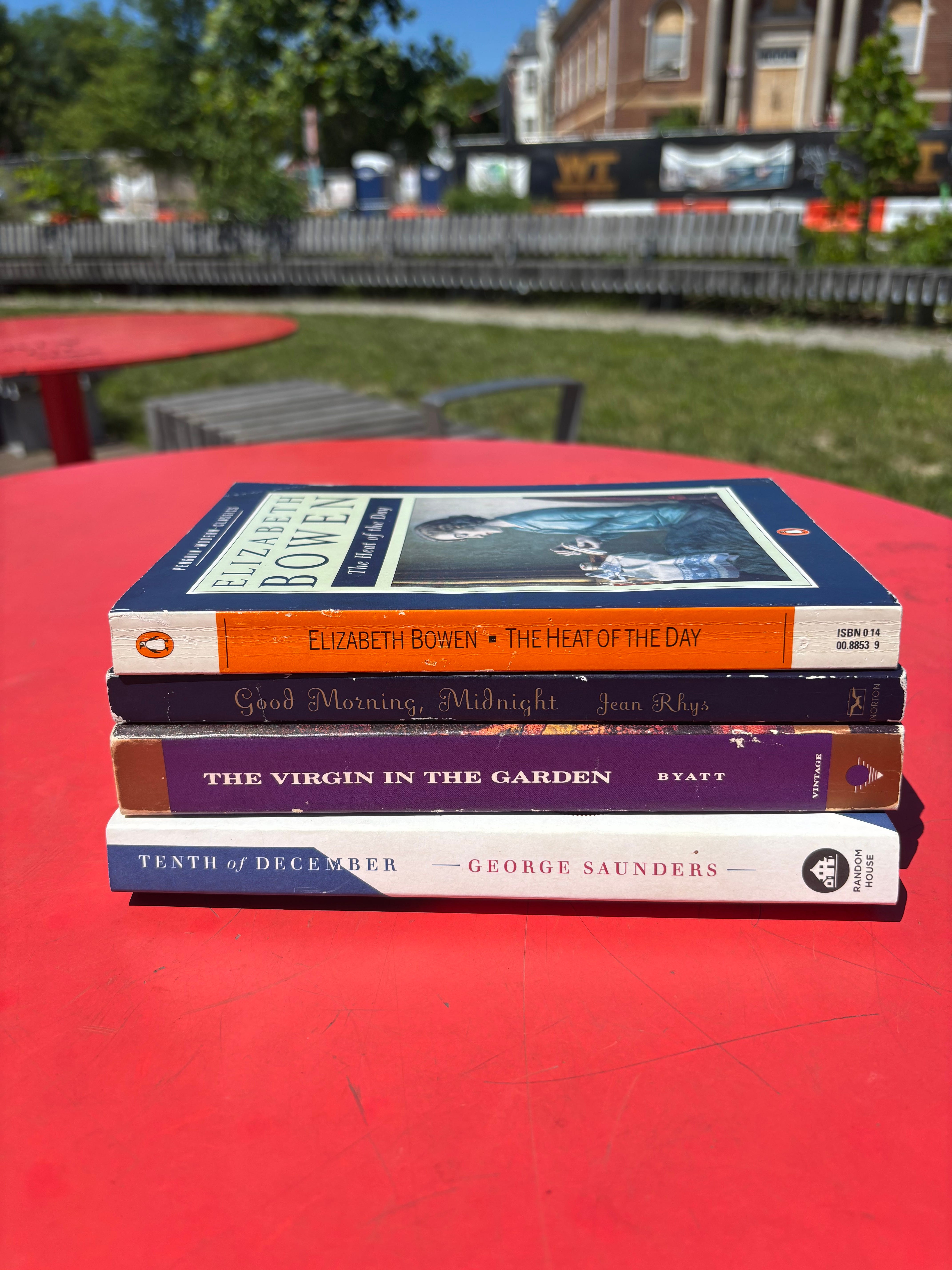
I emerged from the D.C. Metro over Memorial Day Weekend to find a library book sale waiting right at the station exit, which felt like a fairy trap laid explicitly for me. I picked up Good Morning, Midnight, (along with The Heat of the Day, Tenth of December, and The Virgin in the Garden), and proceeded to read the entire thing in one sitting on my Amtrak home that afternoon.

Stack of books (The Heat of the Day by Elizabeth Bowen, Good Morning, Midnight by Jean Rhys, The Virgin in the Garden by A.S. Byatt, and Tenth of December by George Saunders) on top of a red table
thank you, Eastern Market Station!

Good Morning, Midnight is the story of a woman who has returned to interwar Paris in search of a fresh start, despite the ghosts of lost loves and past traumas that seem to lurk around every once-familiar corner. It’s a portrait of a woman in physical and psychological decline, which only escalates when she is targeted by a charming young man who believes she has something more to give.

I was fascinated by the way Rhys layers the Paris of Sasha’s past—as a young girl in love, a soon-to-be mother, and then a single, devastated woman on her own—with the Paris of her present, full of disappointed potential. Sasha’s first-person narration is Mrs. Dalloway-esque, slipping in and out of memory as she goes about her daily errands, purchasing new clothes and cutting her hair in pursuit of a reinvention that can never truly be. Yet it’s Joyce’s Ulysses that is clearly evoked in the “Yes – yes – yes…” of the final line, when Sasha meets her fate with questionable relish: is she a victim or a manipulator? Was there ever really a choice? These are the questions that haunt my Amtrak rides!


And that’s May! I’m looking forward to next month, when I’ll be doing a check-in on the reading goals I set for myself in the beginning of the year. In the meantime, you can find me in all the usual places if you’d like to chat about these or any other books!

Until next time, happy reading!
❤ Catherine


Housekeeping note: all book links go to my Bookshop storefront, where each purchase supports independent bookstores (and this newsletter, because I get a small percentage of each sale).
Why demand a map for uncharted territory?

Lit Chat, Vol. 26 — April in Review

Pyramid of book cover images with The Ministry of Time by Kaliane Bradley on the top, Blackouts by Justin Torres and Madonna in a Fur Coat by Sabahattin Ali in the middle, and Mornings Without Mii by Mayumi Inaba, Lunch Poems by Frank O'Hara, and A Tale of Two Cities by Charles Dickens on the bottom

Hi friends,

While I certainly sympathize with those who feel maligned by April’s traditional cruelty, I had kind of a great month?

We started strong with a double-whammy afternoon of Reading Club at my place followed by the second Heat Lightning poetry series reading at Anaïs, which left me positively glowing with appreciation for such a warm and talented community.

This feeling was sustained by a return to an in-person writing workshop group later in the month, a fabulous first-time visit to the Ripped Bodice in Park Slope for a book event, and the launch party for my dear friend Zoë’s truly incandescent chapbook with No, Dear, which you’ll hear me chat (rave) about more in a future letter.

Oh, and we adopted another cat! His name is Ollie (Oliver) and we love him a whole lot. He likes to climb my bookshelves and take all my knick-knacks with him on the way down.

Brown tabby cat with a blue collar posing regally on top of a scratched gray headboard in front of a framed print of an Arthur Rackham fairy and a portion of Monet's water lilies
new Lit Chat mascot unlocked

I also didn’t have to travel anywhere in April, which rocked because a travel-free month is rare for me and because this meant plenty of time for slow mornings on the couch with a book, which is my preferred habitat.

I’ll stop gloating now and get to those books, but in the meantime, if you would rather get this post directly to your email, make sure you subscribe to my Substack:


THE FOUNDATION:

Book cover images for Mornings Without Mii by Mayumi Inaba, Lunch Poems by Frank O'Hara, and A Tale of Two Cities by Charles Dickens

Mornings Without Mii — Mayumi Inaba, tr. Ginny Tapley Takemori

This book was a birthday gift from my sweet pal Michy, which I fittingly decided to read the week we applied to adopt Ollie. A classic in Japan since it was first published in 1999, Mornings Without Mii is a memoir of a writer’s life through the lens of her relationship with her cat, Mii. Though a devoted pet parent for nearly twenty years, I did find some of Inaba’s care choices difficult to read, especially towards the end of Mii’s life—I’d be remiss not to caution any sensitive pet lovers to be prepared for end-of-life suffering and death. That aside, this is a moving portrait of a very special, life-defining bond, and will make you want to give all the animals in your life a big smooch.

Lunch Poems — Frank O’Hara

April was National Poetry Month, and coming off the heels of a San Francisco trip in March, I was inspired to revisit the City Lights edition of Lunch Poems that I bought there last year and spend a slow morning with Frank’s poems. I love how they evoke a nostalgia for a New York I never knew, but which feels simple and familiar and right. Often written during his lunch breaks from working at the MoMA, the poems serve as an emotional time capsule of both daily minutia and breaking news (see: “The Day Lady Died” and “Poem [Lana Turner has collapsed!]”). I was especially charmed by the copies of O’Hara’s and Lawrence Ferlinghetti’s correspondence about the book, which is collected at the end of the volume.

A Tale of Two Cities — Charles Dickens

I was still riding my long audiobook kick well into April and was once again delighted to find that a new-to-me classic held up as a timeless story of intrigue, romance, and tragedy. A poorly-timed Jeopardy question did spoil the ending for me, but even with a premonition of the protagonists’ fate, I was still kept in rapt suspense the whole 18+ hours (despite the narrator’s slightly irritating pronunciation of “revolutionary,” which says a lot considering the book takes place during the French Revolution). Having listened to a few Dickens novels on audio now, it’s interesting to me how many of them revisit similar themes of loyalty and justice, madness and imprisonment, and of course, love that defies the odds. Say it with me: classics are classics for a reason! Dickens has yet to let me down.


SOLID SUPPORTS:

Book covers for Blackouts by Justin Torres and Madonna in a Fur Coat by Sabahattin Ali

Blackouts — Justin Torres

I have such a fascination with the emerging trend of incorporating mixed media into novels (see: my well-documented admiration for Catherine Lacey’s Biography of X). This time, Blackouts takes its name from a volume of blackout poetry made from an academic study of sex variants, which features prominently in the novel. The volume in question is the project of a dying man named Juan Gay, and is about to be bequeathed to our narrator, his ad hoc caretaker.

The narrative of the present day is visually broken up by pages from the book and photographs of its subjects and other artifacts from Juan’s life, bleeding into the stories that he and the narrator tell each other through the long nights of Juan’s final days. The bond between them is what captivated me the most; though both men are queer and spend most of the book in bed, theirs is primarily an intellectual companionship built on a foundation of mutual care, trust, and deep love. This was a quick read that now has me remembering it like a fever dream and already inclined to revisit.

Madonna in a Fur Coat — Sabahattin Ali, tr. Maureen Freely and Alexander Dawe

Keeping up with my goal to read more in translation, I joined a book club at my office that’s doing exactly that! Their pick this month was this 1946 Turkish novel about the intense friendship between two outsiders in 1920s Berlin, which prompted a really thoughtful debate on the definition of romance and platonic vs. romantic love. I’m gonna do something a little different with this one and send you over to the most recent Pages+Pours newsletter for my full review!

I was fortunate to be a featured reader at last week’s book swap, where I shared my review of the novel with a recommended drink pairing. Kelly has cultivated such a smart, engaging, and welcoming community there, and I felt so safe testing out my wobbly public speaking chops! I highly recommend all my fellow bookish NYC gals come join me at the next one.


THE TIPPY TOP:

Book cover image for The Ministry of Time by Kaliane Bradley

The Ministry of Time — Kaliane Bradley

This was one of those books that ticks so many of my boxes, I knew I’d be obsessed even before I started reading. Our unnamed narrator, a British civil servant, has been selected to become a “bridge” for a top-secret government program formed to extract people from the past and attempt to repatriate them into the present. (Time travel: check!) Our narrator’s assigned expat is Commander Graham Gore, a dashingly sincere naval officer plucked from a doomed Arctic expedition in 1847.

We often see characters travel back and forth in time in fiction, but I think it’s rarer for characters from other times to travel to ours like this. I found it a fascinating thought experiment to see Gore and his cohort attempt to adjust to their new surroundings while also being watched over, reported on, and subtly shaped by their bridges, who live with them and are their only link to the outside world.

Just as it seems that the chemistry building between Gore and the narrator is finally coming to a head (Victorian love interest: check!), so too, we learn, is a sinister plot that has been working its way through the highest levels of government to target bridges and their expats. (Government conspiracy: check!) Add to the mix a final twist I did not see coming, and you have a book that sent me into a deep spiral over how the choices one makes on a daily basis have the unwitting potential to shape history, the present, and the future—all in a single moment.


Thanks for reading! I will do my very best to get my May recap out in a timelier fashion, especially because I’ll have news to share soon on the next Reading Club and/or the summer Proust read-along I’ve been teasing for a while. (This is my way of holding myself accountable to actually hammering out all the details—I think I’m close!)

In the meantime, feel free to drop a comment or send me a note if any of these books are speaking to you! Always down to chat in all the usual places.

Until next time, happy reading!
❤ Catherine


Housekeeping note: all book links go to my Bookshop storefront, where each purchase supports independent bookstores (and this newsletter, because I get a small percentage of each sale).
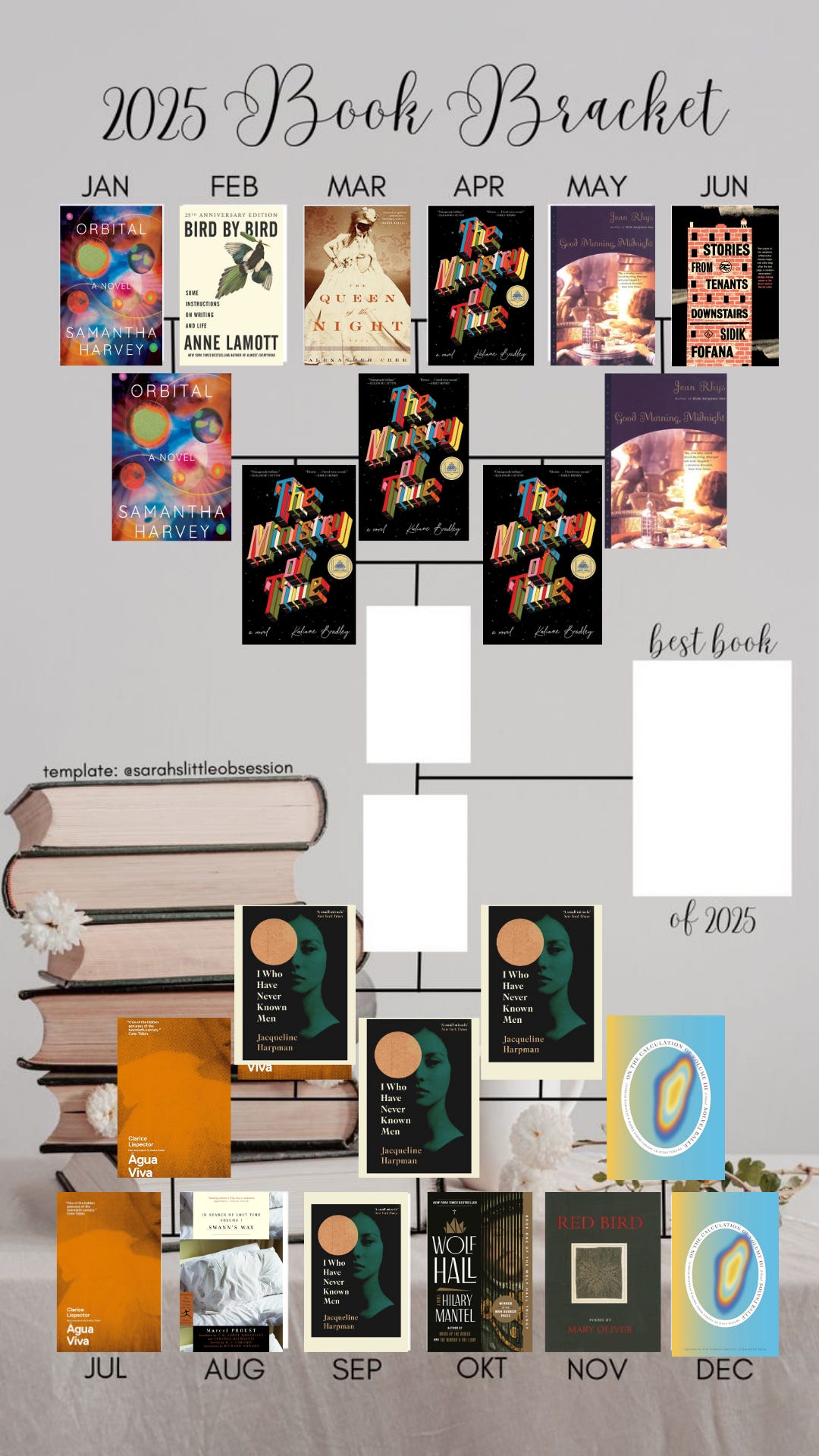
Be like a seed

Lit Chat Vol. 25 (!) — March in Review
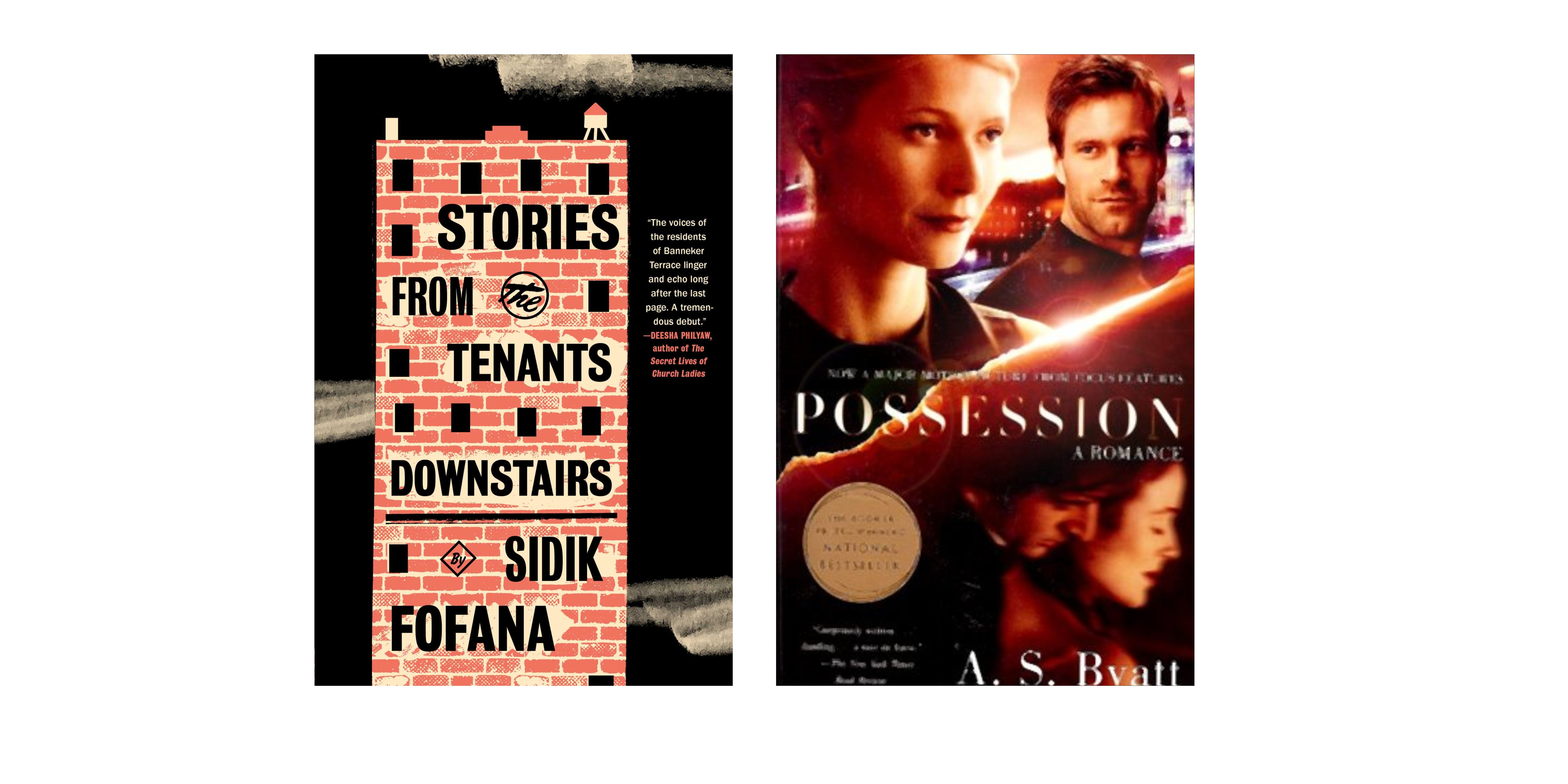
Book cover image for The Queen of the Night by Alexander Chee above book cover images for Lady Jane by Mrs CV Jamison and The Awakening and Selected Stories by Kate Chopin

Hi friends,

We’ve got a mini pyramid for March because I’m back on my long (18+ hours) audiobook kick, and there are only so many hours in a day. I don’t know about you, but I’ve been feeling restless lately. It’s hard for me to sit still on the couch and read, but if I have a book in my ear while I’m walking to yoga or working on my cross-stitch, this feels somehow better on my brain.

For the first time in a very long time, none of the books I read this month were set in the present day. I think this is also a reflection of just how little extra time I wanted to spend in the real world this spring.

At the same time, the piece of writing that made the biggest impression on me from March was this article from beloved poet and novelist Kaveh Akbar in The Nation: What Will You Do?

The title question is in response to the recent arrests of student visa holders Rumeysa Ozturk, Alireza Doroudi, and Mahmoud Khalil. Khalil especially has been on my mind this weekend after an immigration judge in Louisiana ruled he could be deported on the basis that his “otherwise lawful” beliefs, statements, and associations posed a threat to American foreign policy.

Kaveh writes:

“Ozturk, Douroudi, and Khalil were targeted not because they asserted their opposition to the Palestinian genocide—there are white American citizens organizing against Israel’s occupation too. Ozturk, Douroudi, and Khalil were targeted because they were on student visas; they were targeted because they could be targeted.”

This should terrify everybody whose beliefs, statements, and associations are at odds with the current administration. Kaveh, an Iranian-born US citizen, admits to being scared of being targeted in retaliation, and I found myself scared for Kaveh, too.

But isn’t that the point? “The administration’s algorithms of intimidation and terror are working,” he writes, when we are served videos of students being disappeared off the street “between baby photos from casual acquaintances and ads for underwear and linen sheets.”

It feels crazy to live in a world where we just keep witnessing these things and moving on with our days? This isn’t normal. This can’t be normal.

“I am writing this to rebuke the algorithm,” he says, and I guess so am I.

To answer Kaveh’s question, I don’t know what else to do. Not when those scripted emails, petitions, and phone calls to reps don’t seem to be moving the needle against a blatantly evil and self-interested government. I don’t know what to do that would actually make a difference, but it feels like the least we can do is talk about it, share Kaveh’s brave and moving words, and not ignore the moment.

I hope you read Kaveh’s article, and his debut novel Martyr! (which I wrote about last year), and any of his poetry, because he’s an incredible talent and an incandescent human being. We all need a little break from being in the present moment from time to time, and I can think of much worse places to rest than in his words.

Below are the three books where I found rest this month. If you’d like to get subscribe to my Substack and get these posts directly in your email, you can do so below:

Thanks for sticking with me through this lengthy intro. Now, let’s get to the books.


SOLID SUPPORTS:

Book cover images for Lady Jane by Mrs. CV Jamison and The Awakening and Selected Stories by Kate Chopin

Lady Jane — Cecilia Viets Jamison

I picked this book up for $2 at Frenchmen Art & Books in New Orleans because it sounded like exactly the kind of book I would’ve been obsessed with as a kid, and I was right! For some reason, baby me devoured orphan stories like this one, where a beautiful, precocious child is abandoned after tragedy befalls her parents, and ultimately becomes the darling of her new adopted world.

Set in New Orleans in the early 20th century, Lady Jane is a collection of the title child’s adventures in her new home on Good Children Street, charming her neighbors into teaching her how to sing, dance, and sugar pecans despite being unloved by the woman who takes her in after her mother’s death. Little me would have spent hours gazing lovingly at the accompanying woodcut illustrations, and absolutely would have fantasized about having my own blue heron to carry around. Orphans get all the good stuff.

The Awakening and Selected Stories — Kate Chopin

Still nostalgic for New Orleans after Lady Jane, I finally picked up this collection that’s been gathering dust on my shelf since 2022. The former English major in me can’t not read the Introduction first, and it was there that I learned how The Awakening was reviled at the time of its publication (1899), for centering the story of a young woman who chooses to forgo the responsibilities of marriage and motherhood in favor of independence and sexual liberation. How dare she!

Edna Pontellier is twenty-eight, married with two young children, and her biggest crime is waking up one morning on her summer vacation and realizing she wants to live life for herself. Her famous declaration, “I would give my life for my children, but I wouldn’t give myself,” struck her original audience as selfish at best and unhinged at worst, but a modern reader is more sympathetic. That she views her selfhood as more essential than her life was incendiary for her time, but for those of us who now often take this same agency and independence for granted, it’s a haunting reminder that the repression of ~125 years ago isn’t all that far removed.


THE TIPPY TOP:

Book cover image for The Queen of the Night by Alexander Chee

The Queen of the Night — Alexander Chee

This was the aforementioned 18-hour audiobook that I spent close to three weeks listening to, and I treasured it. After being orphaned (again with the orphans!) in America, the protagonist makes her way to Europe in a traveling circus. There, she dons and sheds multiple personas as a hippodrome rider, sex worker, handmaid to the Empress, and unwitting spy before finally becoming Lilliet Berne, a courtesan and renowned opera singer. Few know the truth of Lilliet’s path to fame, but her secret past catches up to her when she is offered an originating role in a new opera, only to find that the libretto is based on her life—and only love.

Chee weaves together each chapter of Lilliet’s life with such delicate extravagance that it feels, well, operatic. I love historical novels that truly immerse you in the time, dwelling with gorgeous prose on everyday details of clothing and food as much as place and character, and Chee spares no expense in this department. The time spent on women’s fashion, in particular, was indulgent in an actually necessary way. If this is starting to pique your interest, I highly recommend checking out Chee’s Substack where he expands on this and the rest of his research process for the novel.

The intrigue of secrets kept and power plays orchestrated carries the reader through the rotating backdrops of cities and circumstances, but the details make the story feel vivid, immediate, and as timelessly fated as the dramas Lilliet enacts both on-stage and off. I loved escaping into Lilliet’s world, and it’s a true testament to Chee’s writing that I would’ve preferred to be starving with her during the literal Siege of Paris than watching whatever fresh hells played out on our daily news.

Also, the audiobook narrator is just really good. Lisa Flanagan’s voice is so rich and lovely that there is never a doubt that she is Lilliet, as capable of bursting into an Italian aria as she is of absconding into the French countryside with a fake name and a stolen coat. I would listen to her read my grocery list.


That’s it for now! I considered just waiting until I had more to write about, but April is already turning out to be a full reading month, and I think I’ll need the extra space then. In the meantime, if you want to chat more about any of these, my inbox/comments/DMs are always open.

Until next time, happy reading!
❤ Catherine


Housekeeping note: all book links go to my Bookshop storefront, where each purchase supports independent bookstores (and this newsletter, because I get a small percentage of each sale).