The Best Books of 2025: Round One

Well, well, well, if it isn’t 2026 already.

If Goodreads is to be believed, I read 62 books in 2025. I smashed the goals I set for myself to read more short story collections and books in translation (7/6 and 16/4, respectively), read exactly six stellar poetry collections, and fell just short of my goal for craft books (5/6). Can’t win em all!

I also finally finished Emily Wilson’s translation of The Iliad in December, and successfully led a cute little Proust book club over the summer to read Volume One of In Search of Lost Time. All in all, it was another fabulous year for books, and I’m proud of the way I challenged myself to broaden my regular reading horizons.

But we’re not done yet.

Welcome, friends, to Round One of the Best Books of 2025 bracket! 2025 may be over, but we can’t put it to bed entirely without first crowning a winner.
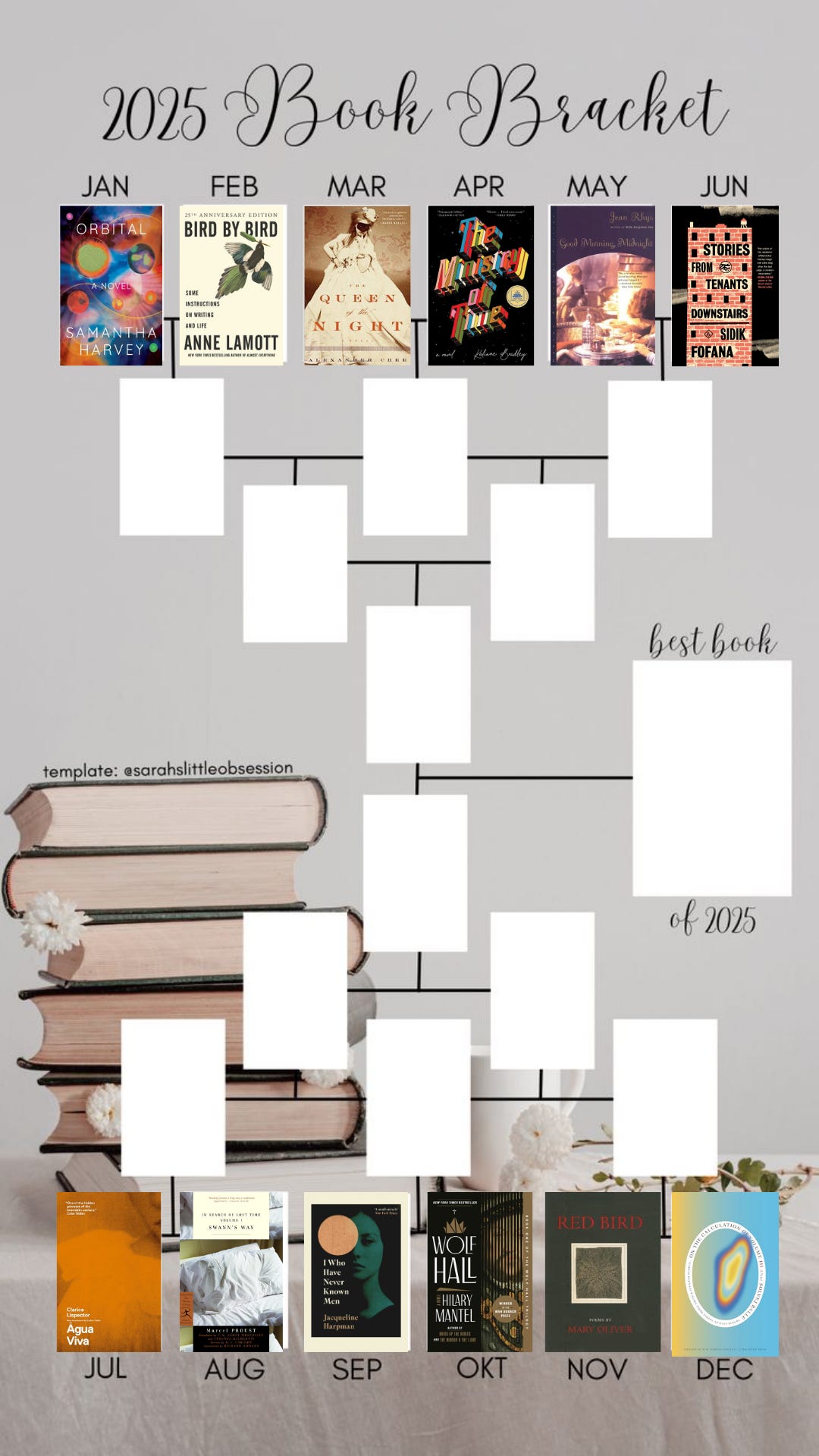
2025 Book Bracket with book cover images filling the first round of spots

This is my third year running this bracket, and I’m amped to dive into these match-ups. Not only were there some absolute bangers in the top spots this year, but a lot of these books also explored many of the same themes in surprisingly complementary ways.

I think this year’s bracket is going to be a really cool reflection/accumulation of a lot of the thoughts I’ve had this year about time, space, and art, so it’s going to be interesting to see what comes out on top as a marker of my final takeaways for the year.

But enough preamble, let’s dive in! You can also read this directly on my Substack here:


ROUND ONE:
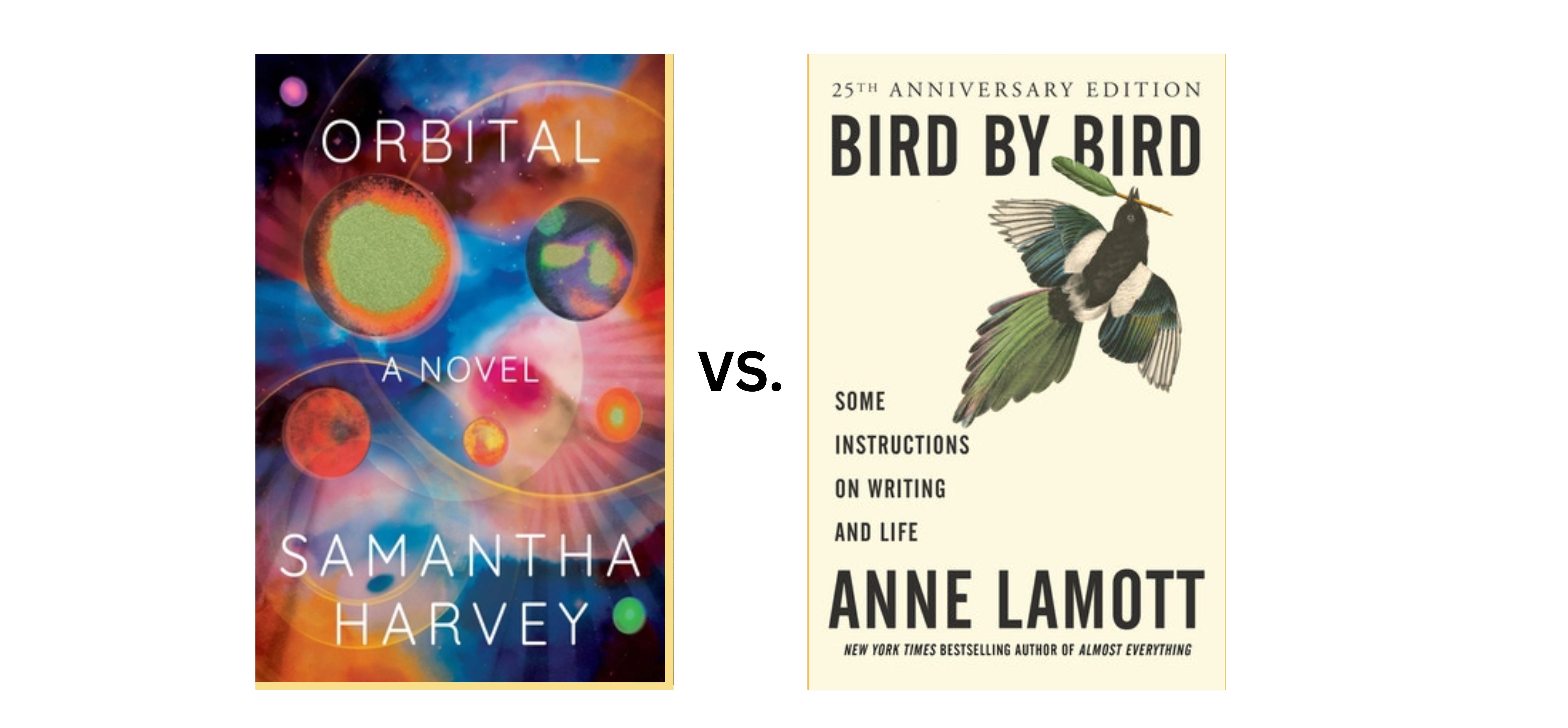
Book cover images of Orbital by Samantha Harvey vs. Bird by Bird by Anna Lamott

Orbital by Samantha Harvey vs. Bird by Bird by Anne Lamott

A tough one to start us off with! Two books in totally different genres that I loved for totally different reasons. As much as I enjoyed and feel that I have made good use of the wisdom that is Bird by Bird, I feel like Orbital set the tone for much of the reading I did for the rest of the year. The explorations of time and (literal) space, and how we navigate the physical and temporal spaces we have and the people inside of them, feel like defining themes for 2025. Plus, the kid version of me who wanted to be an astronaut still gets goosebumps thinking about Harvey’s descriptions of seeing Earth from space. For these reasons, Orbital advances.
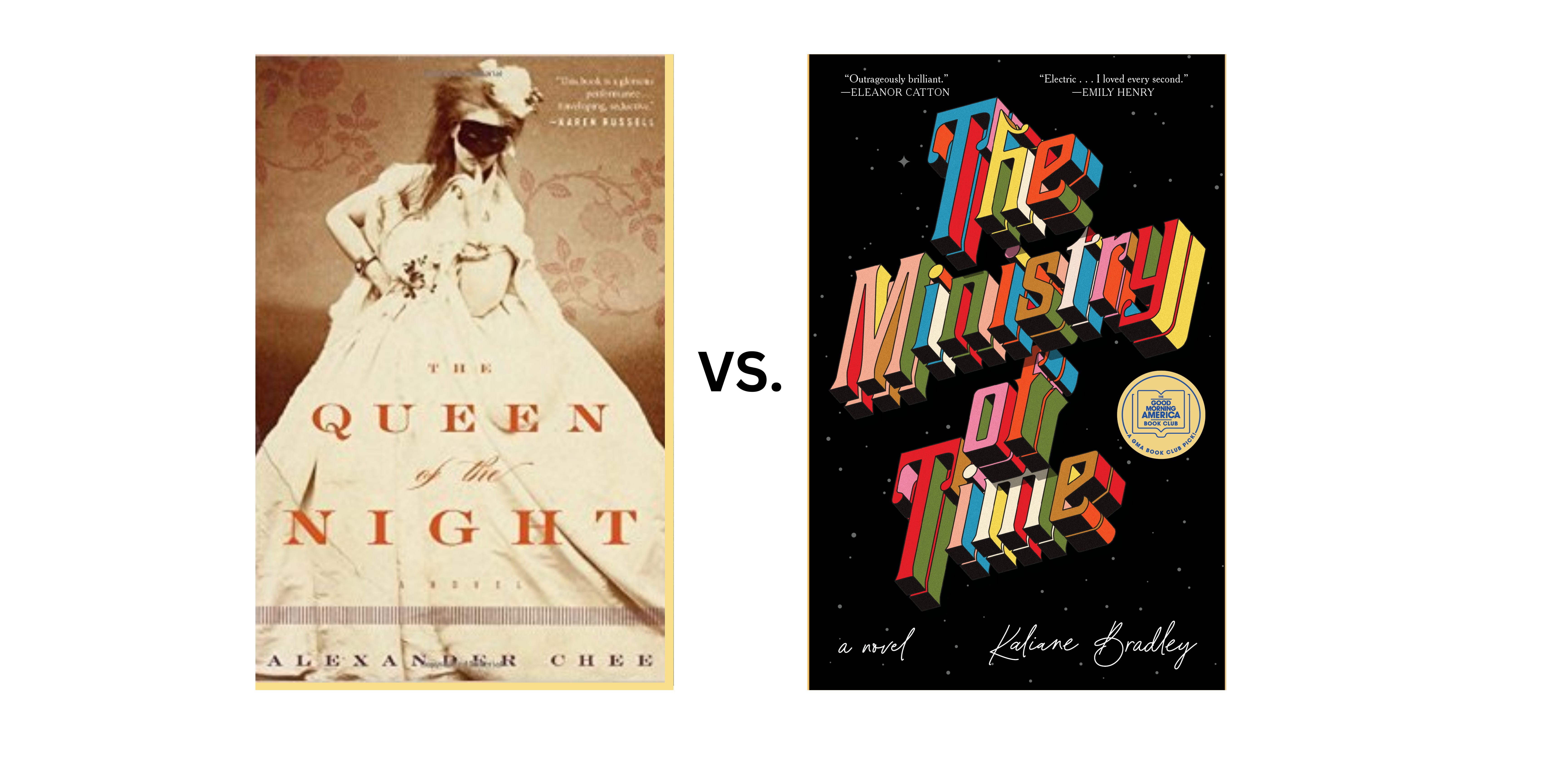
The Queen of the Night by Alexander Chee vs. The Ministry of Time by Kaliane Bradley

I’m already upset because I loved both of these books so much. The Queen of the Night was hands-down the best audiobook I listened to all year, and scores points for hitting many of my favorite elements of historical fiction: eighteenth-century Paris, theatre, the circus, romance, self re-invention. But The Ministry of Time also ticked a bunch of my boxes (namely, time travel and hot Victorian love interests).

I think what it comes down to is that The Ministry of Time took an angle I haven’t seen explored in time travel fiction before, making both its characters and readers answer the same questions about the state of our current world, how we choose to share it with those we love, and the lengths we’d go to protect our version of events. For novelty and long-term thought provocation, The Ministry of Time advances, but I will forever be recommending The Queen of the Night as one of my new all-time favorite historical fiction novels.
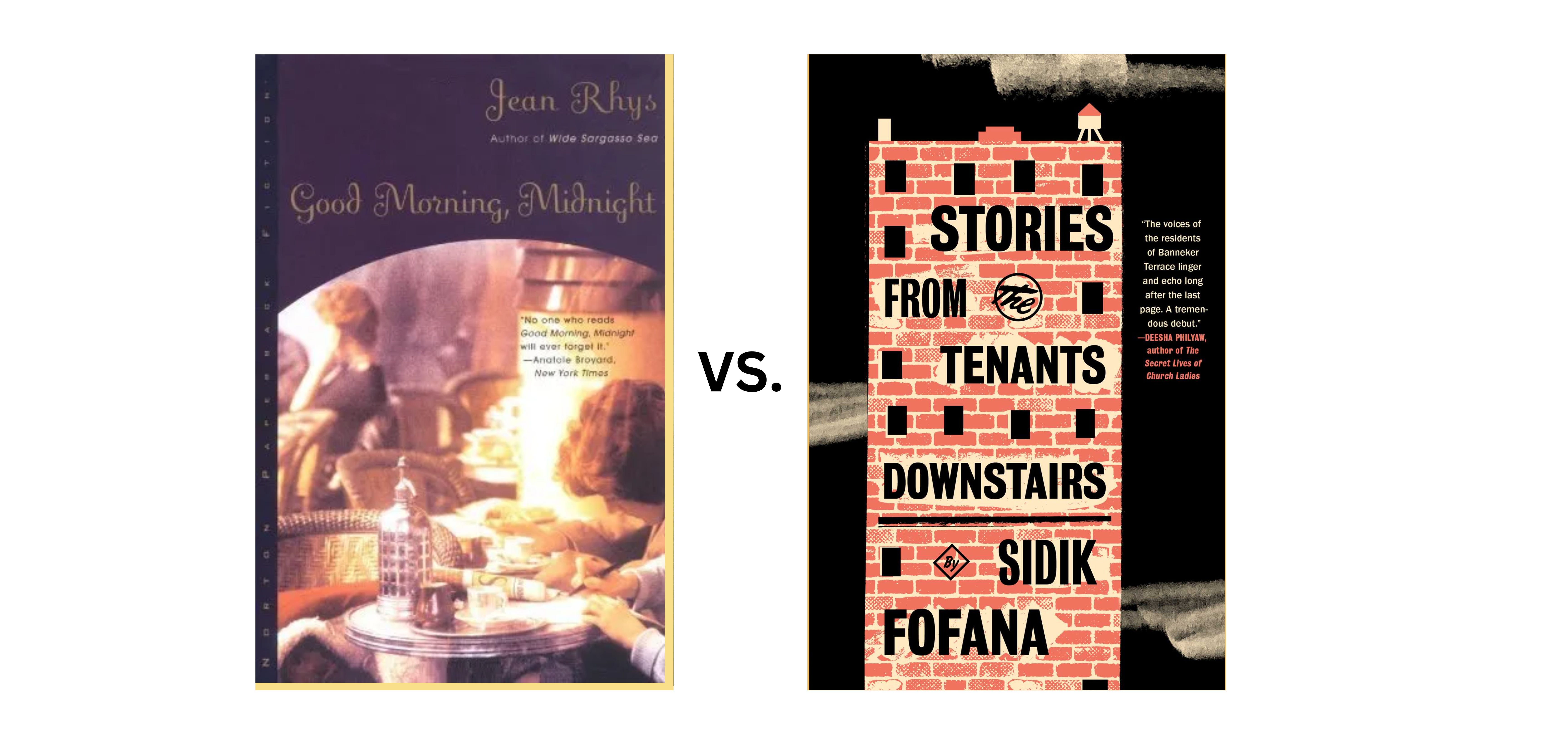
Book cover images for Good Morning, Midnight by Jean Rhys vs. Stories from the Tenants Downstairs by Sidik Fofana

Good Morning, Midnight by Jean Rhys vs. Stories from the Tenants Downstairs by Sidik Fofana

What I admire most about Stories from the Tenants Downstairs is how vividly Fofana captured all of the individual voices in a way that clearly distinguished them but also thematically united them. And yet, Good Morning, Midnight was the one that somehow stuck with me longer.

This may just be the nature of the format—I felt more emotionally connected to Rhys’s protagonist and her corner of Paris in a way that there wasn’t time to do with the individual characters in Fofana’s story collection. In a quieter, subtler sense, Good Morning, Midnight also feels on theme for the year with its exploration of how time changes people and places, rendering them unreliable at best and unrecognizable at worst. Highly recommend both again, but Good Morning, Midnight advances here!

Book cover images for Agua Viva by Clarice Lispector vs. Swann's Way by Marcel Proust

Água Viva by Clarice Lispector vs. Swann’s Way by Marcel Proust

This is such a funny match-up to me, because even though on the surface these could not seem more different, there’s a weird thematic similarity between these two books. One is bite-sized and I read it twice in one weekend, and the other I read slowly over the course of eight weeks. One expressed itself in immediacy, in short bursts of thought and feeling, and the other had long, meandering sentences that went on for entire pages.

Yet both focus on a driving sense of interiority, with the aim of rendering that interiority into something consumable, of capturing the immediate moment as thoroughly as possible with the limited means available to the artists: that is, words. Honestly, if I were a professor, I would pair these books together in the same syllabus because I think they make a surprisingly effective companion read, but for the sake of the bracket, I’m going with Água Viva because its brevity was such a relief after a summer of Proust.

Book cover images for I Who Have Never Known Men by Jacqueline Harpman and Wolf Hall by Hilary Mantel

I Who Have Never Known Men by Jacqueline Harpman vs. Wolf Hall by Hilary Mantel

Another devastating match-up, because I remain deeply obsessed with both of these books. Wolf Hall tapped into my formerly forgotten obsession with Tudor England with prose so freaking lovely and intimate you almost forget you’re witnessing the making of not one, but two notorious tyrants. It’s the best kind of historical fiction, and I’m so looking forward to finishing the trilogy in 2026. And yet I Who Have Never Known Men wasn’t just one of the best books I read this year, but maybe the past decade? It’s one I continue to think about months after reading, and that feels somehow uniquely tailored to the anxieties of our current society, despite being thirty years old. For sheer staying power, I Who Have Never Known Men advances.
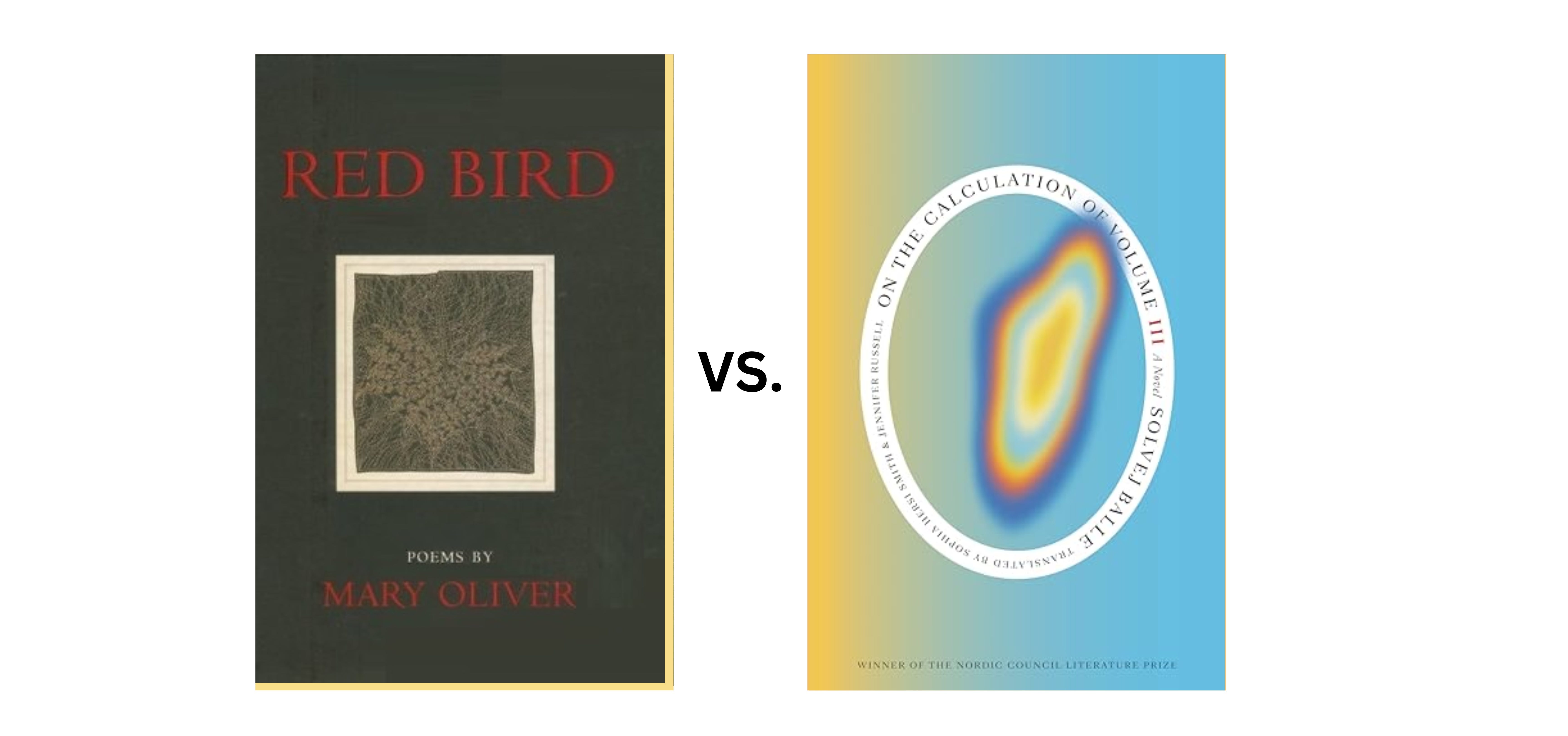
Book cover images for Red Bird by Mary Oliver vs. On the Calculation of Volume III by Solvej Balle

Red Bird by Mary Oliver vs. On the Calculation of Volume III by Solvej Balle

A tough one for sweet Mary Oliver, because as delightful as this collection of poems is, Red Bird is woefully outmatched here. The third and most recent installment of On the Calculation of Volume (and frankly, the entire series) consumed so much of my reading and thinking brain in the back half of 2025 that little else seems to stand a chance.

I loved this third installment in particular for the way it somehow managed to introduce a plot into this otherwise meditative, introspective series, and for how it continued to expand the world in a way that still left you with more questions than you started with. I’m excited to see OTCOVIII face some of the other advancing books; competition seems STIFF for book of the year, but this one is definitely one to watch.
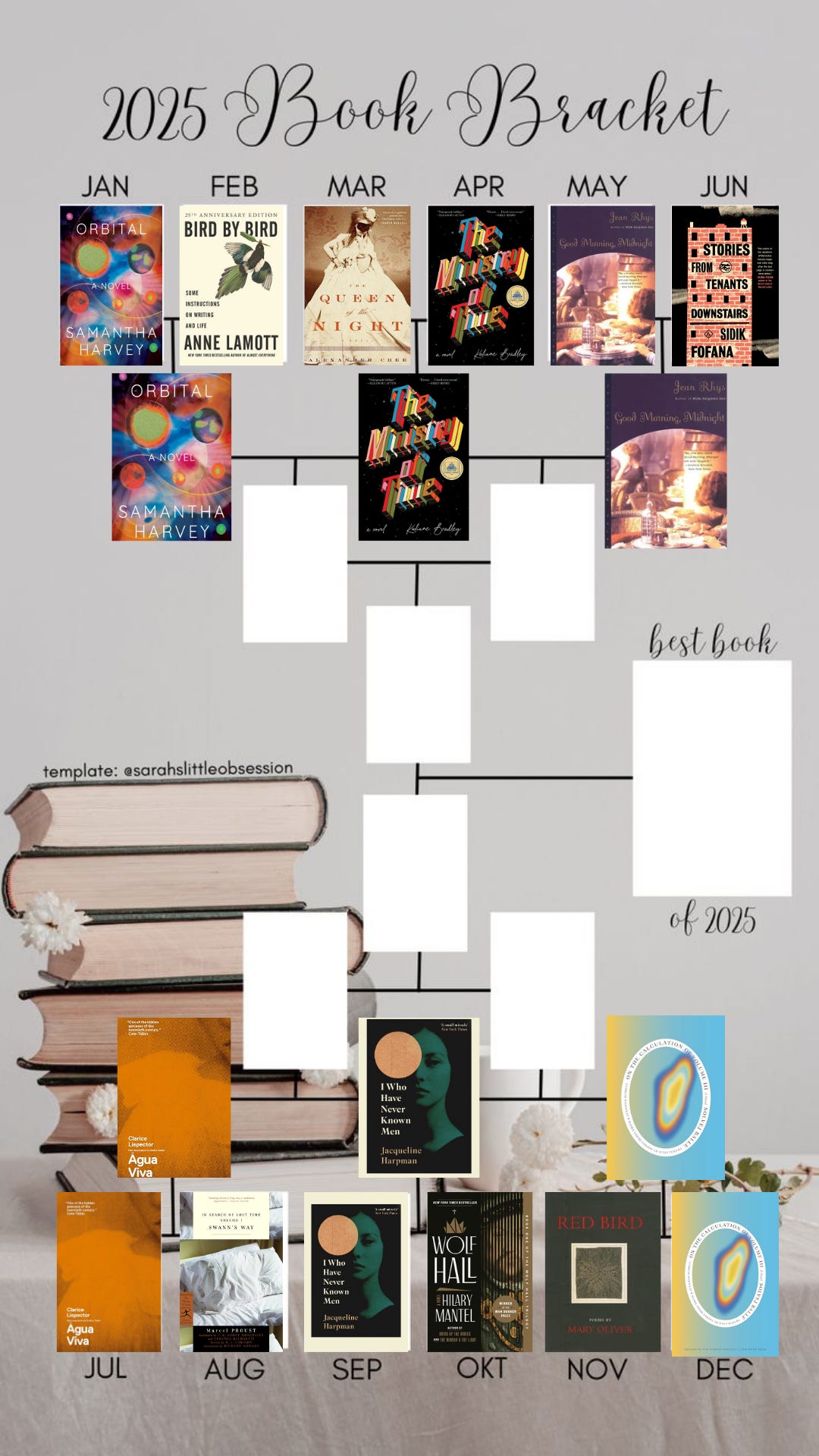

2025 Book Bracket with book cover images filling the first and second round spots

And then there were six! Stay tuned for Round 2 coming at you later this week. Would love to hear your thoughts on the results of the first round in the meantime, especially if you’ve read any of these too!

Until next time, happy reading!
❤ Catherine


Housekeeping note: all book links go to my Bookshop storefront, where each purchase supports independent bookstores (and this newsletter, because I get a small percentage of each sale).

Be like a seed

Lit Chat Vol. 25 (!) — March in Review

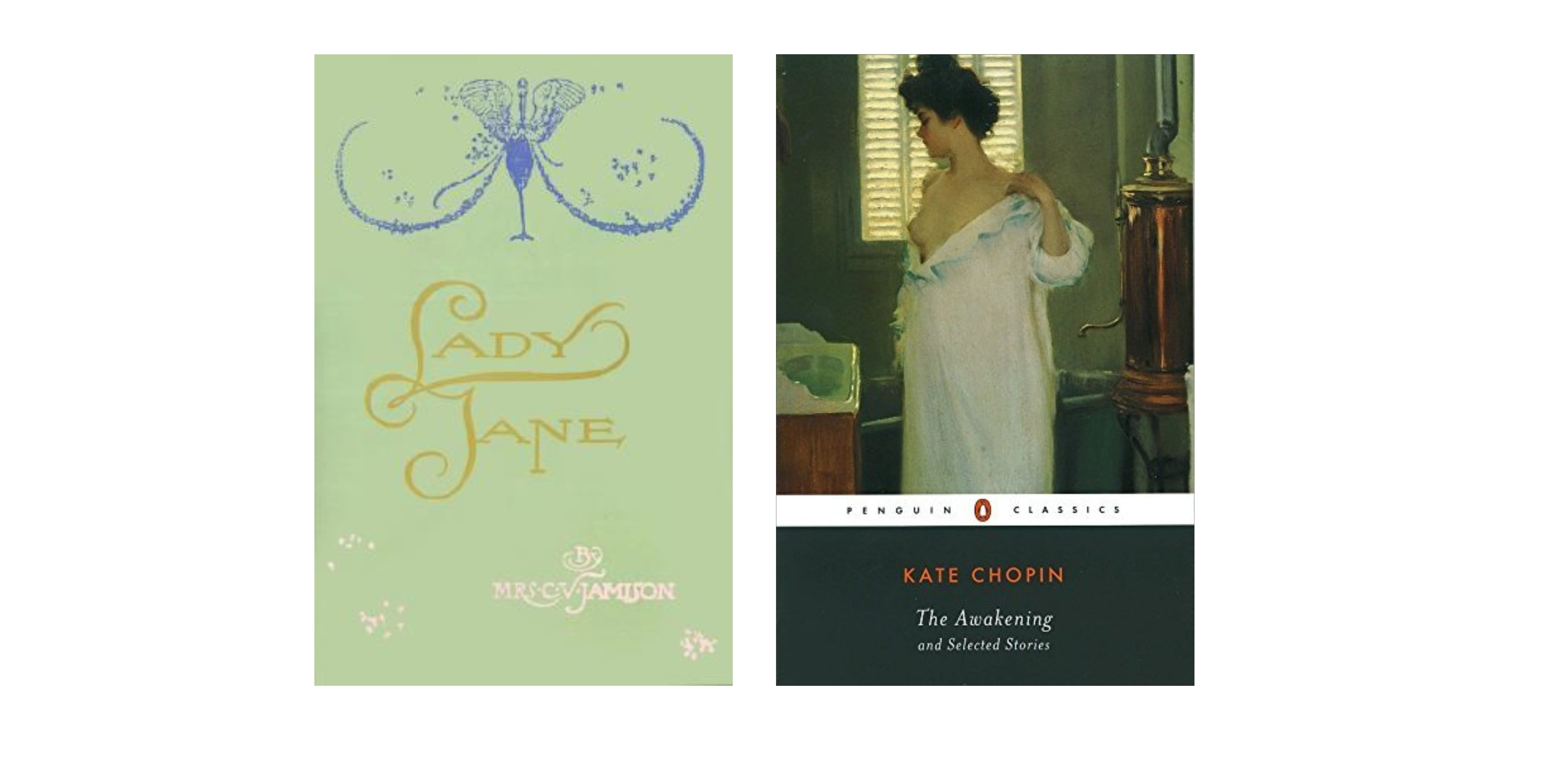
Book cover image for The Queen of the Night by Alexander Chee above book cover images for Lady Jane by Mrs CV Jamison and The Awakening and Selected Stories by Kate Chopin

Hi friends,

We’ve got a mini pyramid for March because I’m back on my long (18+ hours) audiobook kick, and there are only so many hours in a day. I don’t know about you, but I’ve been feeling restless lately. It’s hard for me to sit still on the couch and read, but if I have a book in my ear while I’m walking to yoga or working on my cross-stitch, this feels somehow better on my brain.

For the first time in a very long time, none of the books I read this month were set in the present day. I think this is also a reflection of just how little extra time I wanted to spend in the real world this spring.

At the same time, the piece of writing that made the biggest impression on me from March was this article from beloved poet and novelist Kaveh Akbar in The Nation: What Will You Do?

The title question is in response to the recent arrests of student visa holders Rumeysa Ozturk, Alireza Doroudi, and Mahmoud Khalil. Khalil especially has been on my mind this weekend after an immigration judge in Louisiana ruled he could be deported on the basis that his “otherwise lawful” beliefs, statements, and associations posed a threat to American foreign policy.

Kaveh writes:

“Ozturk, Douroudi, and Khalil were targeted not because they asserted their opposition to the Palestinian genocide—there are white American citizens organizing against Israel’s occupation too. Ozturk, Douroudi, and Khalil were targeted because they were on student visas; they were targeted because they could be targeted.”

This should terrify everybody whose beliefs, statements, and associations are at odds with the current administration. Kaveh, an Iranian-born US citizen, admits to being scared of being targeted in retaliation, and I found myself scared for Kaveh, too.

But isn’t that the point? “The administration’s algorithms of intimidation and terror are working,” he writes, when we are served videos of students being disappeared off the street “between baby photos from casual acquaintances and ads for underwear and linen sheets.”

It feels crazy to live in a world where we just keep witnessing these things and moving on with our days? This isn’t normal. This can’t be normal.

“I am writing this to rebuke the algorithm,” he says, and I guess so am I.

To answer Kaveh’s question, I don’t know what else to do. Not when those scripted emails, petitions, and phone calls to reps don’t seem to be moving the needle against a blatantly evil and self-interested government. I don’t know what to do that would actually make a difference, but it feels like the least we can do is talk about it, share Kaveh’s brave and moving words, and not ignore the moment.

I hope you read Kaveh’s article, and his debut novel Martyr! (which I wrote about last year), and any of his poetry, because he’s an incredible talent and an incandescent human being. We all need a little break from being in the present moment from time to time, and I can think of much worse places to rest than in his words.

Below are the three books where I found rest this month. If you’d like to get subscribe to my Substack and get these posts directly in your email, you can do so below:

Thanks for sticking with me through this lengthy intro. Now, let’s get to the books.


SOLID SUPPORTS:

Book cover images for Lady Jane by Mrs. CV Jamison and The Awakening and Selected Stories by Kate Chopin

Lady Jane — Cecilia Viets Jamison

I picked this book up for $2 at Frenchmen Art & Books in New Orleans because it sounded like exactly the kind of book I would’ve been obsessed with as a kid, and I was right! For some reason, baby me devoured orphan stories like this one, where a beautiful, precocious child is abandoned after tragedy befalls her parents, and ultimately becomes the darling of her new adopted world.

Set in New Orleans in the early 20th century, Lady Jane is a collection of the title child’s adventures in her new home on Good Children Street, charming her neighbors into teaching her how to sing, dance, and sugar pecans despite being unloved by the woman who takes her in after her mother’s death. Little me would have spent hours gazing lovingly at the accompanying woodcut illustrations, and absolutely would have fantasized about having my own blue heron to carry around. Orphans get all the good stuff.

The Awakening and Selected Stories — Kate Chopin

Still nostalgic for New Orleans after Lady Jane, I finally picked up this collection that’s been gathering dust on my shelf since 2022. The former English major in me can’t not read the Introduction first, and it was there that I learned how The Awakening was reviled at the time of its publication (1899), for centering the story of a young woman who chooses to forgo the responsibilities of marriage and motherhood in favor of independence and sexual liberation. How dare she!

Edna Pontellier is twenty-eight, married with two young children, and her biggest crime is waking up one morning on her summer vacation and realizing she wants to live life for herself. Her famous declaration, “I would give my life for my children, but I wouldn’t give myself,” struck her original audience as selfish at best and unhinged at worst, but a modern reader is more sympathetic. That she views her selfhood as more essential than her life was incendiary for her time, but for those of us who now often take this same agency and independence for granted, it’s a haunting reminder that the repression of ~125 years ago isn’t all that far removed.


THE TIPPY TOP:

Book cover image for The Queen of the Night by Alexander Chee

The Queen of the Night — Alexander Chee

This was the aforementioned 18-hour audiobook that I spent close to three weeks listening to, and I treasured it. After being orphaned (again with the orphans!) in America, the protagonist makes her way to Europe in a traveling circus. There, she dons and sheds multiple personas as a hippodrome rider, sex worker, handmaid to the Empress, and unwitting spy before finally becoming Lilliet Berne, a courtesan and renowned opera singer. Few know the truth of Lilliet’s path to fame, but her secret past catches up to her when she is offered an originating role in a new opera, only to find that the libretto is based on her life—and only love.

Chee weaves together each chapter of Lilliet’s life with such delicate extravagance that it feels, well, operatic. I love historical novels that truly immerse you in the time, dwelling with gorgeous prose on everyday details of clothing and food as much as place and character, and Chee spares no expense in this department. The time spent on women’s fashion, in particular, was indulgent in an actually necessary way. If this is starting to pique your interest, I highly recommend checking out Chee’s Substack where he expands on this and the rest of his research process for the novel.

The intrigue of secrets kept and power plays orchestrated carries the reader through the rotating backdrops of cities and circumstances, but the details make the story feel vivid, immediate, and as timelessly fated as the dramas Lilliet enacts both on-stage and off. I loved escaping into Lilliet’s world, and it’s a true testament to Chee’s writing that I would’ve preferred to be starving with her during the literal Siege of Paris than watching whatever fresh hells played out on our daily news.

Also, the audiobook narrator is just really good. Lisa Flanagan’s voice is so rich and lovely that there is never a doubt that she is Lilliet, as capable of bursting into an Italian aria as she is of absconding into the French countryside with a fake name and a stolen coat. I would listen to her read my grocery list.


That’s it for now! I considered just waiting until I had more to write about, but April is already turning out to be a full reading month, and I think I’ll need the extra space then. In the meantime, if you want to chat more about any of these, my inbox/comments/DMs are always open.

Until next time, happy reading!
❤ Catherine


Housekeeping note: all book links go to my Bookshop storefront, where each purchase supports independent bookstores (and this newsletter, because I get a small percentage of each sale).