The Best Books of 2025: Round Two

Listen, I know most people come out with their end-of-the-year wraps well before the year actually ends, but personally, I need a little bit more time to stew on things. This round especially needed extra time to marinate, because I’ll be honest, I was flip-flopping on the last one up until the very end.

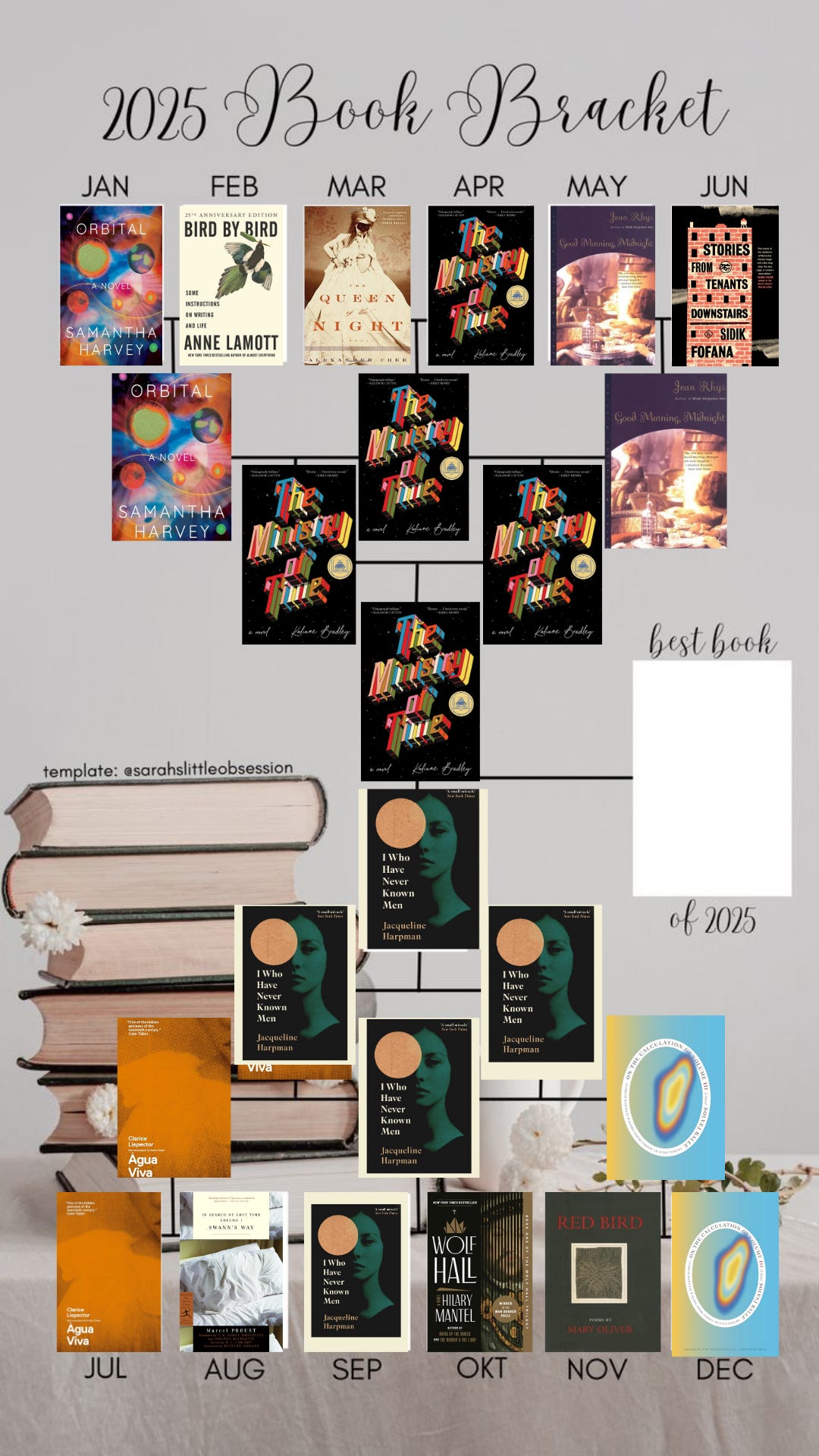
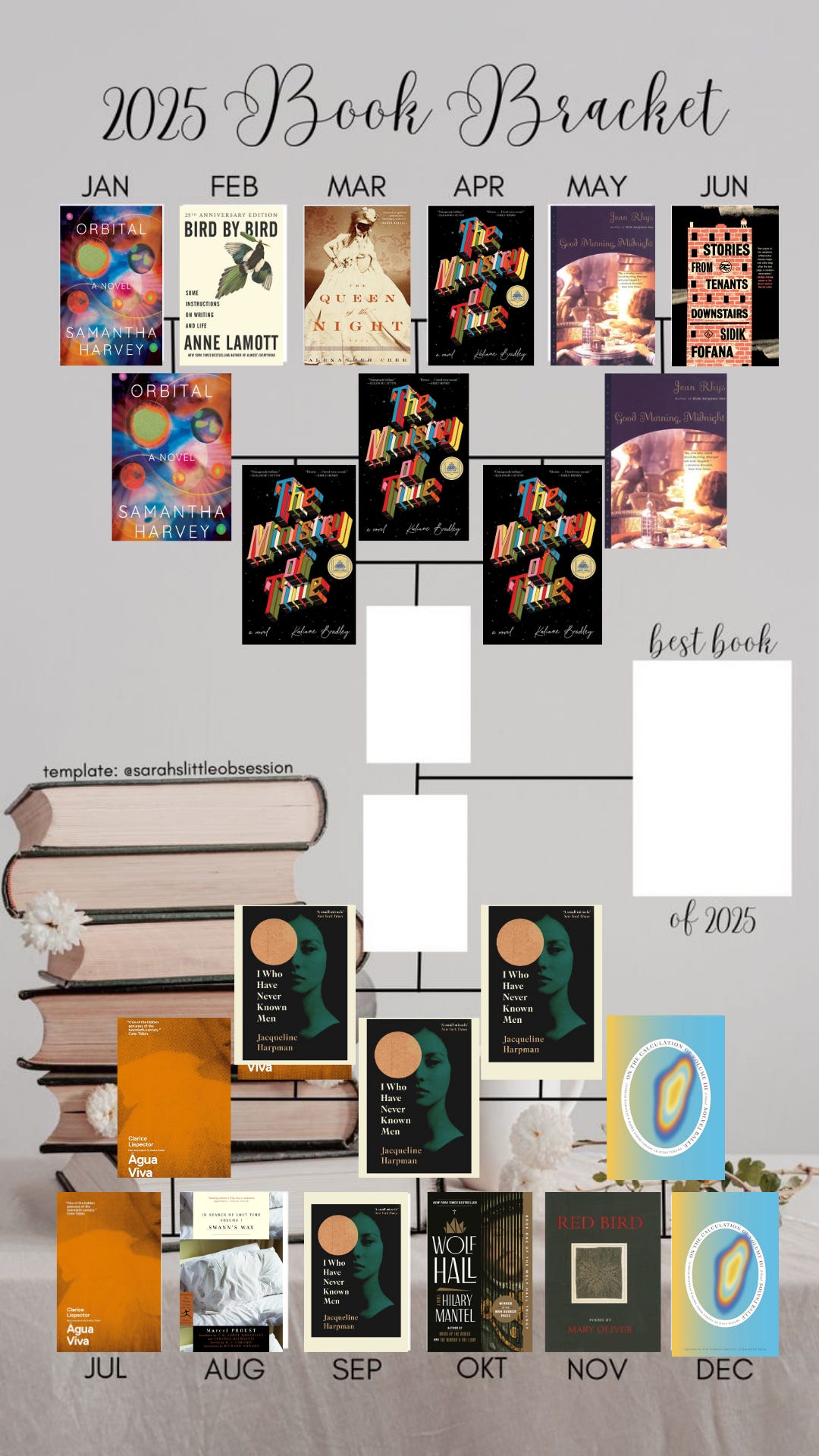
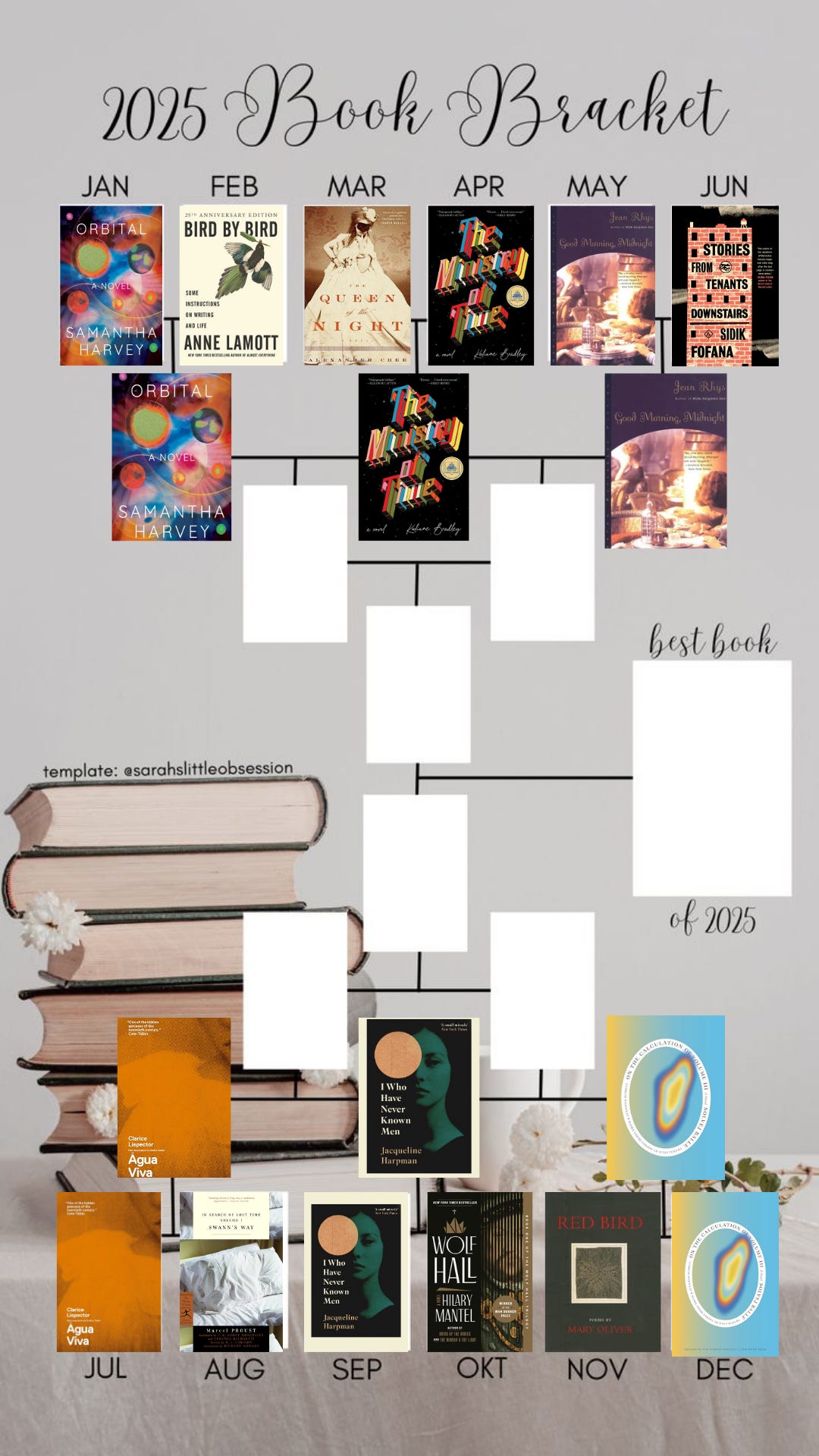
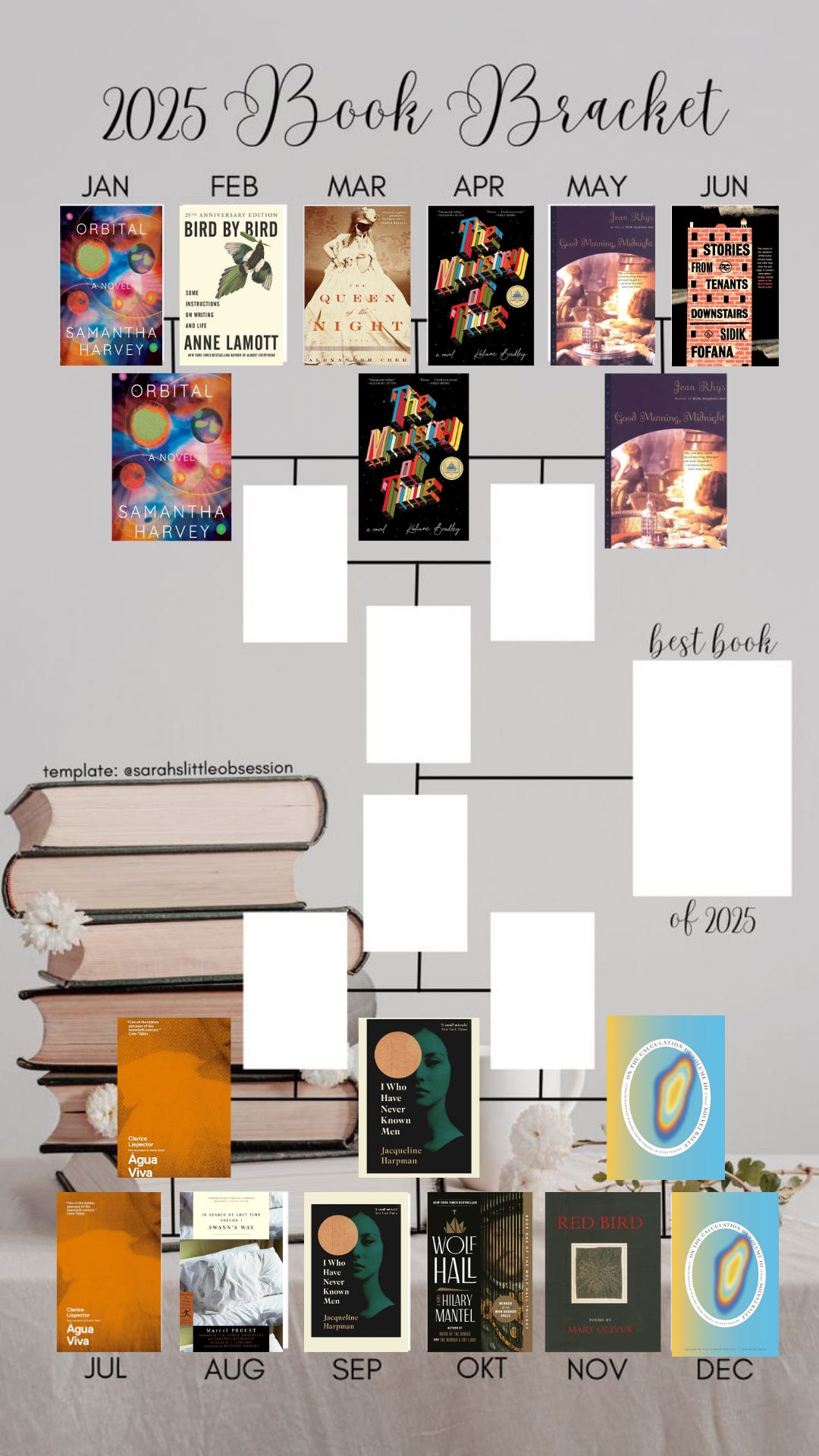
2025 Book Bracket with the first two rounds filled in with book cover images.

Before we move on, I want to say that I don’t love this bracket design (sorry sarahslittleobsession, whoever you are, it’s not personal). Instead of having the middle books duke it out twice in this round, we’re just going to have three match-ups: the Jan-Feb winner vs. the Mar-Apr winner; the May-Jun winner vs. the Jul-Aug winner; and the Sep-Oct winner vs. the Nov-Dec winner.

Essentially, we’re skipping a bracket round as it’s designed here, but you’ll see why at the end. Don’t worry about it! Just enjoy the ride. And if you’d rather enjoy it on Substack, you can do so here:


ROUND TWO:

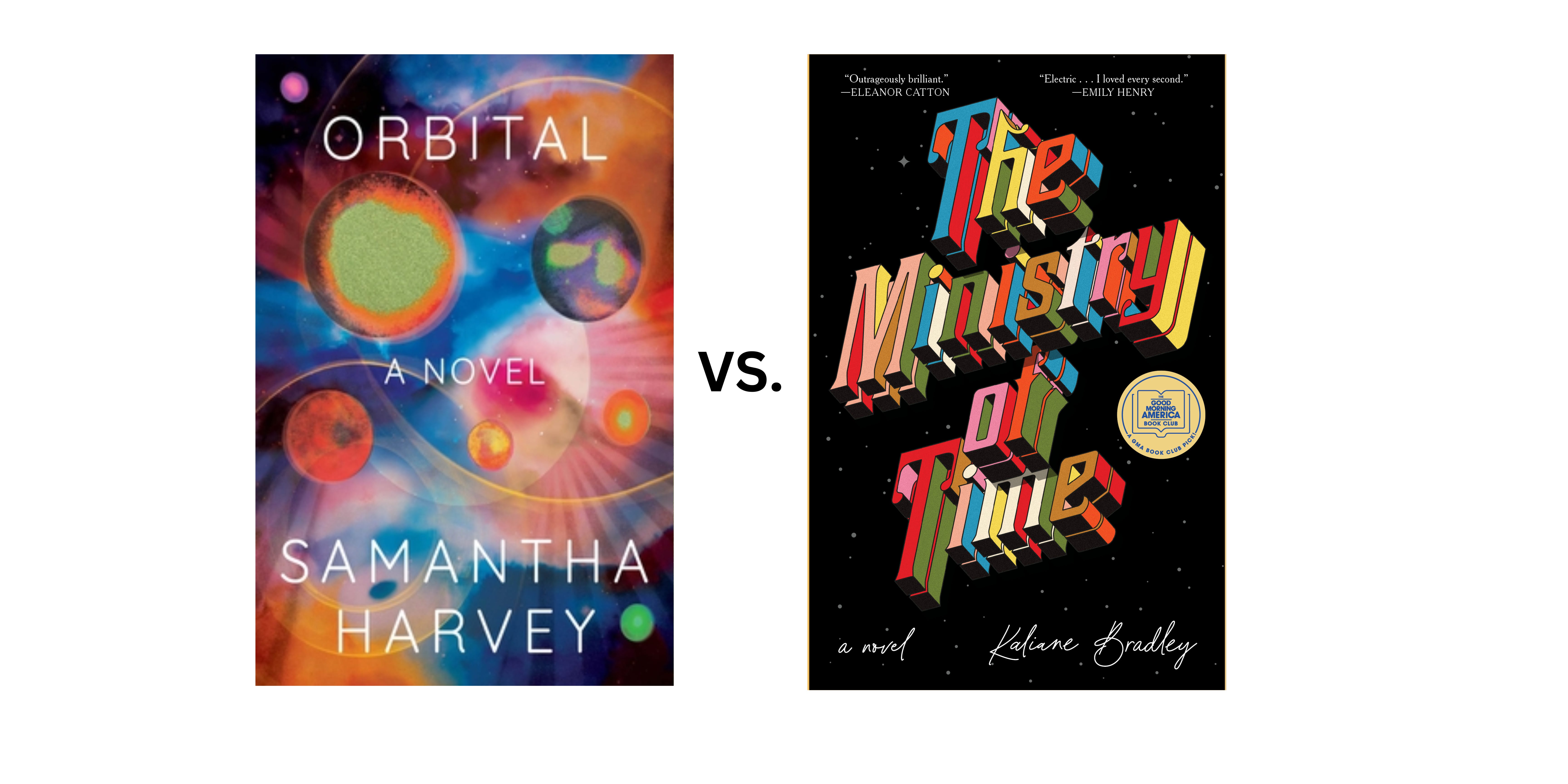
Book cover images for Orbital by Samantha Harvey and The Ministry of Time by Kaliane Bradley

Orbital by Samantha Harvey vs. The Ministry of Time by Kaliane Bradley

Ah, the classic conundrum: space travel vs. time travel. Orbital was such an ideal book to begin 2025 with, especially for me, coming off a hectic 2024. There was something so peaceful about feeling far removed from Earth and all its demands, and in being reminded of just how teeny tiny our little lives and dramas are in comparison to the big, beautiful universe. A quiet and contemplative read, Orbital was perfect for easing back into the January stratosphere.

The Ministry of Time, however, is on the opposite end of the spectrum. It’s a book that’s very much about being in the world, and the inclusion of characters from other times made the present moment feel vast and expansive and foreign without having to leave the planet. It feels reductive to say The Ministry of Time is just more exciting, but at the end of the day, it is! There’s intrigue, there’s romance, and there’s a provocation for the reader to consider their place in the world and what we owe to generations past, present, and future. The Ministry of Time advances, but with no less love for Orbital.


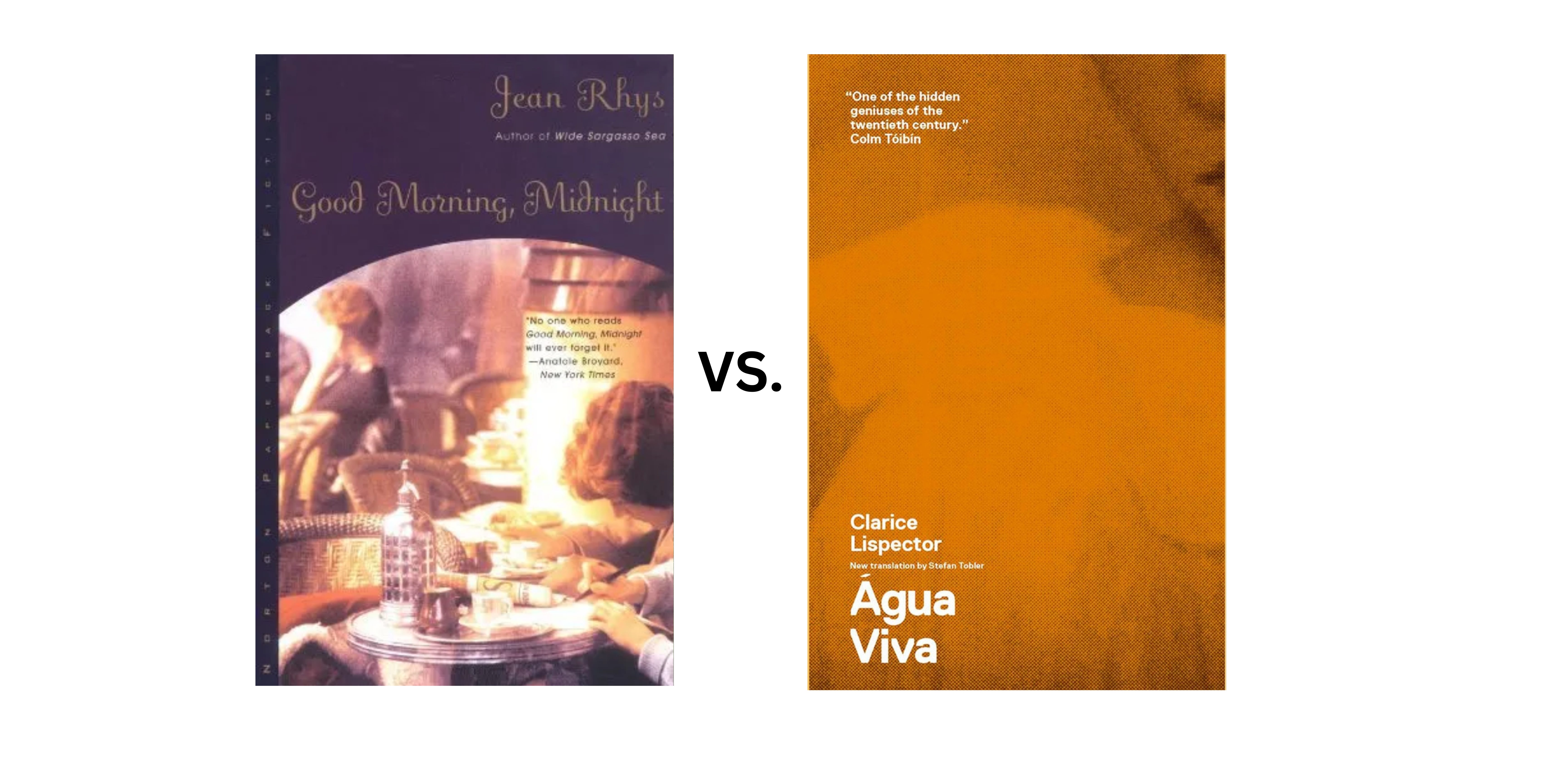
Book cover images for Good Morning, Midnight by Jean Rhys and Agua Viva by Clarice Lispector

Good Morning, Midnight by Jean Rhys vs. Água Viva by Clarice Lispector

Interesting, interesting! These books have absolutely nothing to do with each other, and must therefore be assessed by other factors because they can’t be compared like two novels can. Good Morning, Midnight has a lot going for it that Água Viva does not: a plot, for example, and characters, and a strong sense of time and place—even if that sense is fallible and ultimately unreliable.

And yet!! When I think of Água Viva, I think of a fire burning in my brain. I read both of these books in one sitting while traveling, but Água Viva is the one I came back to for seconds. Água Viva is the one I went to the bookstore to buy so I could underline it on my second read, which is something I almost never do. There was an urgency, an authenticity to Lispector’s searching that utterly possessed me. Água Viva moves forward!


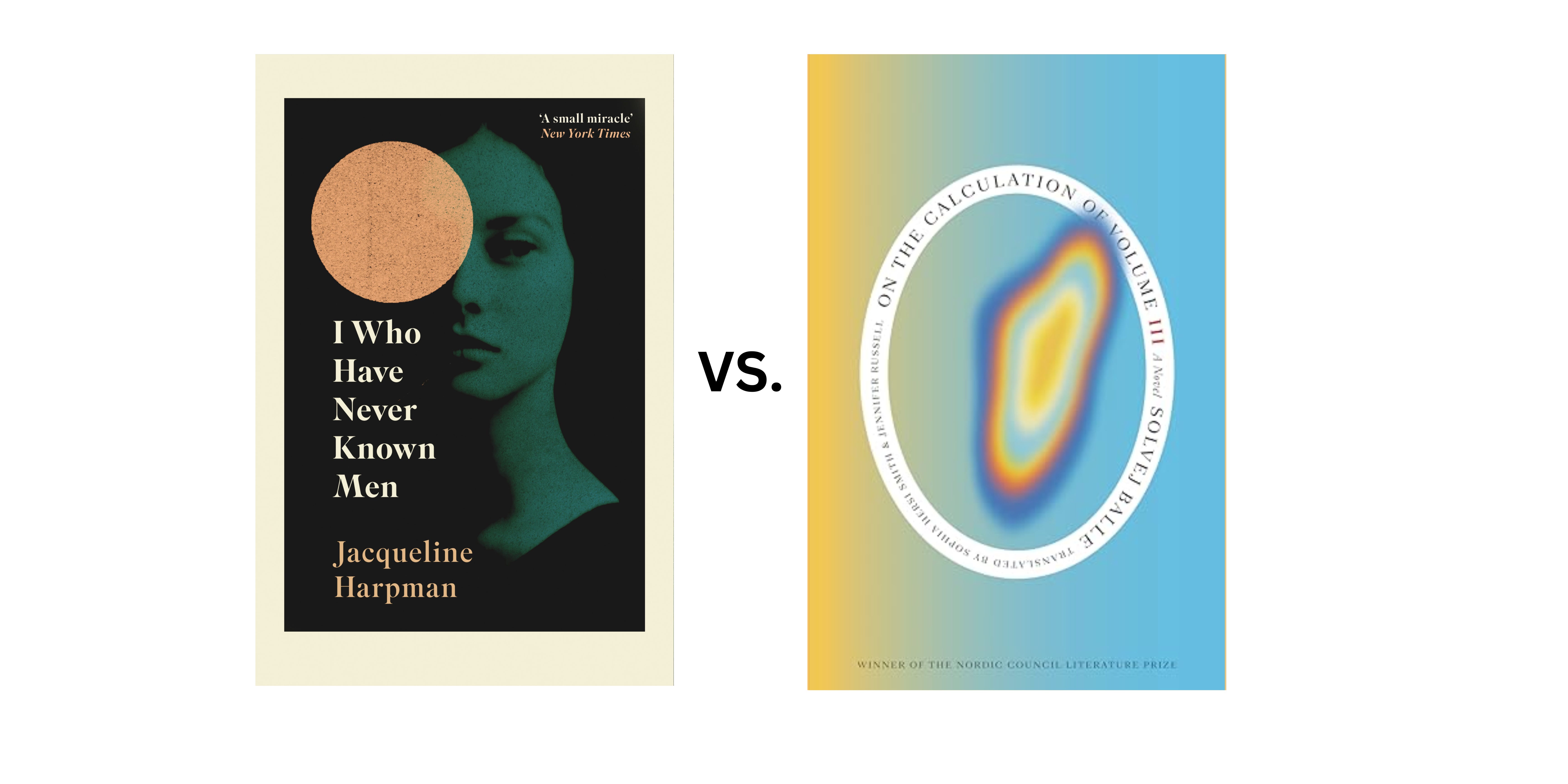
Book cover images for I Who Have Never Known Men by Jacqueline Harpman and On the Calculation of Volume III by Solvej Balle

I Who Have Never Known Men by Jacqueline Harpman vs. On the Calculation of Volume III by Solvej Balle

I find this pairing incredibly upsetting, because if you asked me to just list my top ten books of the year, all of the On the Calculation of Volume books would probably be on that list. But to pit just one of them against I Who Have Never Known Men, of all other books I read this year! Life isn’t fair.

Alas, one must be the victor. I remain deeply, deeply obsessed with the On the Calculation of Volume series, and will continue proselytizing to all of my bookish friends until we are a cult big and important enough to demand and receive a midnight indie bookstore release party for all subsequent volumes.

However.

It feels unfair to weigh the entire series against I Who Have Never Known Men. That’s not what’s in the bracket! And if we’re going off the merits of the individual book as a standalone, I don’t think Volume III holds up. I Who Have Never Known Men has an equal, if not greater amount of originality, and yet its strength is in being contained to this single volume. While we hold onto hope for answers in Volume IV, we know that answers are never coming for I Who Have Never Known Men, and we’re left to reckon with that not-knowing. The not-knowing is the point, and the not-knowing is what’s so haunting. With a conflicted heart, I Who Have Never Known Men advances to the finals.


Do you see now why it would’ve been silly to stick to the bracket as it was designed? It would’ve eliminated a round anyway, because it would’ve reduced the semifinals to just two books instead of four. This way is better because I say so.

2025 Book Bracket with the first three rounds filled in with book cover images
SILLY!

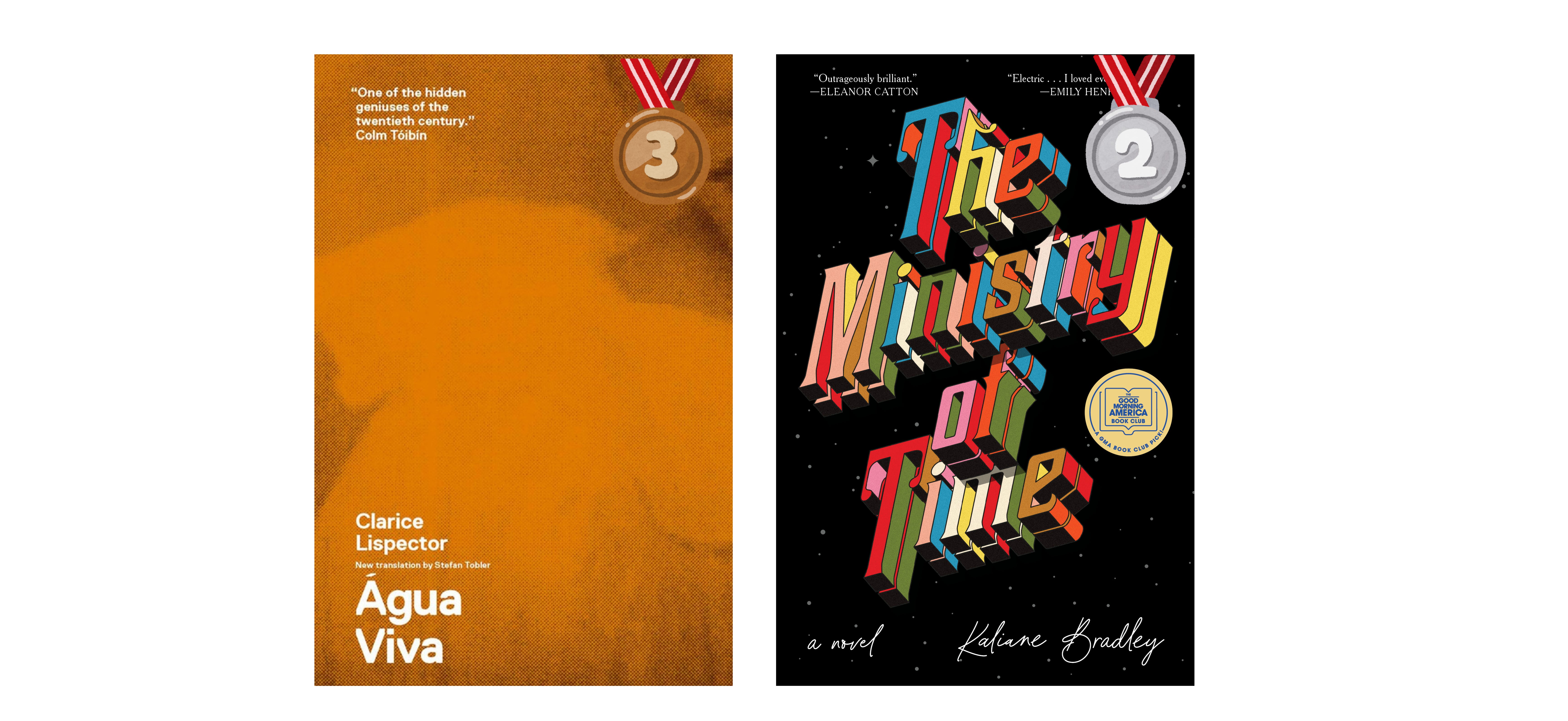
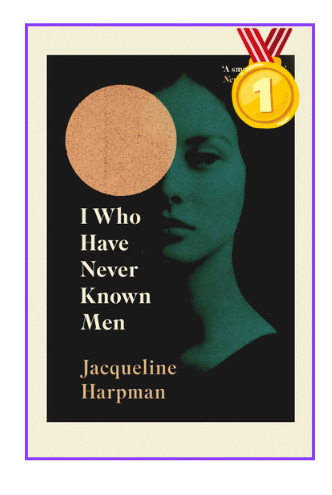
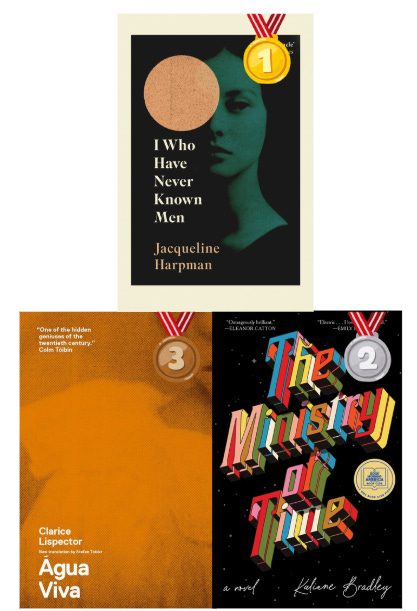
Anyway, stay tuned for the final round tomorrow, which is just a little mini pyramid ranking the top three. I’m ready to put 2025 behind us and I’m sure you are too, but in the meantime, I hope you find some inspiration for your 2026 reading.

Until then, thanks for hanging and happy reading!

❤ Catherine


Housekeeping note: all book links go to my Bookshop storefront, where each purchase supports independent bookstores (and this newsletter, because I get a small percentage of each sale.

The Best Books of 2025: Round One

Well, well, well, if it isn’t 2026 already.

If Goodreads is to be believed, I read 62 books in 2025. I smashed the goals I set for myself to read more short story collections and books in translation (7/6 and 16/4, respectively), read exactly six stellar poetry collections, and fell just short of my goal for craft books (5/6). Can’t win em all!

I also finally finished Emily Wilson’s translation of The Iliad in December, and successfully led a cute little Proust book club over the summer to read Volume One of In Search of Lost Time. All in all, it was another fabulous year for books, and I’m proud of the way I challenged myself to broaden my regular reading horizons.

But we’re not done yet.

Welcome, friends, to Round One of the Best Books of 2025 bracket! 2025 may be over, but we can’t put it to bed entirely without first crowning a winner.

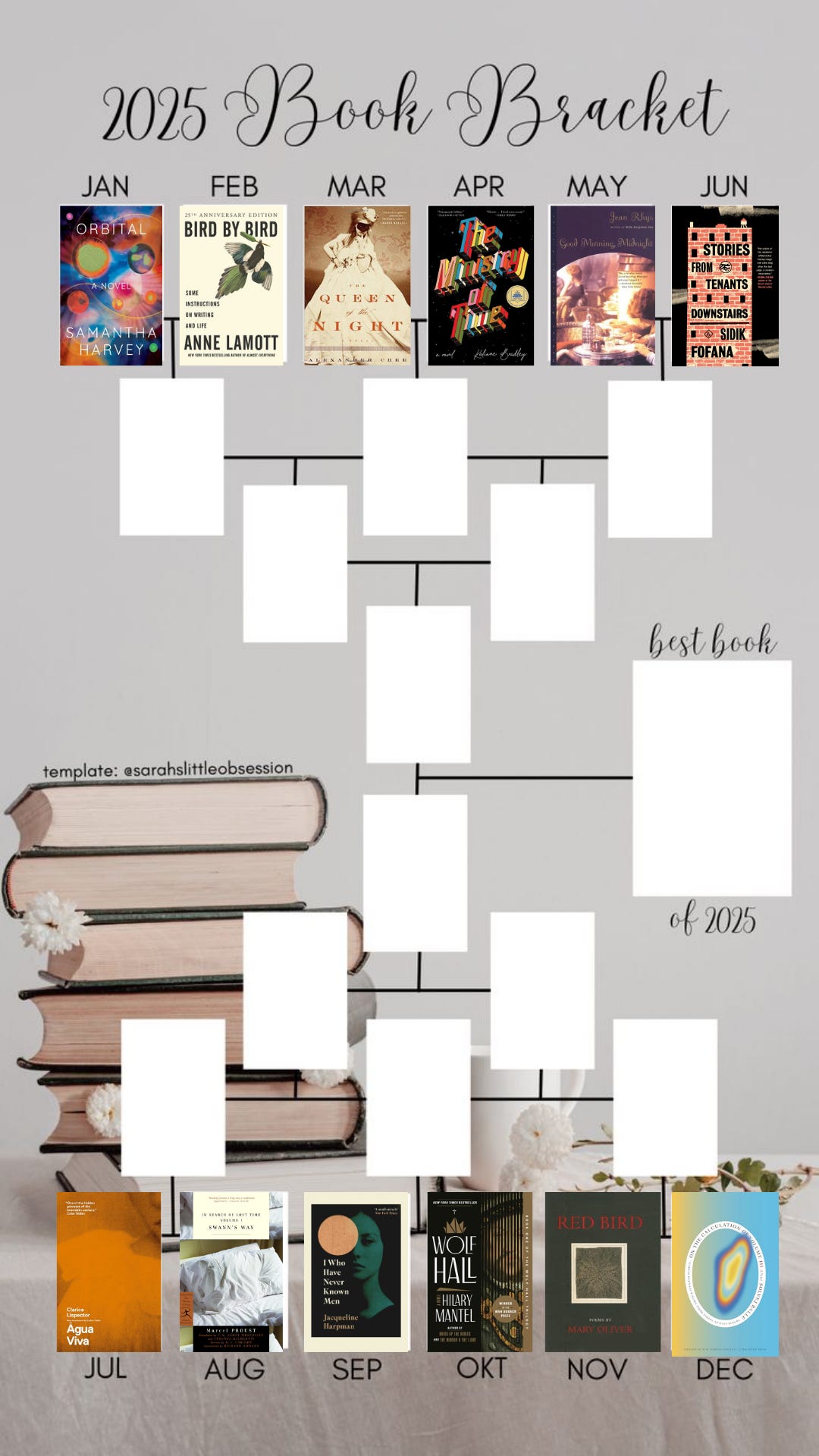
2025 Book Bracket with book cover images filling the first round of spots

This is my third year running this bracket, and I’m amped to dive into these match-ups. Not only were there some absolute bangers in the top spots this year, but a lot of these books also explored many of the same themes in surprisingly complementary ways.

I think this year’s bracket is going to be a really cool reflection/accumulation of a lot of the thoughts I’ve had this year about time, space, and art, so it’s going to be interesting to see what comes out on top as a marker of my final takeaways for the year.

But enough preamble, let’s dive in! You can also read this directly on my Substack here:


ROUND ONE:

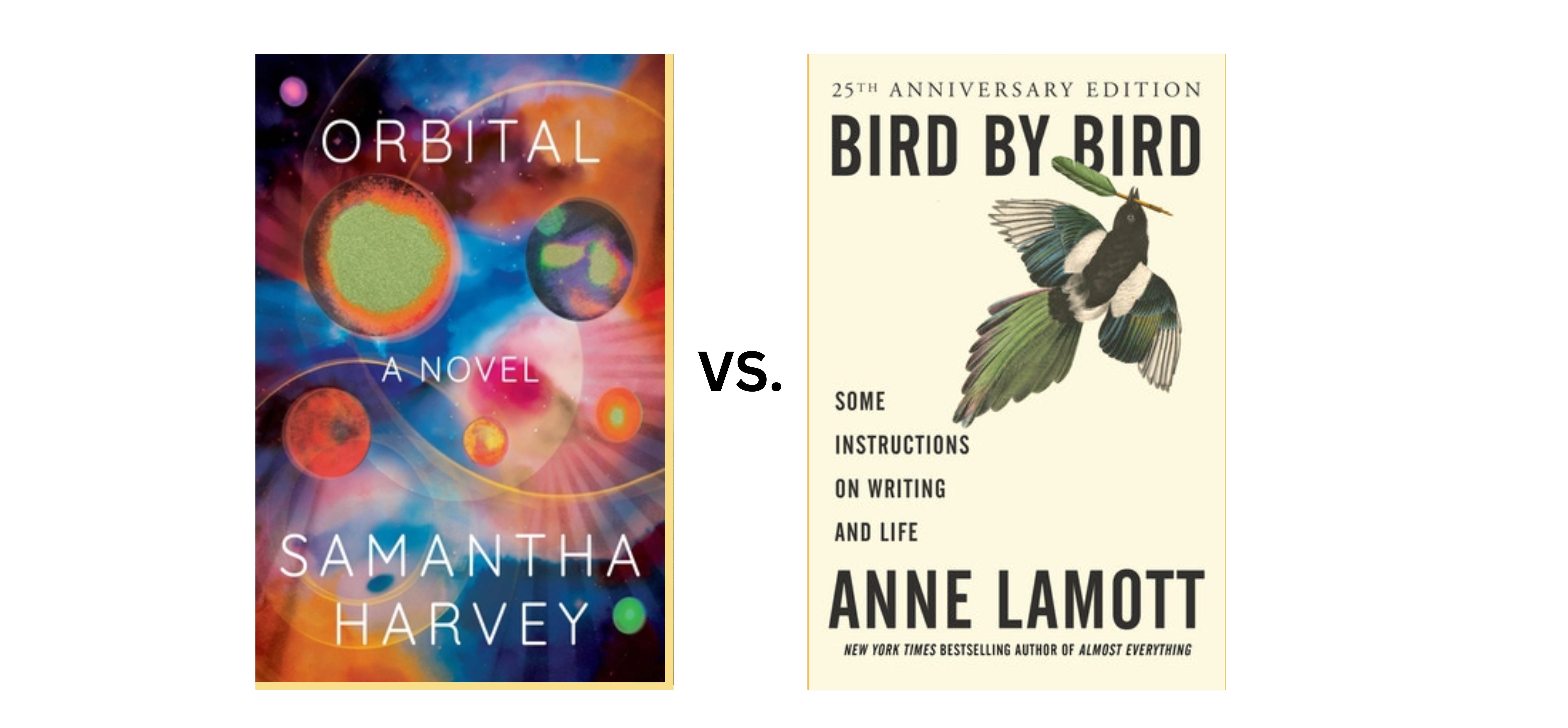
Book cover images of Orbital by Samantha Harvey vs. Bird by Bird by Anna Lamott

Orbital by Samantha Harvey vs. Bird by Bird by Anne Lamott

A tough one to start us off with! Two books in totally different genres that I loved for totally different reasons. As much as I enjoyed and feel that I have made good use of the wisdom that is Bird by Bird, I feel like Orbital set the tone for much of the reading I did for the rest of the year. The explorations of time and (literal) space, and how we navigate the physical and temporal spaces we have and the people inside of them, feel like defining themes for 2025. Plus, the kid version of me who wanted to be an astronaut still gets goosebumps thinking about Harvey’s descriptions of seeing Earth from space. For these reasons, Orbital advances.

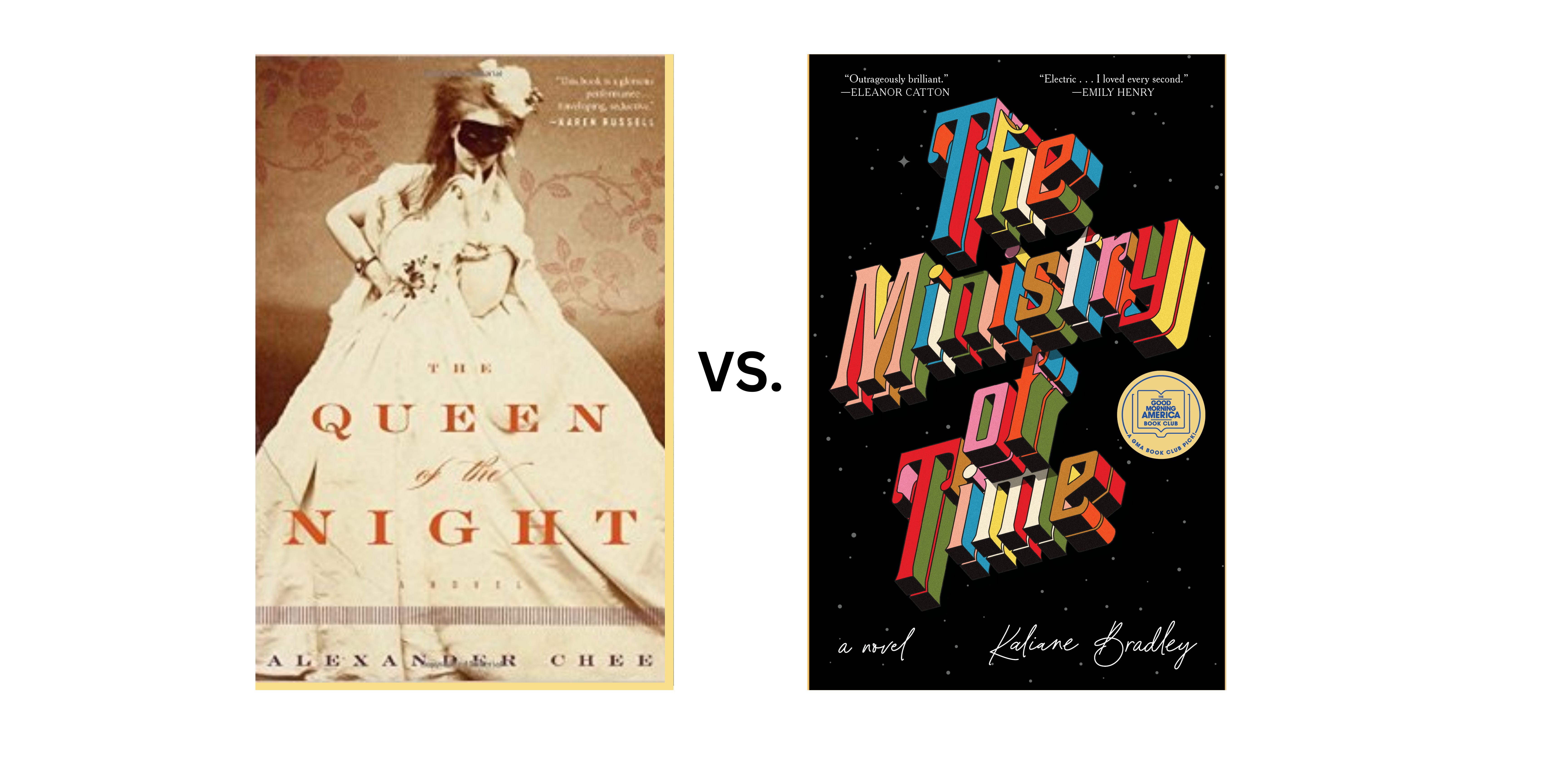
The Queen of the Night by Alexander Chee vs. The Ministry of Time by Kaliane Bradley

I’m already upset because I loved both of these books so much. The Queen of the Night was hands-down the best audiobook I listened to all year, and scores points for hitting many of my favorite elements of historical fiction: eighteenth-century Paris, theatre, the circus, romance, self re-invention. But The Ministry of Time also ticked a bunch of my boxes (namely, time travel and hot Victorian love interests).

I think what it comes down to is that The Ministry of Time took an angle I haven’t seen explored in time travel fiction before, making both its characters and readers answer the same questions about the state of our current world, how we choose to share it with those we love, and the lengths we’d go to protect our version of events. For novelty and long-term thought provocation, The Ministry of Time advances, but I will forever be recommending The Queen of the Night as one of my new all-time favorite historical fiction novels.

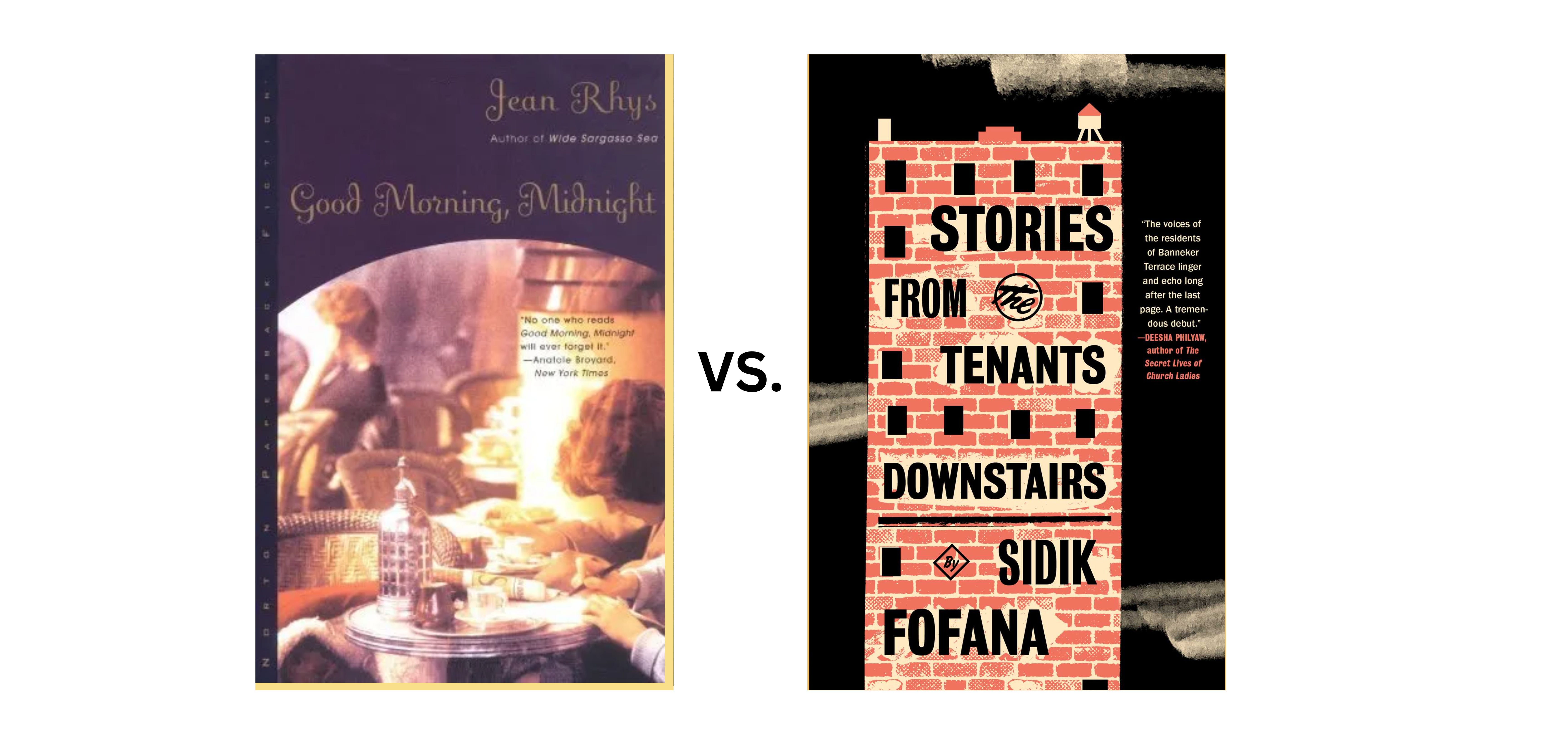
Book cover images for Good Morning, Midnight by Jean Rhys vs. Stories from the Tenants Downstairs by Sidik Fofana

Good Morning, Midnight by Jean Rhys vs. Stories from the Tenants Downstairs by Sidik Fofana

What I admire most about Stories from the Tenants Downstairs is how vividly Fofana captured all of the individual voices in a way that clearly distinguished them but also thematically united them. And yet, Good Morning, Midnight was the one that somehow stuck with me longer.

This may just be the nature of the format—I felt more emotionally connected to Rhys’s protagonist and her corner of Paris in a way that there wasn’t time to do with the individual characters in Fofana’s story collection. In a quieter, subtler sense, Good Morning, Midnight also feels on theme for the year with its exploration of how time changes people and places, rendering them unreliable at best and unrecognizable at worst. Highly recommend both again, but Good Morning, Midnight advances here!

Book cover images for Agua Viva by Clarice Lispector vs. Swann's Way by Marcel Proust

Água Viva by Clarice Lispector vs. Swann’s Way by Marcel Proust

This is such a funny match-up to me, because even though on the surface these could not seem more different, there’s a weird thematic similarity between these two books. One is bite-sized and I read it twice in one weekend, and the other I read slowly over the course of eight weeks. One expressed itself in immediacy, in short bursts of thought and feeling, and the other had long, meandering sentences that went on for entire pages.

Yet both focus on a driving sense of interiority, with the aim of rendering that interiority into something consumable, of capturing the immediate moment as thoroughly as possible with the limited means available to the artists: that is, words. Honestly, if I were a professor, I would pair these books together in the same syllabus because I think they make a surprisingly effective companion read, but for the sake of the bracket, I’m going with Água Viva because its brevity was such a relief after a summer of Proust.

Book cover images for I Who Have Never Known Men by Jacqueline Harpman and Wolf Hall by Hilary Mantel

I Who Have Never Known Men by Jacqueline Harpman vs. Wolf Hall by Hilary Mantel

Another devastating match-up, because I remain deeply obsessed with both of these books. Wolf Hall tapped into my formerly forgotten obsession with Tudor England with prose so freaking lovely and intimate you almost forget you’re witnessing the making of not one, but two notorious tyrants. It’s the best kind of historical fiction, and I’m so looking forward to finishing the trilogy in 2026. And yet I Who Have Never Known Men wasn’t just one of the best books I read this year, but maybe the past decade? It’s one I continue to think about months after reading, and that feels somehow uniquely tailored to the anxieties of our current society, despite being thirty years old. For sheer staying power, I Who Have Never Known Men advances.

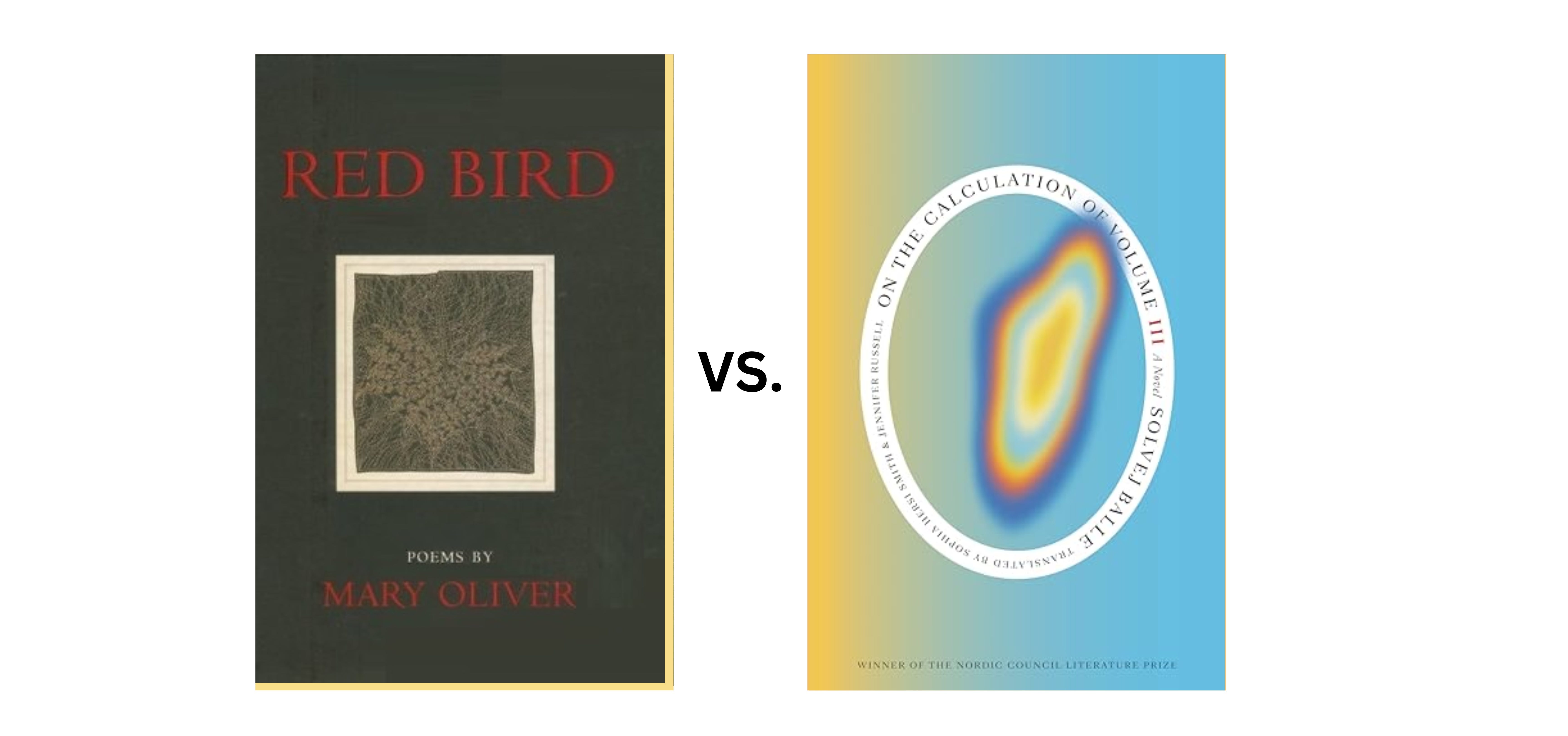
Book cover images for Red Bird by Mary Oliver vs. On the Calculation of Volume III by Solvej Balle

Red Bird by Mary Oliver vs. On the Calculation of Volume III by Solvej Balle

A tough one for sweet Mary Oliver, because as delightful as this collection of poems is, Red Bird is woefully outmatched here. The third and most recent installment of On the Calculation of Volume (and frankly, the entire series) consumed so much of my reading and thinking brain in the back half of 2025 that little else seems to stand a chance.

I loved this third installment in particular for the way it somehow managed to introduce a plot into this otherwise meditative, introspective series, and for how it continued to expand the world in a way that still left you with more questions than you started with. I’m excited to see OTCOVIII face some of the other advancing books; competition seems STIFF for book of the year, but this one is definitely one to watch.


2025 Book Bracket with book cover images filling the first and second round spots

And then there were six! Stay tuned for Round 2 coming at you later this week. Would love to hear your thoughts on the results of the first round in the meantime, especially if you’ve read any of these too!

Until next time, happy reading!
❤ Catherine


Housekeeping note: all book links go to my Bookshop storefront, where each purchase supports independent bookstores (and this newsletter, because I get a small percentage of each sale).
The best is between the lines

Lit Chat Vol. 28 — June & July in Review

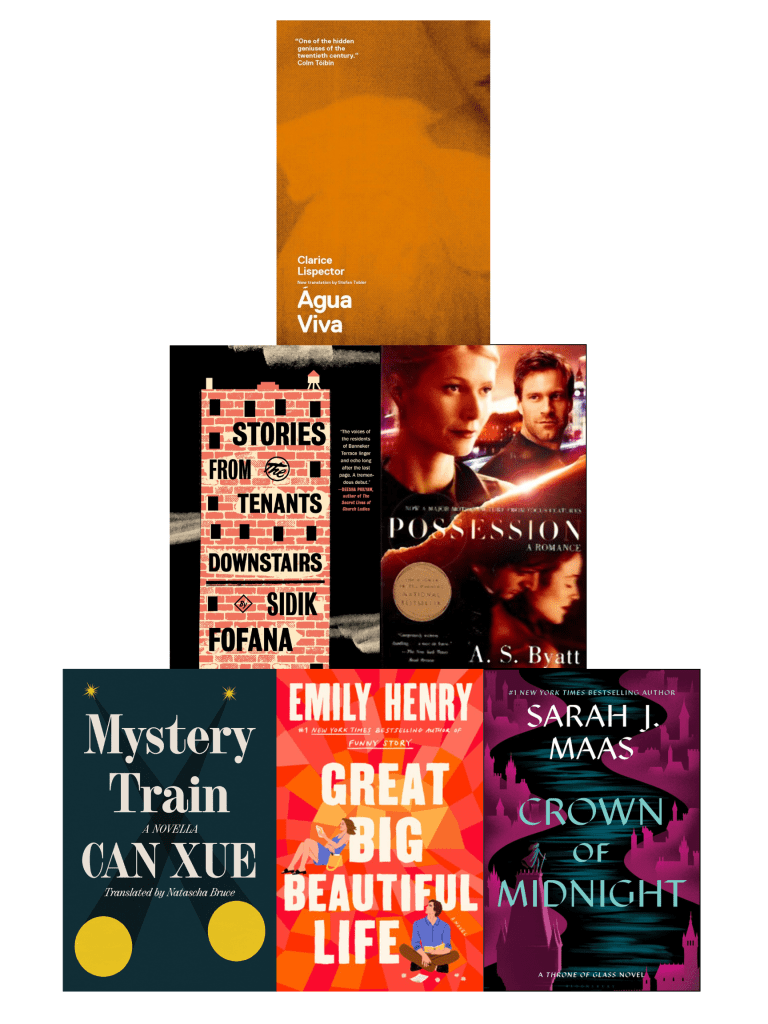
Book cover pyramid with Mystery Train by Can Xue, Great Big Beautiful Life by Emily Henry, and Crown of Midnight b Sarah J. Maas on the bottom row; Stories from the Tenants Downstairs by Sidik Fofana and Possession by A.S. Byatt in the middle row, and Agua Viva by Clarice Lispector on top.

Hi friends,

We’re back after a little summer break! I’ve been letting myself take things slow this summer, and that includes my reading. However! As we are now somehow over halfway through the year, I wanted to take a moment to check in on the reading goals I set for myself in January and see how much progress I’ve made:

My 2025 Reading Goals:

  • read 6 poetry collections
    • 2/6! Time to pick up the pace—now accepting recommendations!
  • read 6 short story collections
    • 4/6! On track and currently in the middle of #5.
  • read 6 craft/writing books
    • 3/6! On track with my next one on hold at the library, but might need to do some thinking about what I want my last two to be.
  • read 4 books in translation
    • 4/4! I joined a literature in translation book club in my office, which has been so much fun. Now it’s something that’s just built into my reading schedule without having to be as intentional about it, which is perfect.
  • read Emily Wilson’s translation of The Iliad
    • Behind on this! I did read all the introductory materials and the first two or three parts at the beginning of the year, but lost steam when I had to clean my desk and put the book up on a shelf. Maybe taking it back off the shelf will help motivate me to come back to it by the end of the year? Or maybe I should just pick a month and say, “This is the month that I read The Iliad.” TBD!
  • read Marcel Proust’s In Search of Lost Time
    • In progress and thrilled about it!! If you didn’t know, I’ve been working my way through the first volume, Swann’s Way, with a few other brave souls behind the paywall on my Substack. We’ve just finished reading Part One, and I’m loving the structure of assigned reading and the weekly space to sit and use my brain for a little bit of analysis. Thank you to all who are currently on this journey with me, and if you’re interested in catching up (or just reading the paywalled posts), you can do so below:

Okay, all in all, pretty proud of how things are going! Even if my reading pace has been slower and I haven’t been reading as many books as in previous years, I do feel like I’ve been engaging with what I read more deeply.

Especially considering the number of opportunities I’ve had to be in literary community over the past six months, I’d say this has already been an especially rich reading year! I’m so grateful for everyone who reads this newsletter and/or has come over to my apartment to talk about books or gone to a book event with me out in the city.

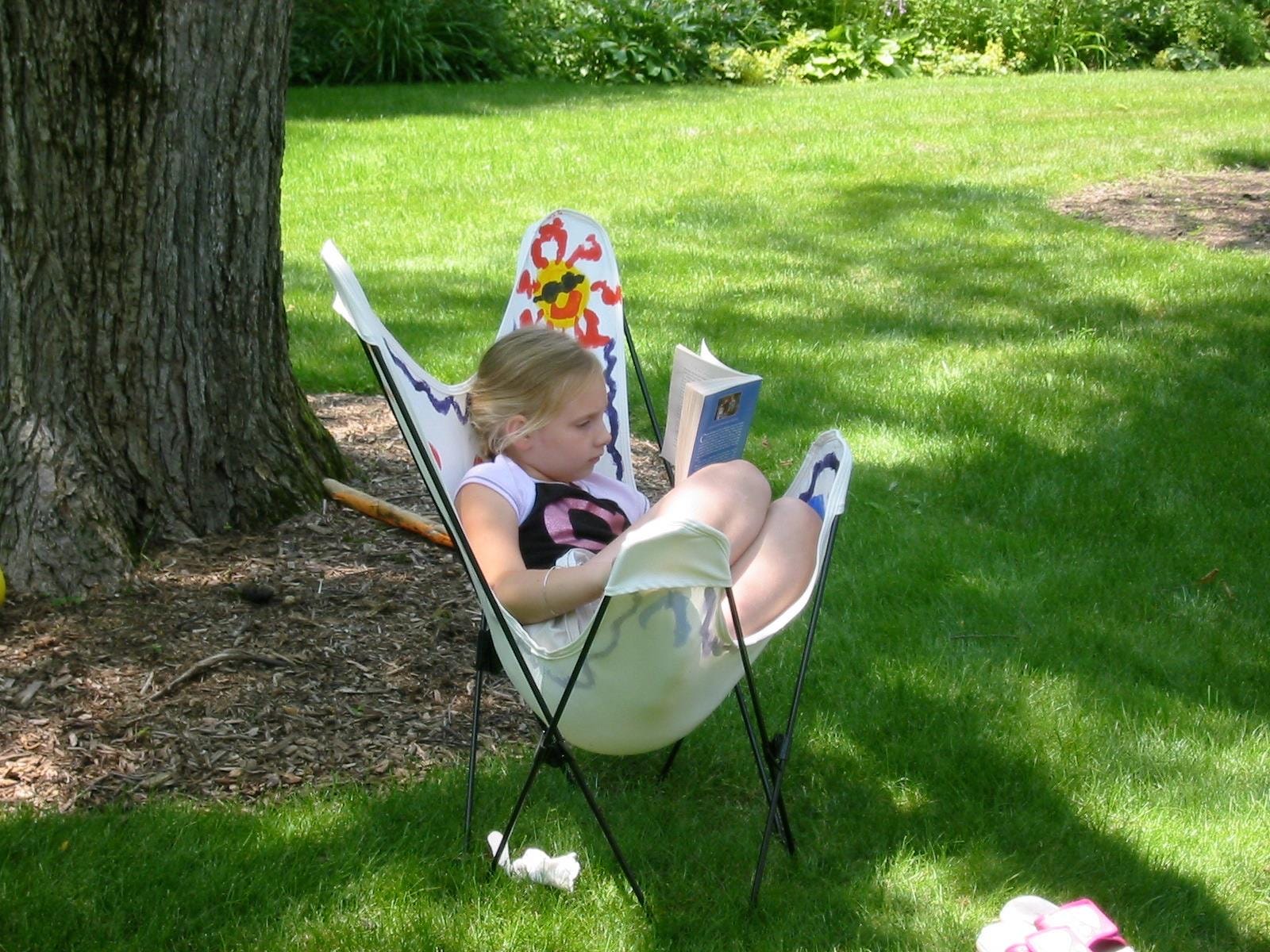
I recently shared this photo of 9-year-old me reading behind the Proust Read-along paywall, but I can’t stop thinking how happy this lil bookworm would be that reading is still such a big part of her life, so I’m sharing it again here:

Young girl curled up in a hand-painted canvas butterfly chair, reading a book in a backyard under a large elm tree
this is still my preferred reading position

Okay! Now with that long preamble over, let’s get to the books of June and July. If you prefer to get this post delivered straight to your inbox, make sure you subscribe to my Substack here:


THE FOUNDATION:

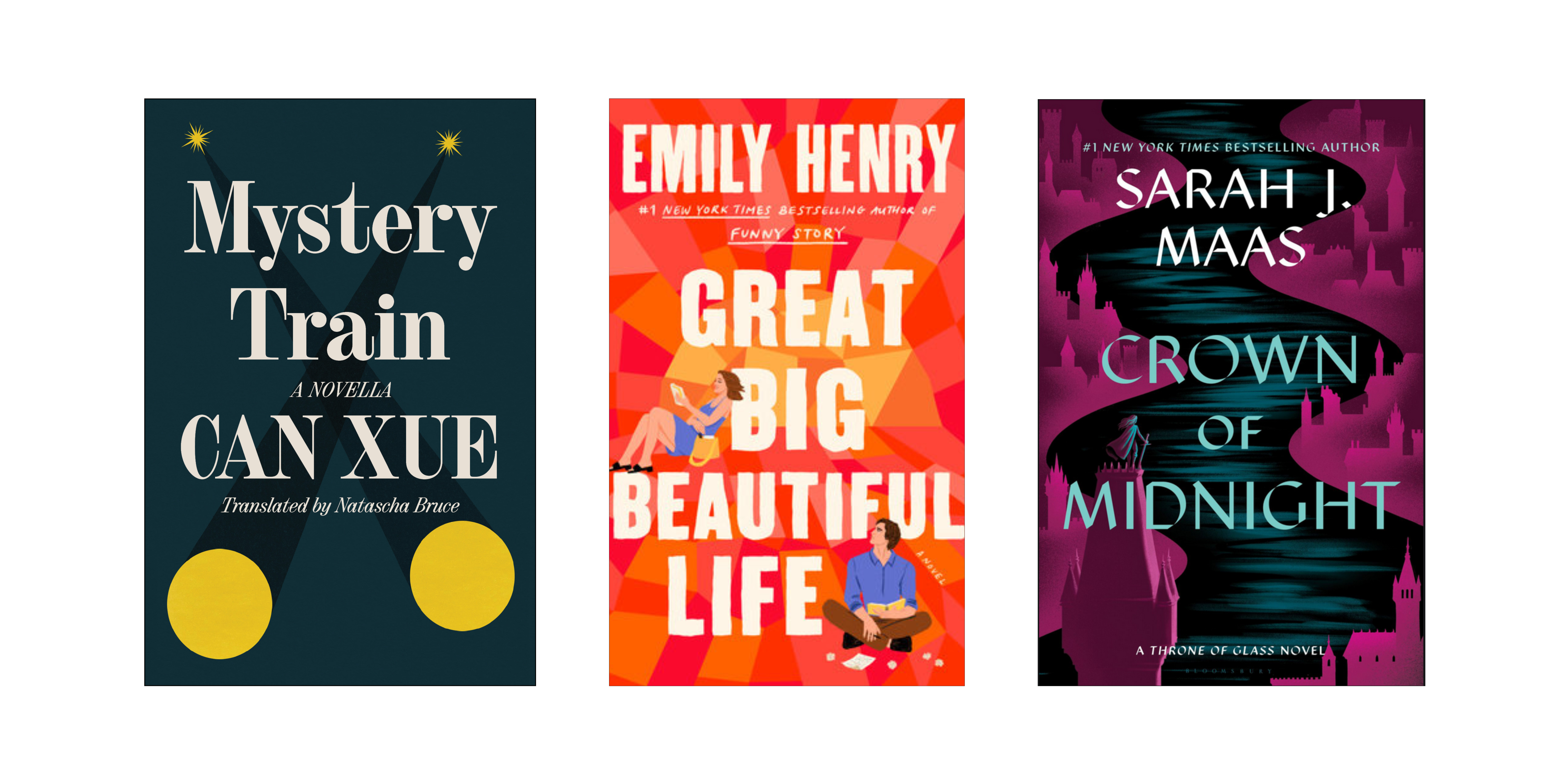
Book cover images for Mystery Train by Can Xue, Great Big Beautiful Life by Emily Henry, and Crown of Midnight by Sarah J. Maas
sidenote: how gorgeous are these covers together??

Mystery Train — Can Xue, translated by Natasha Bruce

This was July’s translation book club pick, and our discussion ended up taking almost as wild a journey as the titular mysterious train. It’s the story of a chicken farmer named Scratch who is sent on a journey to buy chicken feed by his boss, only to realize that this journey is unlike any of the trips he’s ever taken before, and there might not actually be a way off the train. This is a fever dream of a novella, and had us debating questions of life and death, desire and fate, metaphors of light and darkness, and the prerequisites for embracing the unknown. I’ll definitely be looking to pick up more of Xue’s work in the future.

Great Big Beautiful Life — Emily Henry

Okay, I am still very much an Emily Henry stan, but this one didn’t fully do it for me! I loved all of the things I always love about her books: e.g., the unique, cozy setting of small-town coastal Georgia, the witty banter, the sexy love interest with a gruff exterior just begging to be chipped away. I think what didn’t work for me was that it felt like she was trying to write two books at once: the love story of two journalists vying for the chance to write the biography of a famously reclusive former media darling, and the life story of said darling and her media empire family. It was giving The Seven Husbands of Evelyn Hugo, but shoehorned into an EH romance. My opinion is that whatever book-a-year publishing schedule she’s on is starting to take a toll, but this book still does everything it sets out to do and is an easy, fun summer read.

Crown of Midnight — Sarah J. Maas

I would have ranked this higher, but honestly, it’s been less than a month since I finished and I could barely remember what happened in this second Throne of Glass book when I sat down to write this. Since I’ve started listening to the third book, more details about Celaena’s attempts to subvert the king’s plans for her to eliminate resistance in Adarlan have come back to me, and I remembered that I did enjoy leaning into the new romance and the expanded lore found in this sequel. So far, I still prefer the ACOTAR series, but these books have consistently been a good palate cleanser for when I need to get back into a reading groove.


SOLID SUPPORTS:

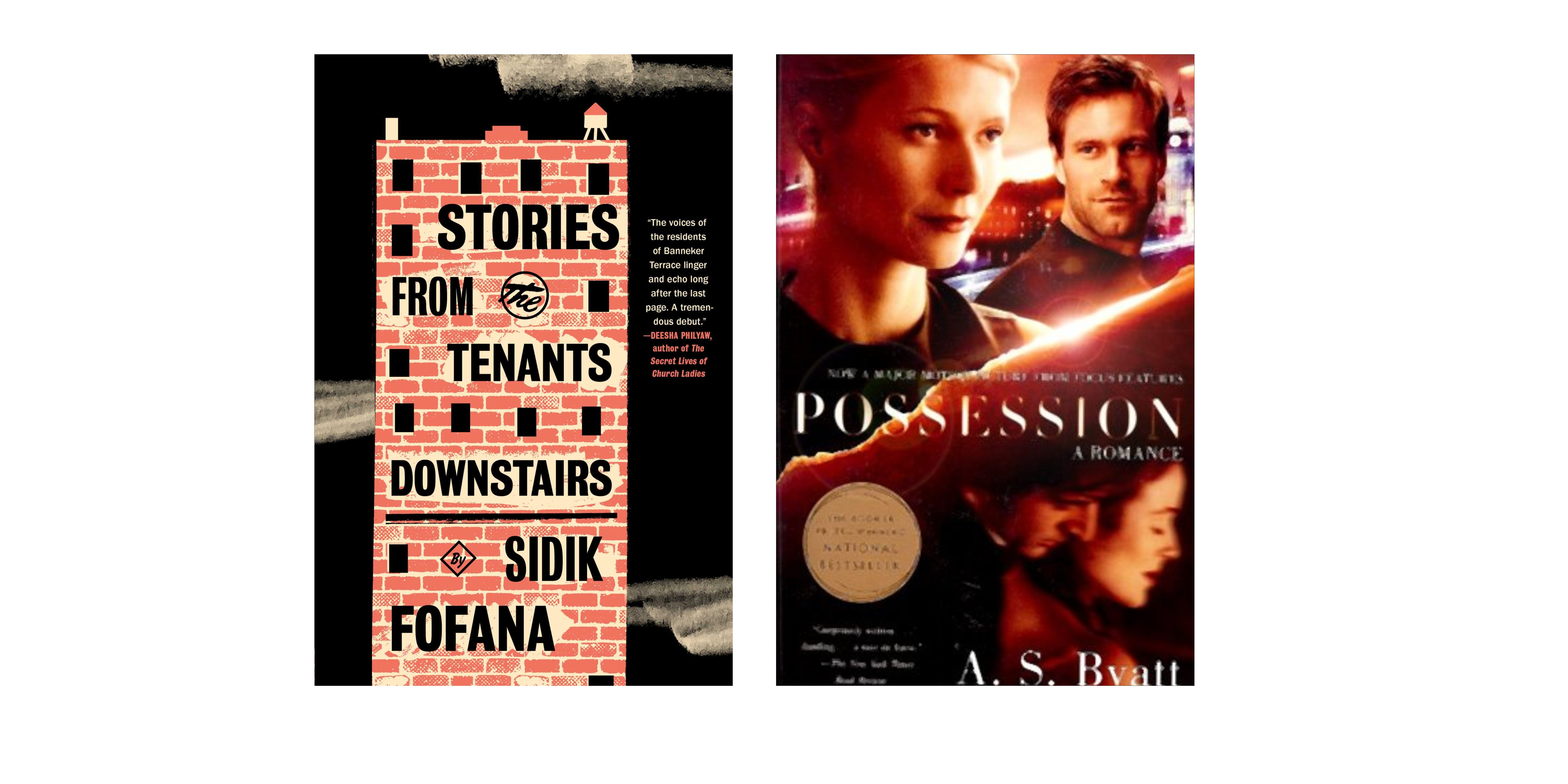
Book cover images for Stories from the Tenants Downstairs by Sidik Fofana and Possession by A.S. Byatt

Stories from the Tenants Downstairs — Sidik Fofana

I picked this up as a “blind date with a book” from Transom bookstore in Tarrytown, which did a perfect job of reeling me in with its no-spoilers pitch. The blind date bio was: “a voicey, bombastic mosaic of a novel full of vibrant characters, real drama, and sharp social commentary on modern urban development,” and I think the Transom bookseller hit the nail on the head with that description.

This story collection is set at Banneker Terrace, a housing project in Harlem facing the looming threat of rent hikes and gentrification. Each chapter focuses on a different tenant, spotlighting single mothers, young entrepreneurs, an aspiring hairdresser, an elderly chess player, and more. A microcosm of New York community, everyone is fighting to support themselves and each other as best they can, and I found myself invested in all the ways the different storylines intersected and diverged. A quick but impactful read, these stories left me wanting to check back up on the characters like they were real people, and had me thinking for a long time about hope and grit and the complicated relationship between identity and home.

Possession — A.S. Byatt

I had to look at this silly-ass book cover every day, so I’m making you look at it too. Well over 500 pages, this book took me a loooong time to get through, but I ultimately appreciated the way it forced me to slow down and lengthen my attention span. The story is split between that of two modern-day British literature scholars investigating a potential affair between two Victorian poets, and the affair itself, pieced together from letters, diary entries, and their poems themselves. When the modern-day scholars’ quest catches the interest of other academics with a stake in the game, it becomes a race through time to uncover—and claim possession of—the truth.

As a novel about literature, this ticked a lot of boxes for the former English major in me. I love a scandalous literary mystery! That said, I definitely think the POV-hopping affects the pacing, and apparently some people (Goodreads reviewers) take issue with the amount of real estate that the poems introducing each chapter take up. However! If you’re paying close attention, the poems actually have little clues and Easter eggs relevant to the narrative, which I think is very cool!! Also, can we take a moment to appreciate how impressive it is that the author not only wrote a whole novel, but multiple poems in distinct styles and voices, attributed to different characters? This is the kind of showing off that wins you a Booker Prize.


THE TIPPY TOP:

book cover image for Água Viva by Clarice Lispector

Água Viva — Clarice Lispector, translated by Stefan Tobler

I don’t even know where to begin with this tiny, crazy book. I can’t remember who recommended it to me, but after waiting months to get it from the library, I read it in one sitting, returned it to the library, bought a copy, and re-read it with a pen in hand so I could underline my favorite lines—something I rarely do! It reminded me a lot of Maggie Nelson’s Bluets for its snippet-like, philosophical-leaning experimentation with form, and because both are journeys of artistic self-exploration in the wake of an ended love.

Água Viva is Lispector’s quest to capture each instant moment as it passes to discover the fundamental truth of what is. She attempts to surpass that which can be expressed through words to reach an experience that exists “beyond thought,” often comparing these forays into the inexpressible to the effect art and music have on the brain. Phillip read it after me and said it was like reading from the perspective of an atom, which I thought was both brilliant and accurate.

Her playful experimentation with language becomes a vehicle for excavating the truest self, transfiguring the reality of our mundane world into symbols that represent shared experiences of emotion and sensation. What ensues is a kind of birth, a reborn Lispector speaking from the instant of the page to both her lost love and all her future readers, transcending the boundaries of time and space and form to preserve her inimitable, unmistakable voice. This is one of those books you could read again and again and get something new out of it every time, and I fully plan to do so.


That’s a wrap on the first half of summer reading! I’d love to hear from you about how your reading goals are going, what’s left on your summer TBR, and if you have any thoughts on the books above. Feel free to drop a comment below or send me a message in all the usual places—I’m always down to chat!

Until next time, happy reading!
❤ Catherine


Housekeeping note: all book links go to my Bookshop storefront, where each purchase supports independent bookstores (and this newsletter, because I get a small percentage of each sale).