Lit Chat’s Best Books of 2023: Round 3

Housekeeping note: all book links go to my Bookshop storefront, where each purchase supports independent bookstores (and this newsletter, because I get a small percentage of each sale).


Hi friends,

I’m just as ready to put 2023 behind me as I’m sure you are by now, so let’s get this show on the road. After yesterday’s semifinals, these were our standings:
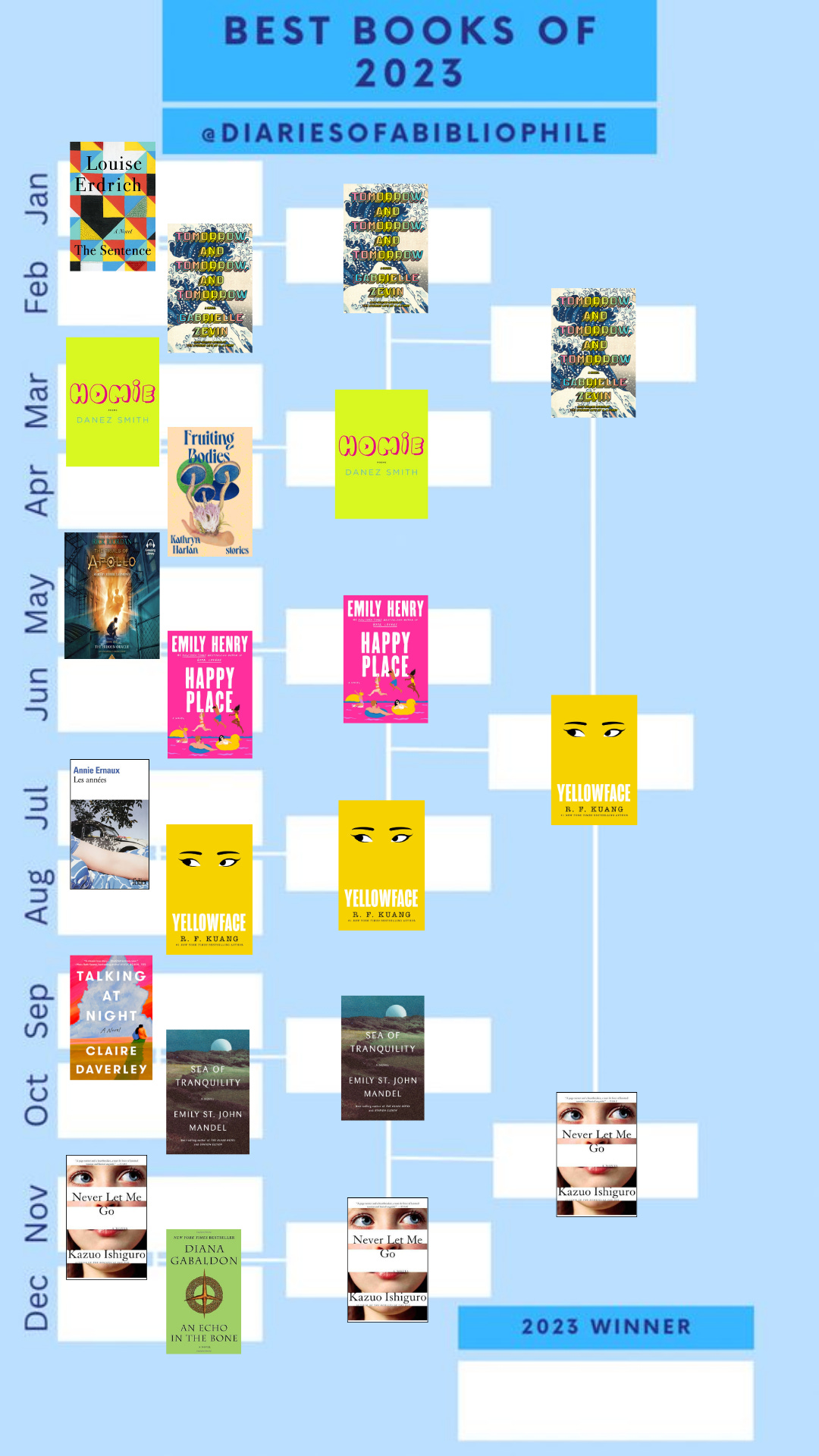
Graphic for the Best Books of 2023 bracket

Which leaves us with a top three: Gabrielle Zevin’s Tomorrow and Tomorrow and Tomorrow, R.F. Kuang’s Yellowface, and Kazuo Ishiguro’s Never Let Me Go. So without further ado, below are my official Best Books of 2023 final rankings:

Round Three:

Third Place: Yellowface by R.F. Kuang

Book cover image for Yellowface by R.F. Kuang
Read my original review here!

The fun thing about this being a bracket is that while I wouldn’t necessarily say this is my third favorite book of the year, I’m pleased that Yellowface has managed to fight its way to the top all the same. It doesn’t come close to the other two finalists in terms of lasting impact and emotional resonance, but as a satire about publishing, it has a distinct appeal to readers invested in this industry.

If you missed my initial review (and don’t feel like revisiting the August newsletter), Yellowface is about a white author who steals her late Asian-American friend’s manuscript about Chinese soldiers during WWI and passes it off as her own under a racially ambiguous pen name. As an Asian-American author writing a white protagonist, Kuang is in a unique position to call out some of the worst cycles of bias that have been perpetuated by those in positions of privilege in the industry via her narrator’s thoughts and behavior. Kuang wants us to feel shocked—she wants us to think, “Oh my God, she can’t say that,” when June thinks or speaks disparagingly about other writers and readers of color—and yet the shock comes not from the sentiment itself but the fact that it has been spoken aloud. In other words: Kuang goes there, sticks our face in the mess like an untrained dog, then washes her hands of it all. A worthy showing for this highly entertaining, if slightly niche read!

Second Place: Never Let Me Go by Kazuo Ishiguro
Book cover image for Never Let Me Go by Kazuo Ishiguro
Read my original review here!

This was so hard!! I flip-flopped a lot, but what my decision came down to is the fact that this book is ultimately SAD. Don’t get me wrong, I loved being knocked out by this book. It’s beautiful and insightful and moving and I do wholeheartedly believe there is value in experiencing the full range of human emotions through literature, but at the end of the day, I would simply prefer not to be sad! I would prefer to have a bit of hope, as a treat, and unfortunately, there is very little of that by the end of Never Let Me Go.

By no means do I mean to put anybody off from reading this—ultimately, it is #2 of the year for a reason and that reason is I believe it to be a profoundly important and impactful work of literature, but it’s heavy enough that I would recommend going into it with enough mental/emotional space to sit with the discomfort. That said, please read this one and come talk to me about it! Let’s be devastated together :’).

First Place: Tomorrow and Tomorrow and Tomorrow by Gabrielle Zevin
Book cover image for Tomorrow and Tomorrow and Tomorrow by Gabrielle Zevin
Read my original review here!

This book, on the other hand!!! The aforementioned full range of human emotions is undeniably present, and I would be lying if I said this one didn’t also make me sad—there may even have been tears! But what makes this one the ultimate winner of my Best Books of 2023 bracket is that the sadness is balanced out by an overwhelming amount of love. In fact, it wouldn’t even be sad if so much love had not preceded the sadness. And there are so many different kinds of love present, including friendship love, romantic love, familial love, creative love, and the ultimate respect that comes from experiencing so many facets of love within the same relationship.

Often when I think back on a book, my first thought is the memory of how I felt when it was over. Tomorrow and Tomorrow and Tomorrow had one of my favorite endings of all time, because (and this isn’t a spoiler!) it ends almost exactly how it begins. Thematically, this restart was the perfect ending for a book about video games, but emotionally, the suggestion that the story was only just beginning anew was everything I wanted for the two main characters. I didn’t need to know how their story ended because I didn’t want it to end—I wanted them to remain open to a whole lifetime of friendship and creative potential and mutual respect borne of years and years of loving each other in different ways. With this ending, we get to believe that this is true. So for the sake of this bracket (and for always), I hereby declare that love WINS!!!


Honorable Mentions:
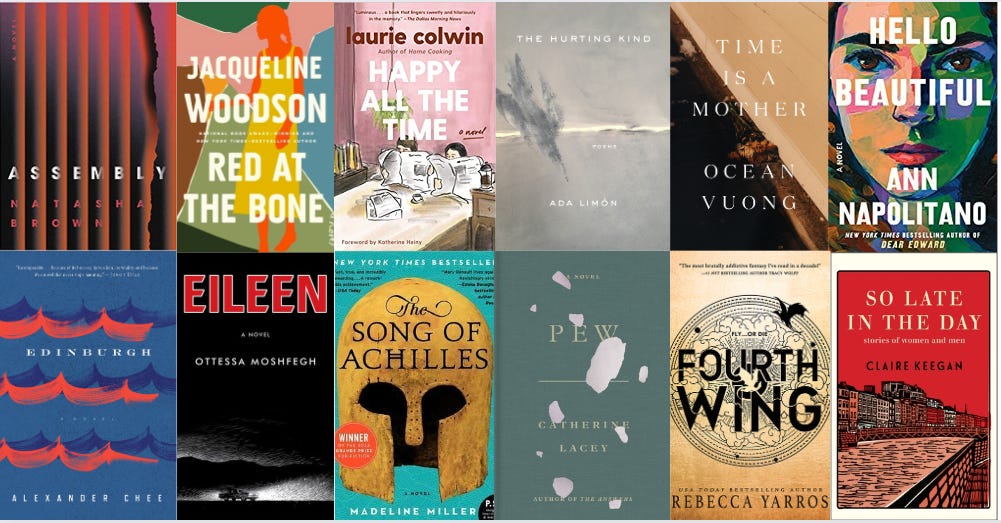
Book cover images for Assembly by Natasha Brown, Red at the Bone by Jacqueline Woodson, Happy All the Time by Laurie Colwin, The Hurting Kind by Ada Limon, Time is a Mother by Ocean Vuong, Hello Beautiful by Ann Napolitano, Edinburgh by Alexander Chee, Eileen by Ottessa Moshfegh, The Song of Achilles by Madeline Miller, Pew by Catherine Lacey, Fourth Wing by Rebecca Yarros, and So Late in the Day by Claire Keegan.

Above are some of my favorite runners-up from the year! Though all of these books fell short of the official monthly top spot, let’s just say this year’s bracket would have looked a lot different had some of these been in play. Maybe I’ll do a bigger one next year? In the meantime, I’ll do one last push for you to check out the Lit Chat archives for reading inspiration if one of these covers catches your eye, and I’ll also remind everyone that all of these books are neatly organized by month on my Bookshop storefront! And if you want these posts straight to your inbox, then go ahead and click the button below to subscribe on Substack.


Thanks so much to everyone for reading with me in 2023, especially those of you who have reached out to chat about these and other books or who have shared this newsletter with other fellow readers. I so appreciate you!

ALSO I almost forgot, but I will be sending an email out soon to those interested in joining my little in-person reading show & tell club! If you’re local to NYC and haven’t already let me know you wanna come, reach out! Tentative date is Saturday, January 20th with more details to follow.

Until next time, happy reading and cheers to many more good books in 2024!
❤ Catherine
Lit Chat’s Best Books of 2023: Round Two

Housekeeping note: all book links go to my Bookshop storefront, where each purchase supports independent bookstores (and this newsletter, because I get a small percentage of each sale).


Hi friends,

Welcome back for another round of my highly subjective Best Books of 2023 bracket! Today, we have six titles facing off for the honor of making it to the top three, which makes this the semifinals already! Here’s where we stand so far:

Best Books of 2023 bracket image

Also, a quick reminder that you can get this post directly to your inbox if you subscribe to my Substack!

All right, it’s a gloomy day in Brooklyn; let’s talk about some books.


ROUND TWO:

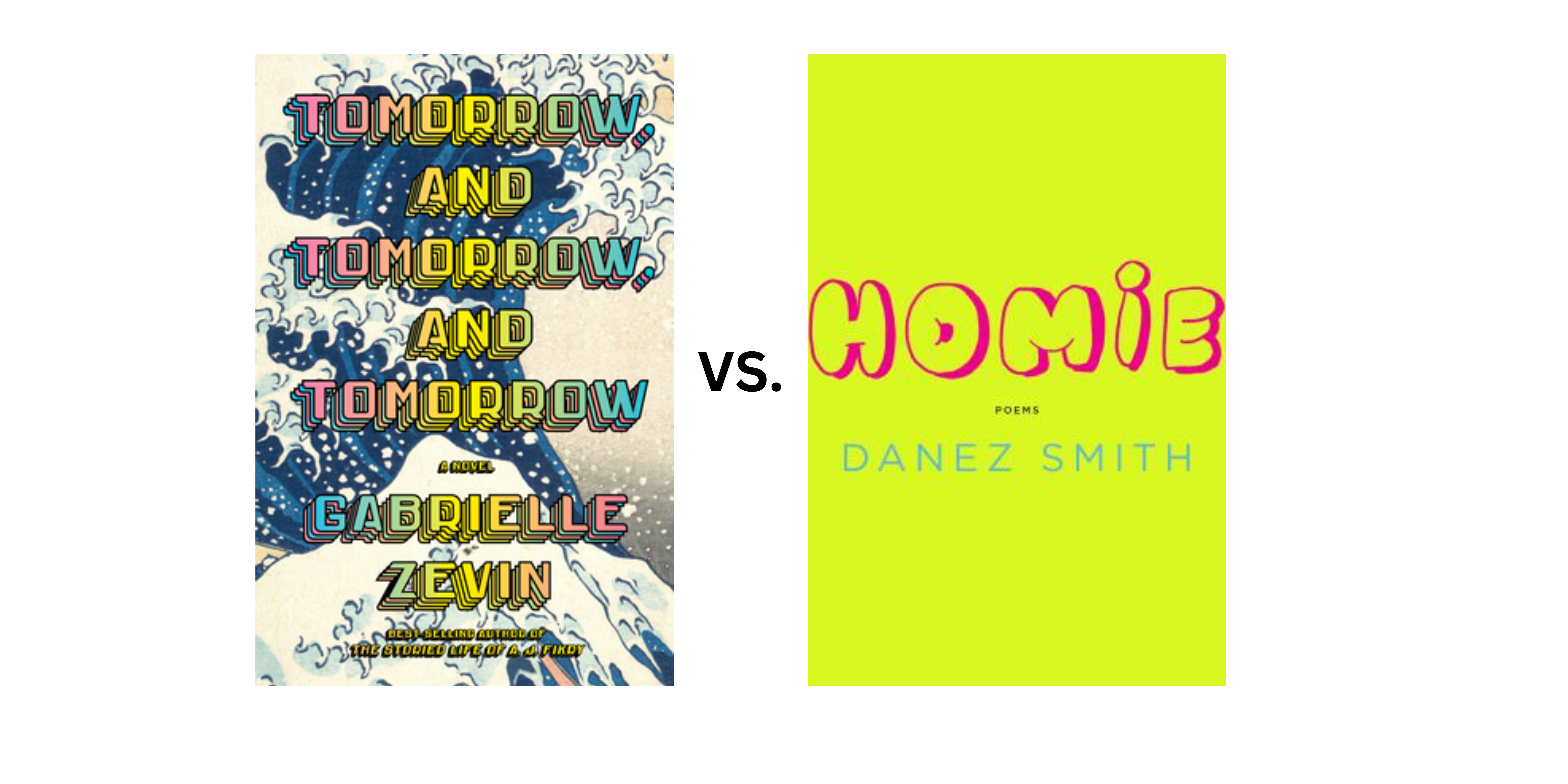
Book cover images for Tomorrow and Tomorrow and Tomorrow by Gabrielle Zevin and Homie by Danez Smith

Tomorrow and Tomorrow and Tomorrow by Gabrielle Zevin vs. Homie by Danez Smith

I so wish I didn’t have to put these two head to head because they are truly in leagues of their own, but so it goes. When I think of comparing these two books, I think of scope: Homie, though completely wonderful, simply feels small in comparison to the sprawling saga that is Tomorrow and Tomorrow and Tomorrow. What I love about Homie is how it does so much emotionally with such a small space, as a testament to all the people and places the poet loves, but we don’t necessarily get to know those people as closely as we do when we follow their lives for decades like we do in Tomorrow and Tomorrow and Tomorrow. At their core, both books are centered around friendship, which is why this feels slightly unfair because a novel is a completely different vehicle for exploring the nuances of that friendship and, in this case, the worlds that are created as a result. While I loved feeling like a witness to Danez Smith’s highly personal world, I felt fully inside not only Sam and Sadie’s real lives, but also each of the worlds they created in their games. This expansiveness is why I’m moving Tomorrow and Tomorrow and Tomorrow forward, though it’s with a heavy heart that I leave Homie behind.

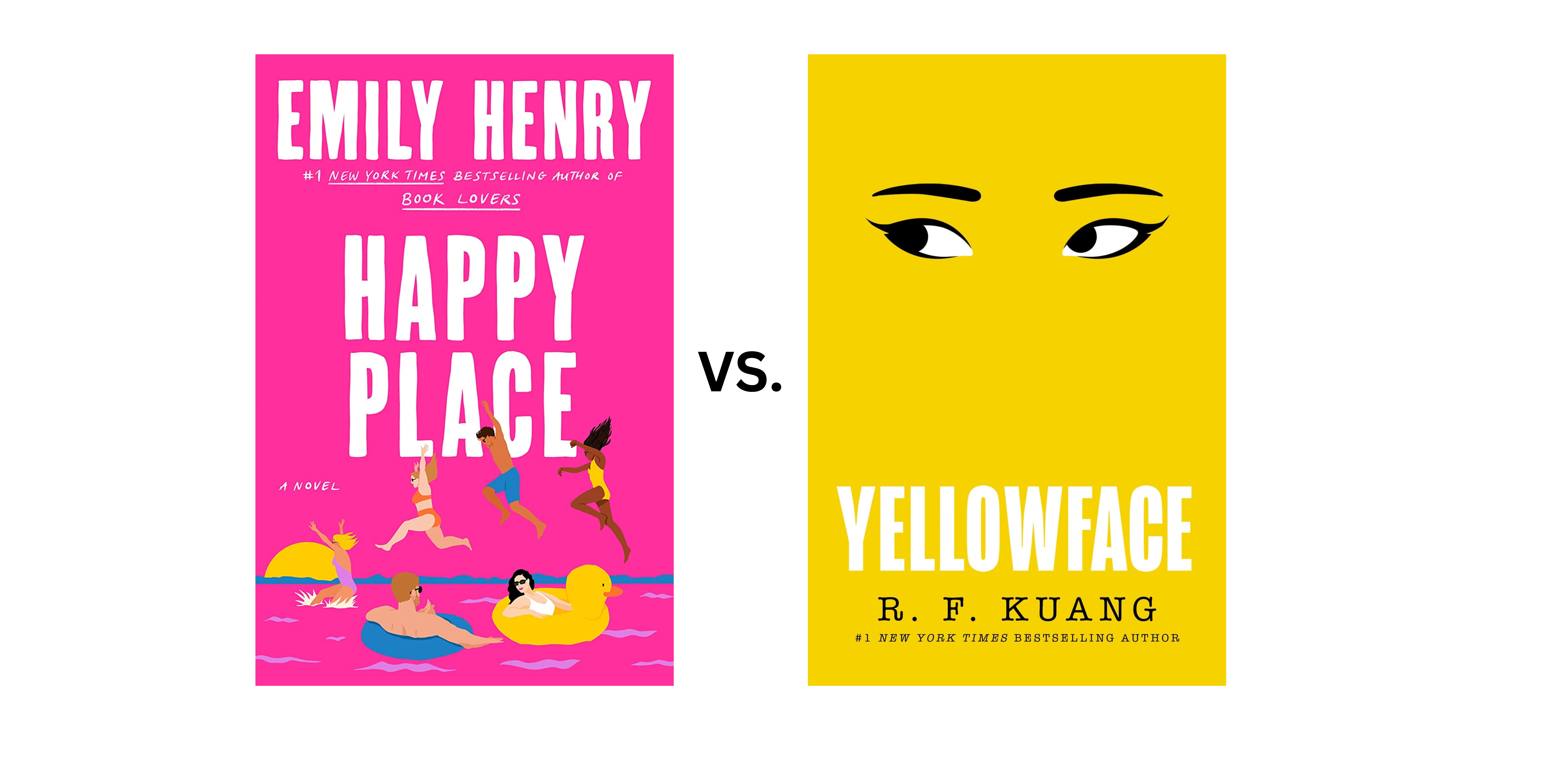
Book cover images for Happy Place by Emily Henry and Yellowface by R.F. Kuang

Happy Place by Emily Henry vs. Yellowface by R.F. Kuang

Something I’ve learned about myself and my media consumption habits lately is that fundamentally, I am not a hater but a liker. I like to enjoy things, and I am fairly easily pleased! Unless I am specifically approaching something with skepticism, I’m more than happy to turn the critical thinking part of my brain off for the sake of entertainment. Some books are better suited for this than others—in my initial read of Happy Place, I was perfectly happy to be along for the ride. I love stories that feature big friend groups, particularly ones in the same phase of life as me, so I was content to overlook the fact that the secondary characters often fell a little flat. I also love rooting for a good romance, especially when we’re more concerned with the characters’ chemistry than the fact that it’s completely insane to (spoiler) abandon a neurosurgery degree that you’re hundreds of thousands of dollars in debt for to become a…potter? Details, details! Suspend disbelief for love! I still had a great time with Happy Place, but as many of my more critical friends were quick to point out, there are definitely some holes.

Yellowface, on the other hand, is meant to be insane. Yellowface is written from the perspective of a hater and a grasper and an all-around kind of terrible person, and there’s something so delicious about being inside her head and watching from behind your fingers as she continues to make shocking decisions. As a commentary on race and privilege in the publishing industry, Yellowface ultimately also has more to say in general than an unconcerned-with-reality rom-com. I have more I want to say about Yellowface still, which is why I’m officially moving it forward to the finals.

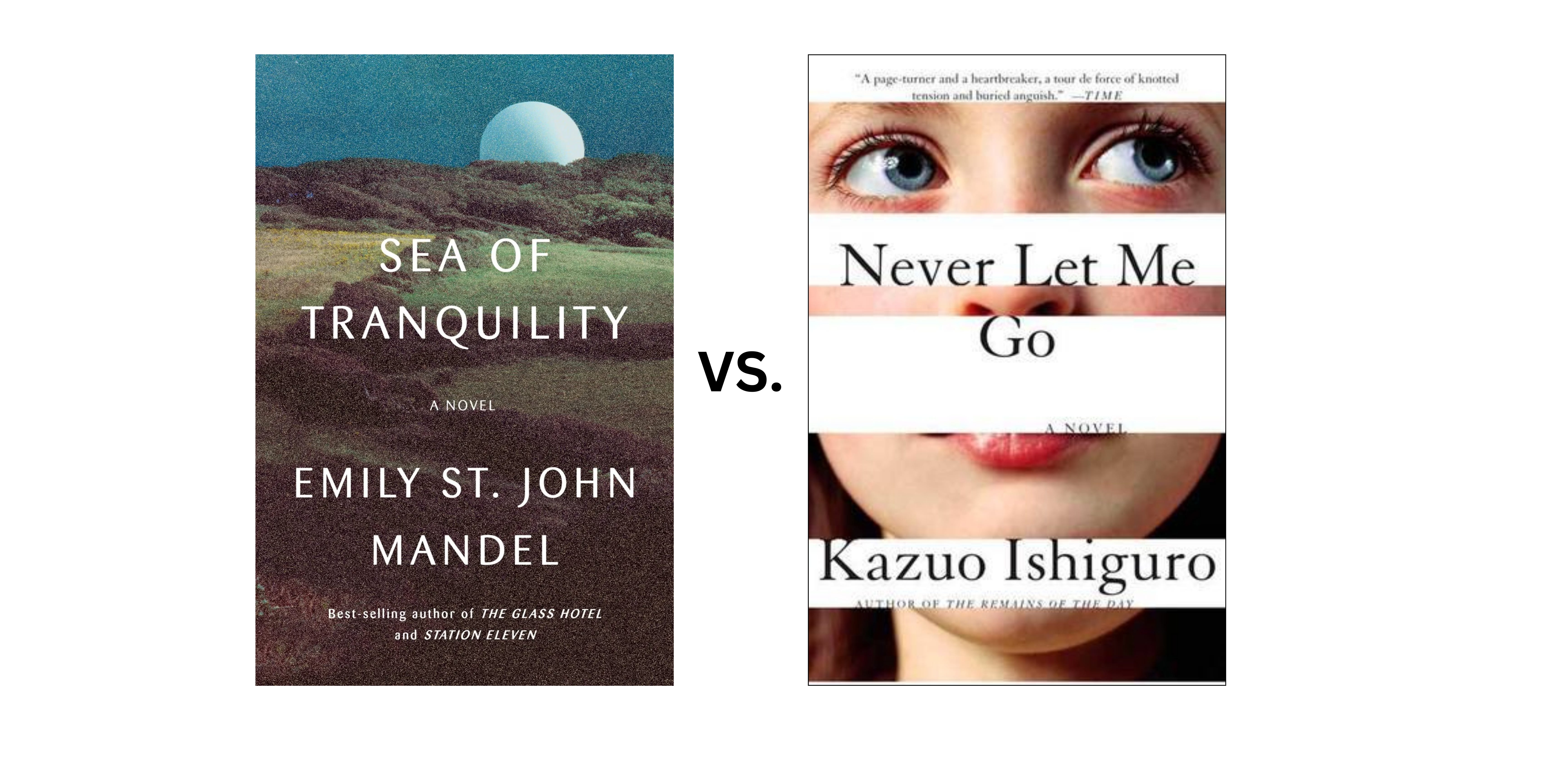
Book cover images for Sea of Tranquility by Emily St. John Mandel and Never Let Me Go by Kazuo Ishiguro

Sea of Tranquility by Emily St. John Mandel vs. Never Let Me Go by Kazuo Ishiguro

This one is TOUGH. The hard thing about this bracket is that a book like Sea of Tranquility would have easily beat out so many others on this list, but against Never Let Me Go it’s a lot less of a wash. These two are similar in genre, and both stayed on my mind for a long time after reading, though for different reasons. As a time-travel story, I spent days puzzling through the events of Sea of Tranquility and how each action seemed perfectly placed to affect not just the story, but also our understanding of time, space, and free will. It presented a fascinating intellectual question that, in its narrative execution, could also be appreciated as a masterful work of literature. It’s still one of my favorite books of the year, but its impact isn’t quite on the scale of Never Let Me Go.

The way that Never Let Me Go continues to take up space in my brain can only be described as a haunting. For a sci-fi/speculative fiction novel, it’s eerie how easily the reader finds themselves settling into daily life at Hailsham, how normalized and almost comfortable it is as a setting in which we’re happy to ignore the many, many red flags about the world beyond. And though a world in which (spoilers!!!) clone children are raised and groomed for the sole purpose of donating their organs does still feel far-fetched (for now), their treatment by society is all too familiar: othered, subhuman, and ultimately disposable. One of the most terrifying parts is realizing how easily we might agree with this thinking had we not spent the whole book watching these characters grow up, and yet the central question of whether or not the children have a soul is still not one I feel fully prepared to answer by the end of the book. It’s a question I’m not sure I’ll ever have a definitive answer for, but one I know I’ll be pondering for a very long time.


There you have it, my top three finalists! Come back tomorrow to see how the final three rank and check out a brief list of honorable mentions for books that I loved in 2023 but which didn’t make the bracket.

Thanks for reading, chat more soon!
❤ Catherine

Lit Chat’s Best Books of 2023: Round 1

Housekeeping note: all book links go to my Bookshop storefront, where each purchase supports independent bookstores (and this newsletter, because I get a small percentage of each sale).


Hi friends,

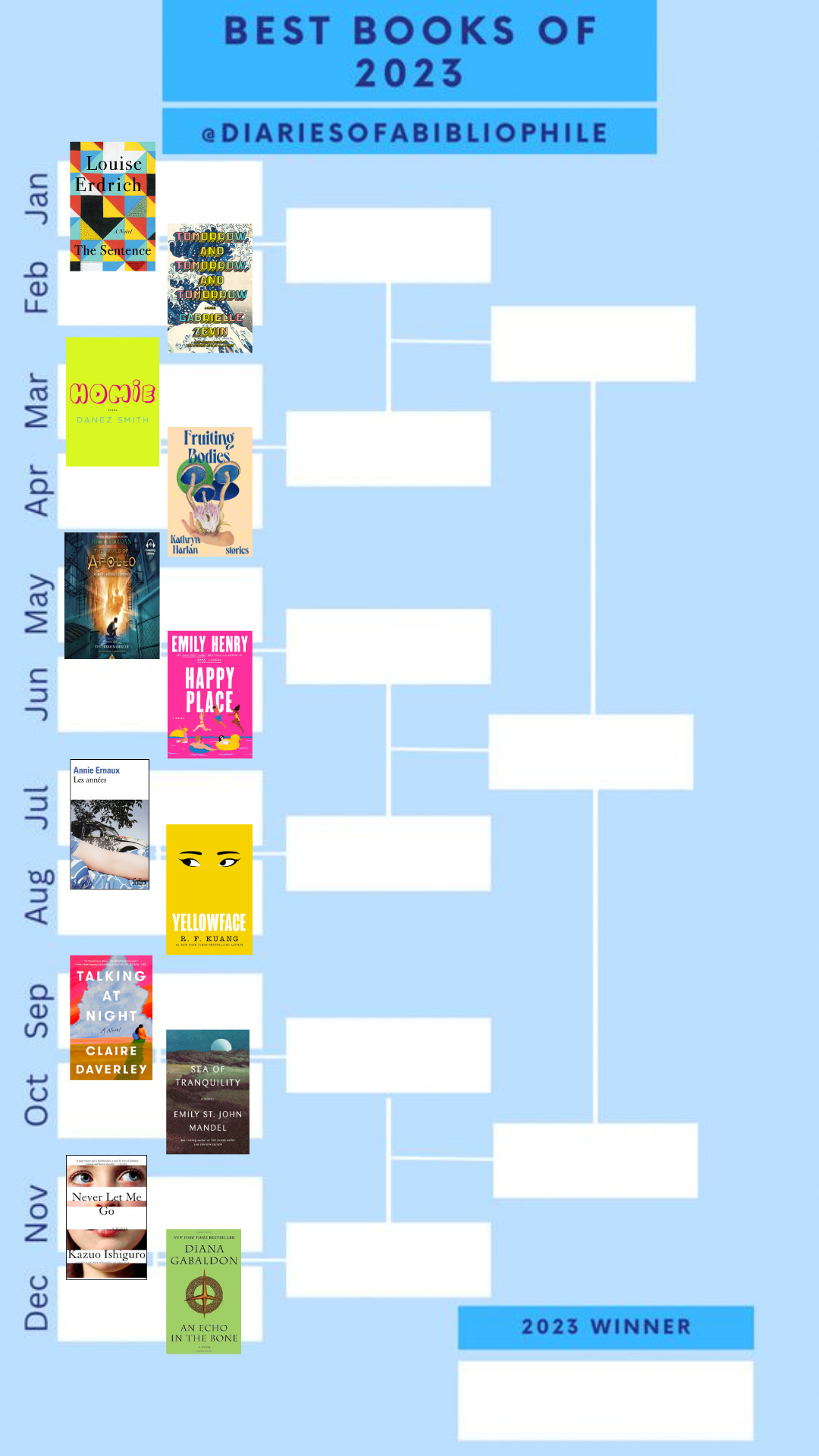
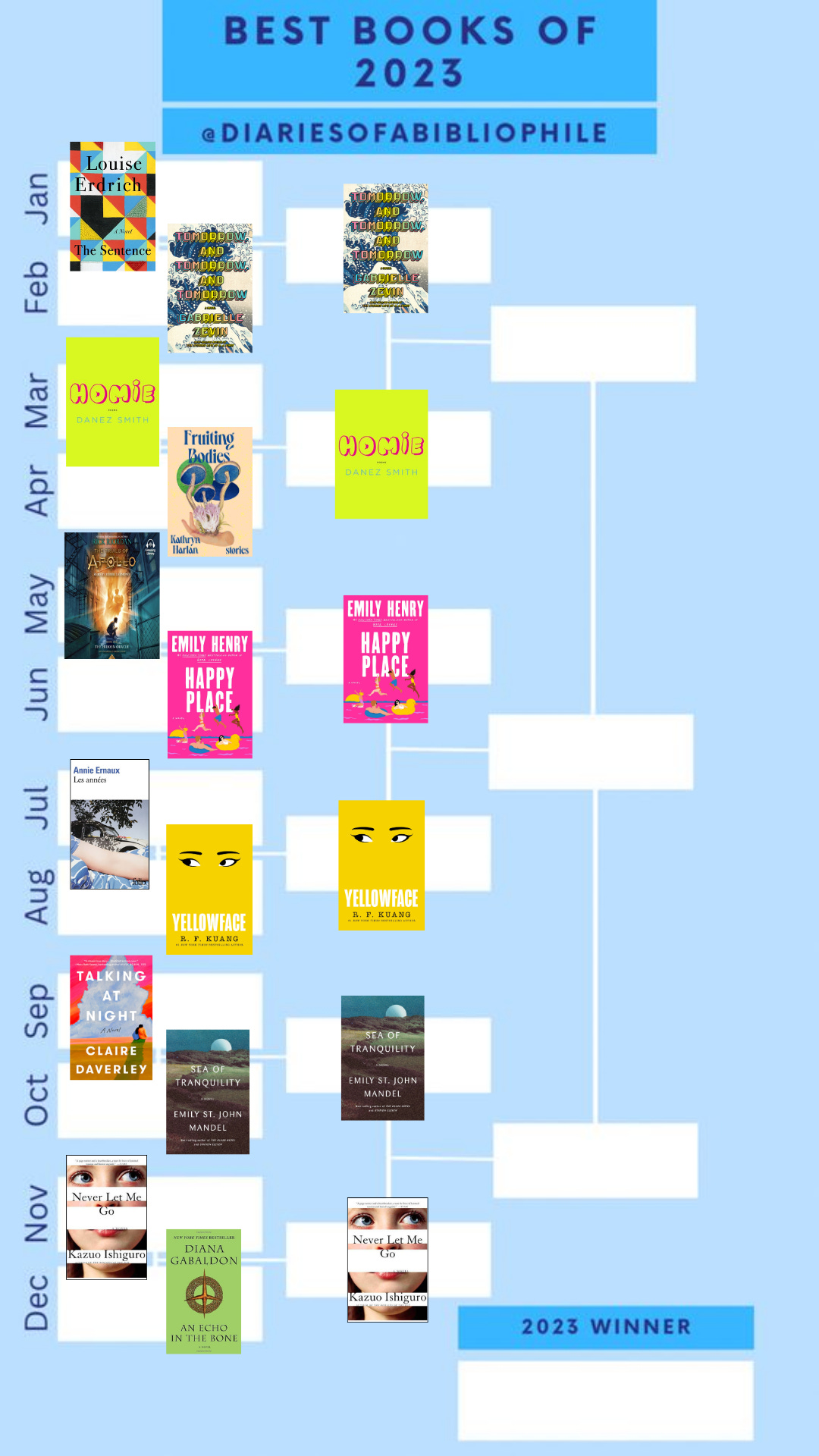
Happy New Year! Bet you thought you were done with end-of-year recaps in your inbox, huh? Lucky for you, the new year has done nothing to cure my pathological procrastination, so here we are a week later! Below is the start to my Best Books of 2023 bracket, courtesy of this graphic I found on Pinterest (thanks, @diariesofabibliophile, whoever you are!) and my very rudimentary Canva skills:

Bracket of book cover images for each calendar month of 2023.

In terms of rating criteria, we’re mostly going for vibes here: how I felt while reading, what’s stuck with me after I’ve finished, and overall impact (on me as a person, my tastes, my interests, my emotions, etc.). You may disagree—in fact, I hope you do and I hope you tell me about it! I love hearing from friends who have had different reading experiences than me.

This year was a particularly strong reading year, and some of my favorites didn’t even make this list by nature of coming in second to another rockstar book that month. I’d encourage you to check out the Lit Chat archives or poke around on my Bookshop storefront for other reading inspiration! I also love nothing more than giving a personal recommendation, so feel free to reach out if you’re in the mood for something specific but don’t know what that is yet.

Without further ado, let’s begin!


ROUND ONE:

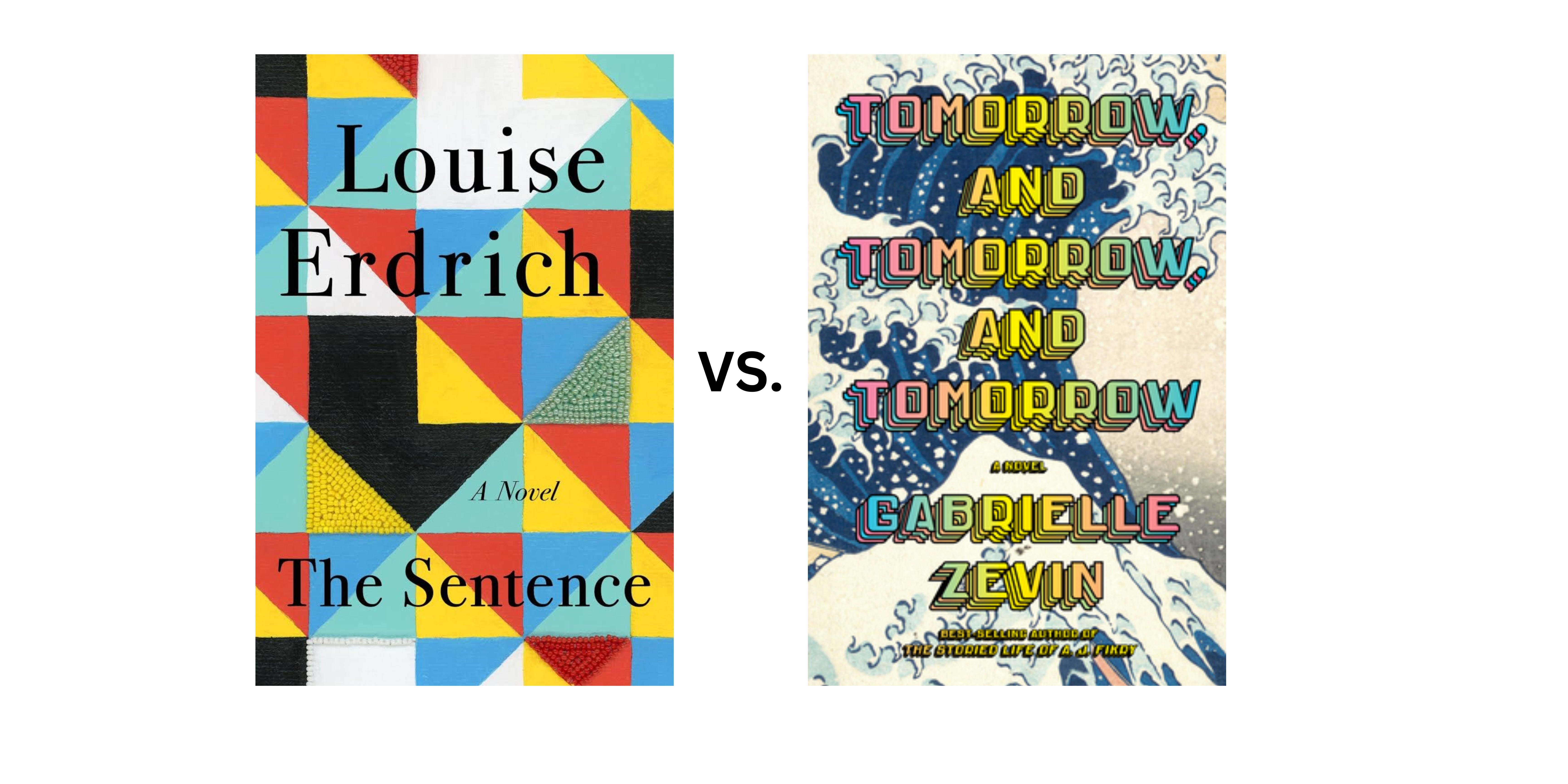
Book cover images for The Sentence by Louise Erdrich and Tomorrow and Tomorrow and Tomorrow by Gabrielle Zevin

The Sentence by Louise Erdrich vs. Tomorrow and Tomorrow and Tomorrow by Gabrielle Zevin

I’m upset about this already because it feels unfair to drop one of these phenomenal books so early. The Sentence was the first book I read in 2023 and set the bar high for its unique characters, sense of community, and portrayal of resilience in the face of so many personal and political upheavals (I was wrong last month when I said Tom Lake was my first Covid book; it was The Sentence!). The Sentence left me energized and inspired for my reading year ahead, whereas Tomorrow and Tomorrow and Tomorrow was so emotionally all-encompassing that it left me with one of the worst book hangovers I’ve had in a long time. To have that happen so early in the year was daunting, to say the least. Ultimately, this is why Tomorrow and Tomorrow and Tomorrow is going to move forward this round, although it pains me to say goodbye to The Sentence so early in the game.

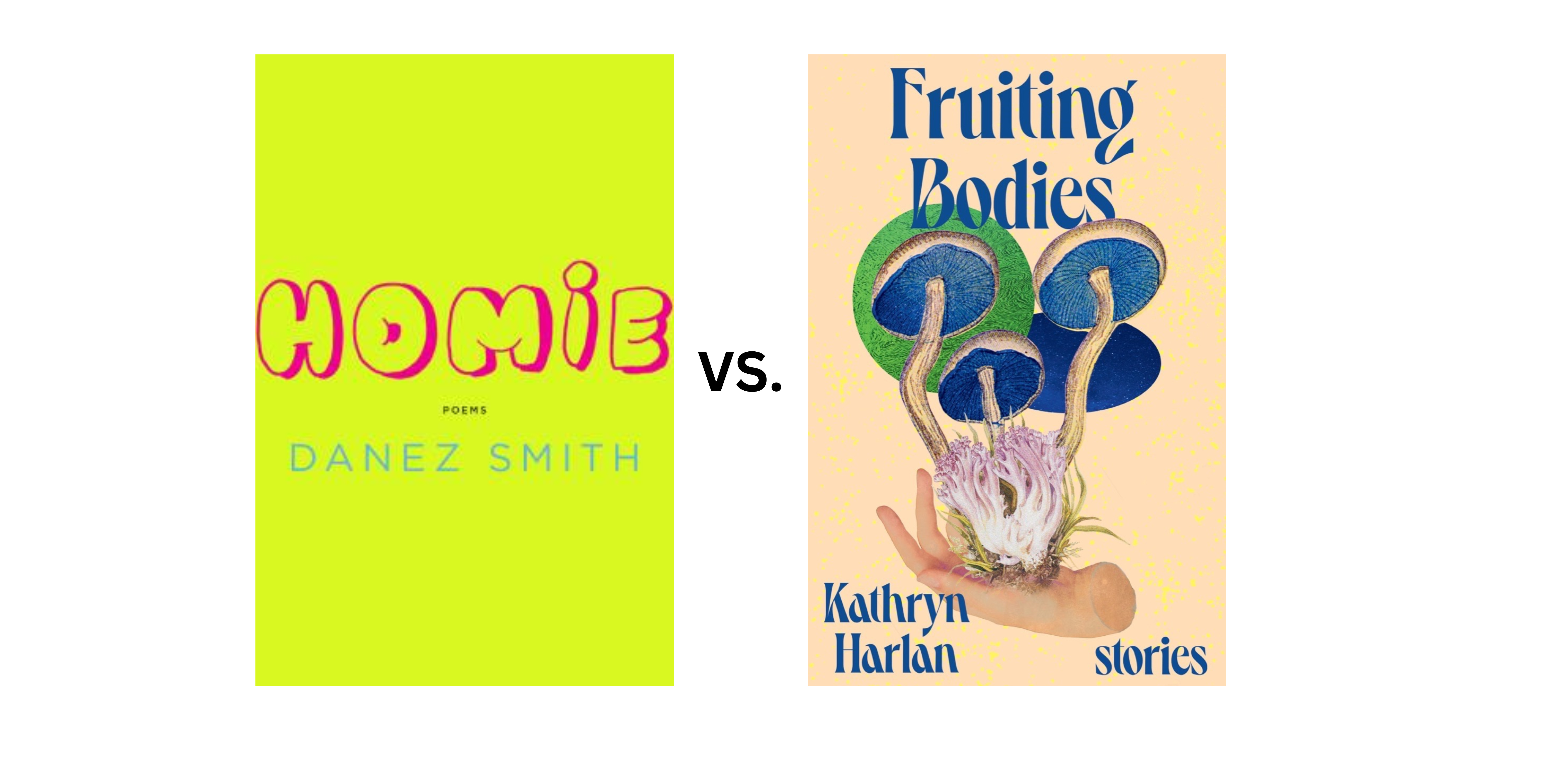
Book cover images for Homie by Danez Smith and Fruiting Bodies by Kathryn Harlan

Homie by Danez Smith vs. Fruiting Bodies by Kathryn Harlan

Another tough but very different match-up! Listening to Danez Smith narrate the audiobook for Homie was one of the highlights of my winter, eclipsed only by getting to see Danez perform live at the New York City Poetry Festival on Governors Island this summer. Likewise, Kathryn Harlan’s collection of eerily enchanting, female-centric short stories has also lingered with me this year, and I recently recommended it to a friend just last month. While Fruiting Bodies renewed my interest in short fiction and magical realism, there’s just something about listening to poems like my president, for Andrew, and waiting for you to die so i can be myself read aloud by the poet, feeling the raw emotion, joy, and vulnerability that exists in these exultations of friendship and community that feels timeless and transcendent. Homie wins this round!

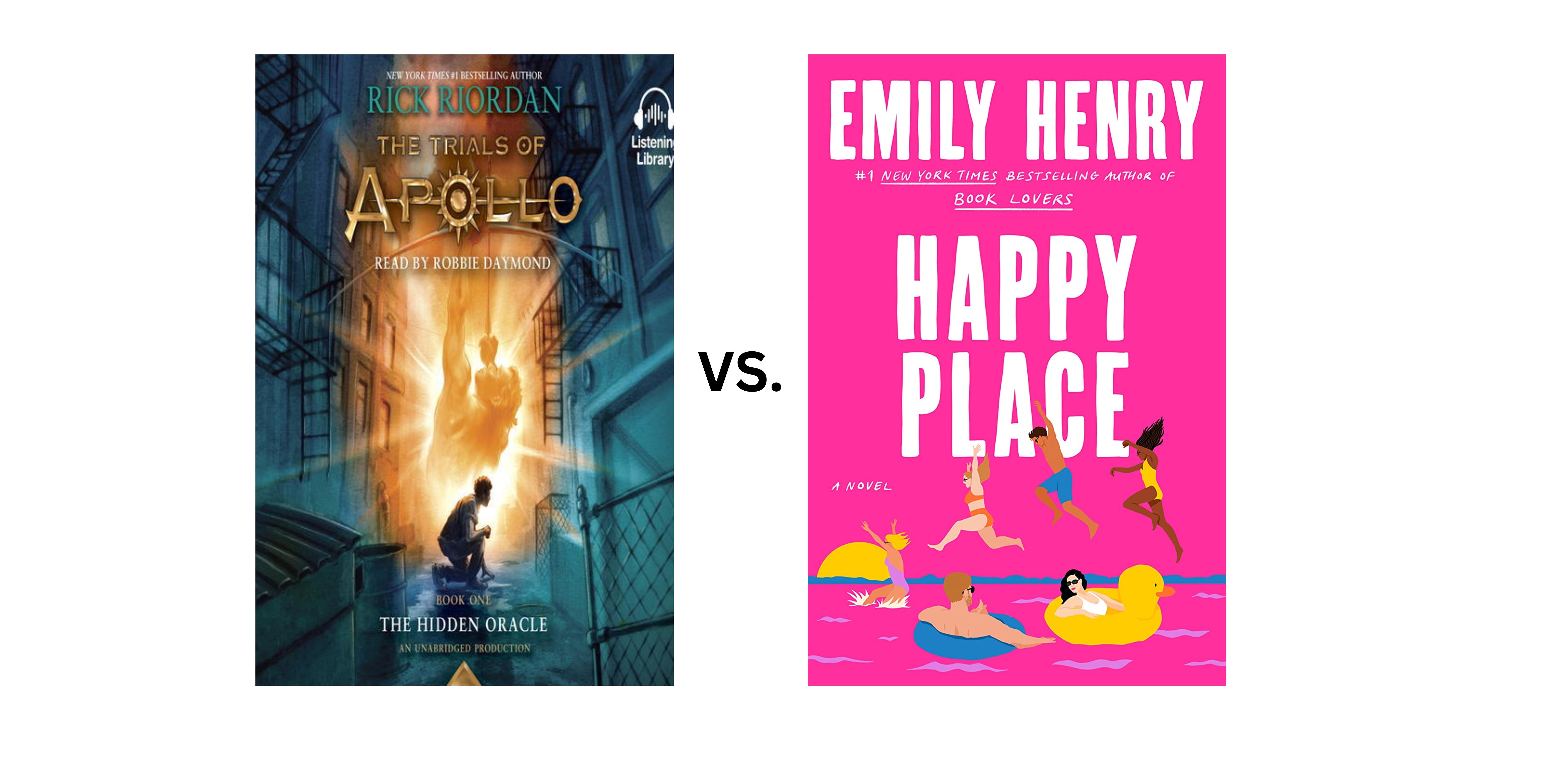
Book cover images for The Hidden Oracle by Rick Riordan and Happy Place by Emily Henry

The Hidden Oracle by Rick Riordan vs. Happy Place by Emily Henry

This might be the silliest match-up of them all, but honestly, it’s still a real contest. The Hidden Oracle was top-notch mythological fun, and with the new Percy Jackson adaptation now streaming, I’m even more favorably inclined to move it along than I might have been a month ago. But to be fair, I forgot I even read this one, whereas I’ve had so many conversations with friends about Happy Place since reading that it’s stayed all too present in my mind. It’s one that I’ve found surprisingly controversial, and though I have plenty more thoughts, I’ll save them for the next round. Happy Place moves forward on the merit of being a thoroughly enjoyable read that is only slightly more relevant to my life as a late twenty-something than the book about fallen gods turned awkward teenagers. (Note to self: finish listening to the Trials of Apollo books in 2024.)

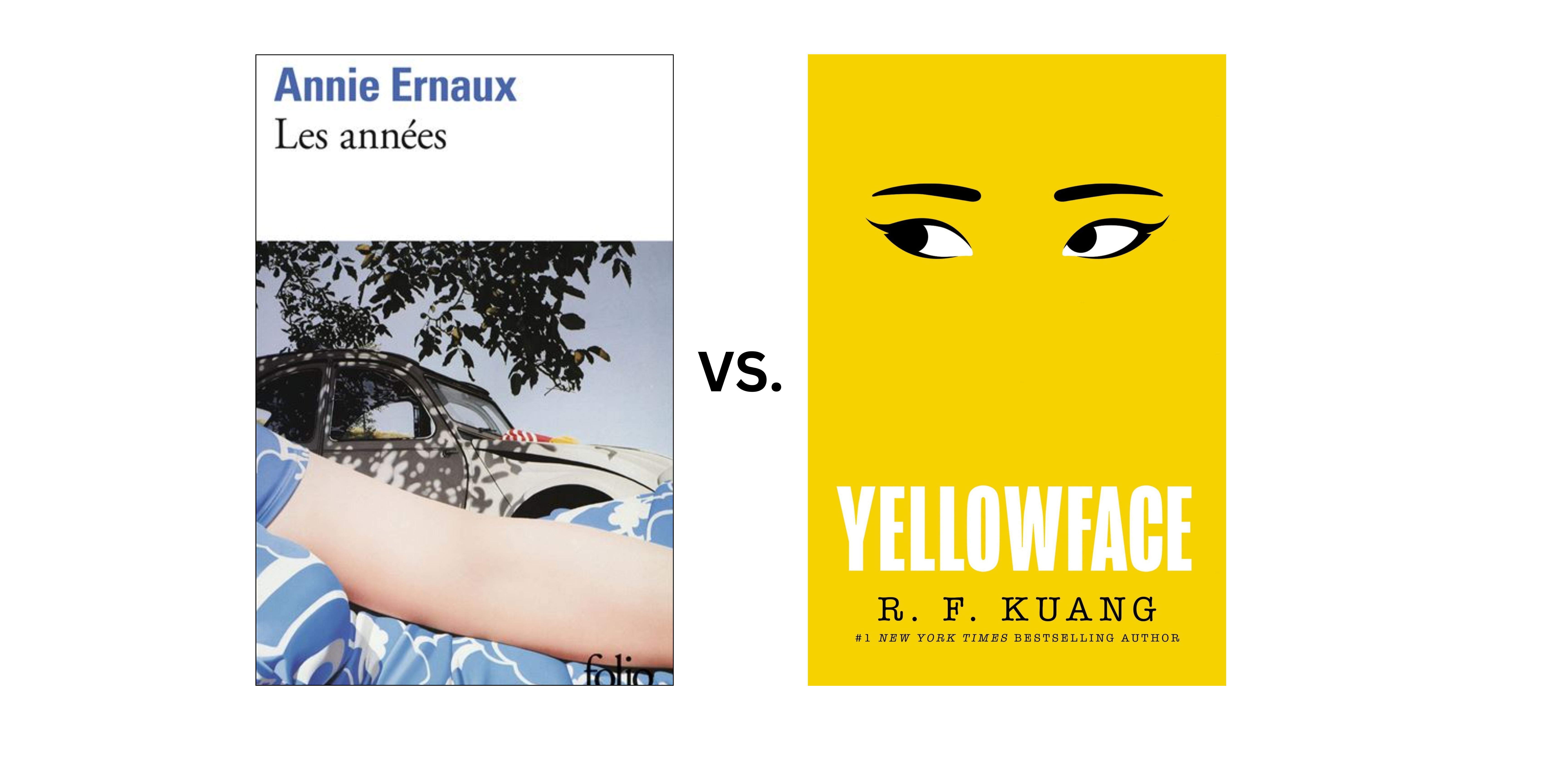
Book cover images for Les annees by Annie Ernaux and Yellowface by R.F. Kuang

Les Années (The Years) by Annie Ernaux vs. Yellowface by R.F. Kuang

You may remember that I didn’t actually finish a single book in July because of moving apartments and traveling, but I’m putting Annie Ernaux forward as the book I spent all of July reading when I had the time. While I spent almost a whole month trying to get through this one in the original French, I flew through Yellowface and its scandalously delightful satire of the publishing industry in a matter of days. I know Les Années is brilliant and I will return to it in English someday, but man, it made my brain so tired. Yellowface moves on to the next round!

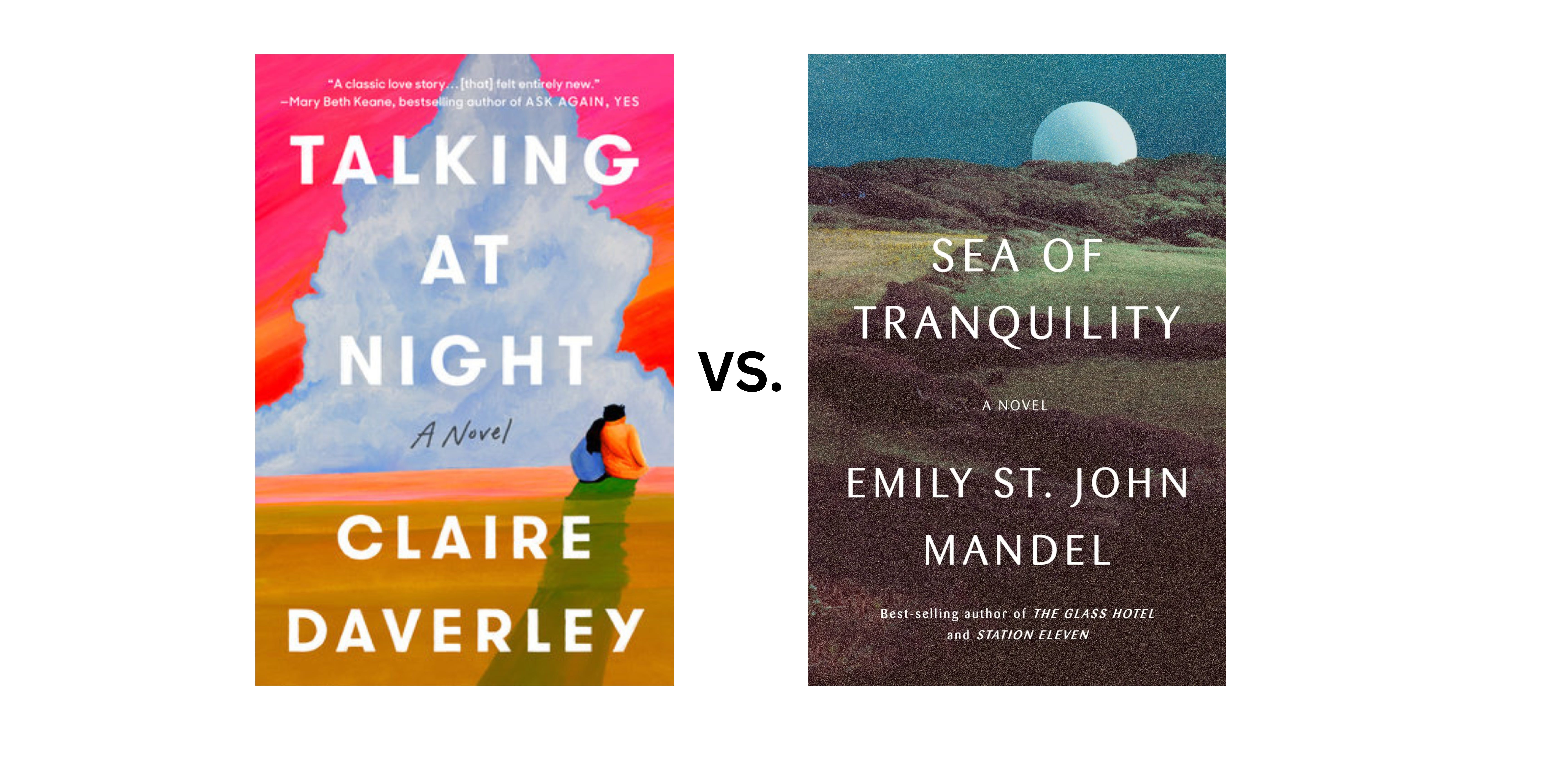
Book cover images for Talking at Night by Claire Daverley and Sea of Tranquility by Emily St. John Mandel

Talking at Night by Claire Daverley vs. Sea of Tranquility by Emily St. John Mandel

This one is so hard!!! I love love loved Talking at Night, which had me smiling and crying and yearning my little heart out during my last international flight of the year. On the other hand, I read almost all of Sea of Tranquility in one sitting on my couch and thought about it for weeks after. Hell, I’m still thinking about it. Sea of Tranquility has buried itself in my brain in a way that was completely unexpected, and which has piqued my curiosity in terms of exploring other kinds of soft sci-fi. For this reason, I think it does ultimately beat out Talking at Night, but I will keep recommending that one to all my Sally Rooney girlies who love a slow-burn, long-game relationship story.

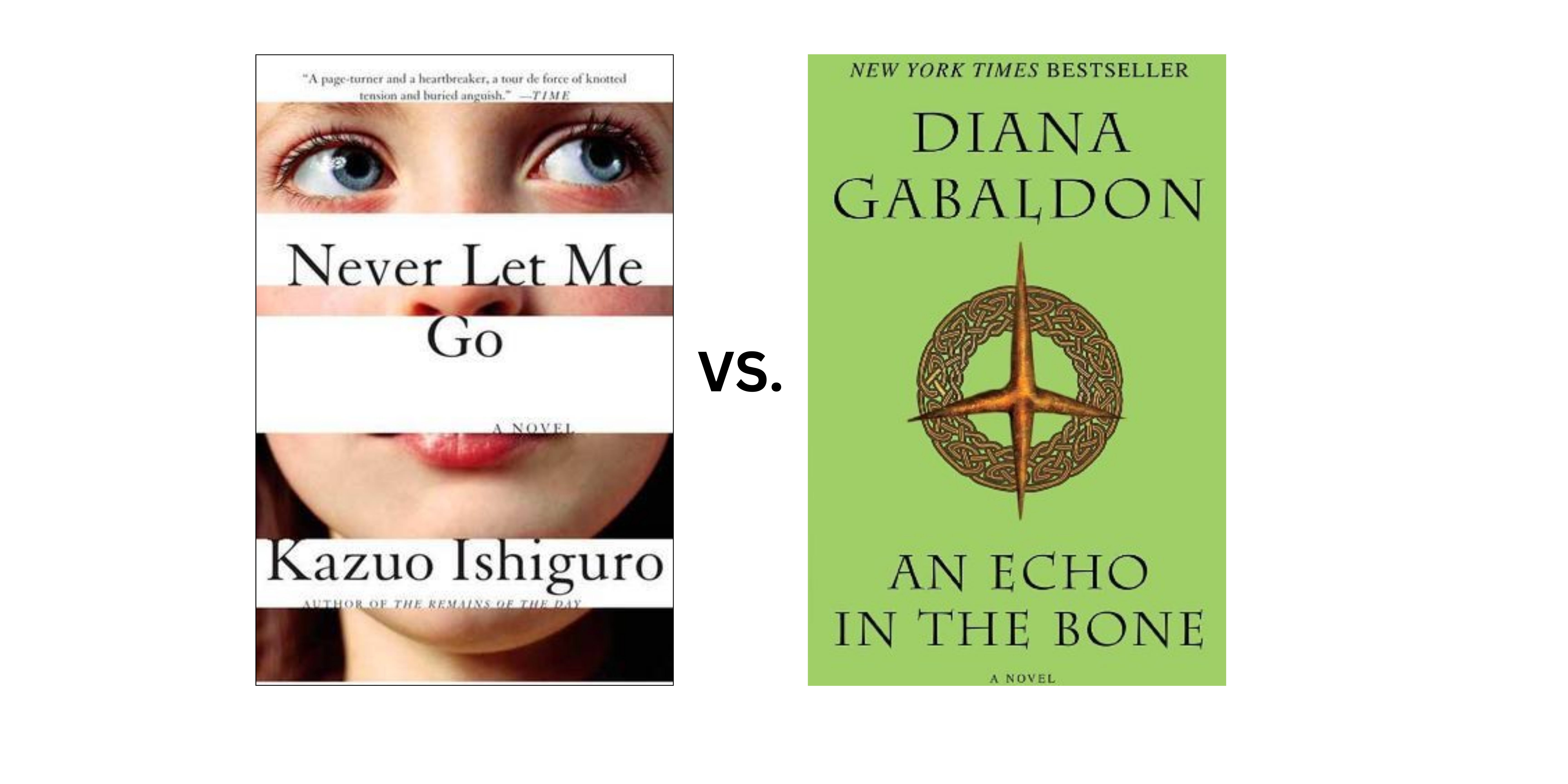
Book cover images for Never Let Me Go by Kazuo Ishiguro and An Echo in the Bone by Diana Gabaldon

Never Let Me Go by Kazuo Ishiguro vs. An Echo in the Bone by Diana Gabaldon

Finally, an easy one! There’s no contest here. I love the Outlander books, and diving into this one was a thoroughly enjoyable way to spend my December, but in terms of literary prowess and lasting impact, I have a feeling Never Let Me Go is going to go a long way in this bracket. While I will say this was one of the least stressful and most satisfying Outlander books in terms of character reunions, new relationships, and surprisingly positive outcomes to ill-fated mishaps, there is still simply no reason for these books to be as long as they are. I’ll keep reading them (and watching the show now that I’m caught up), but HOW does this woman get away with cranking out doorstopper after doorstopper!? That’s beside the point. Never Let Me Go wins, obviously.


And that’s a wrap on Round One! Come back tomorrow for Round Two as we narrow it down from the six semifinalists to the top three!

See you there,
❤ Catherine

Procrastination at Its Finest

August in Review — Lit Chat, Vol. 11

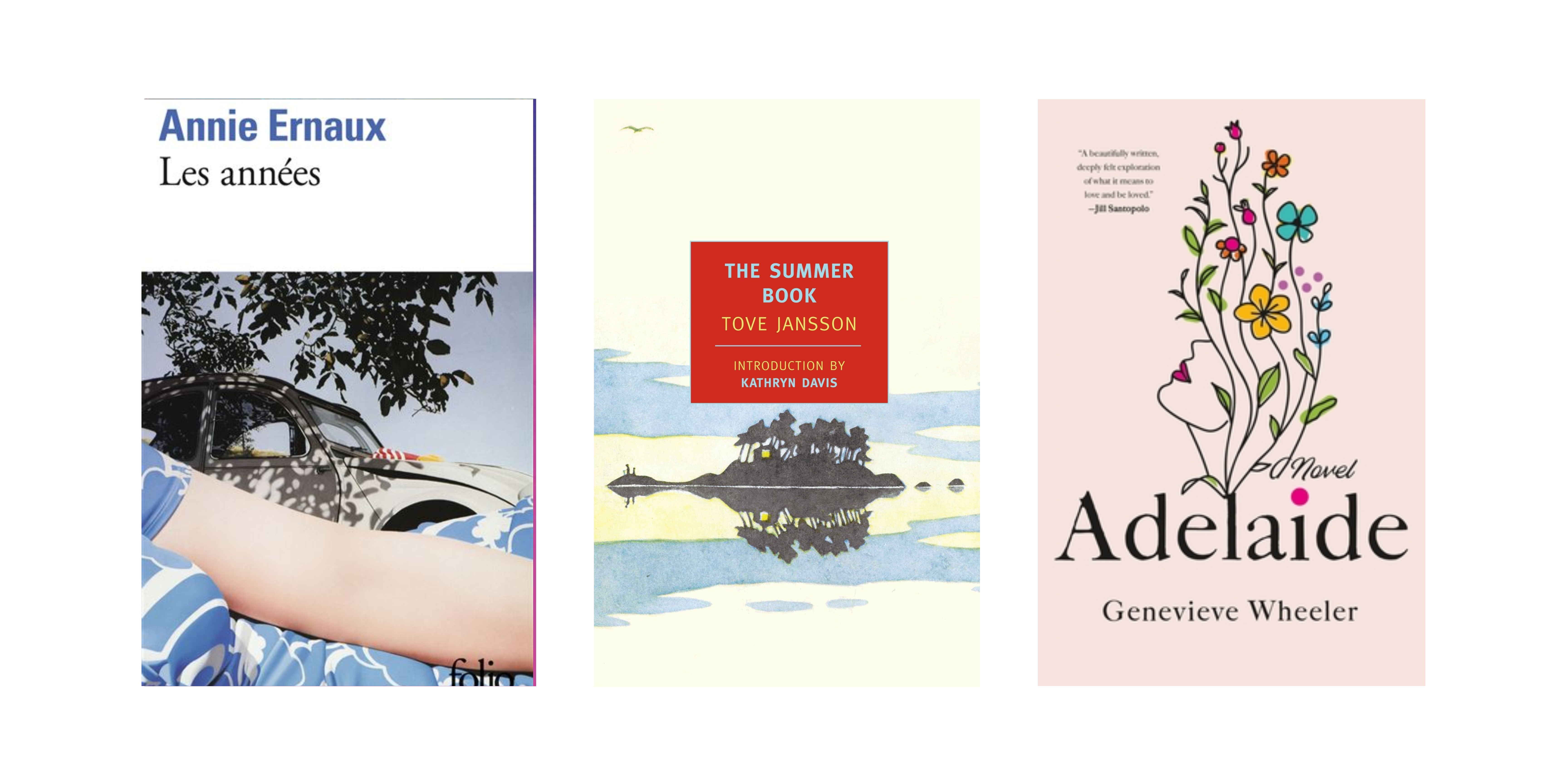
Book cover for R.F. Kuang's Yellowface centered and stacked on top of the book covers for Annie Ernaux's Les Annees, Tove Jansson's The Summer Book, and Genevieve Wheeler's Adelaide.

Housekeeping note: all links go to my Bookshop storefront, where each purchase supports independent bookstores (and this newsletter, because I get a small percentage of each sale).


Hey friends,

Happy Labor Day! This is going to be another quick & dirty Lit Chat Lite™ because I’m leaving for the airport again in approximately five hours and I haven’t finished packing or located my Kindle charger. If you see any typos, no you didn’t. Here we go!!

The Foundation:

Book covers for Annie Ernaux's Les Annees, Tove Jansson's The Summer Book, and Genevieve Wheeler's Adelaide.

Les Années — Annie Ernaux

I mentioned last time that this sucker was taking me forever because I was determined to read it in the original French, and 3 1/2 weeks later, we did it, Joe! Les Années (The Years) is a fascinating narrative memoir that chronicles Ernaux’s life via a series of described photographs, starting as a child in the post-WWII era and moving through the decades into the present moment. She speaks of her memories in the third person and contextualizes each phase of her life against the backdrop of ongoing socio-political events and pop culture, including elections, protests, songs, and the emergence of new technology. It made me wish that I had read this book as part of one of my college French classes because my unfamiliarity with the details of French socioeconomic history combined with lots of new vocab made for slow reading and not a lot of absorption. One day, I’ll come back to this in English and find out just how much I missed.

The Summer Book — Tove Jansson

Most famous for her Moomin comics, Tove Jansson also wrote novels for adults that are positively delightful. The Summer Book is a collection of vignettes following the day-to-day adventures of a young girl and her grandmother as they spend their summers on a remote Finnish island. Even though this book is for adults, it’s the kind of book I would have loved as a kid, because it conveys such a strong sense of nostalgia for slower, simpler times and long days spent outdoors searching for magic under every rock and tree root. This is the perfect book to help you gently transition out of these last couple weeks of summer.

Adelaide — Genevieve Wheeler

This book hit home for me in a lot of ways, and I think it will for many of my friends as well, even though I wish it wouldn’t. Adelaide is a twenty-five-year-old American ex-pat in London who thinks she’s found her Disney prince, but her fairytale ending escapes her when he proves to be painfully unreliable and noncommittal. I found this book frustrating at times because it was difficult to watch Adelaide continue to bend over backward for someone who so clearly did not love her back, all while she clung to the romanticized version of the relationship to the detriment of her own mental health. My frustration with Adelaide came less from her character and more from the fact that I saw in her so many of my friends’ and my own misguided experiences growing up and learning to navigate adult relationships. This is a really candid and vulnerable look at love, mental health, and what it means to feel valued and worthy in a relationship, but it’s definitely not a light-hearted love story.

THE TIPPY TOP:

Book cover for R.F. Kuang's Yellowface.

Yellowface — R. F. Kuang

You might remember that I was not a huge fan of Kuang’s fantasy novel Babel when I read it back in April, but oh man, I flew through her newest contemporary novel. Yellowface is the story of white writer June Hayward, who after witnessing the freak death of her friend, the much more successful Asian-American author Athena Liu, decides to steal Athena’s unpublished manuscript about Chinese soldiers in WWI and pass it off as her own. As someone who has been adjacent to the trade publishing world for a long time, I devoured this darkly funny satire of the industry and its trends and biases.

The part of this story that struck me as most devastating, though, was June’s loneliness. As she goes from critical acclaim as publishing’s newest darling to being canceled and becoming social media’s villain of the day for months at a time, the only friend she ever mentions is the one who dies in the first chapter—and even that relationship we know to have been fraught with envy and resentment. She has no real, honest writing community to lean on or gut-check her, which explains her extreme need for validation from the greater literary world. None of this excuses her truly horrible behavior, but for those of us who are lucky enough to know the benefits of a creative community, it does help us pity her just a little bit in her downfall.


Okay gotta go finish packing, so until next time, happy reading chat later love you bye!!
❤ Catherine