Angels might be we all

January in Review — Lit Chat, Vol. 15

Pyramid of book cover images with The Book of (More) Delights by Ross Gay on top, Minor Details by Adania Shibli and Trespasses by Louise Kennedy in the middle, and Mad Honey by Jodi Picoult and Jennifer Finney Boylan, Days at the Morisaki Bookshop by Satoshi Yagisawa, and Iron Flame by Rebecca Yarros on the bottom.

Housekeeping note: all links go to my Bookshop storefront, where each purchase supports independent bookstores (and this newsletter, because I get a small percentage of each sale).

Hi friends,

January was a long, hard month, but there were a few bright spots, including a bunch of really great book events (Jami Attenberg! Kaveh Akbar!), comedy shows, time with friends, and absconding to Florida for some much-needed sunshine.

And of course, the books. In a month where most of my well-intentioned goals for the new year went swiftly out the window in record time, at least my reading stayed mostly consistent. Books are always a lifeline for me in the winter, but this year, they’ve felt especially necessary. If you have any good winter escapist recs, I would love to hear them.

Moving right along, we’ve got a full slate this month! If you’d prefer to get this post sent directly to your inbox, consider subscribing to my Substack below.


THE FOUNDATION:

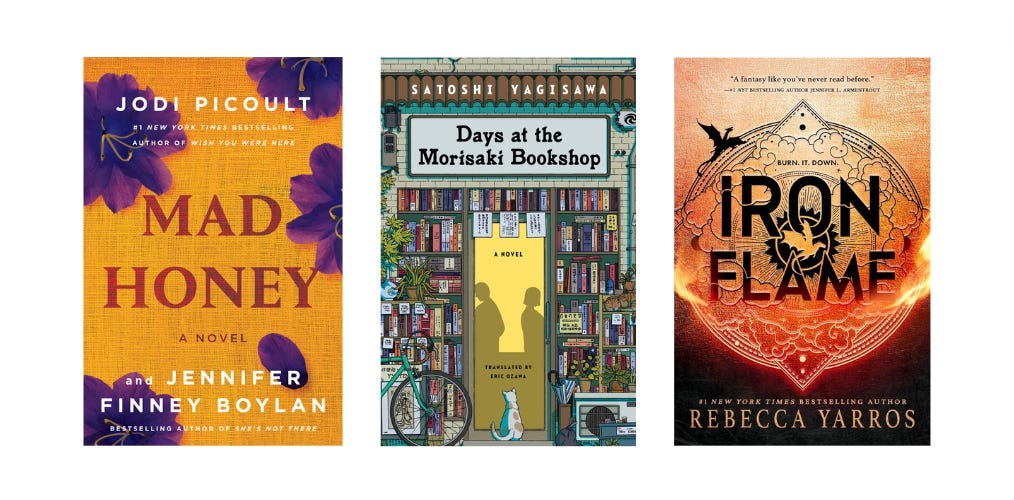
Book cover images for Mad Honey by Jodi Picoult and Jennifer Finney Boylan, Days at the Morisaki Bookshop by Satoshi Yagisawa, and Iron Flame by Rebecca Yarros.

Mad Honey — Jodi Picoult and Jennifer Finney Boylan

I’m not really a Jodi Picoult fan, but this book did prompt one of the most thoughtful book club discussions we’ve had in a long time. Picoult and Boylan largely split the writing for Mad Honey, with Boylan writing the perspective of Lily, a high school senior who tragically dies, and Picoult writing Olivia, a single mother whose son is put on trial for his girlfriend’s death. I preferred Lily’s chapters and appreciated that they were authored by someone with a particularly relevant lived experience, but I didn’t love that the plot ended up hinging on a surprise revelation that made way for a lot of topical spoon-feeding. That said, if there are readers who genuinely learn something about other people’s identities and experiences from this page-turner, then it’s achieving what it sets out to do.

Days at the Morisaki Bookshop — Satoshi Yagisawa, translated by Eric Ozawa

One of my reading goals for the year is to read more in translation, and this one was a fun start! After a bad breakup, Takako quits her life in the city to fulfill my personal dream of living and working in her uncle’s secondhand bookshop in Jimbocho, Tokyo, a neighborhood known for its many used bookshops. Once she’s back on her feet, she finds she has the opportunity to help her uncle do the same when his estranged wife reappears out of the blue. This gentle, heartwarming little book left me with a newfound interest in Tokyo’s secondhand bookshop scene and a whole reading list of translated Japanese literature, courtesy of the translator’s note at the end.

Iron Flame — Rebecca Yarros

The silver lining of an otherwise unsuccessful trip to the DMV in December was discovering that I had somehow been delivered a “skip-the-line” copy of this Fourth Wing sequel on Libby (did anyone else know this existed??). In this one, we’re back with Violet for her second year in the Riders Quadrant, but she’s struggling to hide the truth about what’s really threatening Navarre’s borders from her friends. When she finally caves, the story opens up at last to a world beyond Basgiath, with a host of new characters, folklore, and secrets to be uncovered—and kept. Supposedly this is only book #2 of 5, and judging by the ending, I’d say readers will need to strap in tight for the rest of the series. (TV adaptation when???)

SOLID SUPPORTS:

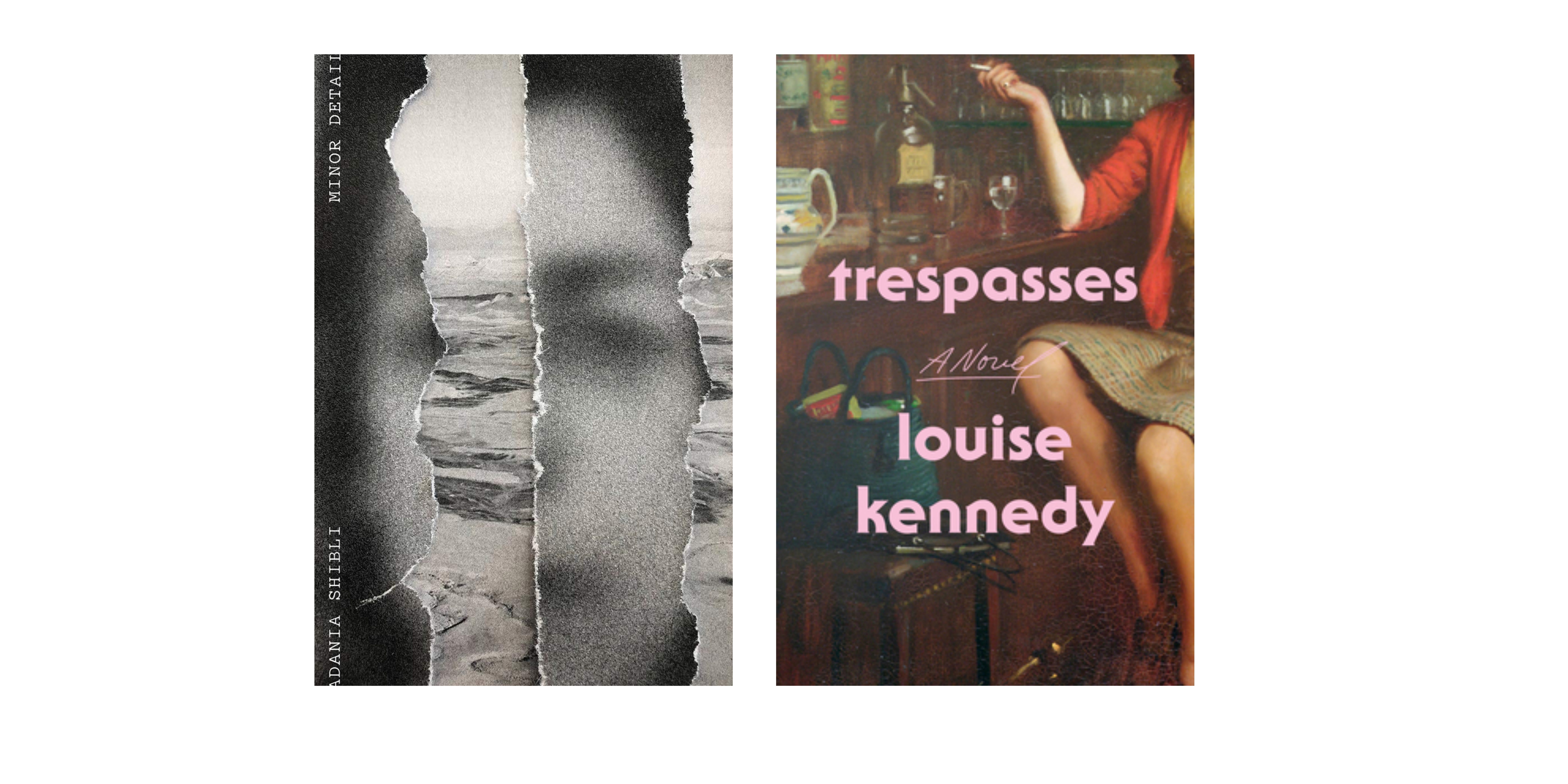
Book cover images for Minor Detail by Adania Shibli and Trespasses by Louise Kennedy

Minor Detail — Adania Shibli, translated by Elisabeth Jaquette

(CW: rape)
Another book in translation, this time from Palestinian author Adania Shibli. Coming in at just over a hundred pages, the first half of this book follows an Israeli officer in the aftermath of the Nakba in 1949, tasked with eradicating the last of the Arabs in the newly occupied territory. Over the course of these raids, the officers capture, rape, and kill a young Palestinian girl. Years later, a woman living in occupied Palestine reads of the incident and is consumed by the desire to learn more from the girl’s perspective.

This brief, haunting narrative is especially poignant when you consider that it was published in 2017, years before this latest chapter of horrific violence in the region but a product of the same conflict that has been ongoing for over seventy years. The book’s foundation is one of violence and eradication, so it’s unsurprising that the painstaking efforts of the second half to recover any personal details resembling truth are ultimately unsuccessful. There are no easy answers here, no closure, and no justice. How can answers be found when there is no one left to keep them, much less find them? This dilemma is once again unfolding in real-time, so if you haven’t written to your senators in a while about supporting a ceasefire, now would be a great time.

Trespasses — Louise Kennedy

Oh, how I love my Irish lit, depressing as it may be. Set in Belfast at the height of The Troubles, Trespasses follows Cushla, a young Catholic primary school teacher who begins an affair with an older, married Protestant barrister. I don’t usually go in for affair storylines, but for me, the romance took a backseat to the other alluring personalities that filled Cushla’s world: the eccentric regulars at her brother’s pub, the world-weary first-graders in her class, her sharp-tongued, alcoholic mother who misses absolutely nothing.

Kennedy brings this community to life in vivid color with smart, witty dialogue and a stark awareness of the boundaries drawn between themselves and the city around them, contrasting their would-be quiet lives with the persistent violence that is quite literally on their doorstep. The book is a study not merely of political conflict, but of internal and interpersonal conflict as well. All of this pushes Cushla to consider just how much she wants to ask from the life she’s been given—and whether it’s enough. I was surprised by how much I wound up enjoying the end of this one, and I’m looking forward to reading Kennedy’s short story collection, The End of the World Is a Cul de Sac, as well.


THE TIPPY TOP:

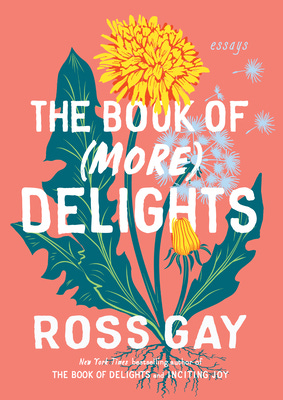
Book cover image for The Book of (More) Delights by Ross Gay

The Book of (More) Delights — Ross Gay

This book is as delightful as its title, made even more so by the author’s joyful audiobook narration. Though I haven’t read its predecessor, The Book of Delights, I believe this follow-up uses much the same format as a collection of daily musings on things the author finds delightful. The delights cover everything from hiking misadventures to gardening, gnomes, beloved family members, aging, basketball, trucks, angels, and many tender observations about the small routines and intimacies that make life precious.

About midway through the book, Gay comes to the realization that the delights are doubling as gratitudes, that they are a way of looking at the world with love and thankfulness for the gift of being able to experience them. As I listened to each delight while walking around my neighborhood, I found myself looking for—and finding—things to be grateful for in the vein of delights: the somehow as-yet unfrozen koi pond on the corner of my block; strangers who smile at you on the street in a wholesome, non-creepy way; the legion of Brooklyn Heights dogs in coats and booties; and the unexpected relief of walking out the front door and finding it warmer outside than expected.

These delights were a much-needed ray of sunshine in an otherwise tough, gray month. Being able to start my reading year off with these words of gratitude, and with the opportunity to use them as a lens for finding joy in my own life, was nothing short of a gift.


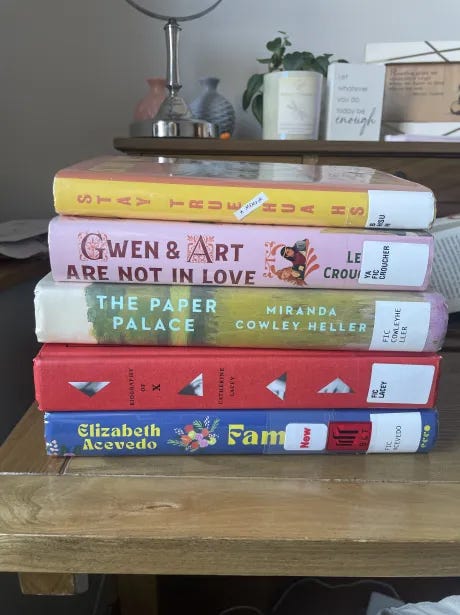
That’s all for January! I’m very excited about my February reading because the BPL gods have smiled on me (see below photo), so it’s safe to say I am BUSY for the foreseeable future (but also always down to chat in all the usual places).

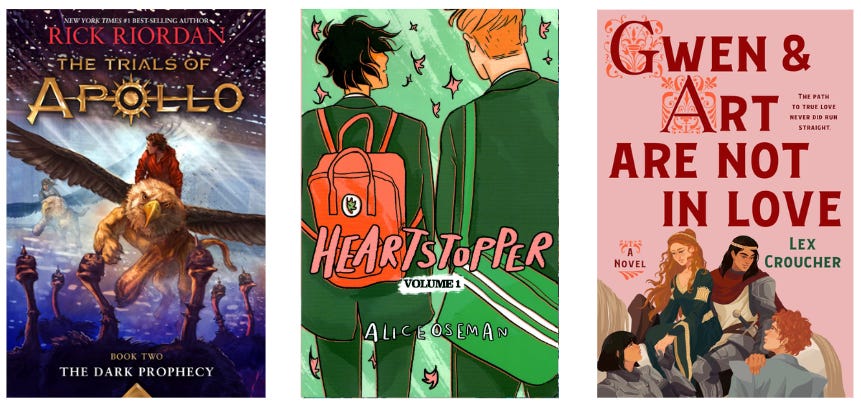
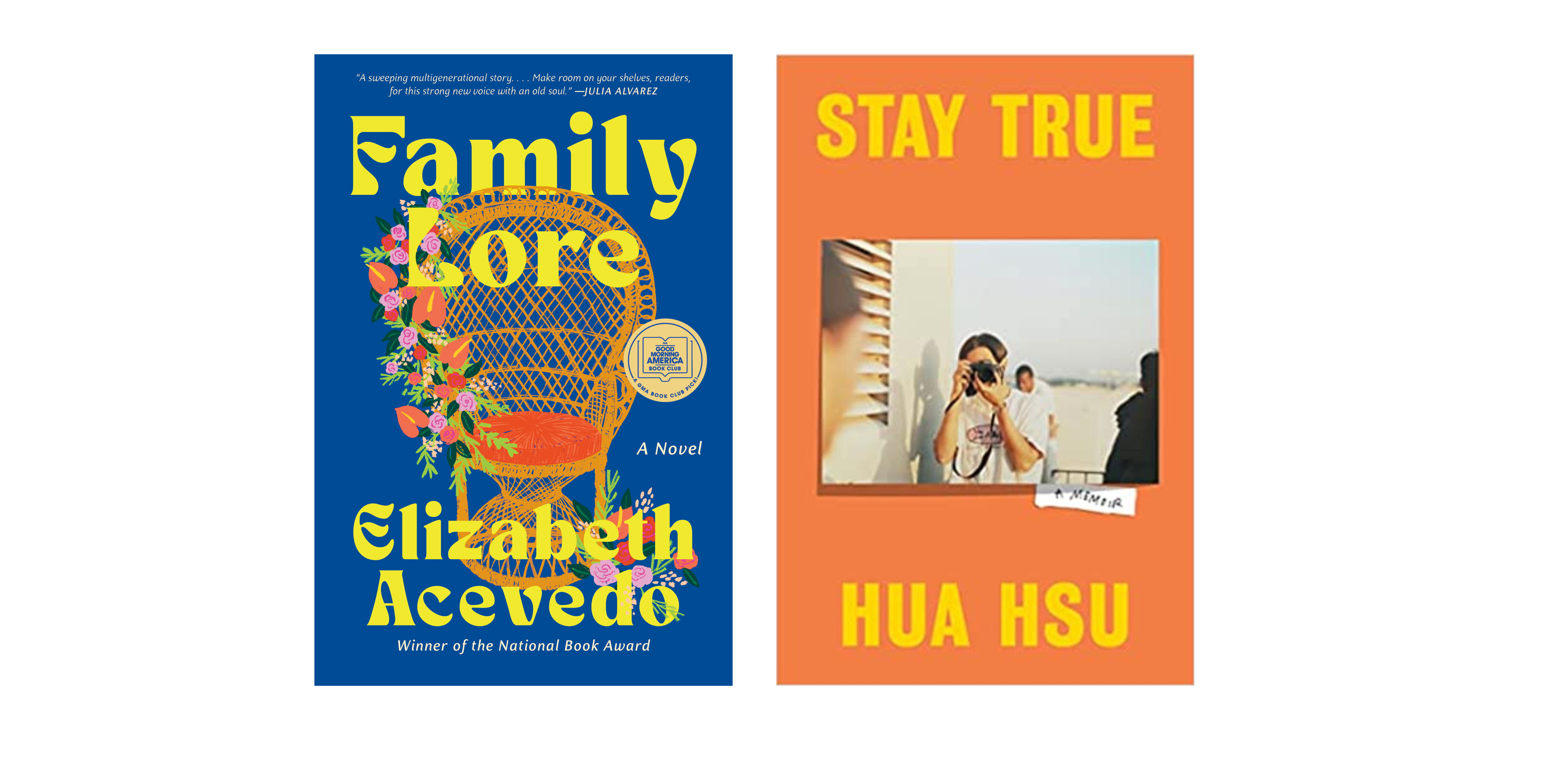
Stack of hardcover books on a wooden desk, from top to bottom: Stay True by Hua Hsu, Gwen & Art Are Not in Love by Lex Croucher, The Paper Palace by Miranda Cowley Heller, Biography of X by Catherine Lacey, and Family Lore by Elizabeth Acevedo.
lucky lucky me!

Until next time, happy reading!
❤ Catherine

Lit Chat’s Best Books of 2023: Round 3

Housekeeping note: all book links go to my Bookshop storefront, where each purchase supports independent bookstores (and this newsletter, because I get a small percentage of each sale).


Hi friends,

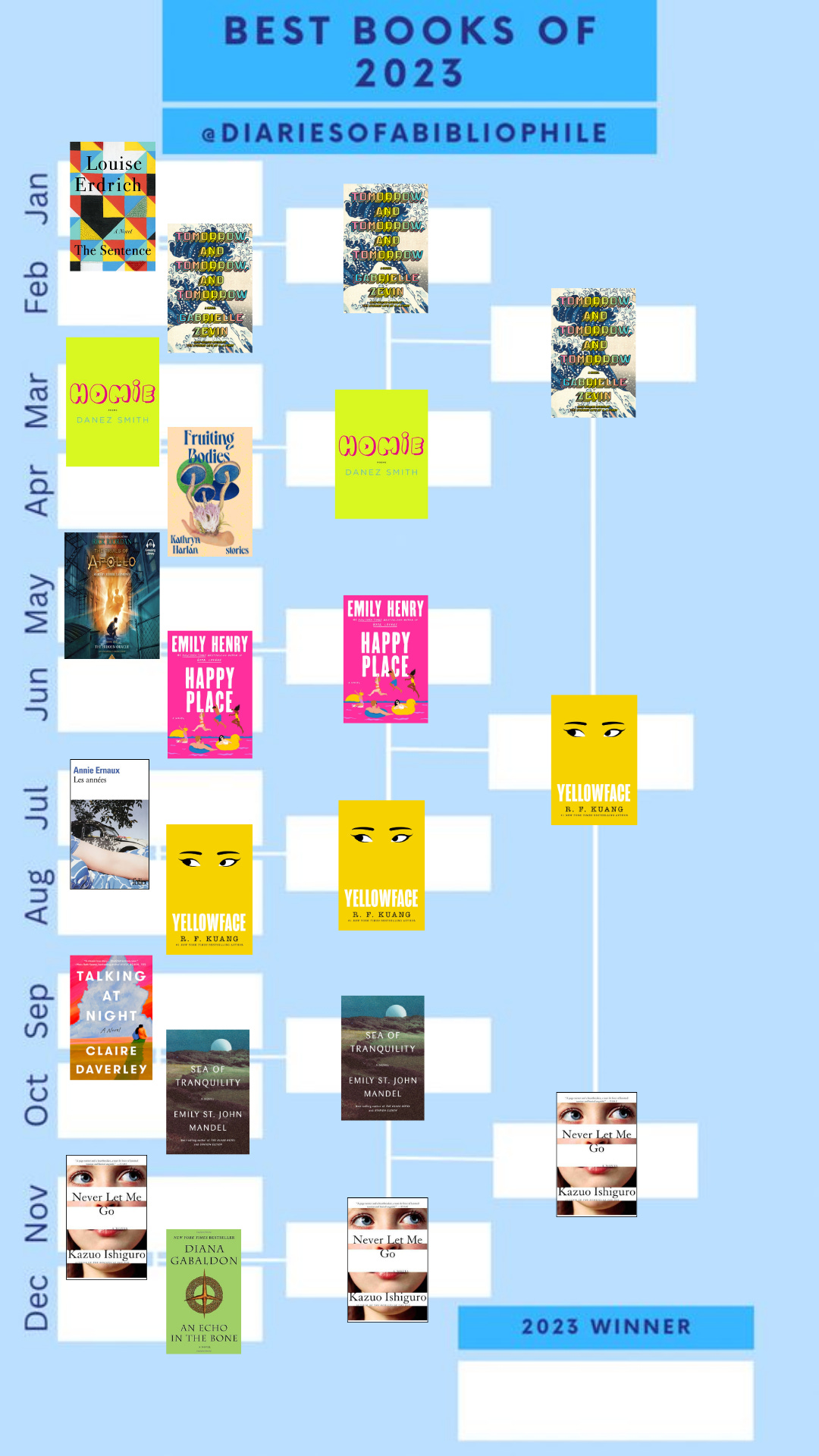
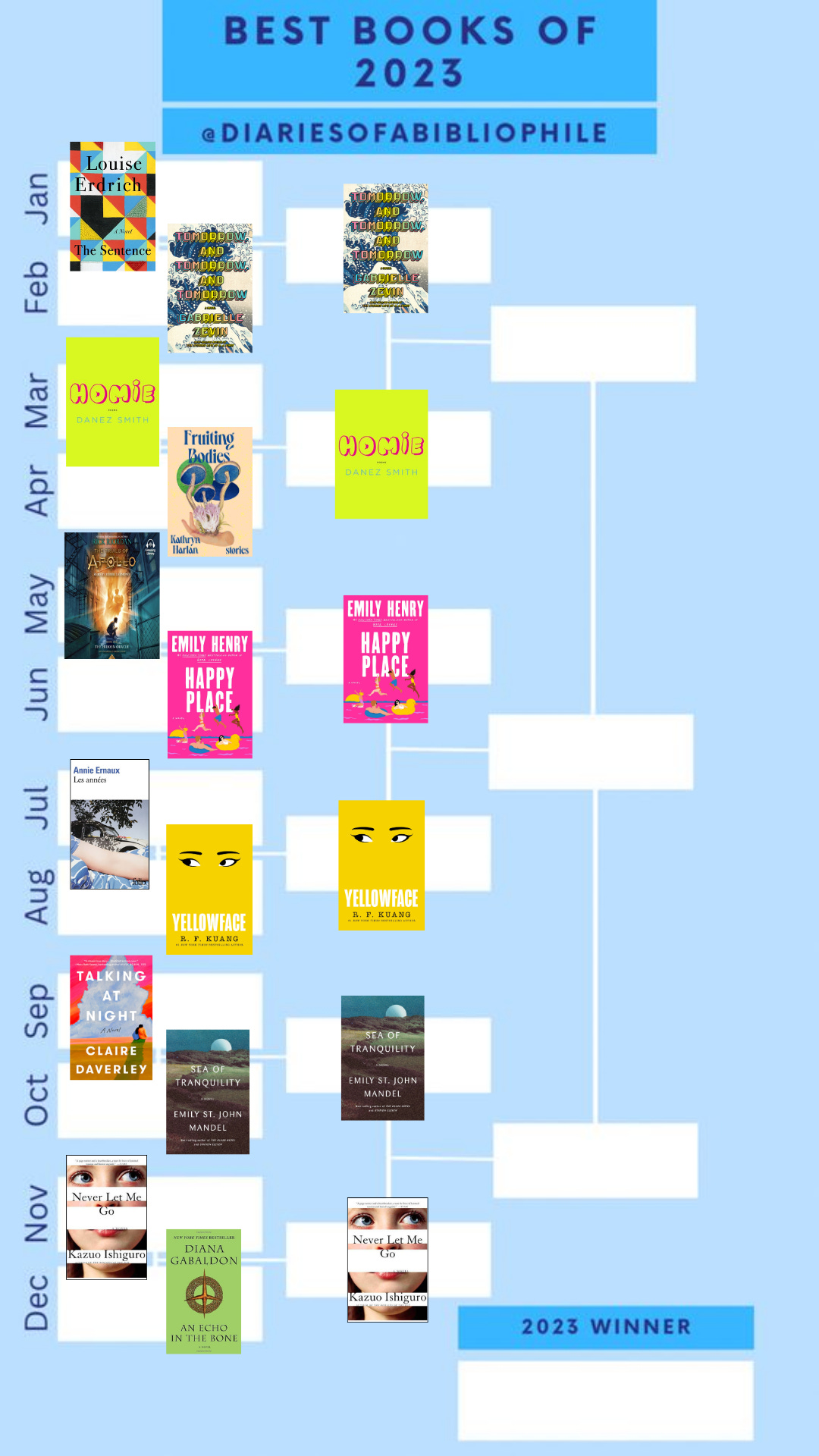
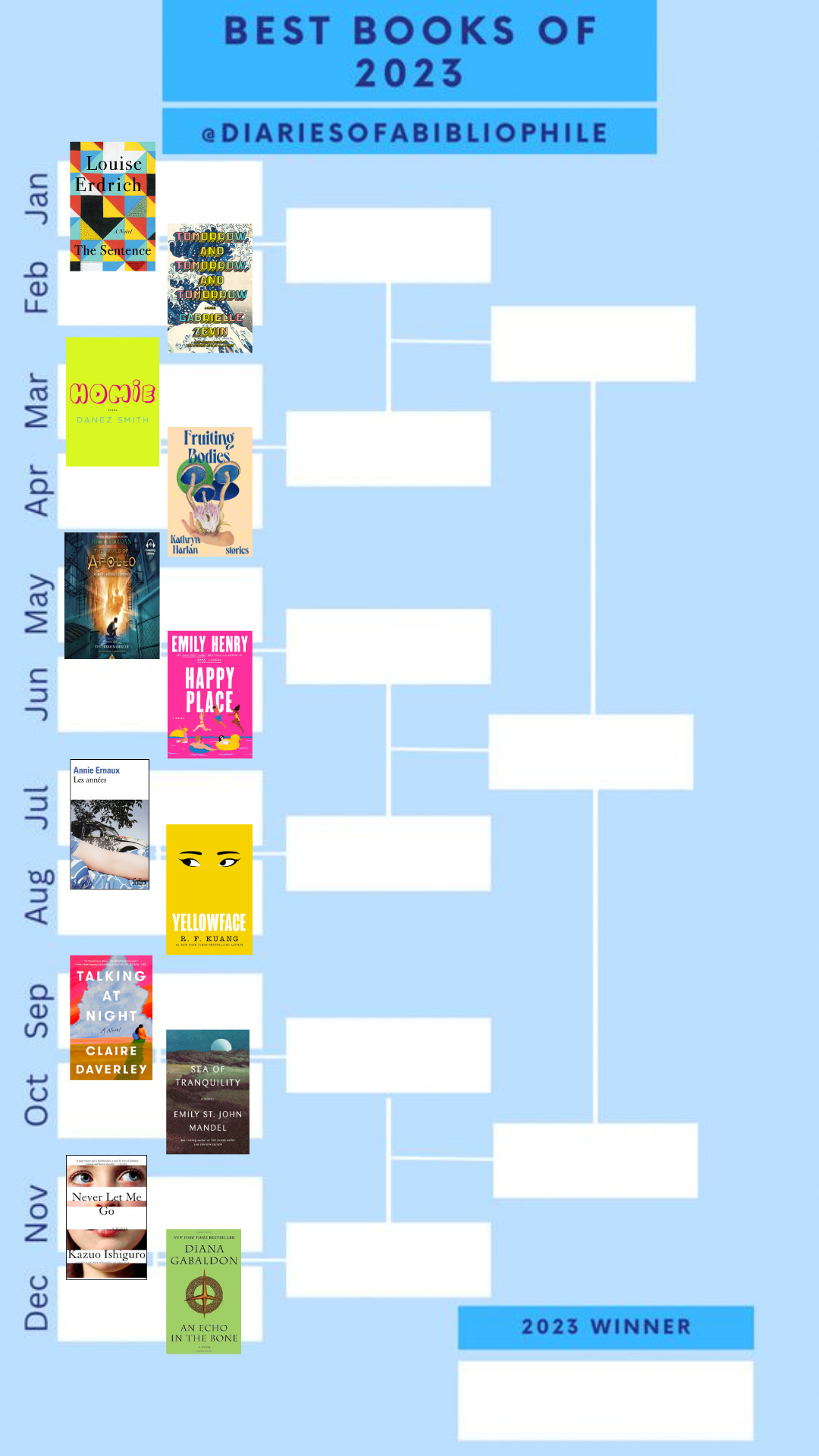
I’m just as ready to put 2023 behind me as I’m sure you are by now, so let’s get this show on the road. After yesterday’s semifinals, these were our standings:

Graphic for the Best Books of 2023 bracket

Which leaves us with a top three: Gabrielle Zevin’s Tomorrow and Tomorrow and Tomorrow, R.F. Kuang’s Yellowface, and Kazuo Ishiguro’s Never Let Me Go. So without further ado, below are my official Best Books of 2023 final rankings:

Round Three:

Third Place: Yellowface by R.F. Kuang

Book cover image for Yellowface by R.F. Kuang
Read my original review here!

The fun thing about this being a bracket is that while I wouldn’t necessarily say this is my third favorite book of the year, I’m pleased that Yellowface has managed to fight its way to the top all the same. It doesn’t come close to the other two finalists in terms of lasting impact and emotional resonance, but as a satire about publishing, it has a distinct appeal to readers invested in this industry.

If you missed my initial review (and don’t feel like revisiting the August newsletter), Yellowface is about a white author who steals her late Asian-American friend’s manuscript about Chinese soldiers during WWI and passes it off as her own under a racially ambiguous pen name. As an Asian-American author writing a white protagonist, Kuang is in a unique position to call out some of the worst cycles of bias that have been perpetuated by those in positions of privilege in the industry via her narrator’s thoughts and behavior. Kuang wants us to feel shocked—she wants us to think, “Oh my God, she can’t say that,” when June thinks or speaks disparagingly about other writers and readers of color—and yet the shock comes not from the sentiment itself but the fact that it has been spoken aloud. In other words: Kuang goes there, sticks our face in the mess like an untrained dog, then washes her hands of it all. A worthy showing for this highly entertaining, if slightly niche read!

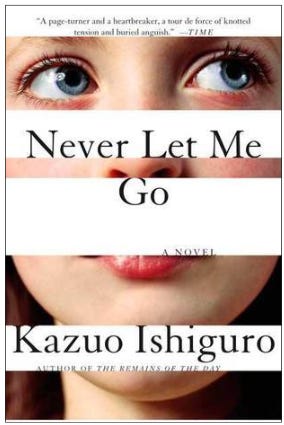
Second Place: Never Let Me Go by Kazuo Ishiguro

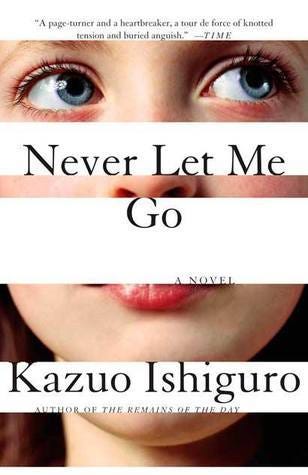
Book cover image for Never Let Me Go by Kazuo Ishiguro
Read my original review here!

This was so hard!! I flip-flopped a lot, but what my decision came down to is the fact that this book is ultimately SAD. Don’t get me wrong, I loved being knocked out by this book. It’s beautiful and insightful and moving and I do wholeheartedly believe there is value in experiencing the full range of human emotions through literature, but at the end of the day, I would simply prefer not to be sad! I would prefer to have a bit of hope, as a treat, and unfortunately, there is very little of that by the end of Never Let Me Go.

By no means do I mean to put anybody off from reading this—ultimately, it is #2 of the year for a reason and that reason is I believe it to be a profoundly important and impactful work of literature, but it’s heavy enough that I would recommend going into it with enough mental/emotional space to sit with the discomfort. That said, please read this one and come talk to me about it! Let’s be devastated together :’).

First Place: Tomorrow and Tomorrow and Tomorrow by Gabrielle Zevin

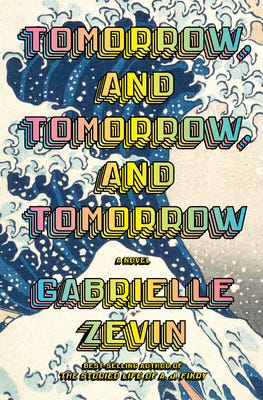
Book cover image for Tomorrow and Tomorrow and Tomorrow by Gabrielle Zevin
Read my original review here!

This book, on the other hand!!! The aforementioned full range of human emotions is undeniably present, and I would be lying if I said this one didn’t also make me sad—there may even have been tears! But what makes this one the ultimate winner of my Best Books of 2023 bracket is that the sadness is balanced out by an overwhelming amount of love. In fact, it wouldn’t even be sad if so much love had not preceded the sadness. And there are so many different kinds of love present, including friendship love, romantic love, familial love, creative love, and the ultimate respect that comes from experiencing so many facets of love within the same relationship.

Often when I think back on a book, my first thought is the memory of how I felt when it was over. Tomorrow and Tomorrow and Tomorrow had one of my favorite endings of all time, because (and this isn’t a spoiler!) it ends almost exactly how it begins. Thematically, this restart was the perfect ending for a book about video games, but emotionally, the suggestion that the story was only just beginning anew was everything I wanted for the two main characters. I didn’t need to know how their story ended because I didn’t want it to end—I wanted them to remain open to a whole lifetime of friendship and creative potential and mutual respect borne of years and years of loving each other in different ways. With this ending, we get to believe that this is true. So for the sake of this bracket (and for always), I hereby declare that love WINS!!!


Honorable Mentions:

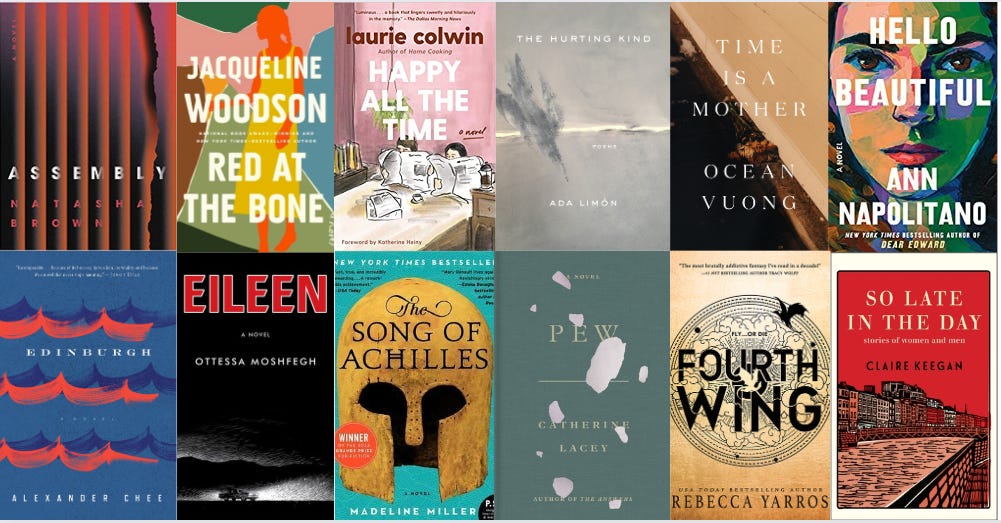
Book cover images for Assembly by Natasha Brown, Red at the Bone by Jacqueline Woodson, Happy All the Time by Laurie Colwin, The Hurting Kind by Ada Limon, Time is a Mother by Ocean Vuong, Hello Beautiful by Ann Napolitano, Edinburgh by Alexander Chee, Eileen by Ottessa Moshfegh, The Song of Achilles by Madeline Miller, Pew by Catherine Lacey, Fourth Wing by Rebecca Yarros, and So Late in the Day by Claire Keegan.

Above are some of my favorite runners-up from the year! Though all of these books fell short of the official monthly top spot, let’s just say this year’s bracket would have looked a lot different had some of these been in play. Maybe I’ll do a bigger one next year? In the meantime, I’ll do one last push for you to check out the Lit Chat archives for reading inspiration if one of these covers catches your eye, and I’ll also remind everyone that all of these books are neatly organized by month on my Bookshop storefront! And if you want these posts straight to your inbox, then go ahead and click the button below to subscribe on Substack.


Thanks so much to everyone for reading with me in 2023, especially those of you who have reached out to chat about these and other books or who have shared this newsletter with other fellow readers. I so appreciate you!

ALSO I almost forgot, but I will be sending an email out soon to those interested in joining my little in-person reading show & tell club! If you’re local to NYC and haven’t already let me know you wanna come, reach out! Tentative date is Saturday, January 20th with more details to follow.

Until next time, happy reading and cheers to many more good books in 2024!
❤ Catherine

Lit Chat’s Best Books of 2023: Round Two

Housekeeping note: all book links go to my Bookshop storefront, where each purchase supports independent bookstores (and this newsletter, because I get a small percentage of each sale).


Hi friends,

Welcome back for another round of my highly subjective Best Books of 2023 bracket! Today, we have six titles facing off for the honor of making it to the top three, which makes this the semifinals already! Here’s where we stand so far:

Best Books of 2023 bracket image

Also, a quick reminder that you can get this post directly to your inbox if you subscribe to my Substack!

All right, it’s a gloomy day in Brooklyn; let’s talk about some books.


ROUND TWO:

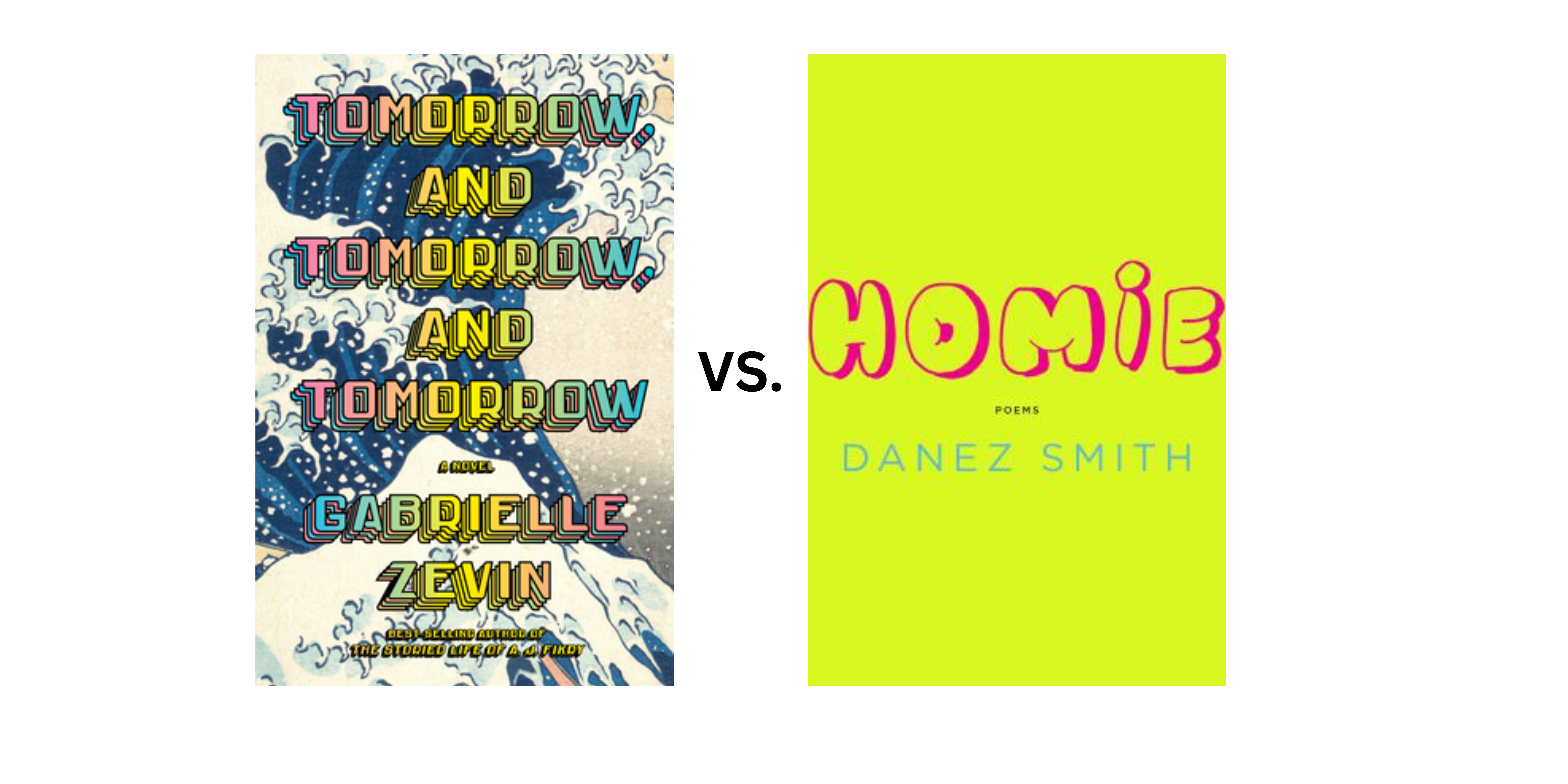
Book cover images for Tomorrow and Tomorrow and Tomorrow by Gabrielle Zevin and Homie by Danez Smith

Tomorrow and Tomorrow and Tomorrow by Gabrielle Zevin vs. Homie by Danez Smith

I so wish I didn’t have to put these two head to head because they are truly in leagues of their own, but so it goes. When I think of comparing these two books, I think of scope: Homie, though completely wonderful, simply feels small in comparison to the sprawling saga that is Tomorrow and Tomorrow and Tomorrow. What I love about Homie is how it does so much emotionally with such a small space, as a testament to all the people and places the poet loves, but we don’t necessarily get to know those people as closely as we do when we follow their lives for decades like we do in Tomorrow and Tomorrow and Tomorrow. At their core, both books are centered around friendship, which is why this feels slightly unfair because a novel is a completely different vehicle for exploring the nuances of that friendship and, in this case, the worlds that are created as a result. While I loved feeling like a witness to Danez Smith’s highly personal world, I felt fully inside not only Sam and Sadie’s real lives, but also each of the worlds they created in their games. This expansiveness is why I’m moving Tomorrow and Tomorrow and Tomorrow forward, though it’s with a heavy heart that I leave Homie behind.

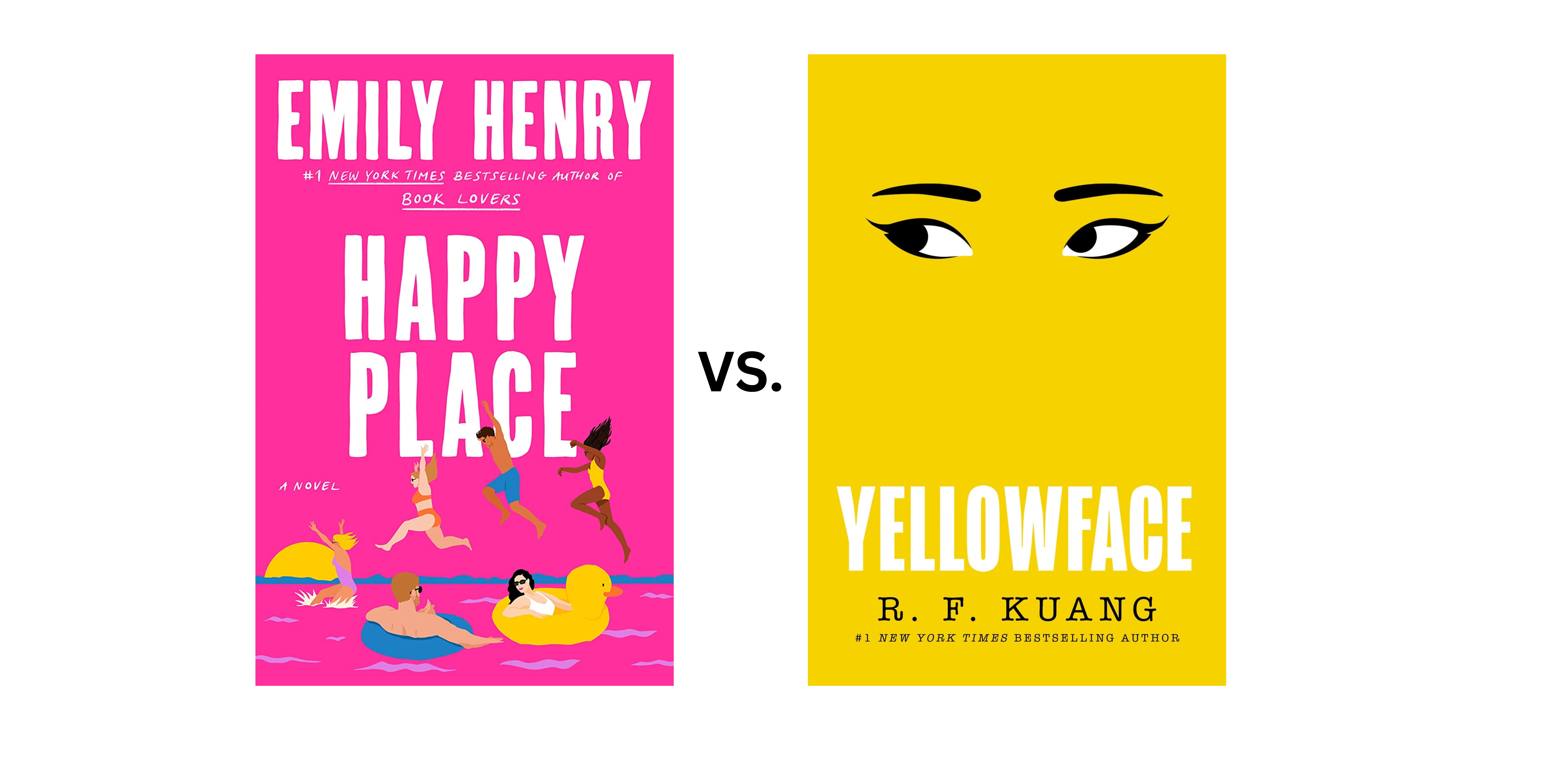
Book cover images for Happy Place by Emily Henry and Yellowface by R.F. Kuang

Happy Place by Emily Henry vs. Yellowface by R.F. Kuang

Something I’ve learned about myself and my media consumption habits lately is that fundamentally, I am not a hater but a liker. I like to enjoy things, and I am fairly easily pleased! Unless I am specifically approaching something with skepticism, I’m more than happy to turn the critical thinking part of my brain off for the sake of entertainment. Some books are better suited for this than others—in my initial read of Happy Place, I was perfectly happy to be along for the ride. I love stories that feature big friend groups, particularly ones in the same phase of life as me, so I was content to overlook the fact that the secondary characters often fell a little flat. I also love rooting for a good romance, especially when we’re more concerned with the characters’ chemistry than the fact that it’s completely insane to (spoiler) abandon a neurosurgery degree that you’re hundreds of thousands of dollars in debt for to become a…potter? Details, details! Suspend disbelief for love! I still had a great time with Happy Place, but as many of my more critical friends were quick to point out, there are definitely some holes.

Yellowface, on the other hand, is meant to be insane. Yellowface is written from the perspective of a hater and a grasper and an all-around kind of terrible person, and there’s something so delicious about being inside her head and watching from behind your fingers as she continues to make shocking decisions. As a commentary on race and privilege in the publishing industry, Yellowface ultimately also has more to say in general than an unconcerned-with-reality rom-com. I have more I want to say about Yellowface still, which is why I’m officially moving it forward to the finals.

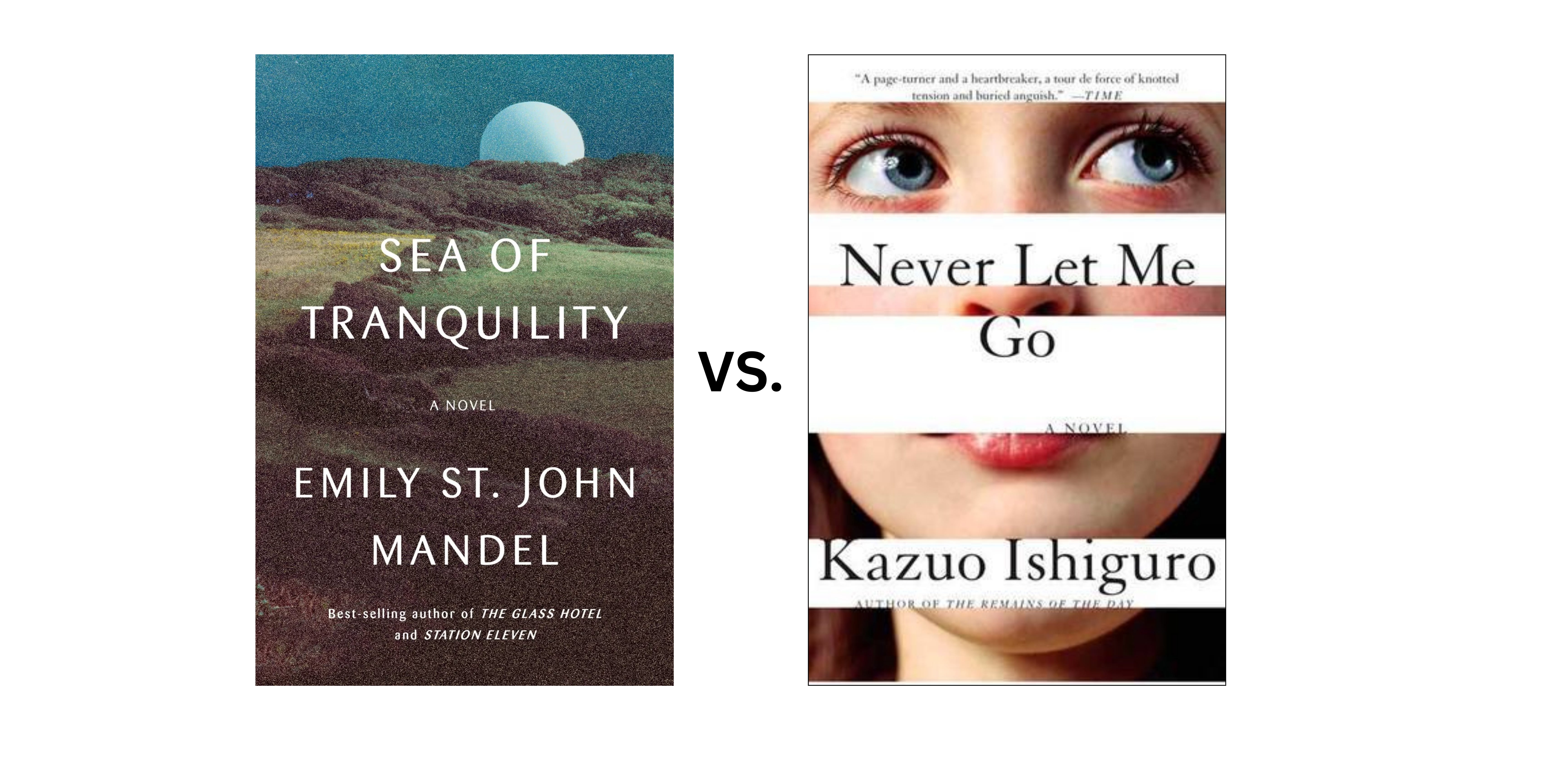
Book cover images for Sea of Tranquility by Emily St. John Mandel and Never Let Me Go by Kazuo Ishiguro

Sea of Tranquility by Emily St. John Mandel vs. Never Let Me Go by Kazuo Ishiguro

This one is TOUGH. The hard thing about this bracket is that a book like Sea of Tranquility would have easily beat out so many others on this list, but against Never Let Me Go it’s a lot less of a wash. These two are similar in genre, and both stayed on my mind for a long time after reading, though for different reasons. As a time-travel story, I spent days puzzling through the events of Sea of Tranquility and how each action seemed perfectly placed to affect not just the story, but also our understanding of time, space, and free will. It presented a fascinating intellectual question that, in its narrative execution, could also be appreciated as a masterful work of literature. It’s still one of my favorite books of the year, but its impact isn’t quite on the scale of Never Let Me Go.

The way that Never Let Me Go continues to take up space in my brain can only be described as a haunting. For a sci-fi/speculative fiction novel, it’s eerie how easily the reader finds themselves settling into daily life at Hailsham, how normalized and almost comfortable it is as a setting in which we’re happy to ignore the many, many red flags about the world beyond. And though a world in which (spoilers!!!) clone children are raised and groomed for the sole purpose of donating their organs does still feel far-fetched (for now), their treatment by society is all too familiar: othered, subhuman, and ultimately disposable. One of the most terrifying parts is realizing how easily we might agree with this thinking had we not spent the whole book watching these characters grow up, and yet the central question of whether or not the children have a soul is still not one I feel fully prepared to answer by the end of the book. It’s a question I’m not sure I’ll ever have a definitive answer for, but one I know I’ll be pondering for a very long time.


There you have it, my top three finalists! Come back tomorrow to see how the final three rank and check out a brief list of honorable mentions for books that I loved in 2023 but which didn’t make the bracket.

Thanks for reading, chat more soon!
❤ Catherine

Lit Chat’s Best Books of 2023: Round 1

Housekeeping note: all book links go to my Bookshop storefront, where each purchase supports independent bookstores (and this newsletter, because I get a small percentage of each sale).

Hi friends,

Happy New Year! Bet you thought you were done with end-of-year recaps in your inbox, huh? Lucky for you, the new year has done nothing to cure my pathological procrastination, so here we are a week later! Below is the start to my Best Books of 2023 bracket, courtesy of this graphic I found on Pinterest (thanks, @diariesofabibliophile, whoever you are!) and my very rudimentary Canva skills:

Bracket of book cover images for each calendar month of 2023.

In terms of rating criteria, we’re mostly going for vibes here: how I felt while reading, what’s stuck with me after I’ve finished, and overall impact (on me as a person, my tastes, my interests, my emotions, etc.). You may disagree—in fact, I hope you do and I hope you tell me about it! I love hearing from friends who have had different reading experiences than me.

This year was a particularly strong reading year, and some of my favorites didn’t even make this list by nature of coming in second to another rockstar book that month. I’d encourage you to check out the Lit Chat archives or poke around on my Bookshop storefront for other reading inspiration! I also love nothing more than giving a personal recommendation, so feel free to reach out if you’re in the mood for something specific but don’t know what that is yet.

Without further ado, let’s begin!


ROUND ONE:

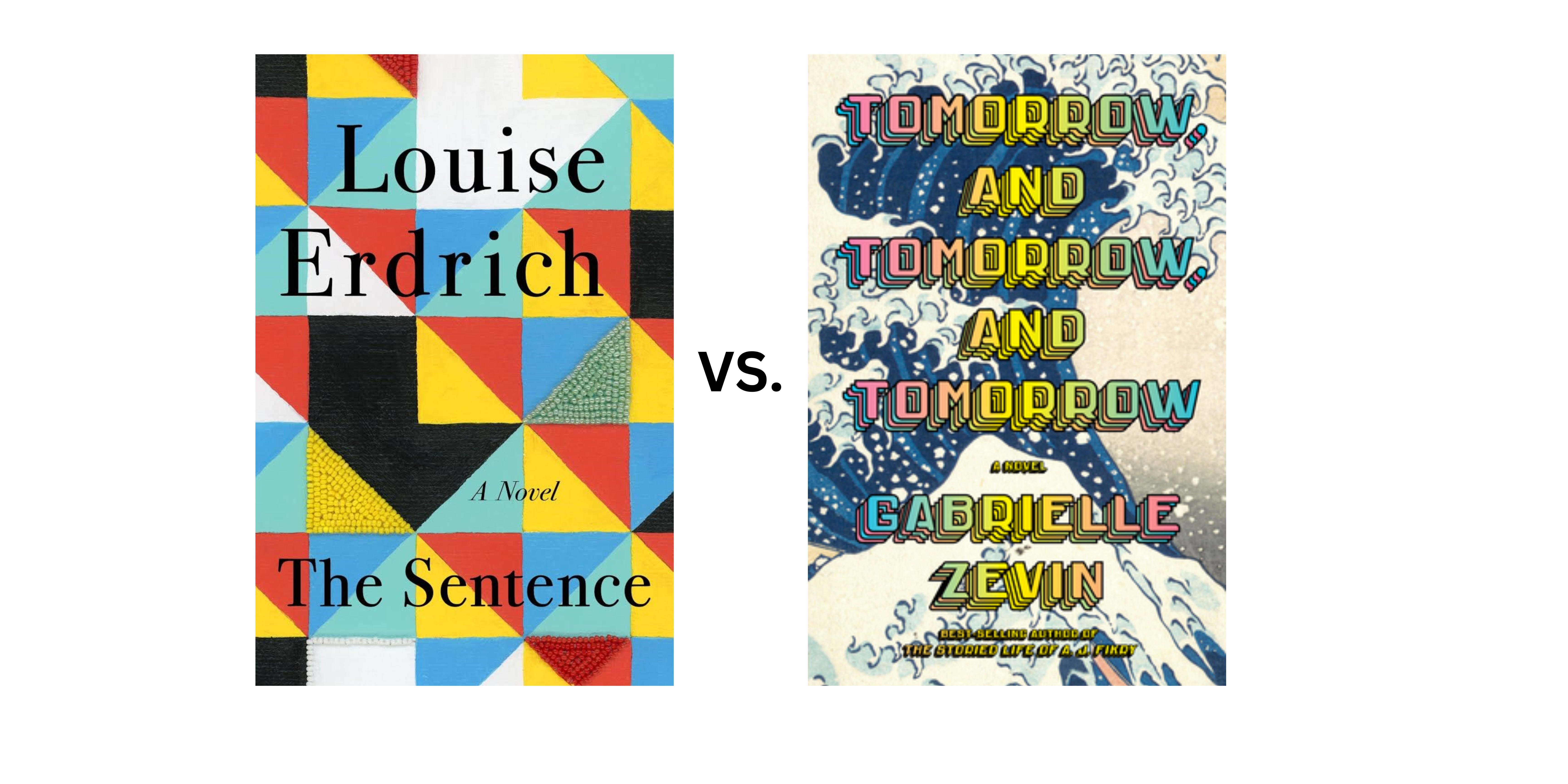
Book cover images for The Sentence by Louise Erdrich and Tomorrow and Tomorrow and Tomorrow by Gabrielle Zevin

The Sentence by Louise Erdrich vs. Tomorrow and Tomorrow and Tomorrow by Gabrielle Zevin

I’m upset about this already because it feels unfair to drop one of these phenomenal books so early. The Sentence was the first book I read in 2023 and set the bar high for its unique characters, sense of community, and portrayal of resilience in the face of so many personal and political upheavals (I was wrong last month when I said Tom Lake was my first Covid book; it was The Sentence!). The Sentence left me energized and inspired for my reading year ahead, whereas Tomorrow and Tomorrow and Tomorrow was so emotionally all-encompassing that it left me with one of the worst book hangovers I’ve had in a long time. To have that happen so early in the year was daunting, to say the least. Ultimately, this is why Tomorrow and Tomorrow and Tomorrow is going to move forward this round, although it pains me to say goodbye to The Sentence so early in the game.

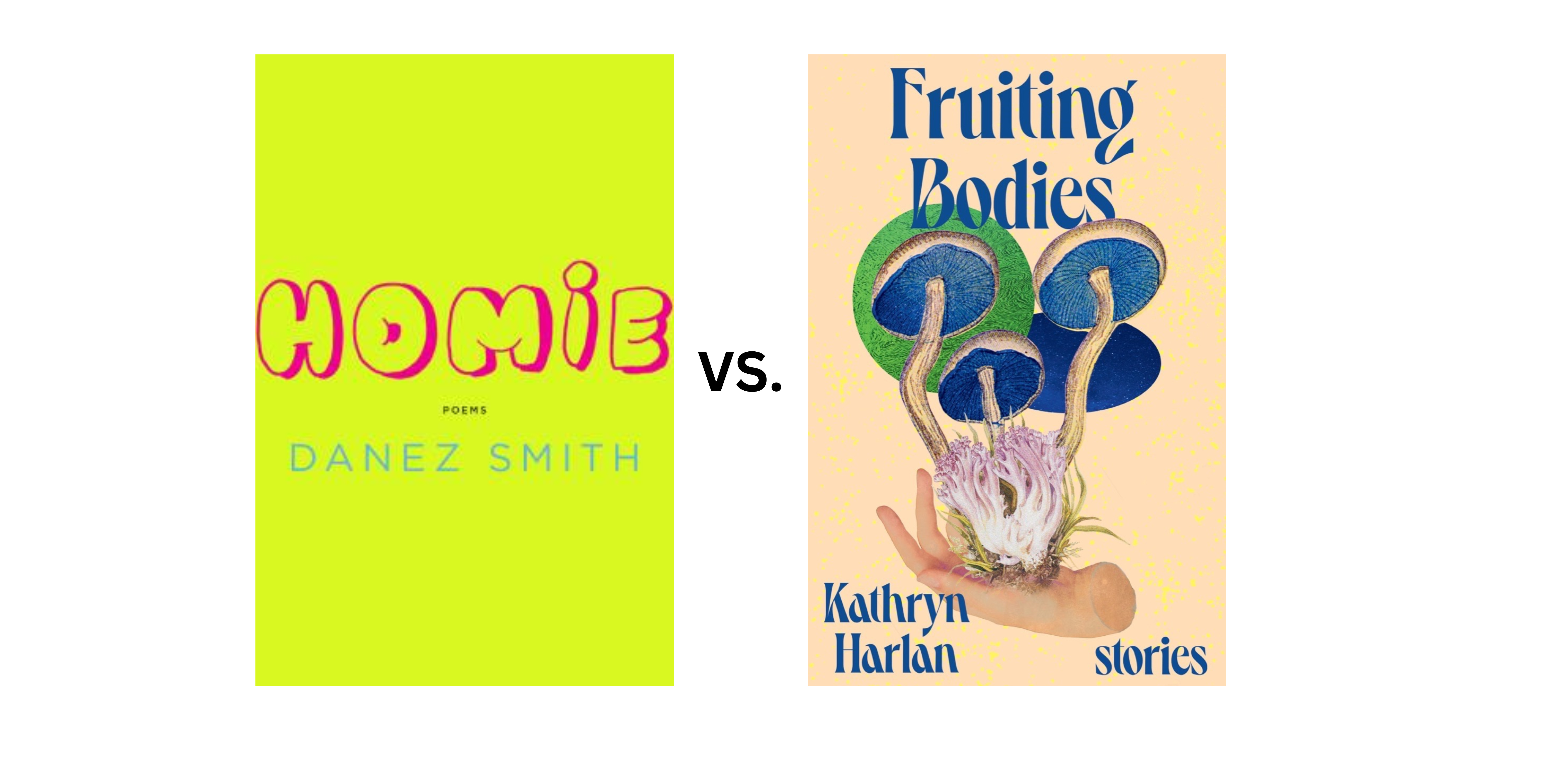
Book cover images for Homie by Danez Smith and Fruiting Bodies by Kathryn Harlan

Homie by Danez Smith vs. Fruiting Bodies by Kathryn Harlan

Another tough but very different match-up! Listening to Danez Smith narrate the audiobook for Homie was one of the highlights of my winter, eclipsed only by getting to see Danez perform live at the New York City Poetry Festival on Governors Island this summer. Likewise, Kathryn Harlan’s collection of eerily enchanting, female-centric short stories has also lingered with me this year, and I recently recommended it to a friend just last month. While Fruiting Bodies renewed my interest in short fiction and magical realism, there’s just something about listening to poems like my president, for Andrew, and waiting for you to die so i can be myself read aloud by the poet, feeling the raw emotion, joy, and vulnerability that exists in these exultations of friendship and community that feels timeless and transcendent. Homie wins this round!

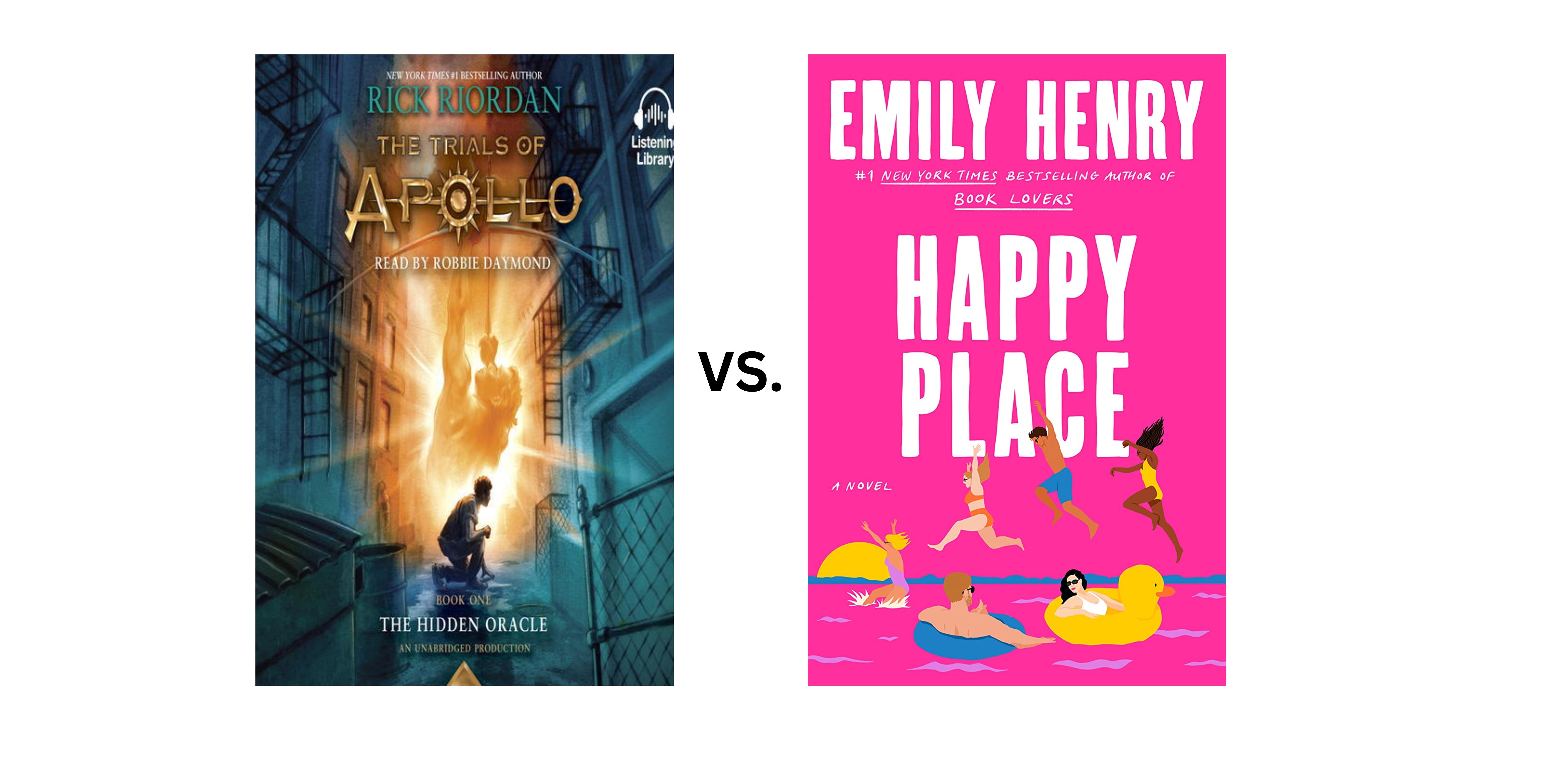
Book cover images for The Hidden Oracle by Rick Riordan and Happy Place by Emily Henry

The Hidden Oracle by Rick Riordan vs. Happy Place by Emily Henry

This might be the silliest match-up of them all, but honestly, it’s still a real contest. The Hidden Oracle was top-notch mythological fun, and with the new Percy Jackson adaptation now streaming, I’m even more favorably inclined to move it along than I might have been a month ago. But to be fair, I forgot I even read this one, whereas I’ve had so many conversations with friends about Happy Place since reading that it’s stayed all too present in my mind. It’s one that I’ve found surprisingly controversial, and though I have plenty more thoughts, I’ll save them for the next round. Happy Place moves forward on the merit of being a thoroughly enjoyable read that is only slightly more relevant to my life as a late twenty-something than the book about fallen gods turned awkward teenagers. (Note to self: finish listening to the Trials of Apollo books in 2024.)

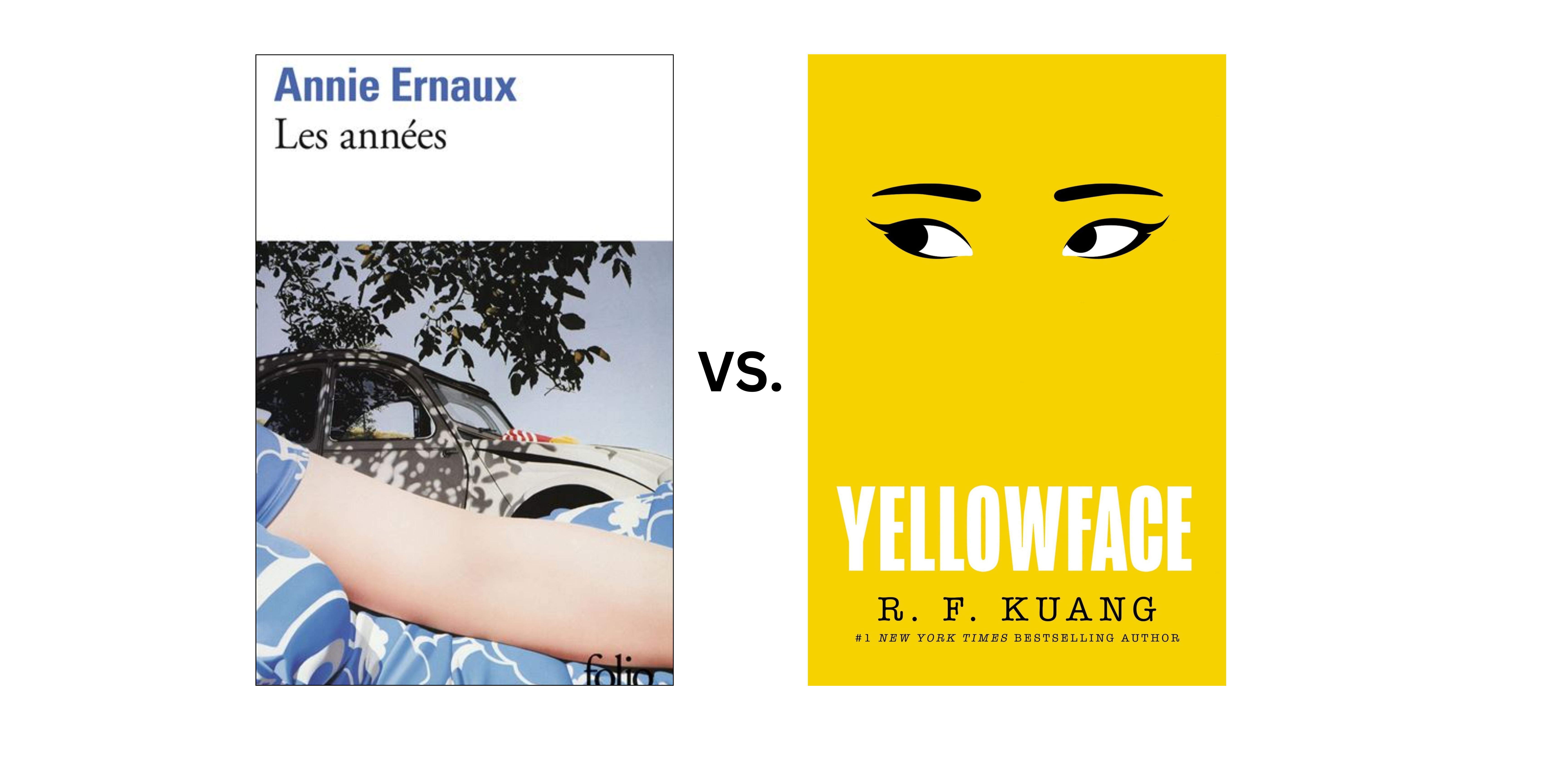
Book cover images for Les annees by Annie Ernaux and Yellowface by R.F. Kuang

Les Années (The Years) by Annie Ernaux vs. Yellowface by R.F. Kuang

You may remember that I didn’t actually finish a single book in July because of moving apartments and traveling, but I’m putting Annie Ernaux forward as the book I spent all of July reading when I had the time. While I spent almost a whole month trying to get through this one in the original French, I flew through Yellowface and its scandalously delightful satire of the publishing industry in a matter of days. I know Les Années is brilliant and I will return to it in English someday, but man, it made my brain so tired. Yellowface moves on to the next round!

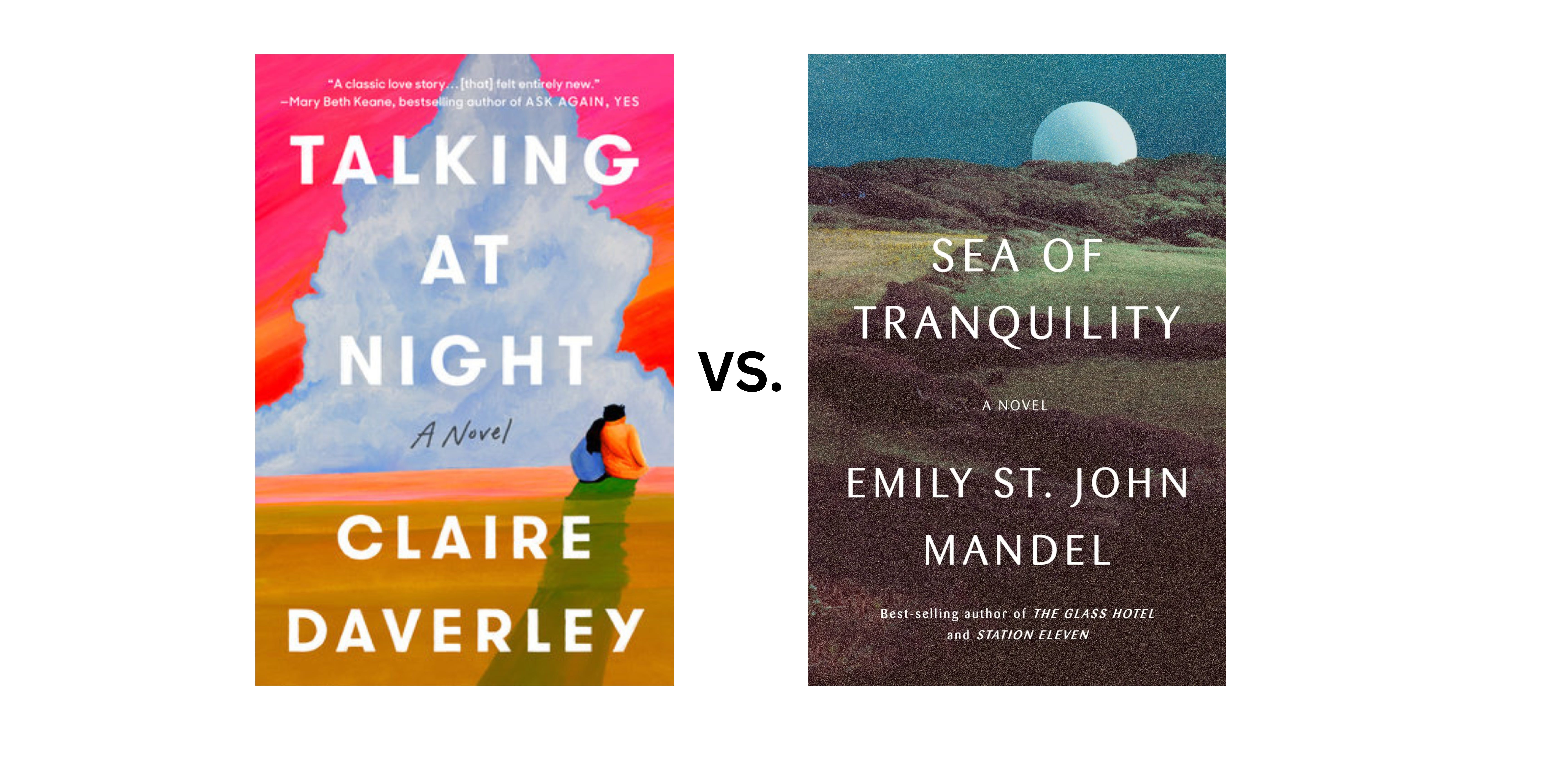
Book cover images for Talking at Night by Claire Daverley and Sea of Tranquility by Emily St. John Mandel

Talking at Night by Claire Daverley vs. Sea of Tranquility by Emily St. John Mandel

This one is so hard!!! I love love loved Talking at Night, which had me smiling and crying and yearning my little heart out during my last international flight of the year. On the other hand, I read almost all of Sea of Tranquility in one sitting on my couch and thought about it for weeks after. Hell, I’m still thinking about it. Sea of Tranquility has buried itself in my brain in a way that was completely unexpected, and which has piqued my curiosity in terms of exploring other kinds of soft sci-fi. For this reason, I think it does ultimately beat out Talking at Night, but I will keep recommending that one to all my Sally Rooney girlies who love a slow-burn, long-game relationship story.

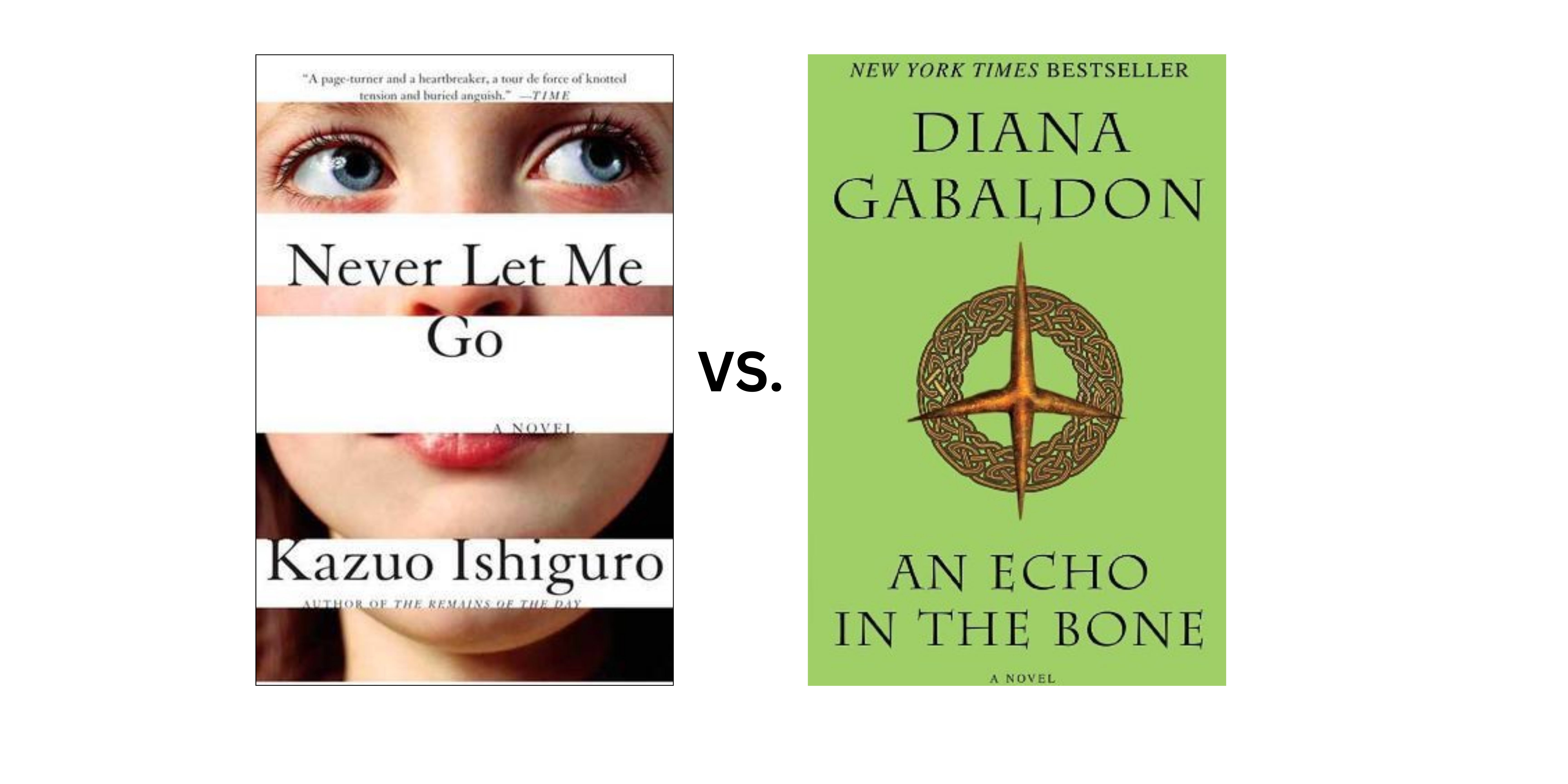
Book cover images for Never Let Me Go by Kazuo Ishiguro and An Echo in the Bone by Diana Gabaldon

Never Let Me Go by Kazuo Ishiguro vs. An Echo in the Bone by Diana Gabaldon

Finally, an easy one! There’s no contest here. I love the Outlander books, and diving into this one was a thoroughly enjoyable way to spend my December, but in terms of literary prowess and lasting impact, I have a feeling Never Let Me Go is going to go a long way in this bracket. While I will say this was one of the least stressful and most satisfying Outlander books in terms of character reunions, new relationships, and surprisingly positive outcomes to ill-fated mishaps, there is still simply no reason for these books to be as long as they are. I’ll keep reading them (and watching the show now that I’m caught up), but HOW does this woman get away with cranking out doorstopper after doorstopper!? That’s beside the point. Never Let Me Go wins, obviously.


And that’s a wrap on Round One! Come back tomorrow for Round Two as we narrow it down from the six semifinalists to the top three!

See you there,
❤ Catherine

You think love is so simple?

November in Review — Lit Chat, Vol. 14

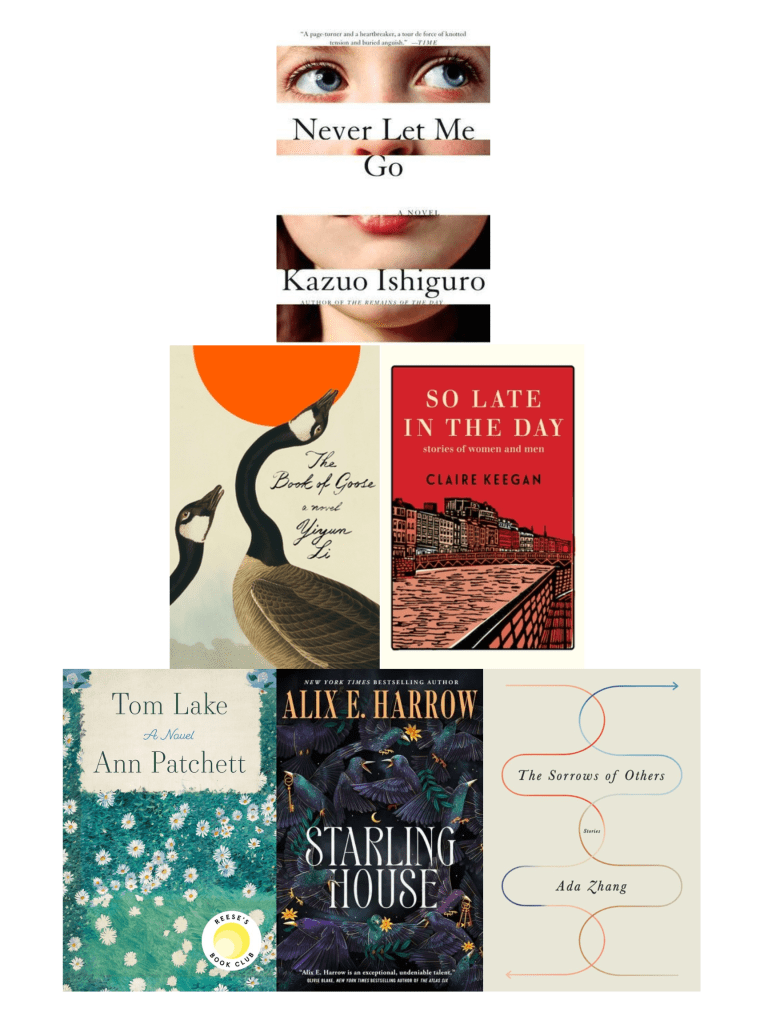
Pyramid of book cover images with Never Let Me Go by Kazuo Ishiguro on top, The Book of Goose by Yiyun Li and So Late in the Day by Claire Keegan in the middle, and Tom Lake by Ann Patchett, Starling House by Alix E. Harrow, and The Sorrows of Others by Ada Zhang on the bottom.

Housekeeping note: all links go to my Bookshop storefront, where each purchase supports independent bookstores (and this newsletter, because I get a small percentage of each sale). Buy your holiday gifts through Bookshop!!

Hi friends,

We made it to December! For me, this means that my brain has started craving hibernation mode: I don’t want to work, or think, or move my body any further than from the bedroom to the kitchen and back. I want to sleep in and eat grilled cheese and play Stardew Valley on the couch under a pile of blankets.

I’m even feeling lazy about reading: I’m nowhere near my original lofty Goodreads goal of 72 books in a year, so I’ve decided that I’m going to take December to indulge in the last 600 pages of the Outlander book I’ve been reading off and on since October. If I finish it and get around to something else this month, great! If not, I will simply enjoy the all-plot-no-thoughts vibes for as long as they last.

However! To atone for this laziness, I’ve decided to do a little end-of-year bracket, pitting the top books from each month against each other to see which one will officially be crowned my favorite book of the year. Start placing your bets now, folks! You’ll be hearing from me a bit more often in the coming weeks as I work through my completely subjective rankings.

One final housekeeping note for my local friends: I’m thinking of starting an informal reading club in the new year, where instead of all reading the same book at a time, everyone just brings one book/story/poem/article they’ve read and loved recently and we all take a turn to show and tell while eating snacks/drinking wine. If that sounds like fun and you’re in the NYC area, reach out!

Okay, okay, before we get too far ahead of ourselves, we still have November to discuss. Let’s get into it.


THE FOUNDATION:

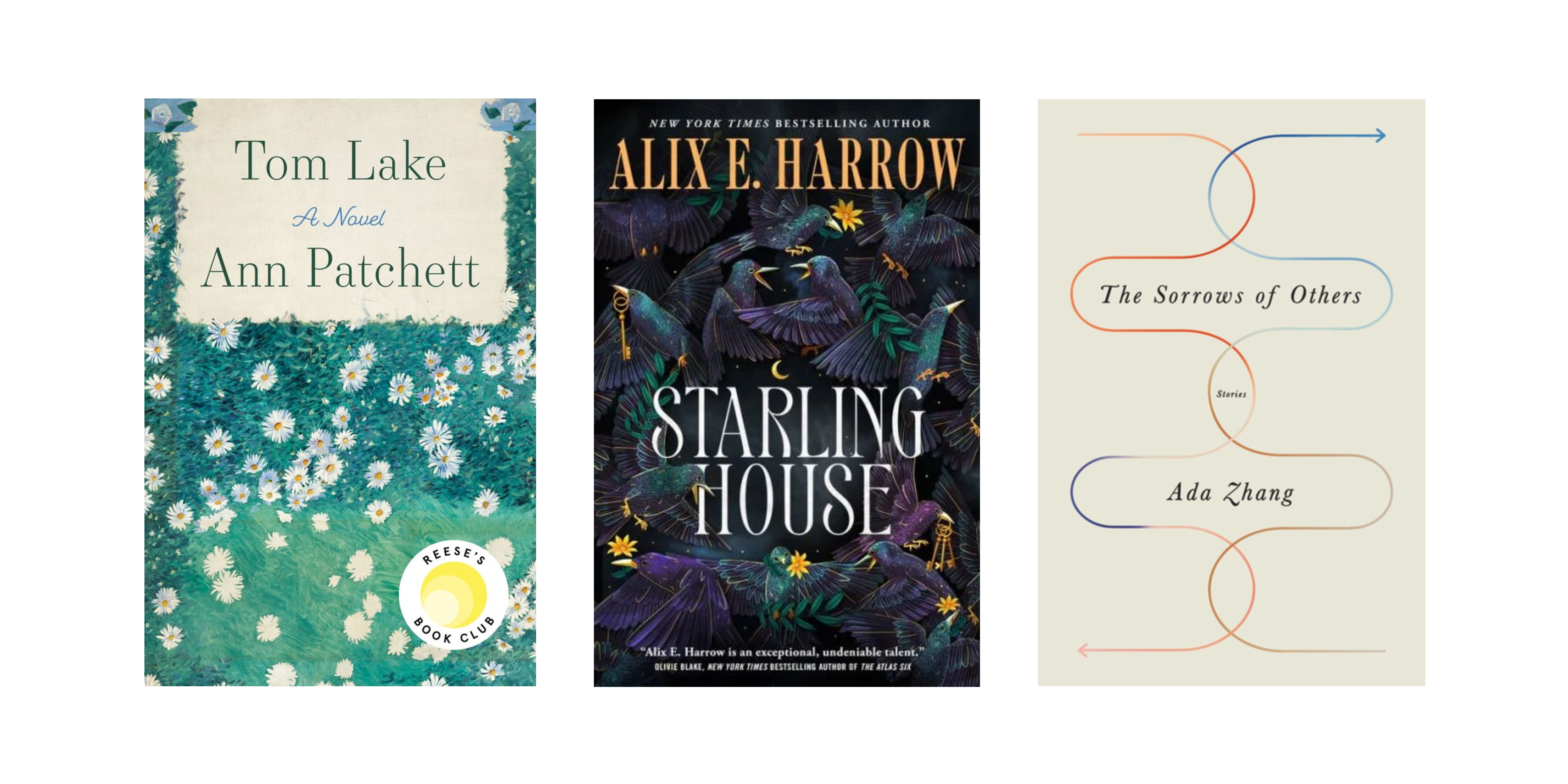
Book cover images for Tom Lake by Ann Patchett, Starling House by Alix E. Harrow, and The Sorrows of Others by Ada Zhang

Tom Lake — Ann Patchett

My first Ann Patchett, and I think my first official Covid-19 novel? Tom Lake is the name of the summer stock theater where young actress Lara Kenison falls for soon-to-be movie star, Peter Duke. Decades later, Lara is now retelling this story to her three adult daughters, who have all come home to help work their family’s Michigan cherry farm during the pandemic. The escapism of a nostalgic summer fling works to soothe the pandemic-related anxieties of both reader and characters, but personally, I realized I’m not quite ready to revisit this time in fiction just yet. That said, I think a lot of the moms in my life will relate to Lara’s conflicted happiness over having her family all unexpectedly under one roof again. A good book club book; Reese is onto something here!

Starling House — Alix E. Harrow

Regular readers of this newsletter know that I am simply a sucker for a mysterious, potentially magical old house! In this case, Starling House is the historic home of an eccentric children’s book author, whose eerie stories of a realm called Underland have fascinated orphan Opal McCoy since childhood. When Opal gets offered a job as a cleaner at the now derelict Starling House, it’s more than just an opportunity to support herself and her teenage brother in an unfriendly and unlucky Rust Belt town; it’s the answer to a calling she’s felt her entire life. Throw in a brooding love interest, a cursed family of greedy oligarchs, and a shady corporate antagonist, and you’ve got a perfectly vibey, gothic mystery to curl up with on the couch this winter.

The Sorrows of Others — Ada Zhang

I was first introduced to this collection when I read “Julia” in Electric Lit’s Recommended Reading, a barbed yet beautiful story about a woman preparing to leave the city and reflecting on the breakdown of a once-treasured friendship. I was initially drawn in by Zhang’s emotional precision, particularly the spot-on representation of the grief that comes from reckoning with the past selves you’ve outgrown. This reckoning is a recurrent theme in Zhang’s debut collection, which hops between China and America to feature the tangled stories of immigrants and the children of immigrants: husbands and wives, mothers and daughters, sisters and granddaughters, each of them struggling to reconcile their sense of self against their needs and desires and those of their families. “Julia” is a fantastic entry point to Zhang’s work, but the entire collection is one to be savored, each story sharper and more poignant than the last.


SOLID SUPPORTS:

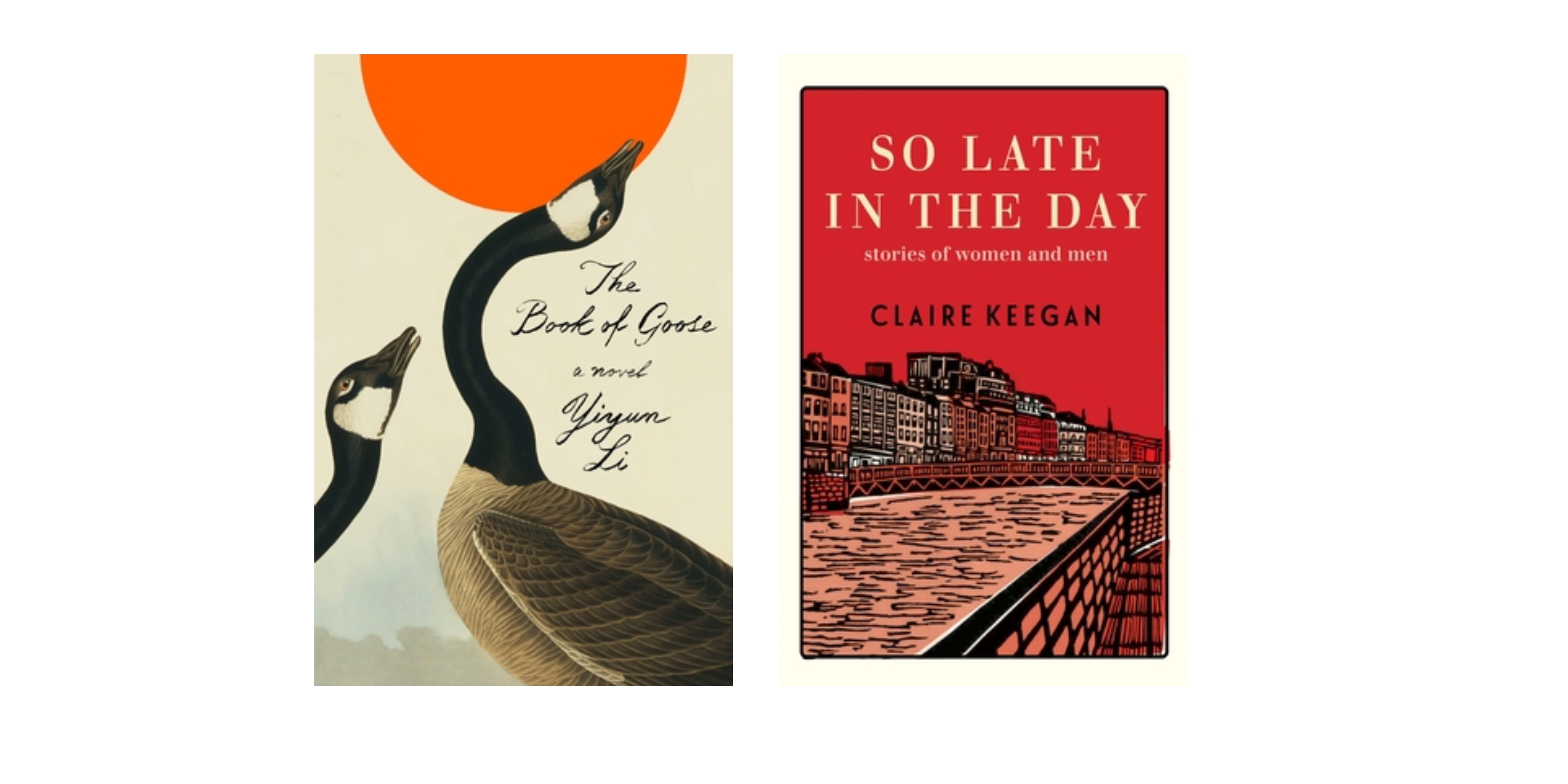
Book cover images for The Book of Goose by Yiyun Li and So Late in the Day by Claire Keegan

The Book of Goose — Yiyun Li

This is a little weirdo of a book, but one that I thoroughly enjoyed. In a small provincial town in the post-war French countryside, childhood best friends Fabienne and Agnès decide to play at writing a book together inspired by their lives. With Fabienne as the creative mastermind, Agnès’s name on the cover, and a little help from the local postman, the book captivates the French literary world—catapulting an unprepared Agnès into the spotlight.

It sounds so much simpler than it is. The narrative is told in the present day by Agnès, now an adult living in America, who feels free to tell her story in her own words only after learning that Fabienne has died in childbirth. Even then, the voice of Fabienne’s ghost is ever-present in Agnès’s mind. The Book of Goose is an intricate portrait of female friendship and an insightful exploration of fame, power, influence, and the fleeting nature of it all. @CB, you have redeemed yourself with this rec!

So Late in the Day — Claire Keegan

I read Claire Keegan’s Small Things Like These around the same time last year, and I’m thinking of making reading her work something of a seasonal tradition. This slim little volume is a compilation of three previously published short stories: the first, about a man on his would-be wedding day, reflecting on where he went wrong; the second, about a woman on a writing retreat forced to host an unwelcome guest; and the third, about a married woman who decides to have sex with a stranger and gets far more than she bargained for.

I really wrestled with whether or not to give this one the top spot because the last story in particular, “Antarctica,” has positively haunted me. The other two stories are masterful, don’t get me wrong, but “Antarctica” is a whole masterclass in character, pacing, and atmosphere. I’m obsessed with the way Keegan lulls you into a false sense of security alongside the protagonist, denying the instinctual sense of dread steadily creeping in around the edges until the danger becomes chillingly obvious. A week later, it still gives me shivers just thinking about it.


THE TIPPY TOP:

Book cover image for Never Let Me Go by Kazuo Ishiguro

Never Let Me Go — Kazuo Ishiguro

Surprise, surprise, the Nobel Prize winner comes out on top! As I said, it was a real struggle between this and So Late in the Day, but ultimately, this one has managed to haunt me longer and more completely as a novel rather than a single story in a collection.

Most of Never Let Me Go takes place at Hailsham, a seemingly idyllic English boarding school where its students are cloistered from the broader world while learning everything they will need to one day go out into it as (organ) “donors.” Kath, a former student, narrates the book as an adult reflecting on her childhood while she cares for other donors in preparation for becoming one herself.

What struck me the most about this book is not the ultimate revelation, unsettling as it is (no spoilers!), but how successfully Ishiguro manages to shield us from the disturbing truth for as long as he does. In this way, we are as sheltered as the Hailsham students—we always know there is more to this story, something that likely has broader and more sinister implications for our understanding of this alternate future, but it feels so far removed from the routine of daily life at Hailsham and the intimacies of Kath’s relationships with the other students that you can easily bury the niggling suspicion that something is not quite right.

For such a quiet book, it’s a fairly scathing take on how easily society can become inured to human rights abuses when those being abused are perceived as less than or unhuman, especially when this abuse becomes accepted as the norm. (Sound familiar? It should.) Never Let Me Go was published in 2005, and yet Ishiguro’s warning to society is as timely as ever. He offers no panacea to Kath’s and the other students/donors’ plight, but he does force the reader to bear witness, with full knowledge of the wrong that is being done. It’s up to us to decide at what point we look away.


All right friends, that’s all for today! If you need me, I’ll be in Revolutionary War-era America with Jamie Fraser for the foreseeable future, so don’t call or text (unless it’s to talk about any of the above books or to give me a rec for my 2024 TBR—those texts are always welcome).

Until next time, happy reading!
❤ Catherine

Fly me to the moon…

October in Review  Lit Chat, Vol. 13

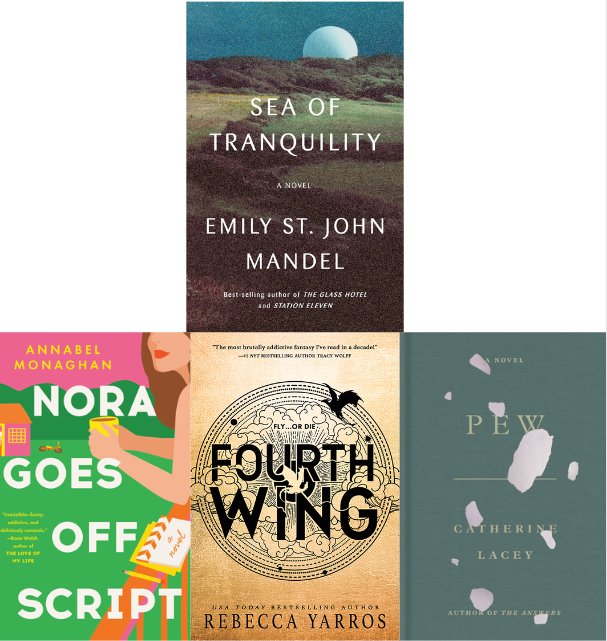
Pyramid of book cover images, with Sea of Tranquility by Emily St. John Mandel on top, and Nora Goes Off Script by Annabel Monaghan, Fourth Wing by Rebecca Yarros, and Pew by Catherine Lacey on the bottom.

Housekeeping note: all links go to my Bookshop storefront, where each purchase supports independent bookstores (and this newsletter, because I get a small percentage of each sale).

Hi friends,

Another short one for you this month. It feels a little strange to be sitting here thinking about the privilege I have of being able to leisurely escape into other worlds via books when there are civilians caught in active war zones, but I’m not a foreign policy expert and that’s not what this newsletter is for. What I will share instead is a recent newsletter from author Alexander Chee, which includes some recommended reading from those whose experiences are far more relevant than mine and whose voices are just as deserving of your attention, plus a link to contact your reps about calling for a ceasefire. If you only pick one to read, let it be this poem from Naomi Shihab Nye. Big thanks to Nikhil for sharing.

Meanwhile in book world, I’ve been settling into fall with some longer reads (not included: the Outlander book I got through 500 pages of before taking a break), and taking the time to really sit with some of the shorter ones that have left their mark this month. I have a bad habit of racing into my next read without giving the last one enough time to marinate in my brain, and I’m trying to be better about that (waiting at least a day). It’s just so hard when there are so many books to be read! My TBR pile is so long. Thank goodness for Daylight Savings ending, honestly, which will make me feel so much less guilty about staying inside and reading as we hunker down into the colder months.

Speaking of, let’s move on to the books.


THE FOUNDATION:

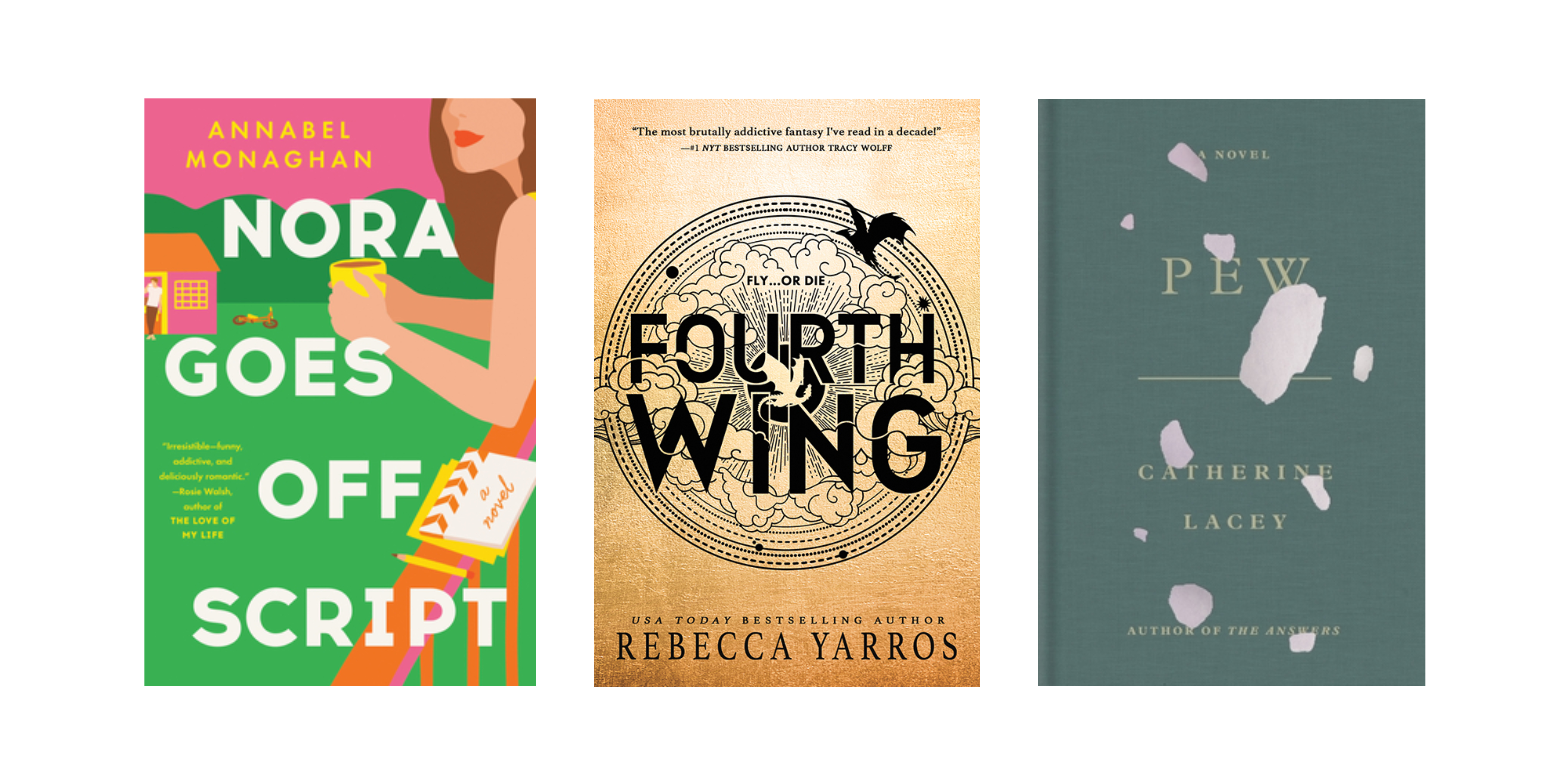
Book cover images for Nora Goes Off Script by Annabel Monaghan, Fourth Wing by Rebecca Yarros, and Pew by Catherine Lacey.

Nora Goes Off Script — Annabel Monaghan

This was my book club book for October, but I sadly couldn’t make it to book club this month so you’re all my book club now. Nora writes cheesy Hallmark movies for a living until a script about her failed marriage unexpectedly sells big in Hollywood. Production promises they’ll only have to shoot on location on Nora’s property for a few days, but Nora’s hundred-year-old house and quiet, comfy life with her two young kids charm the movie’s lead actor, Leo Vance. Leo offers to pay Nora to let him stay an extra week for some rest and relaxation, and cue the romance channel ‘falling in love with a movie star’ montage! But real life can’t possibly follow the same formula as one of Nora’s scripts…or can it? This was a sweet, easy read with a few fun zingers and a heartfelt emphasis on family, belonging, and what it means to feel at home.

Fourth Wing — Rebecca Yarros

If you loved the Eragon books as a kid and thought “Man, you know what would make this better? More sex and death,” then this one’s for you. Violet Sorrengail is the daughter of one of Navarre’s most famous dragon rider generals, and though she’d had no intention of becoming a Rider herself, her mother had other ideas. This is how she ends up enrolled in the deadliest Quadrant of the Basgiath War College, where the names of fallen candidates are read out at roll call every morning. Violet isn’t as physically strong as the others, but she’s smart—smart enough to sense that there’s something the students aren’t being told about the failing protection wards at their borders, and smart enough to keep Xaden Riorson, son of an executed rebellion leader, from making good on his promise to kill her. I’m docking points for excessive horniness (Xaden is unfortunately very hot), but this was exactly the kind of immersive fantasy that I’d been craving since September, and thus it is very likely that I shell out for the sequel when it publishes this week(!).

Pew — Catherine Lacey

This is one of those strange, disorienting books you keep mentally turning over long after you’ve finished. In Pew, the discovery of a young stranger sleeping in a church, whose age, race, and gender remain ambiguous throughout the novel, rocks a small Southern town. Though initially welcoming, the stranger’s inability to speak or provide any clarifying details on their background and identity strains the good intentions of the congregation, especially as their arrival coincides with preparations for the town’s annual Forgiveness Festival. Nicknamed ‘Pew,’ the stranger’s refusal to conform to any of the townspeople’s projections stymies some and intrigues others, and many take Pew’s silence as an opportunity to make their own haunting confessions. What follows is an eerie portrait of a community built on contradictions and an unsettling reflection on American values and morality. Thank you, Monique, for this stellar rec!

THE TIPPY TOP:

Book cover image for Sea of Tranquility by Emily St. John Mandel

Sea of Tranquility — Emily St. John Mandel

Much like Pew, this is a book that I’ve found myself coming back to nearly every day since I’ve finished. It’s a hard one to talk about without spoiling, but Sea of Tranquility follows a set of characters throughout history and the future who have all had the same strange, almost otherworldly experience: a momentary flash of darkness, accompanied by the sounds of a violin and the noise of an airship taking flight. From Vancouver Island in 1912 to the surface of the moon in 2401, the book revolves around the mystery of these recurring moments, and investigator Gaspery-Jacques Roberts’ determination to discover the cause of the anomaly.

I’ve avoided Emily St. John Mandel’s books for years despite having only ever heard high praise, because I thought I didn’t want to read a pandemic novel, or I thought I wouldn’t like sci-fi, etc. etc., but I’m so glad Sea of Tranquility destroyed all my preconceptions. Even the most speculative aspects of the novel felt somehow familiar and accessible, because even on the Far Colonies of the moon, Mandel preserves the humanity of her characters through their ambitions, nostalgias, dreams, and despairs. Best of all, the precision with which every piece of information is perfectly placed for an ultimate reveal has you flipping back whole chapters as you read to see how you could have possibly missed the initial signs. My advice is to read as much of the book in one go as you can—or at least whole chapters at a time. You won’t want to miss a single detail.


That’s all for now! I hope you’re able to squeeze some reading into the extra hour of your day today. If you want to chat more about these books or any others, leave a comment or send me a message!

Until next time, happy reading!
❤ Catherine

Happy Birthday to LC!

September in Review Lit Chat, Vol. 12

Pyramid of book covers with Talking at Night by Claire Daverley on top, Homecoming by Kate Morton and Song of Achilles by Madeline Miller in the second row, and The Night and Its Moon by Piper CJ, The Lesser Bohemians by Eimear McBride, and The Haunting of Hajji Hotak and Other Stories by Jamil Jan Kochai on the bottom row.

Housekeeping note: all links go to my Bookshop storefront, where each purchase supports independent bookstores (and this newsletter, because I get a small percentage of each sale).


Hi friends,

A year ago today, I sent out my very first insanely huge pyramid for the 10(!) books I finished in September 2022. Since then, 60 more books have graced these silly newsletters, for a grand total of 70 books in a year, which is more or less my average Goodreads goal.

These newsletters have become a reading diary of sorts. In looking back at each pyramid, the context of my life at the time of each book comes back vividly: I remember which ones I read on planes and trains, listened to on walks around the neighborhood, or devoured luxuriously on Sunday mornings in bed.

Books have been my faithful companions in a year of uncertainty and upheaval, full of changes and moves, travels and new starts. It’s been a joy and a privilege to intentionally make space for reading in this way, to commit each book further to memory by recording my thoughts for you to read here. Thank you so much for letting me share this journey with you.

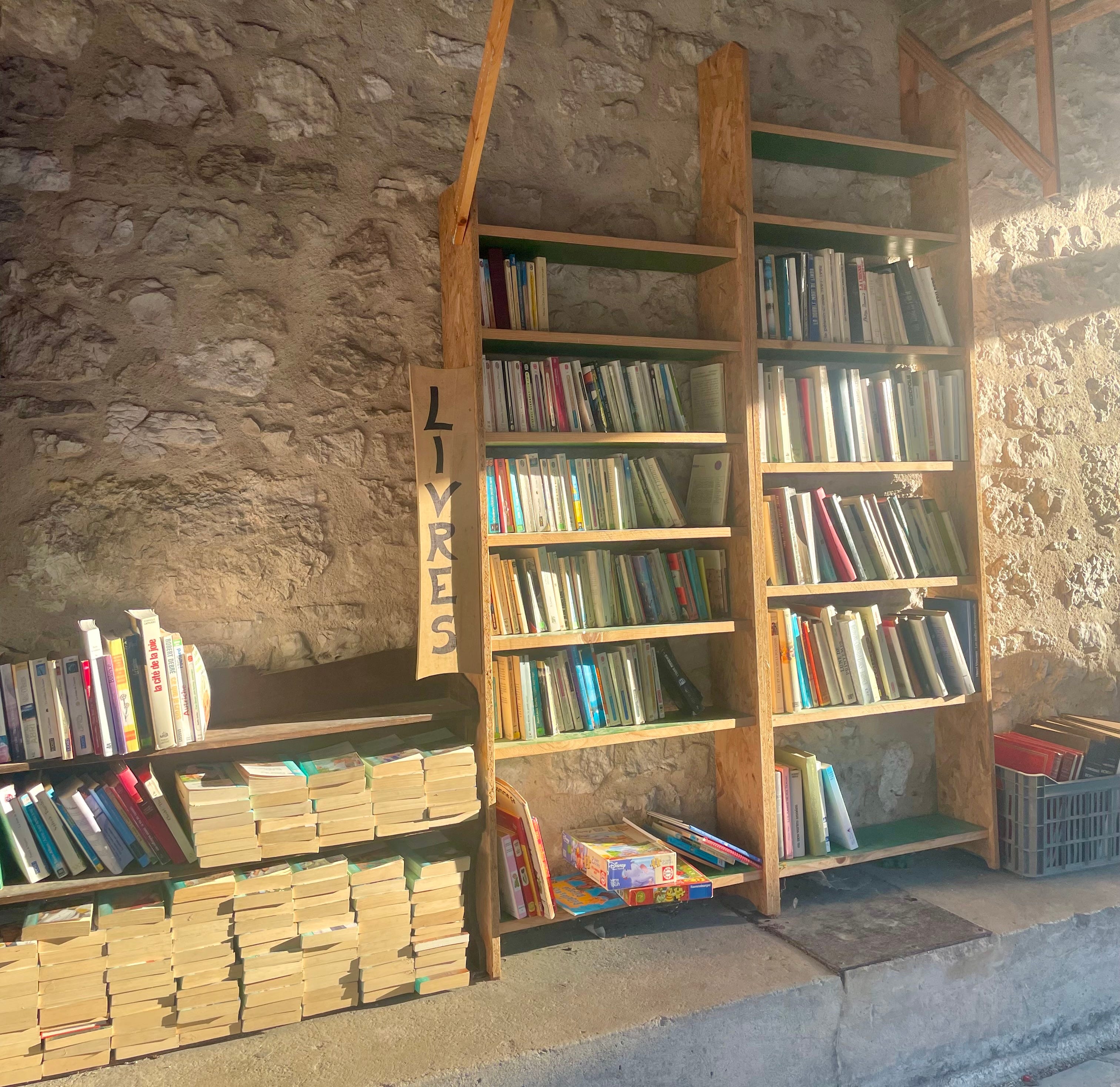
Two wooden vertical bookshelves filled with books against a stone wall, with more books on lower horizontal shelves to the left and in crates on the floor to the right. A sign that says "LIVRES" is attached to the side of one of the vertical bookshelves.
I would give you all a livre from this little French library if I could!

I only finished 4 instead of 10 books in September this year, but one of those books was almost 600 pages, and I also spent a third of the month in a foreign country, so girl math says I probably read closer to 7 books. I also DNF’d (Did Not Finish) two books this month (rare for me!), which those of you on Instagram said you wanted to hear about, so I’ll be including a bit about those as well.

Shall we get started?


THE FOUNDATION:

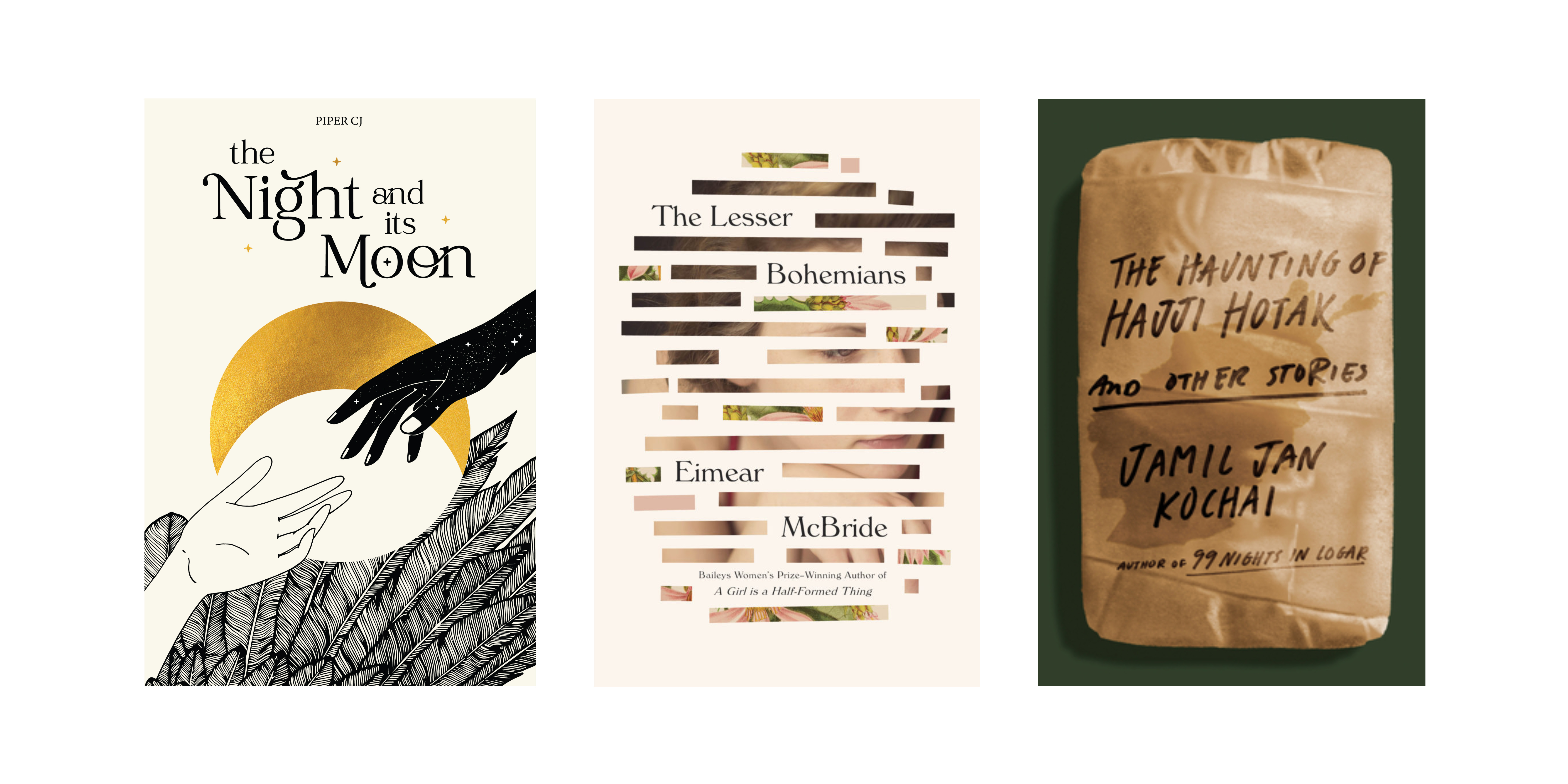
Book cover images for The Night and Its Moon by Piper CJ, The Lesser Bohemians by Eimear McBride, and The Haunting of Hajji Hotak and Other Stories by Jamil Jan Kochai.

DNF: The Night and Its Moon — Piper CJ

This was a BookTok hype trap that I fell for because I was really craving some escapism, and the prospect of getting lost in a queer fantasy series sounded perfect. Sadly, it wasn’t what I was hoping for. The two main characters from the first 100 pages—orphans Nox and Amaris—had no real goals except “be together,” and even when they were inevitably separated, I still had no idea where the book was going or what the supposedly extensive fantasy world was like apart from some obvious parallels to The Witcher. I wanted to be immersed, but the overly flowery writing style ended up just putting me to sleep on the plane to Portugal. Would love to know if anyone’s read this and thinks it’s worth picking back up!

DNF: The Lesser Bohemians — Eimear McBride

To be fair, I think the narration of this audiobook is absolutely gorgeous, read by the author whose Irish lilt is naturally hypnotic. Unfortunately, that was exactly the problem; its rhythmic lyricism kept putting me to sleep, despite the fact that its plot revolves almost entirely around the sexual awakening of a young Irish drama student in London who meets a much older semi-famous actor. I suspect this would actually be quite a fast read if I had a physical copy, but it took me four months to get through four audiobook hours (out of eleven), and I got tired of trying to remember what was happening in the plot outside of the bedroom every time I nodded off mid-sex scene. I’d consider coming back to this in print, but I’m not in any particular hurry to do so.

The Haunting of Hajji Hotak and Other Stories — Jamil Jan Kochai

Every once in a while, there’s a book that reminds me just how small my worldview is by taking me to a place/culture/time in history that I realize I know very little about. I’ve read countless books about New York City or the English countryside, but I’m embarrassed to admit that The Kite Runner is probably the only other book I’ve ever read about Afghanistan until now. Many of the stories in this prize-winning collection follow members of the same extended family, moving between the Afghanistan of memory and family lore to that of the war-torn present day, and overseas to the Afghan diaspora in the United States. Some stories feel folkloric and timeless, while others tend towards a violent kind of magical realism to explore the contemporary consequences of war and conflict. There are moments of humor and levity combined with moments of profound grief and loss, weaving together a portrait of a rich culture and history so often obscured by stereotypes and prejudice in our news at home.

SOLID SUPPORTS:

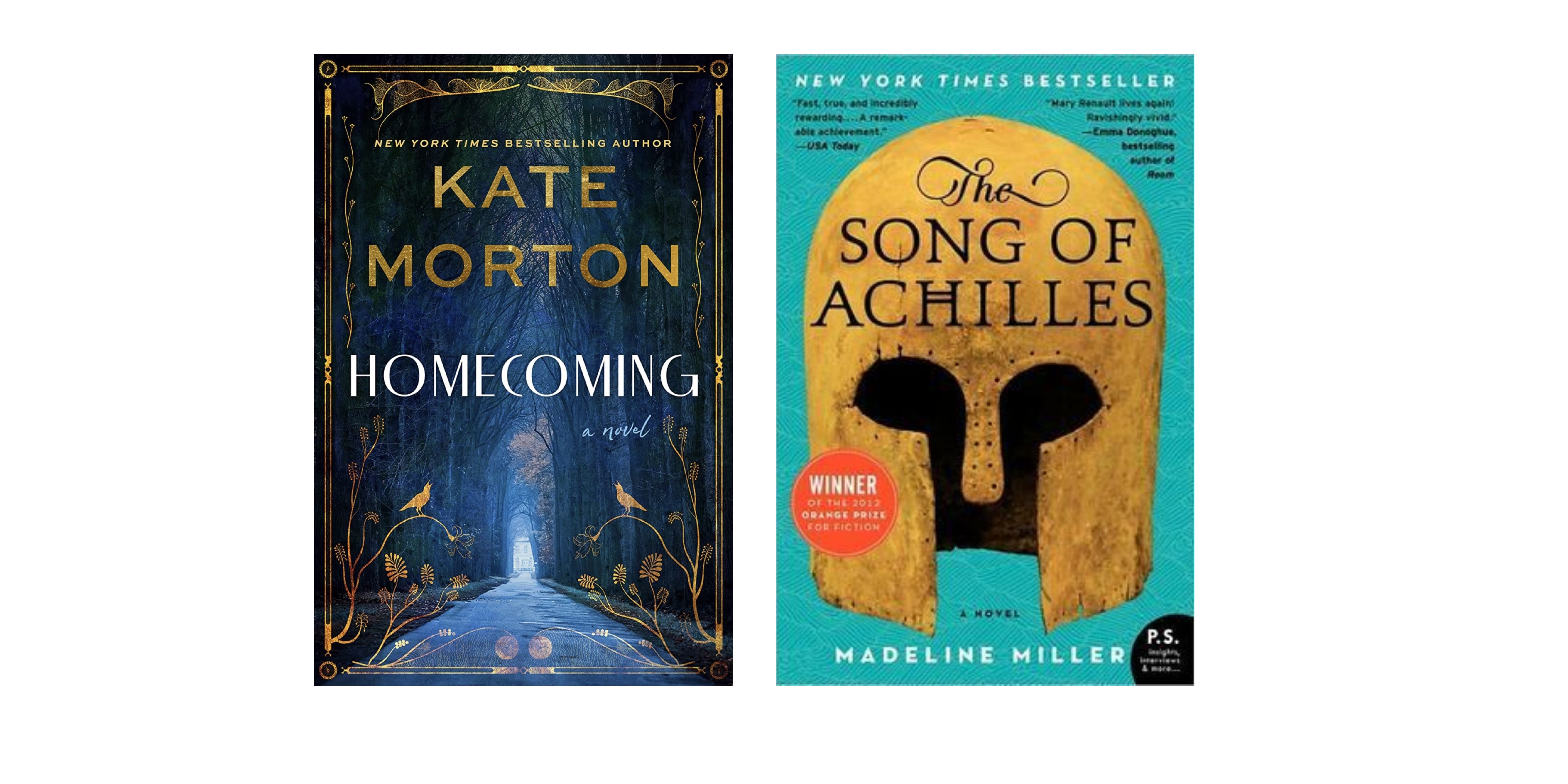
Book cover images for Homecoming by Kate Morton and The Song of Achilles by Madeline Miller.

Homecoming — Kate Morton

I’ve loved Kate Morton’s books since high school because they tend to tick all of my readerly boxes: they all feature stately manor homes (characters in their own right) in small countryside towns that serve as a backdrop against secrets, family dramas, and historical intrigue. Homecoming follows Jess, an ex-pat journalist living in London who returns to Australia when the grandmother who raised her becomes hospitalized. While home, she begins to piece together long-buried family secrets about the mysterious deaths of her grandmother’s sister-in-law and her children, and the story alternates between Jess’s investigation and the text of a contemporary true-crime novel written about the deaths. I read this 550+ pager on the couch during a rainy week stuck inside with a cold, which couldn’t have been a more perfect reading environment. It sags a little in the middle, but if you think you’ve got it figured out, you’re wrong—the series of twists in the last 100 pages more than makes up for the time it takes to get there.

The Song of Achilles — Madeline Miller

I was craving the fantastical and landed on the mythological, which turned out to be exactly what I needed. Narrated by Patroclus, Achilles’ closest companion and lover, The Song of Achilles brings the epic tale of Achilles’ life and role in the Trojan War back down to Earth with the kind of tenderness and intimacy that only a mortal in love could achieve. Miller’s writing is so conservatively evocative—no superfluous words are needed to bring this familiar story to life with vivid precision, clarity, and heart-wrenching vulnerability. I think I ultimately prefer Circe just because of the immanent sadness of this story, but both are must-reads for anyone remotely interested in Greek mythology (grown-up Percy Jackson fans, I’m talking to you!). There’s a reason these stories and characters have persisted as long as they have and are still being told: they’re compelling, tragic, inspiring, and at the end of the day, divinely human.

THE TIPPY TOP:

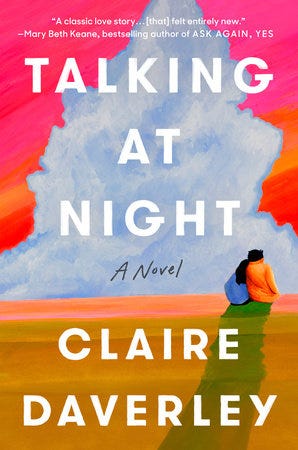
Book cover image for Talking at Night by Claire Daverley.

Talking at Night — Claire Daverley

This book might be benefitting from the romanticization of having been started on a Portuguese beach and then finished in one sitting on my flight back home, but it’s also the closest I’ve found to a Sally Rooney-level of yearning in a long time, and you guys know how much I love to yearn!!

Rosie and Will meet as teenagers and are complete opposites: Rosie is a gifted musician with a regimented, no-nonsense plan for her future success. Will has a dark past of secret shames and addictions, and his only future plans are to travel the world. They’re drawn to each other until a shocking death in Rosie’s family shatters their lives irrevocably, and yet even through years of separation, denial, and other more-or-less fulfilling relationships, they can’t quite let each other go. What stayed with me most about this book was how genuinely it portrayed the way relationships can unexpectedly evolve, and how the smallest decisions and briefest conversations can somehow accumulate to create an entirely different life for yourself than the one you imagined when you were a teenager, never realizing in the moment that that’s what happening.

Talking at Night is a love story at its core, but it also tackles grief, mental health, addiction, and illness with frankness and compassion, and made me absolutely lose it on the plane (although I admit to always crying easier on planes). If you’re a hopeless water sign who loves to yearn, you will love this. If Normal People made you want to bash your head into the wall (but in a good way), then go ahead and let Claire Daverley break your heart and put it back together again, as a little treat.


Thanks for reading with me for a whole year!! I’m off to have a celebratory mini cupcake, but if you’d like to chat some more or want to give me a spooky rec for October, you know where to find me (comments/emails/DMs/call me/beep me/etc).

Until next time, happy reading!
❤ Catherine

Procrastination at Its Finest

August in Review — Lit Chat, Vol. 11

Book cover for R.F. Kuang's Yellowface centered and stacked on top of the book covers for Annie Ernaux's Les Annees, Tove Jansson's The Summer Book, and Genevieve Wheeler's Adelaide.

Housekeeping note: all links go to my Bookshop storefront, where each purchase supports independent bookstores (and this newsletter, because I get a small percentage of each sale).

Hey friends,

Happy Labor Day! This is going to be another quick & dirty Lit Chat Lite™ because I’m leaving for the airport again in approximately five hours and I haven’t finished packing or located my Kindle charger. If you see any typos, no you didn’t. Here we go!!

The Foundation:

Book covers for Annie Ernaux's Les Annees, Tove Jansson's The Summer Book, and Genevieve Wheeler's Adelaide.

Les Années — Annie Ernaux

I mentioned last time that this sucker was taking me forever because I was determined to read it in the original French, and 3 1/2 weeks later, we did it, Joe! Les Années (The Years) is a fascinating narrative memoir that chronicles Ernaux’s life via a series of described photographs, starting as a child in the post-WWII era and moving through the decades into the present moment. She speaks of her memories in the third person and contextualizes each phase of her life against the backdrop of ongoing socio-political events and pop culture, including elections, protests, songs, and the emergence of new technology. It made me wish that I had read this book as part of one of my college French classes because my unfamiliarity with the details of French socioeconomic history combined with lots of new vocab made for slow reading and not a lot of absorption. One day, I’ll come back to this in English and find out just how much I missed.

The Summer Book — Tove Jansson

Most famous for her Moomin comics, Tove Jansson also wrote novels for adults that are positively delightful. The Summer Book is a collection of vignettes following the day-to-day adventures of a young girl and her grandmother as they spend their summers on a remote Finnish island. Even though this book is for adults, it’s the kind of book I would have loved as a kid, because it conveys such a strong sense of nostalgia for slower, simpler times and long days spent outdoors searching for magic under every rock and tree root. This is the perfect book to help you gently transition out of these last couple weeks of summer.

Adelaide — Genevieve Wheeler

This book hit home for me in a lot of ways, and I think it will for many of my friends as well, even though I wish it wouldn’t. Adelaide is a twenty-five-year-old American ex-pat in London who thinks she’s found her Disney prince, but her fairytale ending escapes her when he proves to be painfully unreliable and noncommittal. I found this book frustrating at times because it was difficult to watch Adelaide continue to bend over backward for someone who so clearly did not love her back, all while she clung to the romanticized version of the relationship to the detriment of her own mental health. My frustration with Adelaide came less from her character and more from the fact that I saw in her so many of my friends’ and my own misguided experiences growing up and learning to navigate adult relationships. This is a really candid and vulnerable look at love, mental health, and what it means to feel valued and worthy in a relationship, but it’s definitely not a light-hearted love story.

THE TIPPY TOP:

Book cover for R.F. Kuang's Yellowface.

Yellowface — R. F. Kuang

You might remember that I was not a huge fan of Kuang’s fantasy novel Babel when I read it back in April, but oh man, I flew through her newest contemporary novel. Yellowface is the story of white writer June Hayward, who after witnessing the freak death of her friend, the much more successful Asian-American author Athena Liu, decides to steal Athena’s unpublished manuscript about Chinese soldiers in WWI and pass it off as her own. As someone who has been adjacent to the trade publishing world for a long time, I devoured this darkly funny satire of the industry and its trends and biases.

The part of this story that struck me as most devastating, though, was June’s loneliness. As she goes from critical acclaim as publishing’s newest darling to being canceled and becoming social media’s villain of the day for months at a time, the only friend she ever mentions is the one who dies in the first chapter—and even that relationship we know to have been fraught with envy and resentment. She has no real, honest writing community to lean on or gut-check her, which explains her extreme need for validation from the greater literary world. None of this excuses her truly horrible behavior, but for those of us who are lucky enough to know the benefits of a creative community, it does help us pity her just a little bit in her downfall.


Okay gotta go finish packing, so until next time, happy reading chat later love you bye!!
❤ Catherine

Three Summers & a Murder

June in Review Lit Chat, Vol. 10

Thumbnail of book cover for Happy Place by Emily Henry centered above row of book cover images for The Guest by Emma Cline, Play It As It Lays by Joan Didion, and Eileen by Ottessa Moshfegh.

Housekeeping note: all links go to my Bookshop storefront, where each purchase supports independent bookstores (and this newsletter, because I get a small percentage of each sale).

Hey friends,

I’m back! Did you miss me? I did eventually miss being home, even though I had a fantastic whirlwind of a summer vacation. I confess I haven’t finished a single book since the last week of June, probably because that was the last week my life retained any shred of normalcy. Since then, I’ve moved apartments, traveled to three different countries, and am now writing to you from the Amtrak on my way home from an out-of-town conference. If you think that sounds exhausting…you’d be correct.

But just because I haven’t finished anything doesn’t mean I haven’t been reading! In fact, I’ve been slowly making my way through Annie Ernaux’s Les Années for the better part of the last three weeks. It’s slow going because I’m reading it in the original French, which has been reminding me of how it felt to be reading above my reading level as an ambitious little kid. Too impatient to stop and look up every word I don’t know, I’m comprehending maybe 70% of what I’m reading, but I’m getting enough from cognates and context clues to keep me going. It’s humbling to realize just how much I take for granted my extensive vocabulary and relative mastery of the English language, but it’s also a little thrilling to remember that this is exactly how I achieved it in the first place: ploddingly but determinedly, one sentence at a time.

Anyway, I read four books in June that I’m more than happy to tell you about, with hopes of finally returning to my normal English-reading pace in August. We just got a new couch delivered and are working on a cozy reading nook in our living room, so that’s where I plan to spend most of the next four weeks until I need to travel again.

A six-shelf corner bookshelf filled with an assortment of colorful books, plants, and decorations including a Hogwarts lego on the top shelf.

Also, if you’d rather get this post in newsletter form, you can subscribe to my Substack via the button below:

The Foundation:

The Guest — Emma Cline

This was the last book I finished in June, and I found that stressing over the protagonist’s poor decisions was a compelling antidote to my own pre-move stress. When Alex falls out of her much older “boyfriend’s” good graces while staying at his Long Island beach house, instead of returning to the city where she owes a menacing ex a bunch of money she doesn’t have, she decides to bide her time for a week until she can try to win back his favor. I liked the episodic nature of each day’s challenge to manipulate rich strangers into enabling her survival, but her abrupt departure from each encounter always felt unresolved in a way that I found unsatisfying. I feel like this book would make a great limited series, though.

Play It As It Lays — Joan Didion

Would you believe I’d never read anything by Joan Didion before this? I was mildly obsessed with this book for the better part of a week because it’s the kind of book that makes you want to go right back to the beginning after you’ve finished it. The prose is spare and sharp as a knife as it cuts through the shuffling scenes of former actress/model-turned-housewife Maria’s disintegrating mental health. Set in Hollywood in the 60s, it’s definitely meant to be emblematic of the dissatisfaction of a particular generation, but it also feels timeless in its portrayal of loss, confusion, and grief. It’s not a happy read by any means, but man, it’s a brilliant work of literature and I’m now accepting recommendations for my next Joan.

Eileen — Ottessa Moshfegh

This is, I think, my favorite of Moshfegh’s books that I’ve read so far! I was skeptical because as engrossed as I was in My Year of Rest and Relaxation, Lapvona just plain grossed me out. Eileen gives big Shirley Jackson vibes, as it’s about a socially maladapted young woman who dreams of escaping her day job in a juvenile prison until the arrival of a glamorous new coworker, an older woman named Rebecca. Moshfegh’s trademark morally gray female characters are certainly a main focus here, but so is an actual plot for once, with a twist that made my jaw drop. The story is told from the perspective of a much older Eileen, and I think this distance helps the reader give young Eileen a bit more grace when she’s making reprehensible decisions. I’m really looking forward to the forthcoming movie adaptation, which has Thomasin McKenzie as Eileen and Anne Hathaway as Rebecca.

THE TIPPY TOP:

Happy Place — Emily Henry

I have somehow not consumed Emily Henry’s entire oeuvre yet, but so far, her books are my happy place. This one subverts the typical rom-com structure in a way that was reminiscent of Jane Austen’s Persuasion (a favorite!), because the love story we’ve come to expect—the meeting and becoming friends before falling for each other, the deliciously agonizing will they/won’t they—is already in the past.

When we first meet Harriet and Wyn, they’ve secretly called off their engagement for half-baked reasons we don’t fully understand and which neither of them seems fully happy about. Unwittingly reunited for an annual vacation with their tight-knit group of college best friends, they commit to pretending to stay together for the week for fear of ruining the trip and rocking the foundation of their other friendships.

As much as I rooted for Harriet and Wyn to figure their shit out and get back together already, what I loved most about this book wasn’t their witty banter or romantic tension, but the portrayal of all the other friendships present. Happy Place perfectly captures the late twenties/early thirties growing pains of realizing that you aren’t the same person you were when you first met your oldest friends, and more importantly, that it’s okay for those relationships to change and grow with you.

For Harriet and Wyn, the fear of losing what they had and knew they loved, both in each other and in the group as a whole, was blinding them to the possibility of all the ways each of their relationships could grow stronger by adapting to the changes and challenges of growing up—even if that meant those relationships ultimately looked a little different. As someone who is lucky enough to have lots of long-lasting friendships follow me into adulthood and evolve along the way, this really resonated with me. Like Harriet and Wyn, my happy place is very much with the people who have known and loved me the longest, and these days, I’m grateful for whatever form that takes.


Thanks for reading Lit Chat Lite™! Whether your summer reading is going swimmingly or starting to take on a little water, I definitely want to hear about it. Comments/inbox/DMs etc are always open if you ever want to chat!

Until next time, happy reading.
❤ Catherine

Do you guys ever think about dying?

May in Review — Lit Chat, Vol. 9

A pyramid of book covers with Rick Riordan's The Hidden Oracle on top, Alexander Chee's Edinburgh and Ann Napolitano's Hello Beautiful in the middle, and Maya J. Sorini's The Boneheap in the Lion's Den, Jose Olivarez's Promises of Gold, and Donna Tartt's The Goldfinch on the bottom.

All the links in this newsletter go to my Bookshop storefront, where your purchase supports independent bookstores (and me! I get a little cut). Click below to check it out!

Hey friends,

A few housekeeping notes/life updates before we get to the books:

  1. Lit Chat is going on summer break! I’m moving at the end of the month (hmu if you want my couch), and then I am promptly getting on a plane and absconding to Europe for three weeks, so I don’t anticipate having much time for reading/writing in the foreseeable future. I’ll be back in August!
  2. On that note, I have far too many books in my apartment and books are unfortunately very heavy to pack, so I’m looking to offload some! I’m thinking of doing a little book swap in Fort Greene Park on either the third or fourth weekend in June, so if you’re interested, text/email/message me and I’ll make sure to send you the deets when I have them.
  3. My friend Michy was kind enough to include one of my poems in her newsletter, beat & beatnik, last week! Michy is a talented poet and newsletterist, and her most recent letter is a thoughtful and emotionally resonant reflection on change, intimacy, and community. You can read the whole thing here (my poem’s at the end):
  1. ICYMI on my Instagram, I saw Boris Johnson in Kramer’s bookstore in Washington, D.C. over Memorial Day weekend:

God, I wish I knew what he bought.

Okay! Onto the books, shall we? Most of this month’s reading was done from planes, trains, and hotel beds, and I feel like I’ve lived approximately four lifetimes since I read my first book of the month. The years start coming and they really don’t stop coming, huh?


The Foundation:

Book covers for The Boneheap in the Lion's Den by Maya J Sorini, Promises of Gold by Jose Olivarez, and The Goldfinch by Donna Tartt

The Boneheap in the Lion’s Den — Maya J. Sorini

This debut poetry collection is not for the squeamish among us. Inspired by the poet’s experiences as a medical student and trauma surgery researcher, these poems examine the physicality of life with raw, bloody vulnerability. I especially enjoyed the ones that were patient-centered, such as “Eavesdropping on the Dead” and “The Lies.” In a healthcare system that often makes patients feel less like people and more like cases to be gotten through, the poet’s honoring of their stories is a necessary reminder of the importance of empathy in medicine. Sorini does not shy away from the discomfort of pain, death, or grief, and so neither does her reader; together, we bear witness to the many lives that mattered enough to fill these pages. I had the pleasure of being Maya’s former classmate at Wash U and look forward to following her career both in poetry and medicine. A big thanks to Maya and Press 53 for sending me a copy to read!

Promises of Gold — José Olivarez

I listened to this poetry collection on a 5 AM Amtrak, in a state of semi-consciousness where I’d occasionally slip into half-dreams inspired by details from a poem and then ultimately have to rewind after being rudely jolted back into reality. What’s unique about this collection is not only that some of the poems are recordings of live performances, which feels intimate and communal all at once, but also that it’s fully translated into Spanish in the second half. This is both convenient for Spanish-speaking readers and thematically relevant, as translation, migration, and their implications for one’s identity are some of the most prevalent themes in this collection, as is a profound love for the family, friends, and culture that populate Olivarez’s life and work. I’ve got a note to self to circle back to this one when I’m fully awake enough to appreciate it.

The Goldfinch — Donna Tartt

Look, I don’t care if it won the Pulitzer, this book was too long! I enjoyed it, don’t get me wrong, and I’m glad to finally be able to say I’ve read it, but it did not need to be this long. This meandering tome follows the tumultuous adolescence and eventual adulthood of Theo Decker, whose life is shaped by a tragic accident that kills his mother and brings a priceless work of art into his possession as a young boy. The many misfortunes heaped upon Theo as he tries to protect his painting were slightly reminiscent of A Little Life (though nowhere near as extreme) in that they came to feel gratuitous, but Donna Tartt has a way of making it difficult to escape her worlds even when they are objectively stressful. I kept thinking about this book long after I put it down, but I think I agree with most of the literary populace when I say I liked The Secret History better.


Solid Supports:

Book covers for Edinburgh by Alexander Chee and Hello Beautiful by Ann Napolitano

Edinburgh — Alexander Chee

I was introduced to Alexander Chee by way of his memoir, How to Write an Autobiographical Novel (highly recommend to both writers and readers!), and Edinburgh is that autobiographical novel. I had luckily forgotten enough of the plot details from that chapter of the memoir to still be sufficiently surprised by the novel’s dramatic turns, but I remembered enough to know just how many of the protagonist Fee’s formative experiences overlapped with the author’s, such as being queer, half-Korean, and a victim of child sexual abuse. Though the novel is inspired by and largely revolves around this trauma, Chee’s gift as a writer is his ability to elevate the base tragedy of its plot, re-aligning it with elements from Japanese myth and Greek drama until its scope has been transformed from a deeply personal novel into something artful and transcendent. It’s a heavy novel, but not necessarily dark; if anything, it blazes with the love and compassion both Fee and Chee clearly share for all of the lives held within.

Hello Beautiful — Ann Napolitano

This was my book club book this month and it was a pretty perfect one, in my opinion! It’s the story of a man who marries into a tight-knit family of four sisters in the Pilsen neighborhood of Chicago, and about the ways their lives ultimately deviate and find their way back to each other when faced with the unexpected, cataclysmic forces of death and new love. I fell for this book initially for the Chicago references and the Little Women vibes, but its true strength is in how it portrays so many different kinds of love as being equally expansive, be it romantic, platonic, or sisterly. It’s about the kind of love that holds someone close to your heart even across years and miles, about learning to accept that love for yourself but also to accept that different people need and want to be loved in different ways. If you’re looking for a book to share with your mom/sisters/aunts/grandmothers, or even just with the friends you love as family, I can’t recommend this one enough.


THE TIPPY TOP:

Book cover for The Hidden Oracle by Rick Riordan

The Hidden Oracle — Rick Riordan

It may strike you as odd that I’m choosing a Rick Riordan book as my top for the month above a literal Pulitzer Prize winner, but this is my newsletter and I get to make the rules!!! As a ranking system, this newsletter is so deeply arbitrary and tends to reflect the vibes of my general reading experience more so than the objective quality of the book, and The Hidden Oracle was the book I had the best time with this month, hands-down. Whether I was half-asleep on an early flight or hauling my laundry up and down Dekalb Avenue, Apollo’s narration in my ear was a saving grace for me in May.

The second spin-off series from the original Percy Jackson and the Olympians (real ones know I’ve been making my way through all of Riordan’s books on audio since last summer), The Trials of Apollo follows Apollo’s demotion to an unathletic, acne-ridden mortal teenager after angering his father, Zeus. After his allegiance is claimed by a slightly feral demigod named Meg McCaffrey on the streets of Manhattan, the two make their way to Camp Half-Blood, where they are tasked with finding and regaining control of one of the titular hidden oracles of Ancient Greece: the Oracle of Dodona. The voice actor narrating this book was absolutely perfect for the self-absorbed fallen god, and the writing is funny as hell. I loved the way Apollo’s narration turned classic stories from mythology into gossip from his own personal autobiography, summarizing ancient dramas with conspiratorial asides like, “Juicy story, ask me later.” Yet the real heart of this story is in the way Apollo’s mortality teaches him to appreciate the value of not just his own human life, but the lives of all those he encounters throughout his trials, and how they are made all the more precious in the absence of immortality. This is a hallmark of Riordan’s writing: making myth and legend accessible, fun, and vividly, authentically mortal. I’m saving the rest of this series as a treat for my future self when I need it most (probably next week).


That’s me signing off for now! Next time you hear from me I’ll be tan, fluent in French, and breathing clean air in front of the open windows in my gorgeous new rent-stabilized apartment (a girl can manifest).

Until then, happy reading!
❤ Catherine