
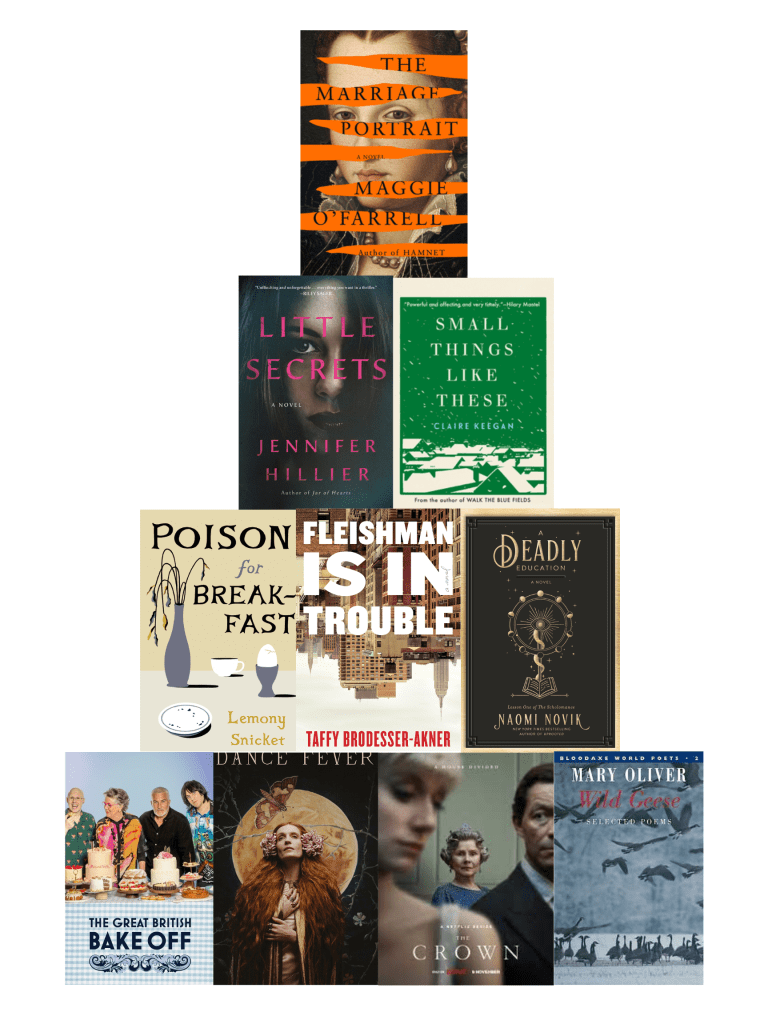
November was a blip, but I do feel like I managed to live multiple reading lifetimes in thirty days. I’m only five books away from my 2022 Goodreads Reading Challenge goal and I’m feeling pretty confident, but there’s also a high chance that I fall behind in the holiday turmoil and end up squeezing in a quick re-read of Jenny Offill’s Dept. of Speculation for the third year in a row. Honestly, I might do that regardless.
But I’m getting ahead of myself. November’s not off the hook yet, and I’ve got six books to recap for you, all of which include themes relating to one of the three options in everyone’s favorite party game, F*ck, Marry, Kill (sorry for the swearing, Mom). There are also a couple of great short reads if you’re looking for help reaching your Goodreads goal, so let’s get into it.
Since I only read six books again, the exclusive-to-this-blog bonus tier features a few other non-books I’ve been watching, reading, and listening to this month. However, if you just want the books, sign up for my newsletter to receive just the top three tiers in your inbox every month!
The Top:

The Marriage Portrait — Maggie O’Farrell
This book is literary historical fiction at its finest. The Marriage Portrait captures the life of Lucrezia de’ Medici, daughter of Cosimo I de’ Medici, Duke of Tuscany, who was married at thirteen years old to Alfonso d’Este, Duke of Ferrara in 1558. O’Farrell’s narrative opens with Lucrezia at fifteen, just over a year into her marriage, convinced that her husband is planning to kill her.
Interwoven into the last days of Lucrezia’s life are vignettes chronicling her childhood in her father’s palazzo in Florence, from infancy in the kitchens to her education as a budding, talented artist, and her eventual betrothal and assumption of her late sister’s intended position as Duchess of Ferrara. These illustrious scenes are strategically balanced against the terror unfolding in Lucrezia’s present day, where removed from court to a remote fortress alone with her husband, she soon falls suspiciously ill.
While the author takes some liberties with dates, locations, and timing to better suit the narrative, she also borrows details from the Robert Browning poem My Last Duchess. Published in 1842, the poem is written from the perspective of the Duke of Ferrara and was inspired by the rumors of murder surrounding Lucrezia’s death.
I read the poem after finishing the novel and delighted in recognizing the small, historically inconsequential, but ultimately humanizing touches O’Farrell incorporated from the poem into her version of Lucrezia’s story. History may not have preserved many personal details about Lucrezia, but O’Farrell paints a striking portrait of a young woman with a fiery, untameable nature who yearns only to be mistress of herself, despite the role that both fate and her family would have her play.
The masterful ability to bring five-hundred-year-old historical figures back to life in vivid color is Maggie O’Farrell’s particular strength, as also proven by the success of her second most recent novel, Hamnet, about the death of William Shakespeare’s son, which won the Women’s Prize for Fiction in 2020. Both books are a testament to what I love most about reading historical fiction: they remind us that no matter our origins, statuses, or circumstances, humans have always been driven by the same essential and painfully familiar motives of love, lust, and death.
Solid Supports:

Little Secrets — Jennifer Hillier
Planning on spending a bunch of time on the couch while the people in your life watch football this month? This thriller will suck you in and quickly drown out all the yelling with its delicious twistiness. Little Secrets is about a grieving mother one year after the unsolved kidnapping of her child, who snaps when she learns her husband is having an affair. I don’t usually go for affair books, but this was fast-paced and just the right amount of juicy, which makes for the perfect lazy winter weekend read—especially if you need snapping out of a seasonal depression reading rut.
Small Things Like These — Claire Keegan
Wouldn’t be a Lit Chat if I didn’t throw in a little Irish lit, right? I read most of this novella on the Metra back to the suburbs after drag brunch, and then read it again when I was clear-headed enough to appreciate its quiet brilliance. It spans the days leading up to Christmas in 1985 Ireland, when a man delivering coal to one of the infamous Magdalen laundries makes an unsettling discovery he can’t ignore. At just under 70 pages, it’s worth taking your time with this powerful story and its nuanced layering of history, empathy, and hope.
The Foundation:

Poison for Breakfast — Lemony Snicket
Yes, this is the same Lemony Snicket of A Series of Unfortunate Events fame and childhood nostalgia! The latest from this enigmatic author is a “true story” following a day in the life of our narrator, which begins with a note slipped under the door informing him: “You had poison for breakfast.” This bewildering little book offers whimsical meditations on philosophy, literature, art, and life, and at just under 160 pages is extremely readable in a day.
Fleishman Is in Trouble — Taffy Brodesser-Akner
The targeted Twitter ads for the new FX adaptation of this book starring Jesse Eisenberg, Claire Danes, and Lizzy Caplan piqued my interest, and in a month where any excuse to leave Twitter was a good one, I took the hint. I thought this book was a smart and at times savagely funny social commentary, but I’m not exactly the target audience for a novel about a forty-year-old recently divorced doctor whose sexual re-awakening gets interrupted when his ex-wife dumps the kids on him and disappears. If that sounds up your alley, though, this is objectively an entertaining read.
A Deadly Education — Naomi Novik
Imagine if Hogwarts was very openly and actively trying to kill you, and you have the Scholomance: a school of magic filled not with eccentric teachers and quirky ghosts, but with hordes of student-eating monsters. I really enjoyed the voice of narrator Galadriel (aka El), a teenage witch with immense destructive power and a whip-smart sense of dry humor, which she wields in equal force as she battles her way through to the end of her junior year. This book is the first in a trilogy, which I definitely plan to revisit.
Honorable Mention:

The Great British Bake Off — Netflix
Need it even be said? There are few shows that bring me more comfort or greater joy as the days grow darker than dear GBBO. I have spent the past three autumns happily knitting under a blanket while watching cute British people wage the politest battles of their lives against all kinds of culinary catastrophes, and I hope to spend many more years in the same fashion. Also, do not sleep on the Holiday version of GBBO, especially the episode from 2020 with the cast of Derry Girls.
Dance Fever — Florence + the Machine
For some inexplicable reason, I’ve been craving the music I listened to in high school lately, and this feeling combined with the lingering inclination towards witchiness left over from October made Florence’s new album a logical solution. In turns joyous, haunting, reflective, and triumphant, it’s the perfect soundtrack for running around the block or dancing in your kitchen with soup on the stove.
The Crown — Netflix
Like any good Anglophile, I was also glued to the new season of The Crown while I was home for Thanksgiving, which was both as scandalous as I had hoped (Dominic West is far too attractive to be playing Charles but not even he could make that call any less uncomfortable) and also a bit anticlimactic? I’m holding out hopes for a more riveting final(?) season, and I’m hopeful that we get to see more of Elizabeth Debicki as Diana in Season 6 as well because she was simply fantastic.
Wild Geese — Mary Oliver
I’m still figuring out what this bonus tier will look like when I don’t actually read more than six books, so lastly, I’ll leave you with a poem that I revisited this month and adored enough to want to commit to memory. It’s one I come back to from time to time, and I find that it’s always exactly what I need to hear. I hope it is for you, too. Click here to hear the late Pulitzer Prize-winning poet Mary Oliver read her short poem, “Wild Geese.”
That’s all for November, and also all for 2022! The comments section is always open if you want to chat about any of these books or others, but otherwise, I’ll be back in January. Until then, I wish everyone a healthy, happy holiday season and a festive new year!
P.S. If you like these reviews, then I highly recommend subscribing to my Substack to get this blog post delivered straight to your inbox every month.
 Catherine Thoms