Beneath every history, another history

Lit Chat Vol. 31 — October in Review
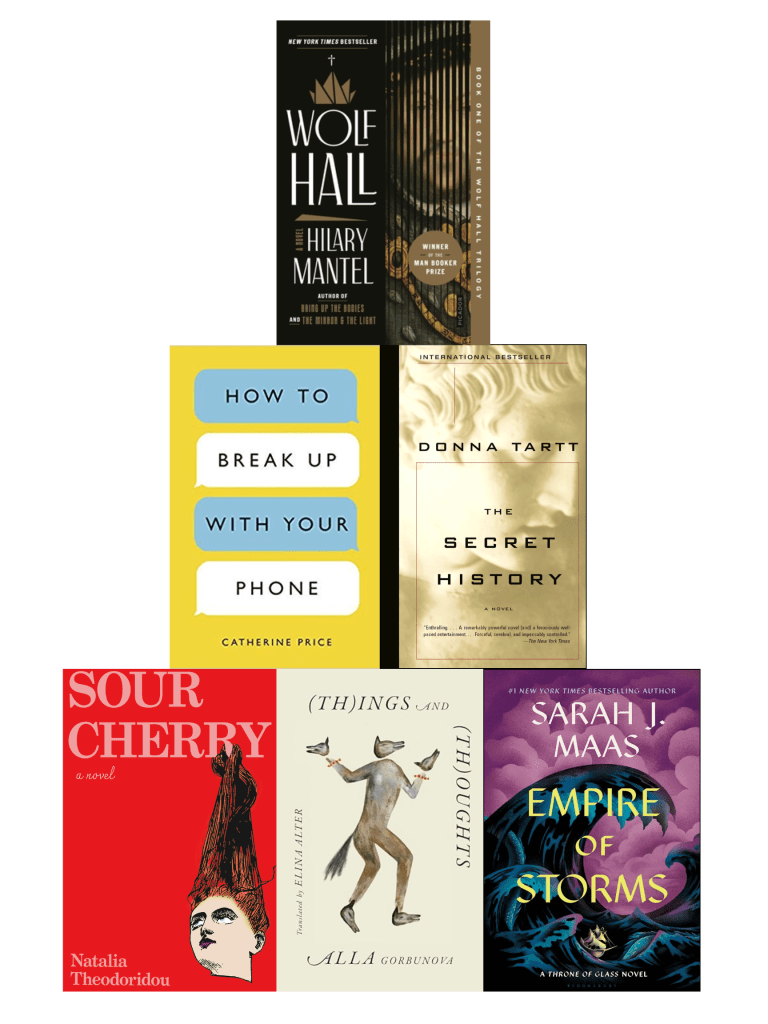
Pyramid of book cover images. On the bottom: Sour Cherry by Natalia Theodoridou, (Th)ings and (Th)oughts by Alla Gorbunova, and Empire of Storms by Sarah J. Maas; In the middle: How to Break Up with Your Phone by Catherine Price and The Secret History by Donna Tartt; On the top, Wolf Hall by Hilary Mantel

Hi friends,

Does anyone else feel like time has been moving suspiciously fast and loose this year? Like I blinked, and suddenly, it’s November.

I’m trying to be really intentional about my reading for the rest of the year, keeping in mind the original reading goals I set for myself, but my library holds keep delivering all at once! This is, unfortunately, the Way of the Library.

I have nine books currently checked out and one on hold to be picked up, which puts me in a bit of a reading pickle, actually. Which highly anticipated new release from six months ago will get to skip the TBR line so it can get returned in time to check out the highly anticipated new release from three months ago?? It’s getting pretty high-stakes over here.

Speaking of high stakes, I’m also starting to think about my Best Books of 2025 bracket, because there have been some absolute bangers in the top spot lately (this month, especially!!!) and I’m excited to see them duke it out.

But before I get too far ahead of myself, let’s get into October’s books! Per usual, if you prefer to get this post delivered right to your inbox, you can subscribe to my Substack here:


THE FOUNDATION:
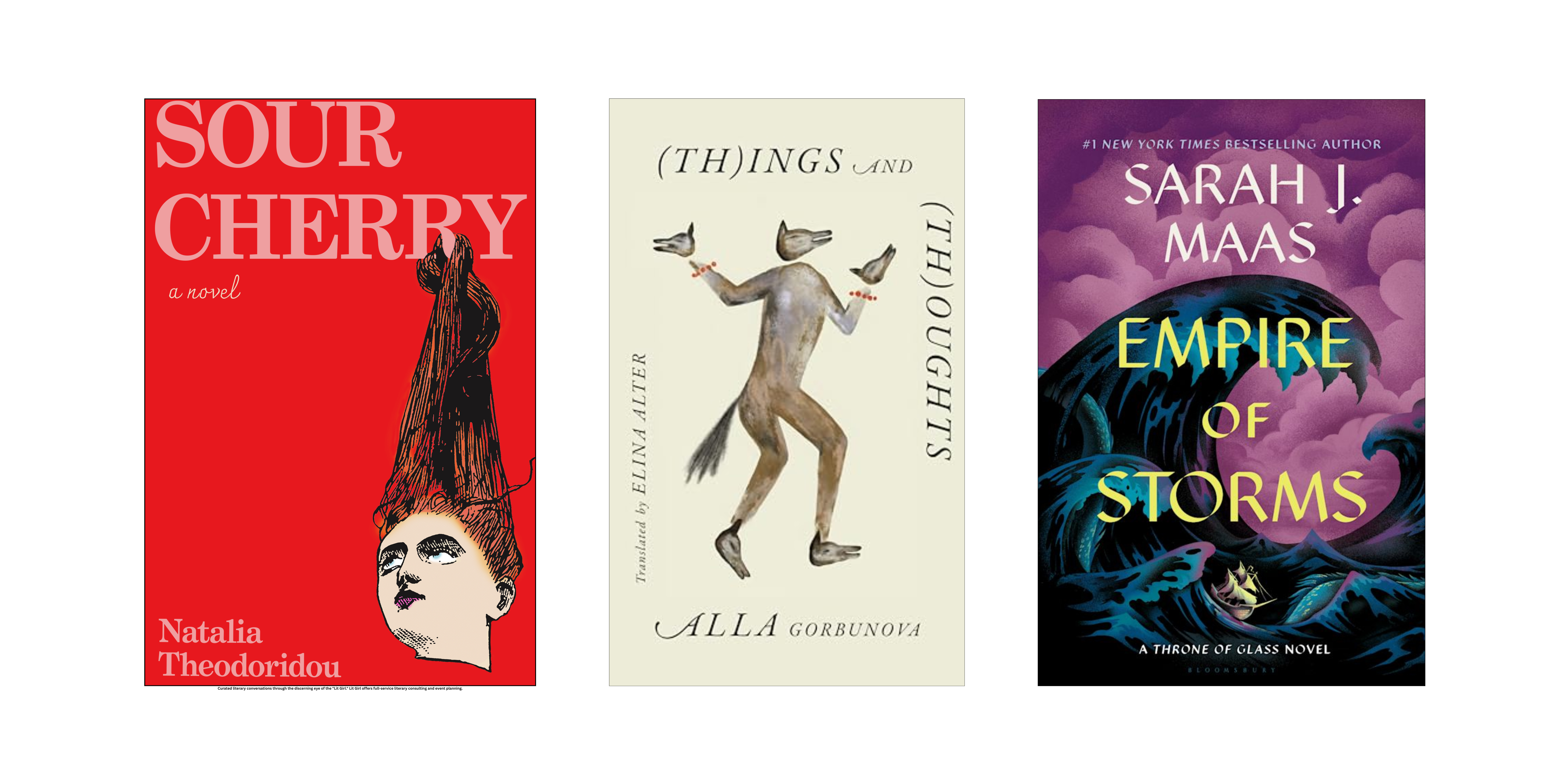
Book cover images for Sour Cherry by Natalia Theodoridou, (Th)ings and (Th)oughts by Alla Gorbunova, and Empire of Storms by Sarah J. Maas

Sour Cherry — Natalia Theodoridou

This one seemed like it would check all my boxes: fairy tales, Gothic mansions, dark curses—yes, please! Sadly, I didn’t feel this book lived up to its potential. It’s essentially a retelling of the Bluebeard fairytale, but in this version, the cursed lord doesn’t kill his wives outright, but leaches life from his surroundings until everything he touches eventually turns to rot. The prose is beautiful and dream-like, but I wanted the story to go deeper beneath the fairytale, to explore more of the characters’ interiority and the mechanics of its world. Instead, it jumps perspective too often to feel settled in one character, and the modern-day narrative throughline felt underdeveloped. I get what it was trying to do in terms of allegorizing toxic masculinity, but it felt like this was at the expense of the actual story. A miss for me, unfortunately!

(Th)ings and (Th)oughts — Alla Gorbunova, tr. Elina Alter

Shoutout to Sarah McEachern for slipping me this galley from the Deep Vellum tent at the Brooklyn Book Festival in September! These absurdist shorts were the perfect kick-off to my month, vignettes that span the weird and the tender and somehow felt both universal and definitively Russian. Often just a few pages long, each short prose piece contains an entire mini universe, filled with bumbling and bewildered characters who search for meaning in religion, nature, train stations, municipal cemeteries, folk tales, and of course, the many frustrations and fulfillments of love. I’ll admit I’m not as well-versed in Russian literature as I am in other literary traditions, but I was reminded of Gogol in the surrealism overlaid onto even the most mundane settings, transforming something as banal as a trip to the gynecologist into a profound and revelatory experience.

Empire of Storms — Sarah J. Maas

That’s right, #5 in the series! These are getting harder to write about without spoilers. However! I’ll say that what I enjoyed most from this installment was seeing all the different characters’ storylines finally intersect as Aelin begins to consolidate her allies, and I’m always just as surprised and delighted as the rest of her team to discover how her scheming ultimately pays off. I’m also perpetually interested in the mechanics of power in fiction (both magical and political/interpersonal), so the chess game that is building an army, fighting battles, and strategizing for a war is something that’s keeping and holding my interest in these later books. Onwards, to book #6, I guess!


SOLID SUPPORTS:
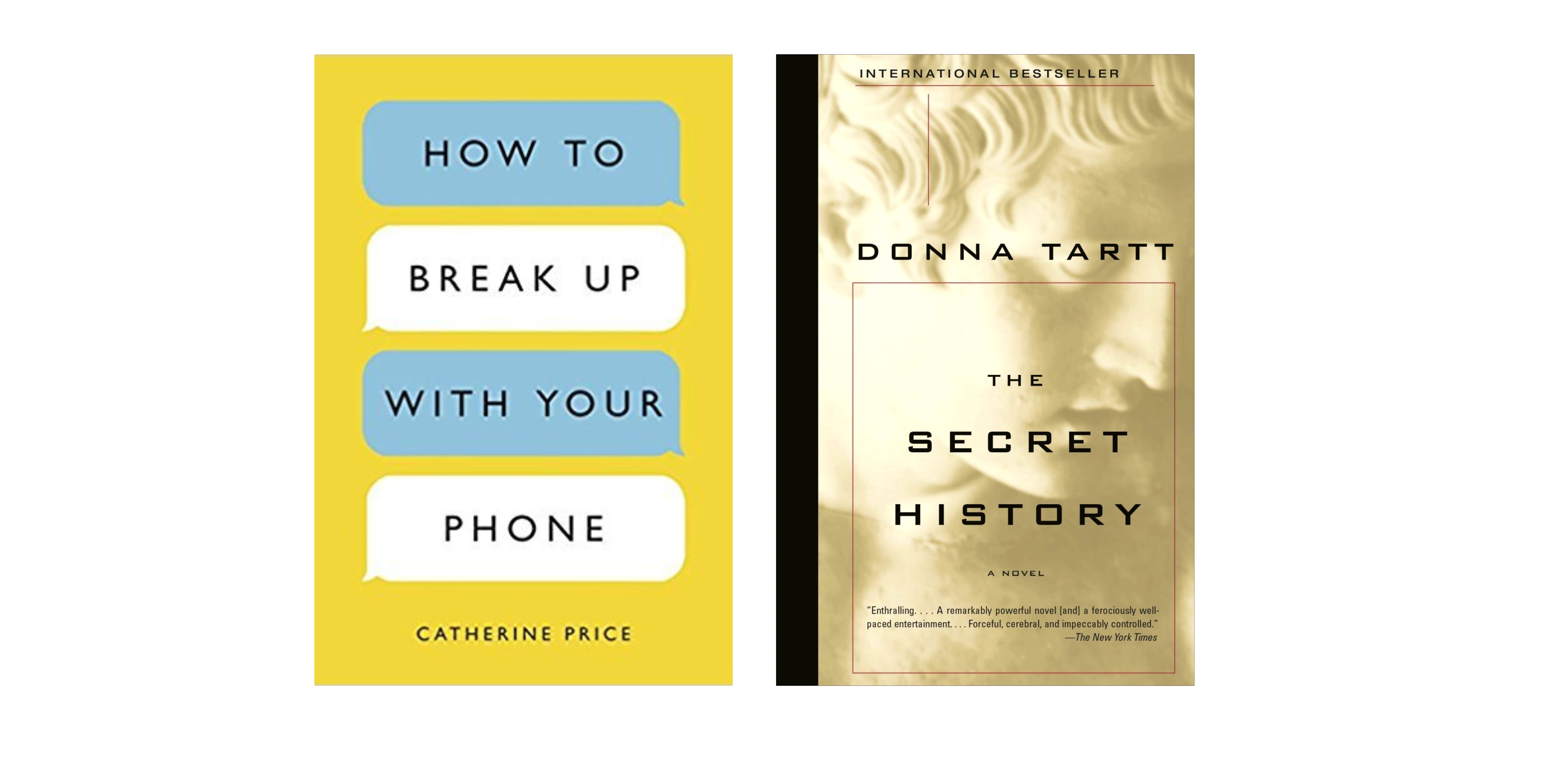
Book cover images for How to Break Up with Your Phone by Catherine Price and The Secret History by Donna Tartt

How to Break Up with Your Phone — Catherine Price

If you’ve seen me in the past month, then you’ve probably already heard me preach about this book and/or my journey to be on my phone less (and likely more than once, sorry!). Spoiler alert: we’re all addicted to our phones. Like, clinically. And it’s not okay! We’ve normalized it because we’re all doing the same thing, but if we swapped our phones out for cigarettes or alcohol in terms of our obsessive usage and the anxiety we feel around having/not having them, it’d be pretty obvious that we all have a problem.

This book does an incredible job of first opening our eyes to the fact that our time and attention are being intentionally manipulated away from us and sold to the highest bidder (aka advertisers on social media), then provides an accessible, mindfulness-based 30-day plan for reclaiming our time/memories/attention spans/lives in general. If you (like me!) are noticing a spike in tiredness, boredom, or general dissatisfaction—especially with the recent time change—or if you often catch yourself thinking you could do so much more with your day if you only had a couple extra hours: put down your phone. That’s where your extra time is. Read this book and take back your life!!!

The Secret History — Donna Tartt

This was such a funny reading experience for two main reasons. The first is that I listened to this on audio, narrated by Donna Tartt herself, and was shocked to discover that she has a little southern twang! This unfortunately meant that her voice for Bunny veered dangerously into Bugs Bunny territory, which I wasn’t sure I was going to be able to get used to, but now I can’t separate Donna’s dulcet tones from the internal monologue of Richard Papin.

The second reason this was funny is that this was technically a re-read. I first read this book in high school (on a recommendation from Kate, if I recall correctly!), but I remembered almost nothing except Bunny’s death and the bacchanal (not spoilers, trust me). The things my impressionable young brain held onto!

Reading this as an adult is a comparatively wild experience. I remember thinking the college-aged characters were such glamorous adults when I read this as a teenager, with their seemingly extensive knowledge of ancient Greek and casual alcoholism. As an adult, you realize that even the most intelligent and collected of them is just a kid in over his head. This book is an absolute master class in atmosphere and tension, and there’s something weirdly nostalgic about the pre-Internet of it all. You simply can’t kill your friends and get away with it like you used to, these days!


THE TIPPY TOP:
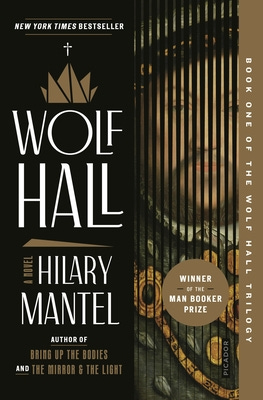
Book cover image for Wolf Hall by Hilary Mantel

Wolf Hall — Hilary Mantel

Who would have expected that my second obsession this month (next to reducing my screen time) would be the court of Henry VIII? Actually, this is likely not a surprise to anyone who knows me. I’ve been obsessed with this kind of fictional biography deep-dive, and this era in particular, since reading Margaret George’s Autobiography of Henry VIII back in high school. Returning to the Tudor court via the eyes of Thomas Cromwell was exactly what my newfound attention span was begging for.

I mentioned earlier that I’m interested in fictional explorations of power, and what better example than this book? Thomas Cromwell, the son of an abusive blacksmith, rises through the ranks of Henry VIII’s court by spreading influence throughout Europe and cultivating a network of allies and informers until he is one of the king’s most trusted advisors. He is personally responsible for many of the machinations that ultimately enable Henry to divorce Katherine of Aragon, proclaim himself head of the Church of England, and put Anne Boleyn on the throne. And that’s just book one.

I’m grateful I read this book when I did, at a time when I was putting special emphasis on retraining my brain and my attention span, because there’s a quietness and a delicacy to the language that requires you to slow down and let it all soak in. Mantel brings these notorious characters to life with such gorgeous intimacy and interiority, while at the same time fostering an atmosphere of intrigue that makes one of history’s oldest and most famous stories feel like a truly novel page turner. This is definitely going to be another contender for my top book of the year, and I can’t wait to read the rest of the trilogy.


And that’s October done! What are you trying to squeeze in before the year’s over? Personally, I will be going home to binge Patricia Lockwood’s (overdue from the library) Will There Ever Be Another You so I can return it this weekend and check out R.F. Kuang’s Katabasis, which also came in this week.

The end is in sight, folks! And there’s still so much reading time left. As always, thanks for being here, and until next time, happy reading!

❤ Catherine


Housekeeping note: all book links go to my Bookshop storefront, where each purchase supports independent bookstores (and this newsletter, because I get a small percentage of each sale).
Do you guys ever think about dying?

May in Review — Lit Chat, Vol. 9

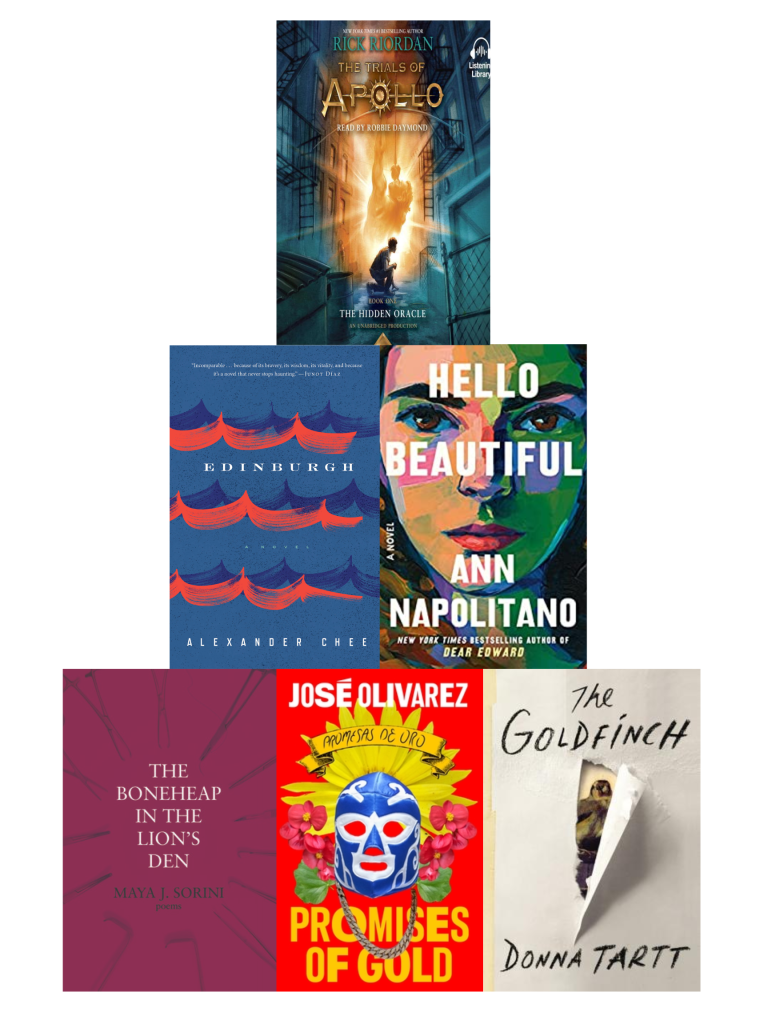
A pyramid of book covers with Rick Riordan's The Hidden Oracle on top, Alexander Chee's Edinburgh and Ann Napolitano's Hello Beautiful in the middle, and Maya J. Sorini's The Boneheap in the Lion's Den, Jose Olivarez's Promises of Gold, and Donna Tartt's The Goldfinch on the bottom.

All the links in this newsletter go to my Bookshop storefront, where your purchase supports independent bookstores (and me! I get a little cut). Click below to check it out!


Hey friends,

A few housekeeping notes/life updates before we get to the books:

  1. Lit Chat is going on summer break! I’m moving at the end of the month (hmu if you want my couch), and then I am promptly getting on a plane and absconding to Europe for three weeks, so I don’t anticipate having much time for reading/writing in the foreseeable future. I’ll be back in August!
  2. On that note, I have far too many books in my apartment and books are unfortunately very heavy to pack, so I’m looking to offload some! I’m thinking of doing a little book swap in Fort Greene Park on either the third or fourth weekend in June, so if you’re interested, text/email/message me and I’ll make sure to send you the deets when I have them.
  3. My friend Michy was kind enough to include one of my poems in her newsletter, beat & beatnik, last week! Michy is a talented poet and newsletterist, and her most recent letter is a thoughtful and emotionally resonant reflection on change, intimacy, and community. You can read the whole thing here (my poem’s at the end):
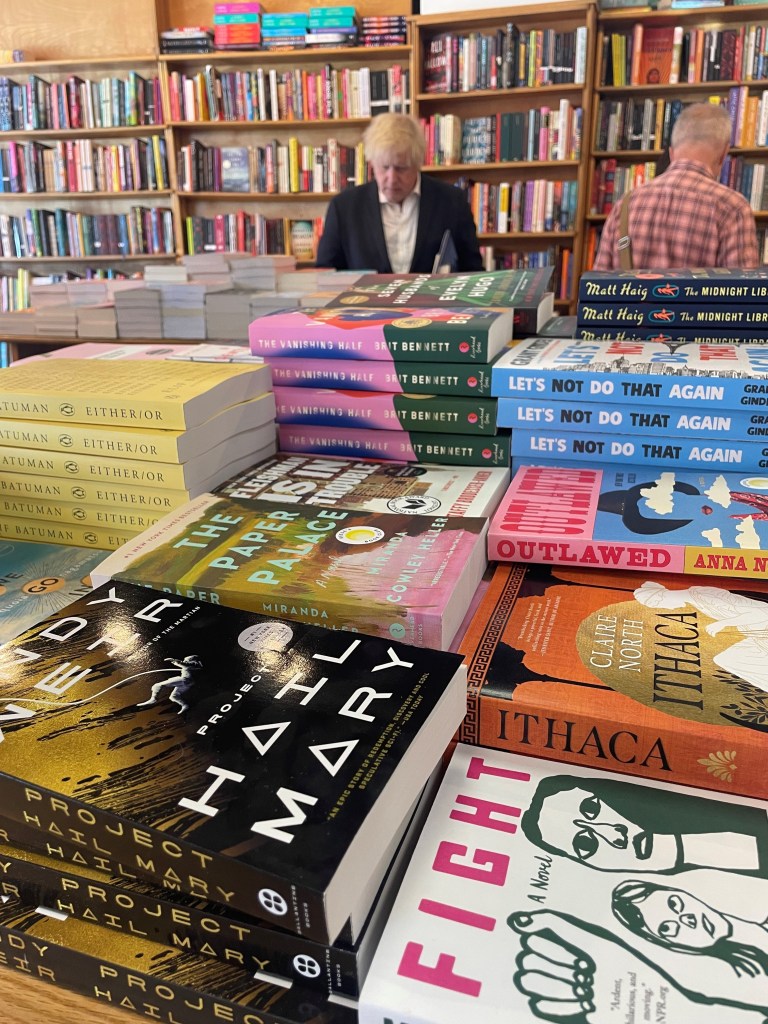
  1. ICYMI on my Instagram, I saw Boris Johnson in Kramer’s bookstore in Washington, D.C. over Memorial Day weekend:

God, I wish I knew what he bought.

Okay! Onto the books, shall we? Most of this month’s reading was done from planes, trains, and hotel beds, and I feel like I’ve lived approximately four lifetimes since I read my first book of the month. The years start coming and they really don’t stop coming, huh?


The Foundation:

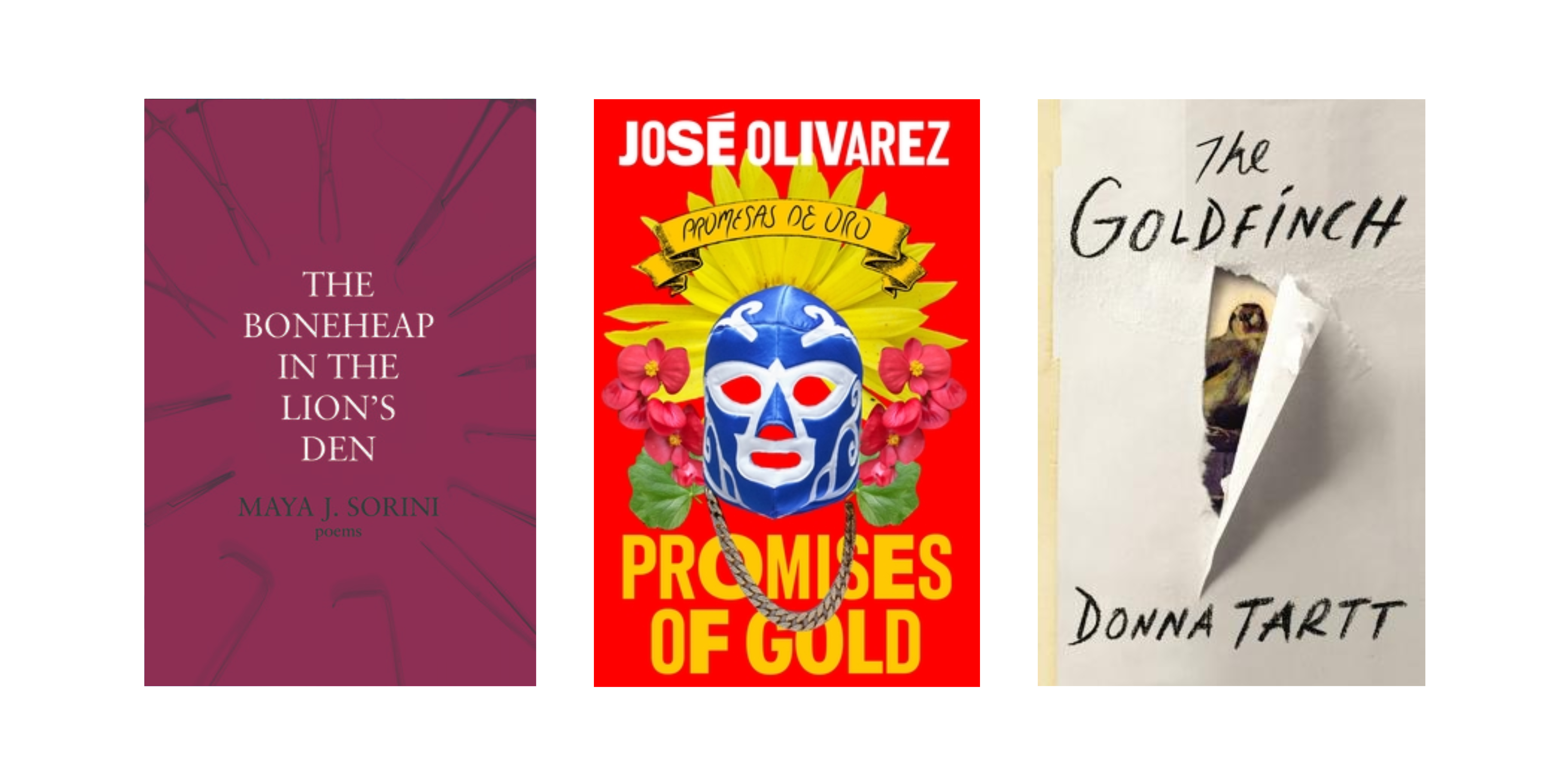
Book covers for The Boneheap in the Lion's Den by Maya J Sorini, Promises of Gold by Jose Olivarez, and The Goldfinch by Donna Tartt

The Boneheap in the Lion’s Den — Maya J. Sorini

This debut poetry collection is not for the squeamish among us. Inspired by the poet’s experiences as a medical student and trauma surgery researcher, these poems examine the physicality of life with raw, bloody vulnerability. I especially enjoyed the ones that were patient-centered, such as “Eavesdropping on the Dead” and “The Lies.” In a healthcare system that often makes patients feel less like people and more like cases to be gotten through, the poet’s honoring of their stories is a necessary reminder of the importance of empathy in medicine. Sorini does not shy away from the discomfort of pain, death, or grief, and so neither does her reader; together, we bear witness to the many lives that mattered enough to fill these pages. I had the pleasure of being Maya’s former classmate at Wash U and look forward to following her career both in poetry and medicine. A big thanks to Maya and Press 53 for sending me a copy to read!

Promises of Gold — José Olivarez

I listened to this poetry collection on a 5 AM Amtrak, in a state of semi-consciousness where I’d occasionally slip into half-dreams inspired by details from a poem and then ultimately have to rewind after being rudely jolted back into reality. What’s unique about this collection is not only that some of the poems are recordings of live performances, which feels intimate and communal all at once, but also that it’s fully translated into Spanish in the second half. This is both convenient for Spanish-speaking readers and thematically relevant, as translation, migration, and their implications for one’s identity are some of the most prevalent themes in this collection, as is a profound love for the family, friends, and culture that populate Olivarez’s life and work. I’ve got a note to self to circle back to this one when I’m fully awake enough to appreciate it.

The Goldfinch — Donna Tartt

Look, I don’t care if it won the Pulitzer, this book was too long! I enjoyed it, don’t get me wrong, and I’m glad to finally be able to say I’ve read it, but it did not need to be this long. This meandering tome follows the tumultuous adolescence and eventual adulthood of Theo Decker, whose life is shaped by a tragic accident that kills his mother and brings a priceless work of art into his possession as a young boy. The many misfortunes heaped upon Theo as he tries to protect his painting were slightly reminiscent of A Little Life (though nowhere near as extreme) in that they came to feel gratuitous, but Donna Tartt has a way of making it difficult to escape her worlds even when they are objectively stressful. I kept thinking about this book long after I put it down, but I think I agree with most of the literary populace when I say I liked The Secret History better.


Solid Supports:

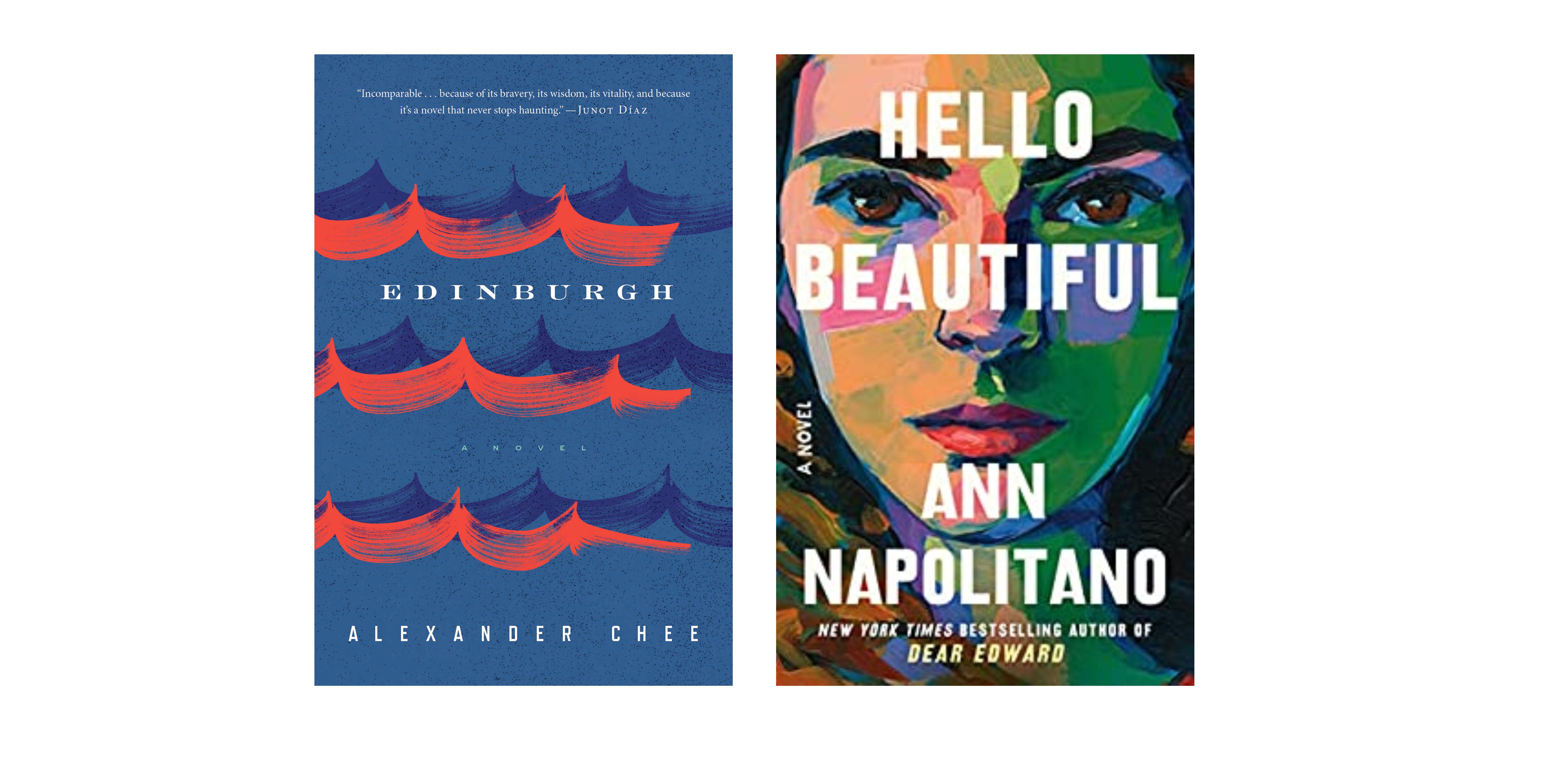
Book covers for Edinburgh by Alexander Chee and Hello Beautiful by Ann Napolitano

Edinburgh — Alexander Chee

I was introduced to Alexander Chee by way of his memoir, How to Write an Autobiographical Novel (highly recommend to both writers and readers!), and Edinburgh is that autobiographical novel. I had luckily forgotten enough of the plot details from that chapter of the memoir to still be sufficiently surprised by the novel’s dramatic turns, but I remembered enough to know just how many of the protagonist Fee’s formative experiences overlapped with the author’s, such as being queer, half-Korean, and a victim of child sexual abuse. Though the novel is inspired by and largely revolves around this trauma, Chee’s gift as a writer is his ability to elevate the base tragedy of its plot, re-aligning it with elements from Japanese myth and Greek drama until its scope has been transformed from a deeply personal novel into something artful and transcendent. It’s a heavy novel, but not necessarily dark; if anything, it blazes with the love and compassion both Fee and Chee clearly share for all of the lives held within.

Hello Beautiful — Ann Napolitano

This was my book club book this month and it was a pretty perfect one, in my opinion! It’s the story of a man who marries into a tight-knit family of four sisters in the Pilsen neighborhood of Chicago, and about the ways their lives ultimately deviate and find their way back to each other when faced with the unexpected, cataclysmic forces of death and new love. I fell for this book initially for the Chicago references and the Little Women vibes, but its true strength is in how it portrays so many different kinds of love as being equally expansive, be it romantic, platonic, or sisterly. It’s about the kind of love that holds someone close to your heart even across years and miles, about learning to accept that love for yourself but also to accept that different people need and want to be loved in different ways. If you’re looking for a book to share with your mom/sisters/aunts/grandmothers, or even just with the friends you love as family, I can’t recommend this one enough.


THE TIPPY TOP:

Book cover for The Hidden Oracle by Rick Riordan

The Hidden Oracle — Rick Riordan

It may strike you as odd that I’m choosing a Rick Riordan book as my top for the month above a literal Pulitzer Prize winner, but this is my newsletter and I get to make the rules!!! As a ranking system, this newsletter is so deeply arbitrary and tends to reflect the vibes of my general reading experience more so than the objective quality of the book, and The Hidden Oracle was the book I had the best time with this month, hands-down. Whether I was half-asleep on an early flight or hauling my laundry up and down Dekalb Avenue, Apollo’s narration in my ear was a saving grace for me in May.

The second spin-off series from the original Percy Jackson and the Olympians (real ones know I’ve been making my way through all of Riordan’s books on audio since last summer), The Trials of Apollo follows Apollo’s demotion to an unathletic, acne-ridden mortal teenager after angering his father, Zeus. After his allegiance is claimed by a slightly feral demigod named Meg McCaffrey on the streets of Manhattan, the two make their way to Camp Half-Blood, where they are tasked with finding and regaining control of one of the titular hidden oracles of Ancient Greece: the Oracle of Dodona. The voice actor narrating this book was absolutely perfect for the self-absorbed fallen god, and the writing is funny as hell. I loved the way Apollo’s narration turned classic stories from mythology into gossip from his own personal autobiography, summarizing ancient dramas with conspiratorial asides like, “Juicy story, ask me later.” Yet the real heart of this story is in the way Apollo’s mortality teaches him to appreciate the value of not just his own human life, but the lives of all those he encounters throughout his trials, and how they are made all the more precious in the absence of immortality. This is a hallmark of Riordan’s writing: making myth and legend accessible, fun, and vividly, authentically mortal. I’m saving the rest of this series as a treat for my future self when I need it most (probably next week).


That’s me signing off for now! Next time you hear from me I’ll be tan, fluent in French, and breathing clean air in front of the open windows in my gorgeous new rent-stabilized apartment (a girl can manifest).

Until then, happy reading!
❤ Catherine